

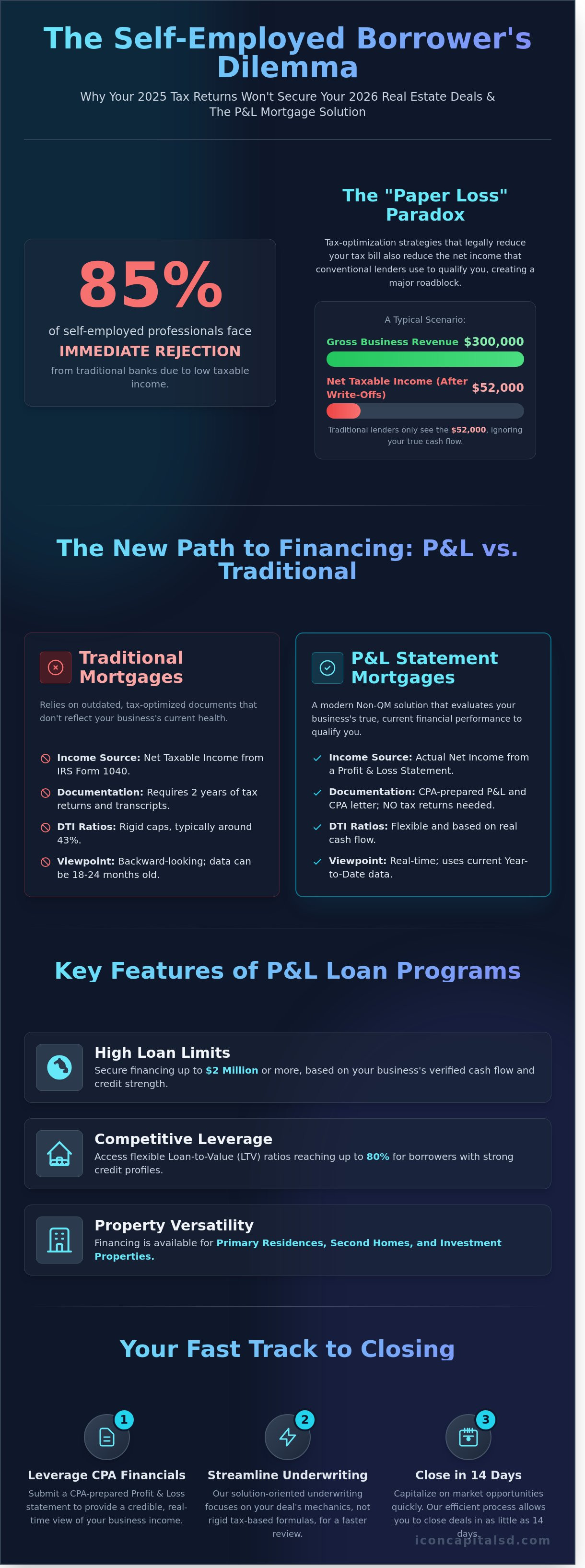
Your 2025 tax returns are likely the single biggest obstacle to your next real estate acquisition. While retail lenders fixate on net taxable income, they ignore the $200,000 or more in depreciation and legal write-offs that actually represent your liquid capital. This disconnect explains why approximately 85% of self-employed professionals face immediate rejection from traditional banks despite maintaining healthy gross cash flows. A profit and loss statement mortgage flips this script by evaluating your business’s true financial performance rather than its adjusted tax liability.
You’ve likely realized that the more successful your tax mitigation strategy becomes, the harder it’s to secure conventional financing. It’s a paradox that penalizes efficient business owners. This 2026 guide provides a direct roadmap to bypass standard IRS documentation. You’ll learn how to leverage CPA-prepared financials to access high-leverage Non-QM products with minimal red tape. We’ll outline the exact steps to maximize your LTV, streamline the underwriter’s review, and close your deal in as little as 14 days to capitalize on 2026 market opportunities.
Key Takeaways
- Understand why tax-optimized returns often disqualify self-employed borrowers and how to bypass traditional debt-to-income hurdles.
- Discover how a profit and loss statement mortgage leverages your business’s actual performance to secure high-leverage financing without tax transcripts.
- Compare P&L-based verification against bank statement loans to identify the most efficient documentation method for your specific financial structure.
- Review the 2026 qualification checklist to ensure your Year-to-Date (YTD) financial statements meet current Non-QM underwriting standards.
- Learn to structure complex investment deals by prioritizing the mechanics of the transaction and property potential over conventional lending criteria.
Why Tax Returns Fail the Self-Employed Borrower in 2026
Self-employed borrowers often face a structural disadvantage when applying for conventional financing. Tax optimization strategies designed to minimize liability frequently reduce net income below the threshold required for standard debt-to-income (DTI) ratios. While a business owner might generate $300,000 in annual revenue, aggressive write-offs can leave a taxable income of $52,000. Conventional lenders see the $52,000; they don’t see the liquidity. This disconnect makes the profit and loss statement mortgage a critical tool for 2026 liquidity. These Non-QM products prioritize actual business performance over historical tax filings that may be 18 to 24 months old.
Traditional DTI ratios penalize successful business owners by ignoring the nuances of corporate structure. For 2026, the shift toward Non-QM (Non-Qualified Mortgage) solutions has accelerated. These products allow for a more pragmatic assessment of a borrower’s financial health. Instead of relying on IRS Form 1040, lenders use a profit and loss statement mortgage to evaluate the current cash position and debt serviceability of the enterprise. This provides a real-time financial snapshot that tax returns simply cannot match.
The ‘Paper Loss’ Paradox
Tax returns are backward-looking documents. In 2026, lenders increasingly recognize that tax data fails to reflect current business health. Depreciation, Section 179 deductions, and non-cash expenses hide actual cash flow. Following the expiration of major Tax Cuts and Jobs Act (TCJA) provisions at the end of 2025, self-employed individuals face a new regulatory environment. A P&L-based approach bypasses these technicalities. It focuses on the last 12 months of revenue and expenses, providing an accurate assessment of a borrower’s ability to service debt without the distortion of paper losses.
Traditional vs. Creative Financing
Fannie Mae and Freddie Mac guidelines remain rigid; they require two years of tax returns and strict DTI caps, often hovering around 43%. Icon Capital LLC provides a different path through creative financing and Non-QM products. We focus on solution-oriented underwriting that accepts income verification via P&L. This approach allows business owners to leverage their success without sacrificing tax efficiency. For a deeper look at specific program requirements, see our P&L Home Loans sibling article. If you’re ready to scale your portfolio, request a quote to see your qualifying numbers today.
What is a Profit and Loss Statement Mortgage?
A profit and loss statement mortgage is a specialized Non-QM loan designed for self-employed borrowers. It allows applicants to qualify based on their business’s actual performance rather than their IRS filings. This product eliminates the need for 1040 forms, W2s, or IRS tax transcripts. It’s a strategic tool for business owners, freelancers, and 1099 contractors who utilize legal tax deductions that reduce their reported taxable income. Underwriters focus on the “Net Income” figure shown on the statement to determine the maximum loan amount. This approach recognizes that a business’s cash flow is a more accurate indicator of repayment ability than a tax-optimized bottom line.
Standard lending relies on historical tax data that might be 18 months old. A profit and loss statement mortgage uses current year-to-date data. This provides a more accurate reflection of a company’s current trajectory. It’s an efficient solution for entrepreneurs who’ve seen recent growth that isn’t yet reflected on a tax return. By focusing on the gross income minus operational expenses, lenders can approve loans that traditional banks would decline due to paper losses.
Key Features of P&L Loan Programs
These programs offer high leverage and flexibility to accommodate complex financial profiles. Key program features include:
- High Loan Limits: Borrowers can secure loan amounts up to $2 million or more based on business cash flow and credit strength.
- Competitive Leverage: Flexible LTV ratios reach up to 80% for borrowers with strong credit profiles.
- Property Versatility: Financing is available for primary residences, second homes, and non-owner occupied investment properties.
The Role of the CPA
Lenders typically require a CPA-prepared P&L statement to approve higher leverage deals. A formal statement signed by a licensed professional adds credibility to the income claims and reduces the risk of manual errors. Most programs also require a CPA letter to verify business ownership and the duration of operations, usually covering a minimum of 24 months. This 24-month history proves the stability of the enterprise through different seasonal cycles. While some niche programs allow borrower-prepared statements, these often require additional bank statement support or result in lower LTV limits. Professional oversight ensures the data meets the specific formatting requirements of Non-QM underwriters.
If you’re ready to see how your business income translates into buying power, you can request a quote to review your specific scenario.
P&L vs. Bank Statement Mortgages: Which is Right for You?
Choosing between a profit and loss statement mortgage and a bank statement loan depends on your business structure and how you track cash flow. Bank statement loans typically require 12 to 24 months of personal or business deposits to verify income. Lenders apply a standard expense factor, often 50%, to these deposits to estimate your qualifying income. If your actual overhead is only 15% or 20%, this automated deduction can significantly reduce your borrowing power.
P&L loans focus on the actual bottom line after all business expenses are accounted for. This product is often faster to underwrite for complex entities. A business processing 1,500 monthly transactions creates a massive volume of data for a bank statement underwriter to manually verify. A single, verified P&L statement simplifies this, often cutting the approval timeline by 48 to 72 hours. It provides a clear, finalized figure that reflects the true health of the business without the need for line-by-line deposit verification.
When to Choose a P&L Loan
This option is ideal for businesses with high gross revenue but also significant, well-documented expenses. If you operate a logistics company or a manufacturing firm, your overhead is likely substantial. A profit and loss statement mortgage allows you to show exactly where the money goes while highlighting your final net gain. It’s the best route for borrowers who maintain a clear, professionally managed accounting system. Choose a P&L loan when your net profit margin is strong and clearly documented by an accountant.
When to Choose a Bank Statement Loan
Bank statement loans favor businesses with frequent cash deposits and varying expense ratios. If you’re a consultant or a digital service provider with minimal overhead, the 12 to 24-month deposit history often yields a higher qualifying income than a traditional tax return. You can also reference Bank Statement Loans as a viable alternative if your business doesn’t keep formal monthly P&L records. In some complex scenarios, we can combine elements of both to strengthen an application, using a P&L to justify a lower expense ratio than the lender’s standard default. To see which program fits your specific financial profile, you can request a quote today.
The 2026 P&L Mortgage Qualification Checklist
Qualifying for a profit and loss statement mortgage in 2026 requires precise documentation. Lenders prioritize current cash flow over historical tax returns, making the accuracy of your financial statements paramount. Underwriters focus on the stability of your revenue and the consistency of your margins over the last 24 months. You’ll need to prepare a specific set of documents to prove your business’s health and your ability to service the debt.
- Year-to-Date (YTD) P&L: A clean statement covering the most recent 60 to 90 days of business activity.
- Full-Year P&L: A complete breakdown of the previous calendar year if you aren’t using tax returns for income qualification.
- CPA Letter: A signed verification from a licensed tax preparer or CPA confirming you’ve owned the business for at least two years and stating your ownership percentage.
- Operational Proof: Documentation showing at least 24 months of continuous business operation, such as a business license or articles of incorporation.
Financial Documentation Standards
Your profit and loss statement mortgage application hinges on the clarity of your reporting. The statement must itemize gross income, all operating expenses, and the resulting net profit. Underwriters use these figures to calculate a qualifying income average. We also require verification of business existence through a Secretary of State filing or a current Business License. To secure optimal 2026 interest rates, maintain a credit score of 660 or higher. Lower scores often trigger higher equity requirements or increased rate premiums.
Asset and Liquidity Requirements
If your business needs a quick injection of capital to meet liquidity requirements or fund growth, another alternative financing route to consider is a merchant cash advance for small business, which provides funds based on revenue streams.
Liquidity acts as a primary risk mitigator for non-traditional loans. Lenders typically look for 3 to 6 months of Principal and Interest (P&I) reserves held in liquid accounts. Sourcing is mandatory for any large deposits that exceed 25% of your average monthly income to ensure compliance with anti-money laundering regulations. These reserves provide a safety net if your business experiences a seasonal downturn. You can request a quote to see specific rate-to-reserve ratios tailored to your current asset profile.
Structure your deal with confidence by ensuring every line item on your P&L is defensible. Ready to move forward? Submit your loan scenario for a professional review today.
Structuring Your Deal with Icon Capital
Icon Capital prioritizes the mechanics of the deal. While traditional lenders often stall due to rigid credit score requirements, we analyze the underlying business strength and cash flow. Our underwriting team specializes in high-net-worth individuals and self-employed professionals who need a profit and loss statement mortgage to reflect their true financial capacity. We manage complex scenarios, including multi-unit acquisitions and mixed-use properties, by focusing on asset performance and liquidity rather than just a tax return bottom line. This focus on the deal structure ensures that viable investments get funded regardless of traditional documentation hurdles.
Speed defines our operation. We move from P&L submission to a clear-to-close status in as little as 18 to 22 business days. This efficiency allows investors to secure properties in competitive markets where delays result in lost opportunities. Our approach integrates seamlessly with other Non-QM products, providing a comprehensive toolkit for portfolio growth. We don’t just look at a single data point; we look at the entire financial trajectory of your business.
Leveraging P&L for Investment Portfolios
Using a P&L statement allows investors to scale quickly from single-family homes to 5-10 unit residential buildings. These loans complement DSCR investment strategies by bridging the gap between personal income verification and property-level cash flow. For instance, we recently closed a $1.25 million deal for a self-employed IT consultant who lacked traditional 1040 income. By using a 12-month P&L, we secured a 75% LTV on a four-unit property that a retail bank had rejected 14 days prior. This flexibility is essential for those looking to expand a portfolio without the constraints of personal debt-to-income ratios. A profit and loss statement mortgage provides the necessary leverage to move on multi-unit opportunities that require rapid execution.
Get Started: The Icon Capital Process
- Step 1: Submit your Year-to-Date (YTD) P&L and the previous full year’s statement for a preliminary review.
- Step 2: Our experts conduct a detailed underwriting analysis of your business cash flow and expense ratios.
- Step 3: We structure a custom loan package aligned with your 2026 growth targets and exit strategies.
Ready to leverage your business success for your next property acquisition? Contact Icon Capital today to explore your P&L mortgage options.
Secure Your 2026 Financing with Creative Solutions
Traditional tax returns often fail self-employed borrowers by masking actual liquidity through legal deductions. In 2026, a profit and loss statement mortgage provides a pragmatic alternative, focusing on your business’s net income rather than IRS-reported figures. This approach allows entrepreneurs to leverage their true buying power without the constraints of conventional underwriting. Icon Capital specializes in these Non-QM products, offering loan amounts up to $2M and underwriting designed for complex financial structures. We bridge the gap. Our team applies creative financing strategies to ensure your business’s success translates into homeownership or portfolio growth. We understand the nuances of self-employment and provide the speed and certainty required in today’s market. You’ve built a successful enterprise; your mortgage should reflect that achievement rather than hide it behind tax codes. Take the next step toward your property goals with a partner who understands the mechanics of your deal. Request a P&L Mortgage Quote from Icon Capital today and experience a streamlined path to funding.
Frequently Asked Questions
Can I get a mortgage with only a profit and loss statement?
You can qualify for a mortgage using only a P&L statement through specialized Non-QM loan programs. These products don’t require tax returns or W-2s, focusing instead on your business’s actual cash flow. Lenders typically require a 12-month P&L statement alongside a year-to-date report to verify your qualifying income. This is a primary solution for self-employed borrowers with significant tax deductions.
Do I need a CPA to sign my P&L for a mortgage application?
Most lenders require your P&L statement to be prepared and signed by a licensed CPA or an Enrolled Agent. While some programs allow for borrower-prepared documents, these often trigger a 5% to 10% reduction in the maximum allowable LTV. A professional signature provides the third-party validation underwriters need to skip the standard IRS tax return transcript verification process.
What is the minimum credit score for a P&L statement loan in 2026?
The minimum credit score for a profit and loss statement mortgage in 2026 is typically 660. Borrowers with scores above 720 secure the most aggressive pricing and can often access 80% LTV options. If your score falls between 660 and 699, expect to provide a 25% down payment and maintain at least 6 months of cash reserves to offset the perceived risk.
How do lenders calculate income from a P&L statement?
Lenders calculate qualifying income by taking the total net profit from your P&L and dividing it by the number of months in the statement period. If your 12-month statement shows $150,000 in net profit, the underwriter recognizes $12,500 in monthly income. They won’t count depreciation or one-time capital gains, focusing strictly on the recurring operational revenue your business generates.
Are interest rates higher for P&L mortgages than traditional loans?
Interest rates for a profit and loss statement mortgage are generally 1.00% to 2.50% higher than standard conventional loans. This premium covers the increased risk of using unaudited financial statements rather than IRS-verified tax returns. For a borrower with a 740 credit score, a P&L rate might sit at 7.75% when the market average for a 30-year fixed conventional loan is 6.25%.
Can I use a P&L loan for an investment property?
You can use P&L loan programs to finance 1-4 unit investment properties and multi-family assets. Investors often choose this route when their tax returns show a paper loss but their actual business bank statements show high liquidity. Most investment P&L products require a 20% down payment and 6 to 12 months of principal, interest, taxes, and insurance (PITI) in liquid reserves.
What happens if my P&L shows a loss in one of the recent months?
A single month showing a net loss won’t disqualify you if the total 12-month net profit remains positive and stable. Underwriters look for the aggregate performance rather than isolated monthly dips. If your business experienced a 15% loss in January due to seasonal trends but recovered in February, you’ll simply provide a brief letter of explanation to satisfy the underwriting conditions.
How many months of business history do I need for a P&L mortgage?
Lenders require at least 24 months of continuous business history to qualify for a P&L mortgage. You’ll need to prove this through a business license, articles of incorporation, or a formal letter from your CPA. Some exceptions exist for borrowers with 5 years of prior experience in the same field, but 2 years remains the standard benchmark for proving business stability.