

Why should a $525,000 net profit on your internal ledger result in a mortgage denial just because your 2025 tax returns show heavy depreciation? Traditional banks often ignore the reality of a business owner’s cash flow by focusing on tax returns designed to minimize liability. P&L Home Loans provide a pragmatic solution, allowing you to leverage your company’s actual profitability to secure high balance financing. It’s a structured approach for borrowers who don’t fit the standard secondary market box but have the assets and income to scale their portfolios.
This guide from Icon Capital LLC provides the technical roadmap to qualifying for a mortgage without the constraints of traditional IRS documentation. You’ll learn exactly how to utilize 12 month or 24 month profit and loss statements to access loan amounts up to $3.5 million. We’ll cover the specific requirements for CPA prepared statements, current 2026 debt to income ratios; and the streamlined four step process to closing your next real estate acquisition in under 22 days.
Key Takeaways
- Understand how to qualify for a mortgage using actual business health rather than the limitations of traditional tax returns.
- Discover why P&L Home Loans offer a faster, more efficient documentation process for self-employed borrowers compared to bank statement reviews.
- Learn how underwriters calculate qualifying income from your 12 to 24-month profit and loss statements.
- Identify the essential bookkeeping and CPA certification steps required to prepare your business for a successful Non-QM application.
- Explore specialized underwriting options for complex business structures that allow for loan amounts up to $2 million and beyond.
What Is a P&L Home Loan?
A P&L home loan is a specialized Non-QM mortgage designed for borrowers who don’t fit the rigid box of traditional agency lending. Instead of using federal tax returns to calculate debt-to-income ratios, lenders analyze a business’s financial health through its income statement. When exploring the mechanics of What Is a P&L Home Loan?, the focus shifts to the business’s net income rather than the adjusted gross income found on a 1040. This approach allows 1099 contractors and business owners to qualify using their actual cash flow.
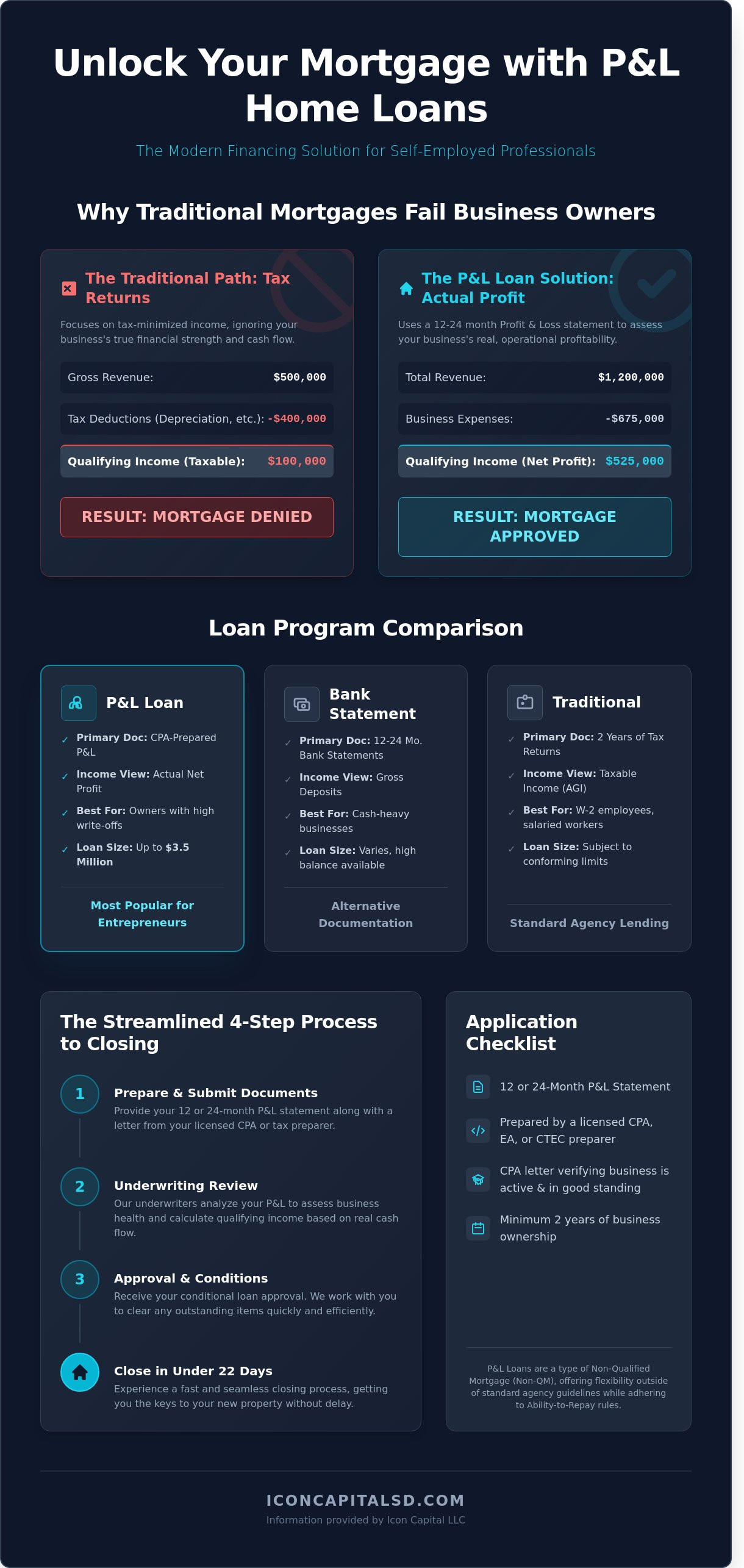
Traditional Fannie Mae and Freddie Mac guidelines rely on the “bottom line” of a tax return. For a self-employed individual who utilizes legal tax deductions like Section 179 depreciation or high mileage write-offs, that bottom line often looks insufficient for a high-balance mortgage. P&L Home Loans bypass these paper losses to focus on the company’s operational strength. This product targets the 16 million self-employed Americans who frequently face rejection from big-box banks. These lenders often see a borrower with $500,000 in gross revenue but $400,000 in deductions as a high-risk applicant, even if the borrower has $10,000 in monthly disposable income. Icon Capital provides a bridge for these professionals to leverage their true earning power.
The Shift from Tax Returns to Profitability
Traditional underwriting is historically reactive. It uses tax data that’s often 18 to 24 months old. In a 2026 market defined by rapid economic shifts, a tax return from two years ago doesn’t reflect a company’s current liquidity or growth trajectory. P&L Home Loans prioritize gross revenue and legitimate business expenses over the last 12 to 24 months. This allows for a more accurate assessment of a borrower’s current ability to repay. We look at the top-line revenue and apply a standard expense ratio, often ranging from 25% to 50% depending on the specific industry, to determine qualifying income. This methodology ensures that business owners aren’t punished for having a savvy accountant who maximizes their tax efficiency.
Key Terminology for P&L Borrowers
Understanding the mechanics of these loans requires familiarity with specific industry standards and documentation types. The process is streamlined but requires specific verification to ensure the deal meets Non-QM standards.
- Non-QM (Non-Qualified Mortgage): These loans don’t follow Consumer Financial Protection Bureau (CFPB) “qualified mortgage” rules. This gives lenders the flexibility to use alternative documentation while still adhering to “Ability to Repay” (ATR) requirements.
- Audited vs. Unaudited P&L: An audited statement is verified by an independent CPA. Most P&L programs accept unaudited statements if they are prepared and signed by a licensed tax professional or CPA.
- CPA Letter: Lenders typically require a letter from a licensed tax preparer confirming they’ve prepared the borrower’s taxes for a specific period and that the business remains active and in good standing.
The flexibility of these programs is essential in the current economy. High-earning professionals often reinvest their profits back into their companies, which creates a mismatch between their lifestyle and their tax-reported income. Icon Capital bridges this gap by evaluating the actual cash flowing through the business. By focusing on real-time profitability instead of historical tax filings, we provide a path to homeownership that traditional institutions simply cannot offer. This ensures that the entrepreneur’s success is an asset during the mortgage process, not a liability.
How P&L Statement Mortgages Work
P&L Home Loans operate on the strength of your business’s current performance rather than historical tax filings. Underwriters calculate qualifying income by reviewing your net profit over a 12 to 24 month period. They don’t just take your net income at face value; they apply industry-standard expense ratios to ensure the numbers align with similar businesses in your sector. For instance, a service-based consulting firm might carry a 20% expense ratio, whereas a retail or manufacturing entity could face 70% or higher. Understanding What is a Profit and Loss Statement is critical for any applicant, as this document tracks every dollar of revenue and expense to establish your debt-servicing capacity.
Documentation requirements are precise. You’ll need to provide a P&L statement that covers the most recent 12 or 24 months of business activity. This document must be signed by a licensed professional. A CPA, Enrolled Agent, or CTEC tax preparer must provide a letter verifying that they’ve prepared the statement and that you’ve owned the business for at least two years. This letter serves as the primary verification of business stability, replacing the standard IRS Form 4506-C used in conventional lending.
- Qualifying Income: Total Gross Revenue minus Total Business Expenses.
- Verification: CPA letter confirming business ownership and P&L accuracy.
- Consistency: Revenue must show a stable or increasing trend over the 24-month window.
- Standardization: Lenders use a standard expense ratio (often 50%) if your P&L shows abnormally low overhead for your industry.
If you’re unsure how your current financials stack up, you can view our full suite of Non-QM products to see which documentation style fits your business model.
Qualifying Criteria for 2026
As we move into 2026, lenders have refined their risk tolerances for P&L Home Loans. You’ll generally need a minimum credit score of 660 to access competitive rates. Maximum Loan-to-Value (LTV) ratios typically cap at 80% for primary residences, meaning a 20% down payment is standard. Debt-to-Income (DTI) flexibility is a primary draw for these programs; many lenders allow for a 50% DTI ratio, significantly higher than the 43% limit often seen in traditional mortgage products.
The Role of the Balance Sheet
Many self-employed borrowers frequently ask whether a full balance sheet is mandatory for qualification. While some aggressive P&L programs focus solely on the income statement, a balance sheet can be a powerful tool for “borderline” applications. If your income shows a slight dip, a balance sheet displaying $50,000 or more in liquid reserves or significant business assets can provide the necessary compensating factors to secure an approval. If your balance sheet is currently weak due to recent capital investments, we focus primarily on the cash flow reflected in your P&L to ensure the loan remains viable.
P&L Loans vs. Bank Statement vs. Traditional Loans
Selecting the right mortgage path requires a clear understanding of how different lenders evaluate your ability to repay. Traditional Fannie Mae and Freddie Mac loans rely almost exclusively on your federal tax returns. For self-employed borrowers, the high 2025 tax deductions that keep your business profitable often lower your qualifying income below the necessary debt-to-income (DTI) thresholds. P&L Home Loans solve this problem by focusing on your current year-to-date performance. Instead of looking at what you told the IRS two years ago, we look at what your business is earning right now.
Speed is a major advantage for the P&L path. Underwriting 24 months of bank statements for a high-volume business can take 7 to 10 business days just for the initial income calculation. An underwriter has to manually review every single deposit to exclude transfers, loans, or non-business credits. Because P&L Home Loans rely on a single, CPA-prepared document, the income verification process is significantly more efficient. This streamlined workflow often results in a clear to close in under 21 days, compared to the 35 or 45 days required for complex bank statement reviews. Pricing for these products typically carries a 1.25% to 2.0% premium over conventional rates, which reflects the risk of using non-traditional documentation.
- Documentation: Conventional loans require two years of 1040s and W2s. Bank statement loans require 12 to 24 months of full statements. P&L loans require a single profit and loss statement covering the last 12 months.
- Loan Limits: Conventional conforming limits are capped at $766,550 for most of the country. Icon Capital offers P&L options with high-balance limits reaching $5,000,000 for qualified borrowers.
- LTV Ratios: You can secure up to 80% loan-to-value (LTV) on a P&L program, provided you have a 680 FICO score or higher.
P&L vs. Bank Statement Loans
P&L programs are the superior choice for businesses with high transaction volumes, such as retail shops or e-commerce platforms. If your business processes 500 small transactions a month, bank statement analysis is slow and prone to calculation errors. Bank statement loans are better suited for consultants or contractors who receive 3 to 5 large deposits per month. In the 2026 market, P&L loans frequently offer 80% LTV, while bank statement programs may pull back to 70% or 75% if the business shows any monthly cash flow volatility.
P&L vs. Conventional (Fannie/Freddie)
The “Tax Write-off” trap is the primary reason entrepreneurs fail to qualify for conventional financing. You might generate $400,000 in gross revenue, but after 2025 Section 179 equipment write-offs and depreciation, your tax return might only show $55,000 in net income. Conventional lenders see $55,000; we see the $400,000 reflected on your P&L. This makes P&L loans the preferred tool for business owners who want to keep their tax liabilities low while scaling their real estate holdings. Request a Quote to see which program fits your scenario.
Preparing Your Business for a P&L Loan Application
Securing P&L Home Loans requires more than just a profit statement; it demands a rigorous alignment of your business financials and personal credit profile. Lenders analyze the relationship between your stated income and your operational cash flow to determine risk. You must start by reconciling your books through the last day of the most recent calendar month. Your Profit and Loss statement needs to reflect exactly 12 or 24 months of activity, depending on the specific Non-QM program guidelines selected for your file. Ensure every category, from cost of goods sold to discretionary spending, is accurately labeled and consistent with industry standards.
Lenders cross-reference your P&L with your business bank statements to verify the accuracy of your reporting. A standard requirement involves a 3-month or 6-month bank statement review to ensure that actual deposits align with the gross revenue reported on your P&L. If your P&L shows $50,000 in monthly revenue but bank deposits only total $35,000, the underwriter will likely decline the file or sharply reduce your qualifying income. Consistency is the primary metric for approval. Use accounting software like QuickBooks or Xero to generate these reports, as manual spreadsheets often trigger additional scrutiny or requests for full audits.
Address the seasoning requirement immediately to avoid processing delays. Most lenders require at least 2 years of documented self-employment in the same industry. If you transitioned from a W-2 role to a 1099 position within the last 24 months, you must provide proof that the line of work remains identical to your previous career path. Additionally, prioritize your credit profile. While P&L Home Loans allow for lower scores than traditional products, a 740 FICO typically secures a rate 1.5% lower than a 660 FICO. On a $500,000 loan, this difference can save you over $400 in monthly interest payments.
Common P&L Red Flags to Avoid
Underwriters look for stability and upward momentum. A 20% or greater decline in year-over-year revenue triggers a requirement for a written explanation or a detailed profit margin audit. Avoid large, one-time business expenses immediately before applying, as these lower your net qualifying income. Keep personal expenses separate; co-mingling funds in a single account complicates the audit process and may lead to 100% of those deposits being disqualified from your income calculation.
Working with a CPA
Your CPA must provide a signed letter or a certified P&L statement to validate your figures. Lenders often apply a 10% variance rule. This means if the lender’s internal calculation of your income differs from your CPA’s P&L by more than 10%, they will default to the lower figure. Use standard accounting software exports rather than custom templates to increase document credibility and accelerate the underwriting phase. For “unaudited” requests, ensure your CPA is prepared to verify the business has been active for the required 24-month period.
Ready to leverage your business success into a new property? Contact Icon Capital today to structure your P&L loan.
The Icon Capital Advantage: Creative P&L Solutions
Icon Capital specializes in high-balance financing for self-employed individuals who require more than a standard bank statement review. We provide P&L Home Loans designed for complex business structures, including S-Corps, C-Corps, and multi-entity LLCs. Our underwriting team evaluates the actual health of your business rather than relying on tax returns that reflect heavy depreciation or carry-forward losses. We offer loan amounts exceeding $2 million for high-net-worth entrepreneurs, ensuring that liquidity and business growth aren’t sacrificed for a home purchase. Our specialists understand that 75% of entrepreneurs reinvest their profits into their companies, which is why we focus on net income reflected in a CPA-prepared Profit and Loss statement.
Efficiency is a core requirement for our clients. Standard banks often take 30 to 45 days to move a file through initial conditions. We operate on an accelerated timeline, moving from loan structure to submission in 48 to 72 hours. This speed allows investors to compete in aggressive markets where 15-day closings are often the standard. You get direct access to experts who understand the mechanics of non-traditional lending, eliminating the layers of bureaucracy found at retail institutions.
- Specialized Underwriting: We analyze complex corporate structures and inter-company transfers to find qualifying income that others miss.
- High Loan Limits: Access up to $2.5 million for primary residences or investment properties with competitive LTV ratios.
- Rapid Execution: Our internal systems prioritize speed, often delivering a conditional approval within 24 hours of submission.
- Expert Consultation: Work directly with senior analysts who specialize in Non-QM products and asset-based lending.
Simplifying the Non-QM Process
The Non-QM landscape requires precision and a methodical approach. Our workflow follows a 4-step protocol: Structure, Submit, Underwrite, and Close. During the structure phase, we analyze your specific LTV requirements and credit profile. We often see files strengthened by Asset Qualification. For example, if a borrower has $500,000 in liquid reserves, we can leverage those assets to offset debt-to-income ratios. This transparency ensures you understand your rate and LTV before the file hits the underwriter’s desk. We focus on the data, providing a clear path to funding without the typical delays associated with self-employed income verification.
Next Steps for Your Home Purchase
Preparation is the key to a fast closing. You need to gather your last 12 months of business performance data. This includes your P&L statement and matching bank statements to verify cash flow. We recommend a 680 minimum credit score to access the most favorable LTV tiers, though we review every file on its individual merits. Once your documentation is ready, schedule a strategy call with an Icon Capital specialist to review your file. We focus on the mechanics of the deal to ensure your capital remains deployed where it’s most effective. Our goal is to secure your financing while you focus on scaling your business operations. Get started today with a personalized mortgage quote and see how P&L Home Loans can facilitate your next real estate acquisition.
Secure Your 2026 Financing Strategy
Traditional tax returns often fail to capture the full strength of a successful business. P&L Home Loans solve this by using 12-month or 24-month profit and loss statements to verify income, providing a clear path for self-employed professionals. At Icon Capital, we specialize in Non-QM and creative financing for loan amounts exceeding $2 million. Our model bypasses standard retail hurdles by offering you direct access to specialized underwriters. This ensures your deal is structured correctly from the start, focusing on your actual net cash flow rather than paper losses.
We’ve built our reputation on handling complex files that traditional lenders don’t have the expertise to process. Whether you’re scaling a real estate portfolio or purchasing a primary residence, our data-driven approach prioritizes efficiency and transparency. By utilizing these specialized loan products, you can maintain your business’s tax advantages while still securing the leverage you need. We’re ready to help you navigate the 2026 lending landscape with precision and speed. Your business’s success should be your greatest asset in the mortgage process.
Explore your P&L Home Loan options with Icon Capital
Frequently Asked Questions
Do I need a CPA to sign off on my P&L statement?
Most programs require a P&L statement prepared and signed by a licensed CPA or Enrolled Agent. This professional verification confirms the accuracy of your business financials over the preceding 12 to 24 month period. Lenders use this signed document to calculate qualifying income without reviewing IRS tax transcripts. If you don’t have a CPA, you’ll need to engage one to review your books before submitting the application.
Are interest rates higher for P&L home loans?
Interest rates for P&L home loans are generally 0.75% to 1.25% higher than standard agency products. This premium accounts for the increased risk associated with alternative documentation and Non-QM lending. Rates fluctuate based on your LTV ratio and credit profile; however, the flexibility allows self-employed borrowers to leverage 100% of their actual net income. You can expect a direct correlation between your down payment and the final rate offered.
Can I get a P&L loan with a 620 credit score?
You can qualify for a P&L loan with a 620 credit score, though your maximum loan-to-value (LTV) will likely be capped at 75% or 80%. Borrowers with scores above 720 typically access 90% LTV options without requiring mortgage insurance. We evaluate your mid-score to determine the specific rate and down payment requirements for your file. Lower scores often require more significant compensating factors like six months of liquid cash reserves.
How many months of P&L do I need to provide?
Lenders typically require a year-to-date P&L statement plus the previous 12 or 24 months of business history. The specific requirement depends on whether you’re applying for a 12-month or 24-month program. Providing 24 months of data often results in more stable income calculations and better pricing tiers. We use these documents to establish an average monthly income that reflects the current health and trajectory of your business operations.
Is a balance sheet always required for a P&L mortgage?
A balance sheet isn’t mandatory for all P&L mortgage products, but it’s standard for loan amounts exceeding $1,500,000. Underwriters use the balance sheet to verify business liquidity and existing debt obligations. For smaller loan amounts under $1,000,000, a standalone P&L statement signed by a CPA is usually sufficient for approval. If your business holds significant assets or debt, providing a balance sheet can help clarify your overall financial position during review.
Can I use a P&L loan for an investment property or just a primary residence?
P&L home loans are available for primary residences, second homes, and investment properties. Investors often use these programs to scale their portfolios when tax deductions make traditional qualifying difficult. For investment properties, we can also explore DSCR options if the rental income covers the monthly debt service. This versatility allows you to purchase a 1-unit to 4-unit property using the same alternative documentation standards applied to a personal home purchase.
What happens if my business revenue is trending downward?
A revenue decline of 15% or more year-over-year may trigger a more rigorous underwriting review or a reduction in qualifying income. If your business revenue is trending downward, we typically use the most recent, lower income figures rather than a two-year average. You’ll need to provide a letter of explanation detailing the cause of the variance. Consistent growth is preferred, but we can often structure the deal if the business remains profitable.
How long do I need to be self-employed to qualify?
You must demonstrate at least 2 years of continuous self-employment in the same industry to qualify. Verification involves providing a business license or a letter from your CPA confirming you’ve operated the business for at least 24 months. This requirement ensures the stability of the income used to support the mortgage payment. We may accept a 12-month history if you have significant prior experience in a similar role before starting your current company.