

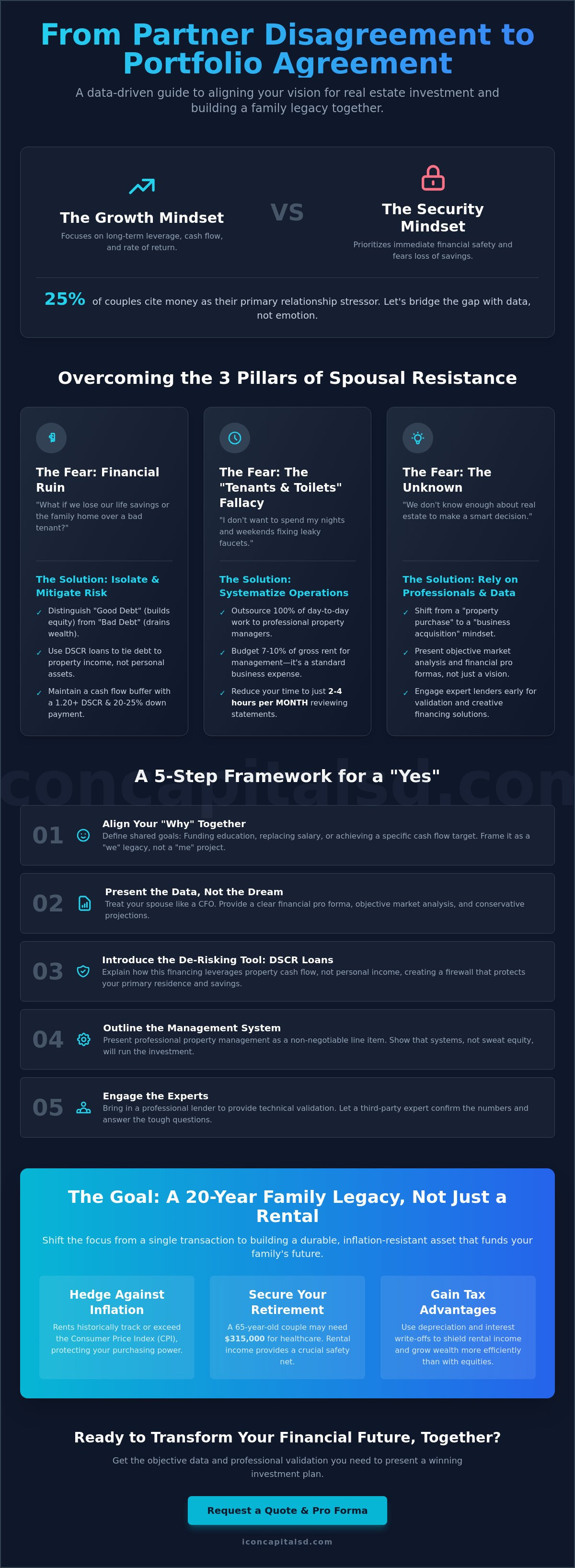
What if your biggest barrier to scaling a real estate portfolio isn’t a high interest rate, but the person sitting across from you at the dinner table? A 2023 study by Fidelity Investments found that 25% of couples cite money as their primary relationship stressor. Learning how to convince spouse to invest in rental property requires moving beyond emotional pleas and into the territory of hard data. Most investors face resistance because their partners prioritize immediate security over long-term leverage. It’s natural to fear the loss of personal savings or the perceived burden of property management.
You’ll learn how to transform this friction into a professional partnership by using creative financing solutions, such as DSCR loans, that isolate risk and protect your primary residence. We’ll provide the tools to present a clear plan for asset protection and wealth alignment. This framework delivers a methodical approach to risk mitigation and portfolio growth using modern lending tools designed for serious investors who value efficiency and tangible results.
Key Takeaways
- Address the three pillars of resistance—risk, time, and expertise—to shift the conversation from a property purchase to a 20-year family legacy.
- Learn how to convince spouse to invest in rental property using a data-driven 5-step pitch that focuses on objective market analysis and financial pro formas.
- De-risk the investment by utilizing DSCR loans, which leverage property cash flow instead of personal income to protect household finances.
- Engage professional lenders early to provide the technical validation and creative financing solutions necessary to bridge the retirement gap.
Understanding the Resistance: Why Spouses Say No to Rental Properties
Learning how to convince spouse to invest in rental property starts with identifying the specific source of their “no.” Resistance to real estate acquisition typically stems from three pillars: Financial Risk, Time Consumption, and Lack of Expertise. When one spouse proposes a property purchase, they often operate from a growth mindset, focusing on internal rate of return and cash flow. The other spouse often operates from a security mindset, viewing the asset as a liability that threatens the family’s primary residence or emergency fund.
Investment Friction is the gap between one partner’s growth mindset and the other’s security mindset.
Effective communication requires moving past the “Partner vs. Passenger” dynamic. In this scenario, the “Partner” performs the research and expects the “Passenger” to simply agree to the risk. This imbalance triggers a defensive response. Emotional appeals regarding “financial freedom” or “retiring early” usually fail because the skeptical spouse perceives a direct threat to current stability. Understanding real estate investing fundamentals is necessary to bridge this gap with data rather than sentiment. You can’t solve a logical fear with an emotional vision. You must address the mechanics of the deal to lower the perceived threat level.
The “Tenants and Toilets” Fallacy
Many spouses reject the idea of rental properties because they envision themselves as a 24/7 handyman. This fear is a relic of amateur landlording. Modern real estate investing utilizes professional property management to automate operations. A standard pro forma includes a 7% to 10% management fee as a non-negotiable line item. By outsourcing these tasks, the actual time commitment for the owner drops to approximately 2 to 4 hours per month. This time is spent reviewing monthly statements and approving major repairs rather than unclogging drains at midnight. Systems replace sweat equity.
The Fear of Financial Ruin
The resistance often centers on a misunderstanding of debt. It’s critical to distinguish between consumer “bad debt” and income-producing “good debt.” While a credit card balance drains wealth, a mortgage on a cash-flowing asset builds equity through tenant debt paydown. Spouses often worry that a single vacancy will lead to losing the family home. However, structuring deals with a 20% to 25% down payment and maintaining a Debt Service Coverage Ratio (DSCR) of 1.20 or higher provides a safety margin. Utilizing non-recourse or limited-recourse financing options can further insulate personal assets from investment liabilities. To see how these numbers look in a real-world scenario, you can request a quote to get concrete data for your presentation.
The Business Partner Mindset: Aligning Shared Financial Visions
Successful investment starts by shifting the dialogue from “buying a house” to “building a 20-year family legacy.” Most traditional retirement strategies rely on the 4% withdrawal rule, which often fails to account for longevity and inflation. According to the 2023 Fidelity Retiree Health Care Cost Estimate, a couple aged 65 may need approximately $315,000 to cover medical expenses in retirement. Rental property serves as a critical hedge against these rising costs because rents historically track or exceed the Consumer Price Index (CPI).
Real estate offers unique tax advantages that traditional equities can’t match. Through depreciation and interest write-offs, the household can shield a significant portion of rental income from taxes. This creates a source of passive income that supports long-term goals like college tuition or early retirement. Framing the discussion around these tangible financial outcomes is a key step in how to convince spouse to invest in rental property.
Defining Your “Why” Together
Conduct a “Financial Vision Board” session to synchronize your objectives. Instead of focusing on the property itself, focus on the milestones the income facilitates. This might include:
- Funding a $100,000 education account for children.
- Replacing a specific percentage of primary salary to allow for career flexibility.
- Building a portfolio that generates $5,000 in monthly net cash flow.
Identify whether the primary value is time freedom or financial surplus. When the investment is tied to a shared emotional or financial goal, the perceived risk becomes a calculated step toward a better future. It’s about moving from a “me” project to a “we” legacy.
Treating the Spouse as a Chief Financial Officer (CFO)
Structure the partnership like a business. One spouse acts as the Visionary, finding opportunities and analyzing markets. The other serves as the CFO or Integrator, focusing on risk management and operational efficiency. Giving a skeptical spouse “veto power” over specific deal metrics, such as a minimum 1.25 DSCR or a maximum 75% LTV, establishes a safety net that builds trust. Transparency is the foundation of this role. Maintain shared digital folders for all inspection reports, tax returns, and loan documents. If you’re ready to evaluate the numbers on a potential asset, you can request a quote to see how current Non-QM or DSCR loan products fit your strategy.
De-Risking the Deal: Using DSCR Loans to Protect Family Finances
Financial risk is the primary reason most people hesitate to enter real estate. When you are researching how to convince spouse to invest in rental property, the conversation usually stalls at the potential impact on personal credit. Traditional financing uses your personal debt-to-income (DTI) ratio, meaning a rental property’s debt could hinder your ability to qualify for a personal car loan or a primary mortgage. DSCR loans eliminate this concern by shifting the focus from the borrower to the asset.
These loans prioritize the property’s cash flow over your personal paycheck. Because the debt is tied to the investment’s performance, it doesn’t typically impact your personal DTI. This keeps your spouse’s borrowing power for personal needs completely intact. DSCR lenders care more about the property’s ability to pay for itself than your day job. If the rental income covers the mortgage, taxes, and insurance, the deal stands on its own merits without requiring your salary to back it up.
Separating Personal and Professional Assets
Holding property within an LLC creates a definitive boundary between family assets and investment liabilities. This structure ensures that a legal issue at the rental doesn’t threaten your personal home or savings accounts. Specialized lending keeps family credit scores insulated from investment debt because many commercial lenders don’t report these balances to personal credit bureaus. For business owners, P&L Home Loans are ideal for self-employed couples. They allow for qualification based on business profit and loss statements, bypassing the complexities and deductions found on personal tax returns.
Mitigating the “Vacant Property” Nightmare
The fear of a vacant property is often the biggest hurdle to overcome. You can neutralize this anxiety by building a 3 to 6 month Capital Expenditure (CapEx) reserve directly into the initial deal structure. This cash cushion ensures the mortgage is paid even during a tenant transition or unexpected repair. Additionally, rent loss insurance provides a safety net by covering the mortgage payment if the unit becomes uninhabitable due to a covered claim. Presenting a “Stress Test” is a powerful way to show how the deal survives a 10% vacancy rate or a 15% increase in maintenance costs without requiring a personal cash infusion.
By using these data-heavy tools, you transform a speculative “what if” into a structured business plan. This shift in perspective is often exactly what’s needed when figuring out how to convince spouse to invest in rental property without risking the family’s stability. Focusing on the mechanics of the loan and the protection of the LLC shows that you aren’t just chasing a dream, you’re building a protected financial system.
How to Present the Investment Pitch: A 5-Step Framework
Presenting a deal to a partner requires a shift from emotional enthusiasm to technical precision. To successfully understand how to convince spouse to invest in rental property, you must treat the conversation like a professional board meeting. Use this five step framework to structure your presentation.
- Step 1: Present the Market Analysis. Don’t just say a neighborhood is “nice.” Provide data on the 2024 rental growth rates and local inventory levels. If the submarket has a vacancy rate below 5%, lead with that number.
- Step 2: Show the Pro Forma. This is the financial core of your pitch. It details every expected dollar in and out.
- Step 3: Detail the Management Plan. Address the lifestyle impact immediately. Explain whether you’ll use a property management firm or handle operations yourself. Specify who responds to a 2:00 AM plumbing emergency.
- Step 4: Outline the Exit Strategy. Risk mitigation is vital. Define the “stop loss” point. If the property fails to meet a 1.20 DSCR within 18 months, detail the process for a 1031 exchange or a traditional sale.
- Step 5: Define the First 90 Days. Provide a calendar of actions. This includes LLC formation, securing a pre-approval, and closing the first deal.
The Power of the Pro Forma
A realistic pro forma builds credibility. It must include property taxes, insurance premiums, a 10% maintenance reserve, a 5% vacancy factor, and professional management fees. Under-promising on cash flow estimates is a strategic move to build trust; if the numbers still work with conservative assumptions, the deal is robust. You can use different types of loans for flipping houses to demonstrate how various leverage levels affect your cash-on-cash return and total equity growth.
Handling Objections with Data, Not Emotion
When objections arise, don’t argue; provide a datasheet. Create a “Worst Case Scenario” worksheet that pairs every fear with a specific safeguard. If the fear is a market downturn, show how a long term fixed rate mortgage protects the monthly payment. Compare real estate returns directly to your current S&P 500 performance, which historically averages 10% annually. Real estate often outperforms when you factor in depreciation and principal paydown. For those interested in quicker turnarounds, providing a Fix and Flip Guide can help illustrate the difference between short term capital gains and long term wealth accumulation.
Ready to back your pitch with concrete financing options? Request a quote today to see the exact rates and terms available for your first investment.
Taking the First Step: Professional Support and Next Steps
Trying to navigate a real estate acquisition as a lone wolf often leads to marital friction. When one partner holds all the information, the other naturally feels sidelined or pressured. To solve the problem of how to convince spouse to invest in rental property, you must transition from a subjective sales pitch to a collaborative, data-backed strategy. Involving a professional lender early in the process shifts the burden of proof from you to the numbers.
Invite your spouse to a discovery call with a specialist who understands creative financing. This isn’t about persuasion; it’s about education. A specialist can explain how a DSCR (Debt Service Coverage Ratio) loan works, focusing on the property’s income rather than your personal debt-to-income ratio. This transparency builds a common vocabulary and ensures both partners understand the risk-to-reward profile of the asset before any capital is committed.
Leveraging Professional Expertise
A professional mortgage quote provides the first concrete data point for your family investment thesis. It defines your purchasing power and establishes realistic expectations for LTV (Loan-to-Value) limits and down payment requirements. Beyond the financing, use third-party appraisals and inspections as unbiased referees. An inspection report detailing a 15-year life expectancy for a roof or a 98% efficiency rating for a HVAC system provides objective facts that personal opinions can’t override. Additionally, networking with established investor couples allows your spouse to see a 20% equity gain or consistent monthly cash flow in a real-world context.
The “Beta Test” Investment
Start with a single-family rental as a proof of concept. This beta test allows you to refine your property management systems without the high stakes of a multi-unit complex. To ensure long-term alignment, establish a 12-month performance review timeline. You should agree on specific metrics before closing, such as a minimum 10% cash-on-cash return. Clear agreements are essential for the following areas:
- Reinvestment vs. Cash Out: Decide if profits will fund the next acquisition or pay down the primary mortgage.
- Management Roles: Define who handles tenant screening and who tracks the accounting.
- Exit Strategy: Determine the specific appreciation target that would trigger a property sale.
The transition from research to action requires a clear understanding of your financial leverage. Request a professional quote from Icon Capital to see exactly what your family can qualify for and take the first step toward securing your financial future.
Secure Your Family’s Financial Future with a Structured Plan
Success in real estate requires more than just finding a good property; it demands a strategic alignment of your household’s financial goals. You now have a framework for how to convince spouse to invest in rental property by shifting the conversation from emotional risk to objective business metrics. By leveraging specialized DSCR programs, you can acquire assets without personal income verification. This strategy keeps your family’s primary finances isolated from the investment’s performance. Icon Capital provides the expertise in non-QM lending that self-employed business owners need to scale portfolios without the standard hurdles of traditional banking.
Our team focuses on direct, data-driven loan structuring to de-risk every deal you present. We handle the technical complexities of Debt Service Coverage Ratios so you can present a deal that stands on its own merits. Taking the next step is about providing your partner with tangible numbers rather than abstract ideas. It’s time to replace uncertainty with a professional debt schedule. Get a Professional Investment Loan Quote to Show Your Spouse and start building your legacy today. You’ve got the tools to make this a reality.
Frequently Asked Questions
What is the best way to explain real estate risk to a risk-averse spouse?
Frame real estate risk through the lens of historical asset performance and specific mitigation strategies. Since 1975, the Case-Shiller U.S. National Home Price Index shows a 4.6% average annual appreciation rate. Present a worst-case scenario model that includes a 10% vacancy rate and a 20% maintenance reserve. This data-driven approach demonstrates how to convince spouse to invest in rental property by focusing on objective safety margins rather than speculation.
How do I show my spouse that we can afford an investment property?
Create a liquidity map that separates your 6 month emergency fund from your investment capital. Use a pro forma statement to show how the down payment and closing costs affect your net worth. Most lenders require a debt-to-income ratio below 43% for conventional loans. Showing that your current DTI remains well below this threshold proves the acquisition doesn’t compromise your household stability.
Should I invest in real estate if my spouse is 100% against it?
You shouldn’t proceed with a real estate investment if your spouse is completely against the idea. Marital strain can cost more than any potential ROI. Focus on education and small steps instead. According to a 2023 survey by Ramsey Solutions, money is the leading cause of divorce. Aligning on a 12 month research phase is a more productive strategy than forced participation.
What financial metrics are most important to show a skeptical partner?
Focus on the Debt Service Coverage Ratio (DSCR) and Cash-on-Cash (CoC) return. A DSCR of 1.25 or higher indicates the property generates 25% more income than the debt obligation. This metric provides an objective margin of safety. Show how a 10% CoC return outperforms the 0.06% average interest rate on standard savings accounts reported by the FDIC in 2024.
How can we protect our personal home if an investment property fails?
Use an LLC and adequate insurance coverage to create a legal barrier between your rental and your primary residence. An umbrella policy with a 1 million dollar limit provides an additional layer of liability protection. Most real estate attorneys recommend holding each asset in a separate entity. This structure ensures that a lawsuit or foreclosure on the investment property won’t impact your personal equity or home ownership.
Is it better to start with a fix-and-flip or a long-term rental for a first-time couple?
Long-term rentals are generally better for first-time couples because they offer more predictable cash flow. Fix-and-flip projects carry higher execution risk and require intense management. Data from Attom Data Solutions shows that flip profits can fluctuate by 20% or more depending on market timing. A buy-and-hold strategy allows for a 30 year amortization period, which provides a more stable entry point into the market.
How does a DSCR loan make the conversation with a spouse easier?
A DSCR loan simplifies the discussion because it qualifies the deal based on the property’s rental income rather than your personal tax returns. This removes the stress of scrutinizing your W-2 income or personal debt. It makes the process of how to convince spouse to invest in rental property easier by shifting the focus to the asset’s performance. The loan acts as an objective validation of the deal’s viability by a professional underwriter.
What happens to our personal credit if the rental property mortgage is in an LLC?
Your personal credit score is still relevant because most lenders require a personal guarantee for LLC-held mortgages. While the debt may not appear on your personal credit report, you’re still legally responsible for the balance. According to FICO, a score of 740 or higher typically secures the best LTV and interest rate terms. This structure protects your credit from high utilization ratios while maintaining your accountability for the loan.