

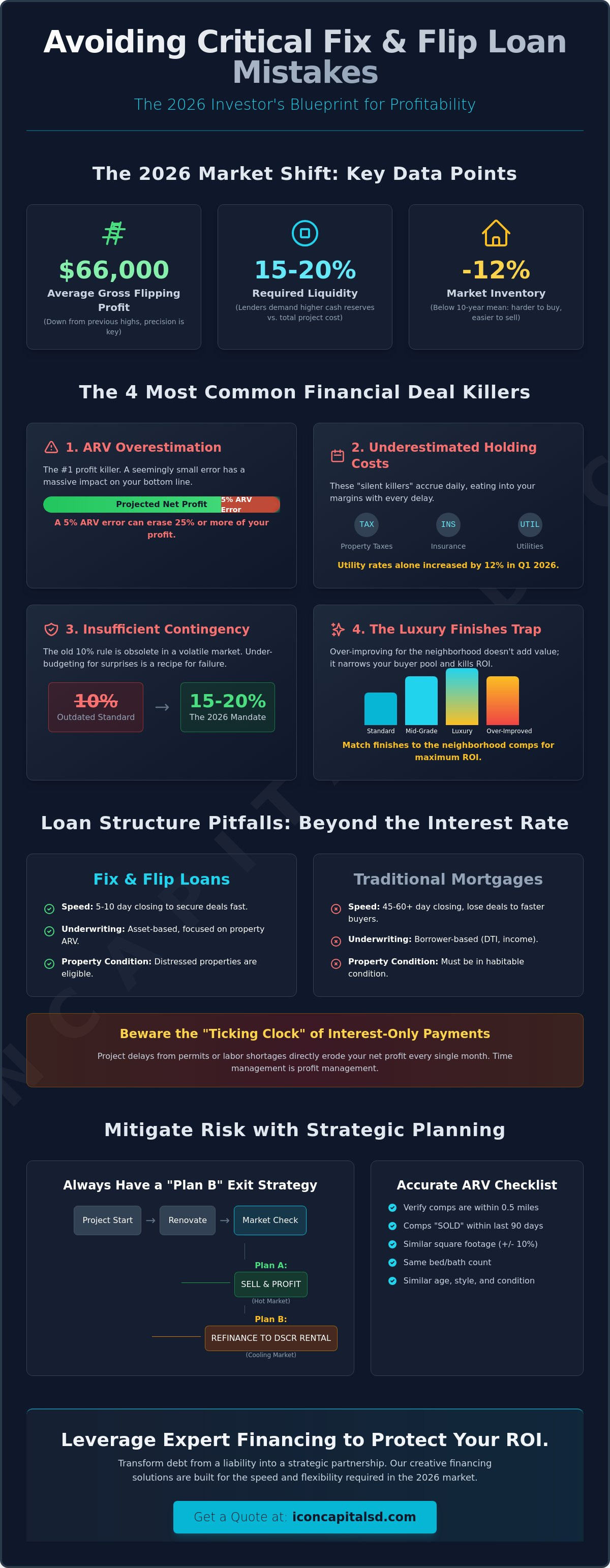
In 2024, average gross flipping profits dropped to $66,000 per property according to Attom data, marking a significant shift in market dynamics that will define 2026 investment strategies. Successful investors know that even a minor miscalculation in leverage can turn a profitable asset into a liability. Learning how to avoid mistakes with fix and flip loans is now a requirement for any professional looking to scale their portfolio without sacrificing liquidity or equity.
You likely recognize that hidden lender fees and unexpected project delays can quickly inflate interest carry, eating 15% or more of your projected net profit. This guide provides the technical framework to identify and bypass the structural, financial, and operational traps that derail fix and flip profitability. We’ll analyze how to secure financing that aligns with your specific project timeline, ensure accurate ARV assessments to prevent over-leverage, and streamline your transition to a final sale or a DSCR long-term rental. Our focus is on the mechanics of the deal, helping you maintain margins through efficient capital structure and precise execution.
Key Takeaways
- Identify the 2026 shift in lending standards to ensure your liquidity meets the latest requirements for asset-based bridge financing.
- Avoid the most common financial deal killers by mastering accurate ARV calculations and accounting for hidden holding costs.
- Learn how to avoid mistakes with fix and flip loans by evaluating restrictive draw schedules and the nuances between LTV and LTC.
- Mitigate market volatility with strategic exit planning, including “Plan B” transitions into rental portfolios when markets cool.
- Utilize creative financing structures to transform debt into a strategic partnership that maximizes your project’s ROI.
Navigating the Fix and Flip Lending Landscape in 2026
Fix and flip loans serve as short-term, asset-based bridge financing specifically designed for distressed real estate. In 2026, the lending environment has shifted toward stricter capital requirements. Most private lenders now demand a minimum of 15% to 20% liquidity relative to the total project cost to offset potential market volatility. This shift makes learning how to avoid mistakes with fix and flip loans critical for maintaining project solvency. While traditional financing relies on borrower debt-to-income ratios, fix and flip lenders prioritize the After Repair Value (ARV) and the property’s underlying equity. Success in this landscape requires a shift from focusing on interest rates to focusing on capital structure.
The primary advantage of these loans is the speed of execution, often closing in as little as 5 to 10 business days. However, this speed can be a double-edged sword. Investors frequently overlook structural risks in the loan agreement, such as high exit fees or restrictive renovation draw schedules. To stay profitable, you must treat the loan as a tool for leverage rather than a long-term debt obligation. Balancing the cost of capital against the projected timeline is the only way to ensure the debt doesn’t outpace the asset’s value growth.
The High Stakes of Short-Term Leverage
Most fix and flip products utilize interest-only payments. This structure creates a ticking clock for project profitability. If a project stalls due to permitting or labor shortages, the monthly interest payments immediately begin eroding your net profit. In 2026, average market inventory levels remain approximately 12% below the historical ten-year mean. This tight supply increases competition for houses, making it easier to sell but harder to buy at a discount. Many professional investors use hard money fix and flip loans to scale portfolios quickly, but the strategy only works if the renovation phase is tightly managed. Long durations in a high-leverage environment are the most common cause of project failure.
Why Traditional Banks Often Fail Flippers
Conventional mortgages aren’t built for distressed assets. Banks require properties to be in habitable condition, which disqualifies most flips involving structural issues, outdated electrical systems, or roof damage. A deep understanding property flipping reveals that speed is the only way to secure deals in a competitive 2026 market. Traditional underwriting often takes 45 to 60 days, a timeline that loses deals to cash buyers or private money investors.
Asset-based underwriting from Icon Capital focuses on the deal’s viability rather than just the borrower’s personal tax returns. We provide creative financing solutions to bypass the bottlenecks of institutional banking. Identifying these differences early is a key part of how to avoid mistakes with fix and flip loans when you’re trying to move fast on a high-potential property. If you’re ready to see how our debt structures can support your next project, you can request a quote to get started.
Avoiding the Most Common Financial Math Errors
Precision in your financial modeling determines whether a project yields a profit or a loss. In 2026, the margin for error has tightened significantly. Overestimating the After Repair Value (ARV) remains the primary deal killer for most investors. If your projected exit price is off by even 5%, it can erase your entire net profit. Understanding how to avoid mistakes with fix and flip loans requires a cold, data-driven approach to every line item in your budget.
Investors often fall into the holding cost trap. This includes property taxes, insurance premiums, and utilities that accrue every day the property sits unsold. By Q1 2026, utility rates in many urban centers increased by 12% compared to the previous year. Furthermore, the traditional 10% construction contingency is no longer sufficient. Given the 2026 labor market volatility and specialized trade shortages, savvy flippers now budget a 15% to 20% cushion to absorb unexpected cost spikes. Another common error is the luxury trap. Installing high-end finishes that exceed the neighborhood standard won’t provide a dollar-for-dollar return; it simply narrows your buyer pool and kills your ROI.
Mastering the ARV and Comps Audit
ARV is the projected market value after all renovations are completed to professional standards. To calculate this accurately, you must audit “sold” comparables with extreme scrutiny. Use this checklist for every potential acquisition:
- Verify comps are within a 0.5-mile radius of the subject property.
- Ensure the properties sold within the last 90 days to reflect current 2026 pricing.
- Match square footage within a 15% variance.
- Confirm the bedroom and bathroom count is identical.
Adjust your final sale price for seasonal fluctuations. In 2026, data shows that properties listed in late Q4 sit on the market 22 days longer than those listed in the spring. You must account for these additional days of interest payments in your initial math.
The Real Cost of Capital: Beyond the Note
The interest rate is only one component of your total cost of capital. You must account for origination fees, which typically range from 1% to 3% of the loan amount. Be alert for “junk fees” such as excessive document preparation or administrative charges that can add thousands to your closing costs. Many 2026 loan products utilize interest reserves. This structure allows the lender to hold a portion of the loan to cover monthly interest payments. While this helps your monthly cash flow, it increases the total loan balance and interest accrued over time.
If a project stalls due to permitting delays or contractor issues, you might face refinancing pitfalls that force you into higher-rate bridge loans. To prevent this, ensure your initial loan term is at least two months longer than your most conservative construction timeline. For a clear look at your potential expenses, you can request a quote to see a transparent breakdown of all costs associated with your specific deal structure. This transparency is vital for anyone learning how to avoid mistakes with fix and flip loans before committing capital.
Structural Loan Pitfalls: Beyond Interest Rates
Focusing solely on the interest rate is a primary reason investors fail. A low rate often masks restrictive terms that kill liquidity. Understanding how to avoid mistakes with fix and flip loans requires a deep dive into the loan’s structural components, specifically how capital is deployed and repaid. The cheapest paper on the market often carries the most baggage in the fine print.
Dutch Interest is a common financial trap. In this model, you pay interest on the total loan amount from the day of closing, regardless of how much you’ve drawn for construction. If you have a $500,000 loan but have only spent $100,000 on the initial purchase, you’re still paying interest on the full $500,000. This significantly increases your carrying costs compared to a loan where interest only accrues on disbursed funds. Additionally, maturity dates impact your exit strategy. A 6-month term provides no margin for error. Permitting delays or contractor no-shows can force you into expensive extensions. Aim for 12-month terms to maintain project stability and avoid unnecessary stress.
The Draw Schedule Bottleneck
Draw inspections are the pulse of a flip. If your lender requires a 7-day turnaround for inspections, your contractors stop working while waiting for payment. This stalls progress. Negotiate for a 48-hour inspection window and clear milestones to keep the crew on site. Avoid “rear-weighted” draws where the lender holds back a disproportionate amount of capital until the project is 90% complete. This structure leaves you cash-poor during the critical middle phase of the rehab. Proper planning prevents these refinancing pitfalls for fix and flip loans if the project timeline extends beyond your initial projections and you’re forced to hold the asset longer than expected.
LTV vs. LTC: Understanding Your Skin in the Game
Lenders in 2026 use two primary metrics to determine leverage: Loan-to-Value (LTV) and Loan-to-Cost (LTC). LTC measures the loan amount against the total project cost, including purchase and rehab. LTV measures the loan against the After Repair Value (ARV). A common mistake is assuming 90% LTC means you only need 10% cash. If the loan also has a 75% LTV cap, the lower of the two figures usually wins, which can unexpectedly increase your required down payment at the closing table.
- LTC Focus: Limits the loan based on what you actually spend on the acquisition and renovation.
- LTV Focus: Limits the loan based on the projected final value of the property.
- Cross-Collateralization: Experienced flippers use equity in existing portfolios to secure higher leverage, sometimes reaching 100% financing by pledging other assets as security.
Knowing how to avoid mistakes with fix and flip loans means analyzing these ratios before signing the term sheet. For a breakdown of current leverage limits and specific program requirements, refer to the Fix and Flip Loans Ultimate Guide. If you have a specific deal that needs a professional review, you can request a quote to see your customized terms and leverage options.
Strategic Exit Planning and Market Risk Mitigation
A fix and flip loan is only as effective as its exit strategy. Relying on a single path to profit is a primary reason investors lose capital. To understand how to avoid mistakes with fix and flip loans, you must analyze the “Plan B” before signing the note. Market conditions in 2026 show that liquidity can shift within a 90-day window. If the sales market cools, your bridge loan becomes a liability rather than a tool.
Pre-payment penalties are a critical factor in your timeline. Many 2026 loan products include a “minimum interest” clause, typically covering the first 4 to 6 months. If you renovate and list a property in 90 days, these penalties can erase 2% to 5% of your projected profit margin. Always align your construction schedule with the loan’s lock-out period.
To reduce days-on-market, leverage 2026 digital trends. High-fidelity VR staging and AI-targeted ad placements now account for a 30% faster sales rate compared to traditional methods. These technologies ensure the property gains maximum exposure during the peak listing window.
The Pivot: From Flip to DSCR Rental
When a retail sale isn’t viable, transitioning to a DSCR loan allows you to pay off the bridge debt and hold the asset. Qualification depends on the property’s cash flow rather than personal income. In 2026, most take-out lenders require a 1.20x Debt Service Coverage Ratio to move forward.
Seasoning requirements are a common hurdle. Current 2026 standards often require 90 to 180 days of title seasoning before you can refinance based on the new appraised value. Using a lender that provides both bridge and long-term products simplifies this. It eliminates redundant appraisal costs and speeds up the closing by approximately 15 days.
Mitigating Contractor and Permit Risks
Contractor failure is a leading cause of default. Use this 3-step vetting process:
- Verify active licenses and $1 million minimum general liability insurance.
- Conduct site visits for three projects completed within the last 12 months.
- Review sub-contractor payment records to ensure no pending liens.
Municipal permit backlogs are a significant threat in 2026. Major metropolitan areas currently report structural permit wait times exceeding 120 days. This delay can easily push a project past a 6-month loan term. Ensure your loan documents include “extension clauses.” These allow you to extend the term for a pre-negotiated fee, which is a vital strategy for how to avoid mistakes with fix and flip loans when facing bureaucratic delays.
Leveraging Expert Financing to Protect Your ROI
A well-structured loan functions as a strategic partnership rather than a simple debt obligation. In the 2026 real estate market, your capital structure determines your agility. High-leverage financing allows you to preserve cash reserves for unexpected renovation costs or additional acquisitions. Icon Capital provides creative financing solutions designed for investors who require speed and flexibility. Understanding how to avoid mistakes with fix and flip loans starts with selecting a lender that recognizes the nuances of different types of flipping loans. This alignment ensures your exit strategy isn’t compromised by restrictive loan terms or rigid repayment schedules.
Investors should initiate a proactive deal review with an underwriter before signing a purchase contract. This preliminary analysis identifies potential valuation gaps or title issues that could derail a project. It’s a pragmatic step that secures your capital before you’re legally committed to a property. By treating your lender as a technical consultant, you gain a second pair of eyes on the project’s financial viability. This collaboration is a primary defense against over-leveraging on assets with thin margins.
The Icon Capital Advantage
Icon Capital supports ambitious investors by funding up to $2 million for multi-unit flips and high-end residential projects. We eliminate the hurdles common in traditional banking by focusing on the asset and the investor’s experience. For self-employed flippers, we offer a streamlined path via P&L Home Loans. This product allows you to qualify based on business performance rather than personal tax returns. Our process is defined by transparency. We provide explicit draw schedules and interest calculations from the outset. You’ll know exactly when funds will be released and how your interest accrues, allowing for precise cash flow management throughout the construction phase.
Getting Started with Your 2026 Flip
Speed is the most valuable currency in a competitive market. To secure a fast pre-approval, you must have your documentation ready for review. This typically includes a detailed scope of work, a resume of past projects, and proof of liquid assets for the down payment. Icon Capital also facilitates growth for international investors. We support foreign national investors entering the US market with specialized programs that don’t require a domestic credit history. Establishing your financing early is the most effective way how to avoid mistakes with fix and flip loans. Explore your fix and flip options with a custom quote to lock in your borrowing power before your next deal goes live.
Secure Your 2026 Investment Strategy
Success in the 2026 real estate market requires more than just finding the right property. The Mortgage Bankers Association 2025 forecast suggests that while market volatility may settle, inventory levels remain a critical variable for fix and flip margins. Mastering how to avoid mistakes with fix and flip loans involves precise financial math and a clear exit strategy that accounts for these specific shifts. You must look beyond simple interest rates to understand the full structural impact of your leverage on your ROI. Icon Capital acts as a specialized partner for investors who require efficiency and technical expertise.
We provide creative financing solutions tailored for self-employed individuals and foreign nationals who don’t fit into traditional lending boxes. Our team focuses on high-leverage options with loan amounts up to $2 million to help you scale your portfolio quickly. Stop guessing at your financing and start building with a partner that understands the mechanics of the deal. Request a custom Fix & Flip loan quote from Icon Capital to secure your next project today. It’s time to leverage professional expertise to protect your capital.
Frequently Asked Questions
What is the most common mistake beginners make with fix and flip loans?
The most common mistake is underestimating the renovation budget and the total project timeline. Beginners frequently fail to include a 15% contingency fund for unforeseen structural issues or permit delays. Learning how to avoid mistakes with fix and flip loans starts with securing accurate contractor bids. Overlooking holding costs like insurance and taxes for an extra 90 days can erode 5% of your projected profit margin.
How do interest reserves work in a fix and flip loan?
Interest reserves are funds set aside from the loan proceeds at closing to prepay monthly interest. Lenders typically hold 6 to 12 months of payments in an escrow account to ensure debt service while the property generates zero cash flow. This structure reduces your out of pocket monthly expenses. It increases the initial loan balance, meaning you pay interest on the reserve amount from day one.
Can I get a fix and flip loan with no experience?
You can obtain a fix and flip loan without experience, but expect more restrictive leverage and pricing. First time investors often face a maximum 75% LTV, while experienced flippers with 5 successful exits in 2 years can access 90% LTC. Lenders mitigate risk for novices by requiring a credit score of 680 or higher and verified liquid reserves equal to 20% of the project cost.
What happens if my fix and flip project takes longer than the loan term?
If a project exceeds the loan term, you must request a formal extension or risk a default notice. Most bridge loans offer a 12 month term with options for two 3 month extensions. These extensions carry fees ranging from 1% to 2% of the principal balance. Failing to secure an extension results in penalty interest rates that often exceed 18% annually and can trigger foreclosure proceedings.
Is it better to use LTV or LTC when evaluating a flip loan?
LTC is the more critical metric for evaluating flip loans because it accounts for the total capital required for the project. While LTV focuses on the appraised value, LTC ensures you have enough funding for both the purchase price and 100% of the renovation costs. Understanding the interplay between these ratios is vital when learning how to avoid mistakes with fix and flip loans and calculating your equity requirement.
How does a draw schedule affect my project cash flow?
A draw schedule dictates when the lender releases funds for completed renovation phases. Most schedules include 4 to 6 milestones, such as foundation completion, framing, and final finishes. Delays occur if the third party inspector doesn’t verify work within 48 hours of a request. This lag can stall a project if you lack the cash to pay subcontractors before the reimbursement arrives from the lender.
What is a “Dutch Interest” loan and should I avoid it?
Dutch Interest means you pay interest on the entire loan amount starting at closing, regardless of how much you’ve actually drawn for renovations. If you have a $500,000 loan but only spent $100,000 on the purchase, you still pay interest on the full $500,000. It’s more expensive than “interest on drawn funds” and can increase your total interest expense by 25% over the project life.
Can I convert my fix and flip loan into a long-term rental loan?
You can convert a flip loan into a long term rental loan using a DSCR exit strategy once the renovation is complete. This transition requires a tenant to be in place and a lease agreement signed. Lenders look for a Debt Service Coverage Ratio of 1.20 or higher based on the new appraised value. This allows you to pull out equity and secure a 30 year fixed rate to hold the asset.