

In a competitive 2026 market, waiting 45 days for a traditional bank mortgage is the fastest way to lose a high-yield property to a cash buyer. Speed is the primary metric that matters when your ROI depends on a quick acquisition. Professional investors frequently ask how quickly can you get a dscr loan once they realize conventional underwriting cannot keep pace with the current real estate cycle. You likely already know that red tape and appraisal delays can kill a deal before the ink is dry. It’s frustrating to watch a perfect asset slip away because of bureaucratic hurdles that don’t apply to investment-grade financing.
This guide outlines the exact roadmap to secure a 10 to 21 day closing window. You’ll learn how to leverage non-QM flexibility to scale your portfolio without the typical 30 day wait times found at retail banks. We break down the four specific stages of the DSCR timeline and provide a precise checklist of documentation. This ensures your underwriter moves at the speed of the market, giving you the confidence to outbid competitors who are still stuck in the paperwork phase.
Key Takeaways
- Understand how quickly can you get a dscr loan by identifying the typical 14-to-30-day closing window for streamlined Non-QM financing.
- Master the five critical stages of the DSCR process to eliminate bottlenecks between initial submission and final funding.
- Identify why the 1007 Rent Schedule is the primary cause of delays and how to manage the appraisal process effectively.
- Utilize our fast-track documentation checklist to ensure your purchase contracts and rent rolls are ready for immediate underwriter review.
- Discover how Icon Capital leverages creative financing to accelerate closings for complex scenarios, including Foreign National investment properties.
DSCR Loan Closing Timelines: What Is Realistic in 2026?
Investors frequently ask how quickly can you get a dscr loan when a time-sensitive deal is on the line. In 2026, the standard closing window for these products typically ranges from 14 to 30 days. This timeline is significantly faster than conventional financing, which often requires 45 to 60 days due to rigorous debt-to-income (DTI) checks and personal tax return audits. DSCR loans are inherently streamlined because they bypass the borrower’s personal financial history. Instead, lenders focus on the Debt Service Coverage Ratio (DSCR) of the property itself to determine eligibility.
By early 2026, over 80% of top-tier Non-QM lenders have integrated AI-assisted underwriting into their workflow. These AI systems analyze rent rolls, market data, and property history in seconds, which has reduced the manual data entry phase by approximately 60% compared to 2023. However, property type remains a critical variable. A single-family residence (SFR) can often close within two weeks because residential appraisals are readily available. In contrast, multi-unit properties or commercial assets may require 25 to 35 days. This delay is usually due to the complexity of commercial appraisals and the necessity of more detailed environmental or structural reports.
Standard vs. Express DSCR Timelines
A standard timeline of 21 to 30 days is common for retail lenders who handle a mix of traditional and investment products. These institutions often have layered approval processes that can slow down the file. In contrast, express timelines of 10 to 14 days are achievable through specialized investment lenders. These “express” deals are distinguished by three factors: the use of pre-vetted appraisal panels, digital title integration, and the absence of secondary investor reviews. If your documentation is organized and the property is a standard SFR, the 10-day window is a realistic target in the current 2026 market.
Speed as a Competitive Advantage
The ability to close in 14 days allows investors to compete directly with all-cash buyers. Sellers prioritize certainty and speed; a fast closing period often outweighs a slightly higher offer with a 45-day contingency. Rapid funding also secures the Earnest Money Deposit (EMD) more effectively, as it reduces the window for market fluctuations or property issues to derail the transaction. Icon Capital structures deals for maximum leverage and speed, utilizing a methodical process to move files from submission to clear-to-close without unnecessary friction. To see how your specific asset qualifies for an accelerated timeline, you can request a quote and speak with a specialist today.
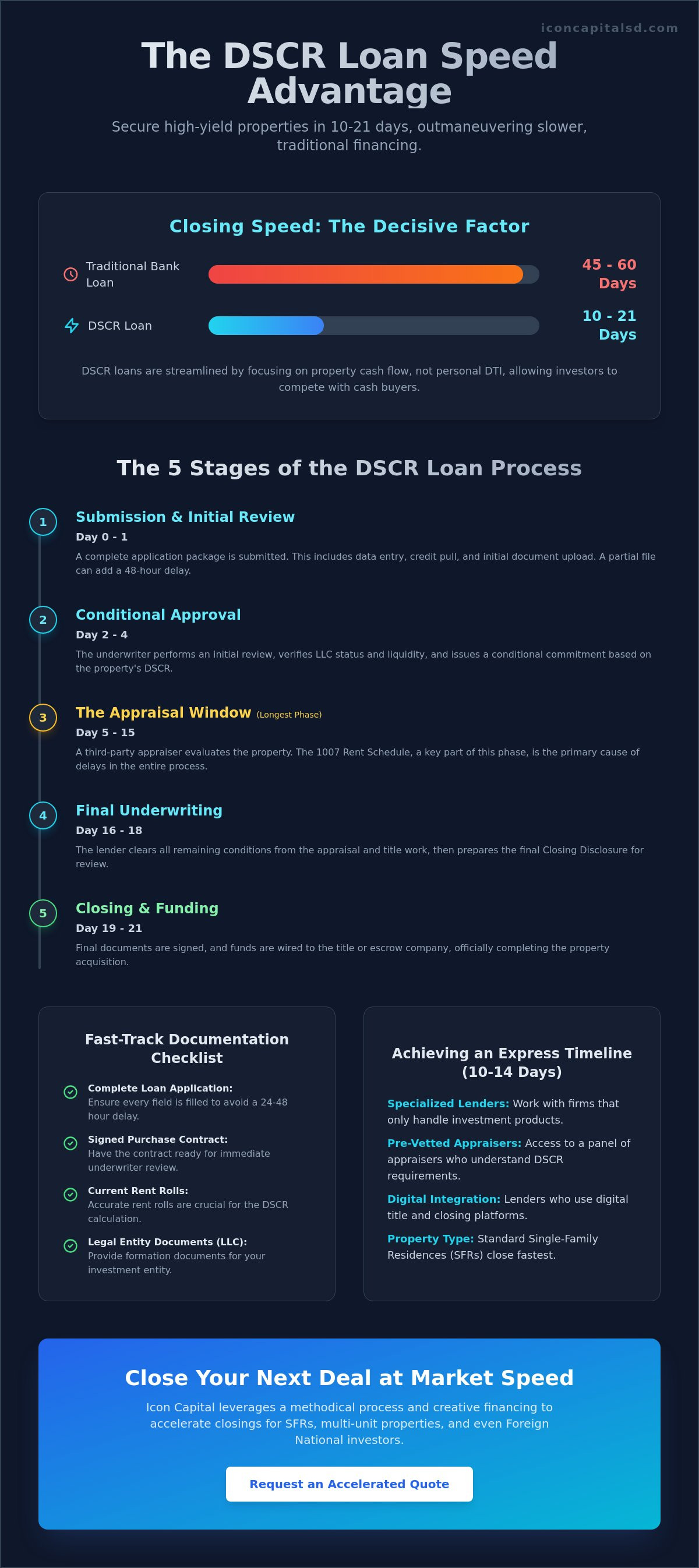
The 5 Stages of the DSCR Loan Process
Determining how quickly can you get a dscr loan depends on your ability to navigate five specific milestones. While traditional financing often drags through 45-day cycles, the DSCR model is built for speed, focusing on the property’s cash flow rather than your personal debt-to-income ratio. Understanding the 21-day roadmap allows you to coordinate with sellers and title companies with precision.
- Submission (Day 0-1): This phase involves the initial data entry, credit pull, and the submission of the loan application package.
- Conditional Approval (Day 2-4): The underwriter performs an initial review to ensure the deal meets core eligibility and issues a conditional commitment.
- The Appraisal Window (Day 5-15): This is the longest phase of the process, where a third-party appraiser evaluates the property and provides a 1007 rent schedule.
- Final Underwriting (Day 16-18): The lender clears all remaining conditions, reviews the title work, and prepares the closing disclosure.
- Closing and Funding (Day 19-21): The final signing occurs, followed by the wire transfer to the title company or escrow agent.
Phase 1: Application and Conditional Approval
A complete application is the only way to secure a 24-hour initial review. If you submit a partial file, you immediately add 48 hours of administrative delay. Underwriters look for specific ‘conditions’ in the first 48 hours of the process. These conditions usually involve verifying the legal entity, such as an LLC, and confirming that the investor has the liquidity for the down payment and required reserves. Since Understanding the Debt Service Coverage Ratio is the foundation of the credit decision, lenders prioritize the rent-to-debt math over your personal tax returns. You must ensure your file aligns with standard DSCR loan requirements to avoid getting stalled at the intake desk.
Phase 2: The Valuation and Underwriting Bridge
The appraisal order happens concurrently with title searches to prevent sequential delays. This 10-day window is the most variable part of the timeline because it relies on third-party schedules. Once the appraisal is back and the value is confirmed, the file moves toward ‘Clear to Close’ (CTC) status. This status is generally achieved in the final 72 hours of the transaction. It’s important to recognize that the ‘funding’ day might differ from the ‘signing’ day. In many jurisdictions, the wire transfer happens the business day after the documents are signed and notarized. To see where your current deal fits in this timeline, you can request a quote and receive a preliminary term sheet within hours.
Solving the #1 Delay: Managing the DSCR Appraisal
The appraisal process accounts for approximately 60% of all timeline setbacks in non-QM lending. While credit and background checks finish in 24 hours, a physical valuation requires external coordination. To understand how quickly can you get a dscr loan, you must first address the ‘1007 Rent Schedule.’ This document provides the market rent estimate required to calculate the Debt Service Coverage Ratio (DSCR). Without it, the underwriter cannot determine if the property’s income covers the debt obligation.
In 2026, lenders increasingly utilize desktop appraisals for standard single-family homes. These digital valuations can reduce the window by 3 to 5 business days. However, complex multi-unit assets still require a full interior inspection. Investors often struggle with valuation targets. If you’re refinancing a property mid-renovation, an ‘as-is’ value might fail to meet LTV requirements. Requesting an ‘as-repaired’ value (ARV) appraisal allows you to leverage future equity, though it requires a detailed scope of work to be submitted on Day 1.
Why Investment Appraisals Take Longer
Appraisers spend extra time sourcing comparable rental data. Unlike standard residential reports, these must include at least three active or recently closed lease agreements within a 2-mile radius. Urban properties typically see faster turnaround times due to data density. Rural locations or 5-8 unit buildings often face 10-day delays because specialized commercial appraisers are in short supply. Complexity adds time; a 2025 industry report showed that multi-family valuations take 40% longer to verify than single-family units.
Proactive Strategies to Shorten the Valuation Window
Speed is a function of early execution. Knowing how quickly can you get a dscr loan depends largely on how fast the appraiser can access the site. Follow these steps to maintain momentum:
- Order on Day 1: Don’t wait for conditional approval. Order the appraisal as soon as the letter of intent is signed.
- Pay the Rush Fee: Spending an extra $200 to $400 for a 48-hour turn time is a standard cost of doing business when 1031 exchange deadlines loom.
- Coordinate Access: Provide the appraiser with the tenant’s contact info or the lockbox code immediately to prevent scheduling gaps.
Eliminating these logistical hurdles ensures the file moves to underwriting without idling for weeks. To see how these strategies impact your specific timeline, you can request a quote and speak with a specialist about your asset type.
Fast-Track Documentation Checklist for Investors
Closing speeds in 2026 depend on the quality of your initial submission. If you’re asking how quickly can you get a dscr loan, the timeline is often dictated by your ability to provide a complete package on day one. Underwriters prioritize files that require the least amount of back and forth. Efficient investors treat their loan application like a business presentation.
To hit a 10 to 14 day closing window, you must have these items ready:
- Property Information: Provide the fully executed purchase contract and proof of Earnest Money Deposit (EMD) immediately.
- Income Evidence: Submit a current rent roll and all executed leases for occupied units. For vacant properties, the appraiser’s 1007 rent schedule will determine the numbers.
- Insurance: A quote for a landlord policy is required. Ensure coverage limits meet the replacement cost or the loan amount.
- Entity Docs: Most DSCR lenders require closing in an entity. Have your Articles of Organization, Operating Agreement, and EIN letter from the IRS ready.
Entity and Borrower Documentation Prep
Closing in an LLC is the industry standard for asset-based lending. It separates personal liability and allows for easier portfolio scaling. To avoid delays, ensure your Operating Agreement clearly lists all members and their percentage of ownership. Borrowers must also provide a clear photo ID and proof of liquidity, such as two months of bank statements, to cover the down payment and required reserves. For a detailed breakdown of what your specific deal requires, view this custom document needs list to stay ahead of the underwriter.
The ‘Clean File’ Secret to Fast Closings
Organization is the primary driver of speed. Submit your documents in clearly labeled PDF folders rather than fragmented image files or cell phone photos. This simple step can save 48 hours of administrative processing. If your credit report shows a minor dip or the title history has a quirk, include a Letter of Explanation (LOE) upfront. Don’t wait for the underwriter to ask for it.
Transparency regarding your other financed properties is also vital. Lenders run background checks that reveal your current real estate footprint. Disclosing your full schedule of real estate owned (SREO) at the start prevents the file from being flagged for non-disclosure. In many cases, hidden debt discovered during a background check can add five days to the approval process or lead to an immediate denial. Providing a clean file from the start is the most effective way to influence how quickly can you get a dscr loan.
Why Icon Capital Closes DSCR Loans Faster
Speed in real estate isn’t a luxury. It’s often the difference between a secured asset and a missed opportunity. Icon Capital prioritizes Non-QM efficiency to answer the question of how quickly can you get a dscr loan with actual results rather than vague estimates. We eliminate the standard 45 day wait times common in traditional banking. This is especially evident in our handling of Foreign National loans, where our internal protocols bypass the typical delays of international document verification. For self-employed borrowers, our P&L Home Loans process uses profit and loss statements to move files into underwriting in 24 to 48 hours. We focus on the mechanics of the deal. We don’t need narrative fluff or personal stories to make a decision.
Specialized Underwriting for Real Estate Investors
Our team evaluates Net Operating Income (NOI) and Loan-to-Value (LTV) ratios immediately. Traditional banks often get bogged down in personal debt-to-income (DTI) calculations that don’t apply to asset-based lending. We assume our borrowers possess a high level of financial literacy. We don’t spend time explaining basic concepts. Instead, we provide direct access to decision-makers. If a bottleneck occurs, you talk to the person who can clear it. This structural advantage reduces the time spent in the “black hole” of corporate committees. Our underwriting focuses on three primary factors:
- Property Cash Flow: Rapid verification of the DSCR ratio.
- Asset Value: Quick appraisal turnarounds through preferred vendor lists.
- Liquidity: Straightforward verification of reserves without 60 days of sourcing.
Closing Complex Deals on Tight Deadlines
Complex files don’t have to be slow files. In November 2024, our team closed a five-unit multi-family acquisition in 19 days. This included the full appraisal and title search. We achieve this by integrating 1099 and bank statement data directly into the DSCR file at the start of the process. Most lenders wait until mid-process to ask for these details. We ask for them on day one. Understanding how quickly can you get a dscr loan depends on the lender’s ability to handle these variables without resetting the clock. We don’t let 1099 status or multiple entities slow down the pipeline. If the numbers work, the deal moves forward. Ready to see how fast we can move on your next acquisition? Request a Quote to see your specific closing timeline today.
Scale Your Portfolio With Efficient DSCR Financing
Success in the 2026 market requires a clear understanding of how quickly can you get a dscr loan. Most timeline delays occur during the appraisal stage or due to incomplete documentation packages. Industry data suggests that investors who utilize a fast-track checklist and provide organized data from the first day often see a 30 percent faster turnaround than those who don’t. Icon Capital operates as a direct Non-QM lender, which simplifies the five-stage loan process for self-employed borrowers and foreign nationals. Our team specializes in 5-8 unit properties and multi-family financing, providing the technical expertise needed to navigate complex investment structures without unnecessary delays.
We maintain a proven track record of closing deals that traditional banks often reject. By focusing on the mechanics of the deal rather than narrative-driven underwriting, we ensure your capital is deployed on schedule. Don’t let administrative bottlenecks stall your next acquisition. Partner with a specialist who prioritizes speed and precision in every transaction. Secure your fast DSCR loan quote from Icon Capital today and move your investment strategy forward with confidence.
Frequently Asked Questions
Can I get a DSCR loan in 10 days?
Closing a DSCR loan in 10 days is possible but requires a rush appraisal and an existing title policy. Most standard transactions take 21 to 30 days to clear all underwriting conditions. You’ll need to provide all requested documents within 24 hours of the request to meet such an aggressive deadline.
What is the biggest delay in the DSCR loan process?
The appraisal report causes approximately 50% of all closing delays in the private lending space. Appraisers often require 7 to 14 days to visit the property and finalize the 1007 rent schedule. Title issues, such as unresolved liens or ownership disputes, represent the second most common bottleneck for investors.
Do I need tax returns to get a fast DSCR loan?
No, you don’t need tax returns or W-2s to qualify for this financing. Because lenders focus on the property’s rental income rather than your personal earnings, the paperwork is significantly reduced. This streamlined documentation is a major factor in how quickly can you get a dscr loan compared to a conventional mortgage.
How does the appraisal affect my DSCR loan timeline?
The appraisal is the primary driver of your closing date because it confirms the debt service coverage ratio. Lenders won’t issue final loan documents until they verify that the Fair Market Rent covers the debt obligations. If an appraiser takes 10 days to submit their report, your closing will likely take at least 15 days total.
Is a DSCR loan faster than a fix and flip loan?
DSCR loans are typically slower than fix and flip loans by 5 to 10 business days. Fix and flip products often use internal valuations or Broker Price Opinions (BPOs) which are faster than full appraisals. While a bridge loan might close in 7 days, a DSCR loan usually requires 21 days for full compliance and secondary market standards.
What documents should I have ready for a 48-hour approval?
You must have a signed purchase contract, a detailed rent roll, and two months of verified bank statements ready. Including a clear photo ID and your entity documents, such as an Operating Agreement or Articles of Incorporation, allows the underwriter to issue a conditional approval quickly. Missing a single page of a bank statement can delay your file by 24 hours.
Does my credit score impact how quickly my loan closes?
Yes, a credit score above 720 often triggers streamlined underwriting paths with fewer documentation requirements. Borrowers with scores below 660 frequently face manual underwriting reviews that add 3 to 5 business days to the process. Higher scores provide the underwriter with more confidence, leading to faster sign-offs on credit-related conditions.
Can foreign nationals get fast-tracked for DSCR loans?
Foreign nationals can close quickly, but their timelines usually average 30 to 45 days due to international document verification. While the DSCR program is available to them, verifying assets in non-US banks and obtaining a US tax ID adds complexity. Approximately 80% of foreign national deals require extra time for legal translations and international wire setups.