

Your credit score and investment resume are not the only factors lenders evaluate in May 2026. While traditional banks often demand a three-year track record, the current private lending market prioritizes the asset’s viability. You can secure financing for house flipping with no experience by focusing on the property’s After-Repair Value (ARV) rather than your personal history. Most novice investors feel stuck when they face high down payment requirements or standard bank rejections, but specialized loan products provide a clear path to your first closing.
It’s a common frustration to find a profitable property only to be sidelined by rigid institutional guidelines that favor seasoned professionals. This guide explains how to present your project to secure at least 80% to 85% Loan-to-Cost (LTC) and keep your personal cash outlay to a minimum. You’ll learn the mechanics of hard money rates, which currently range from 9.5% to 12% for first position loans, and how to leverage professional contractor estimates to satisfy underwriter requirements. We’ll break down the exact steps to move from a prospective buyer to a funded investor.
Key Takeaways
- Understand how asset-based lending allows you to secure funding based on the property’s potential rather than your personal investment resume.
- Identify the differences between hard money and bridge loans to select the best leverage for your specific project timeline.
- Learn the exact steps to present a deal to underwriters, including the critical role of the After-Repair Value (ARV) appraisal.
- Discover how to access specialized financing for house flipping with no experience by utilizing programs that prioritize deal structure and contractor track records.
- Master the “70% Rule” to ensure your project maintains the profit margins required for high-leverage LTC approval.
Can You Get House Flipping Financing with No Experience?
Securing financing for house flipping with no experience is a standard hurdle for new investors in May 2026. Traditional mortgage lenders typically reject these projects because they prioritize W-2 income stability and a three-year history of successful exits. If you don’t have a resume of completed projects, a big bank will likely view your application as high-risk. However, the private lending market operates on a different set of metrics. Specialized short-term loans, often referred to as fix-and-flip or bridge loans, are designed specifically for these scenarios. These products focus on the asset’s potential rather than the borrower’s track record.
The 2026 market relies heavily on Non-QM lenders and private capital to maintain housing inventory. These lenders shift the focus from personal credit scores to property profitability. They evaluate the deal based on the After-Repair Value (ARV) and the total project cost. For a first-time investor, this means your ability to find a distressed property with a wide profit margin is more important than how many houses you’ve sold in the past. If the math of the deal works, the capital is usually available.
The Reality of First-Time Flipping in 2026
Residential redevelopment is a primary driver of the current real estate economy. For new investors, liquidity is now more important than a resume. Lenders in May 2026 generally require first-time flippers to have more “skin in the game,” often requiring a 15% to 20% down payment. Success in house flipping requires a documented exit strategy. You must decide early if you’ll execute a standard fix-and-flip for immediate profit or a fix-and-rent strategy. The latter often involves refinancing into a DSCR loan once the renovation is complete. Having this plan ready for your underwriter is essential for approval.
Traditional Banks vs. Private Lenders
Traditional banks use a process that’s too slow for the fast-paced investment market. Their requirements for debt-to-income ratios and extensive documentation often disqualify active investors. Private lenders, conversely, use the property as the primary collateral. This allows for much faster execution. While a bank might take 60 days to close, a private lender can often fund a deal in 14 to 21 days. This speed is a critical advantage when you’re competing for distressed assets. While you may pay 1 to 2 points more in interest as a novice, the ability to close quickly and secure the asset is the tradeoff for the lack of experience. To see how these structures apply to your specific project, you can request a quote to review your leverage options.
Top Financing Options for New Real Estate Investors
Selecting the right vehicle for financing for house flipping with no experience depends on your project’s timeline and the property’s condition. In May 2026, the lending market offers several specialized products that bypass the rigid requirements of traditional institutions. Fix-and-flip loans are the most common entry point for beginners because they prioritize the asset’s potential over your investment history. These loans are designed for speed and flexibility, allowing you to secure distressed properties before they reach the open market.
Fix & flip specialty loans often provide a high degree of leverage, sometimes funding 80% to 85% of the purchase price and 100% of the renovation costs. This structure minimizes your personal cash outlay, which is critical for maintaining liquidity during your first project. If you intend to hold the property long term after the renovation, you’ll eventually transition into a DSCR loan. This rental program qualifies the borrower based on the property’s rental income rather than personal tax returns, providing a seamless exit strategy for the initial short-term debt.
Hard Money for Beginners
Hard money loans are the standard for rapid, asset-based funding. Most lenders in 2026 charge between 1 and 3 points in origination fees, which are paid at closing. Interest rates for first position loans currently range from 9.5% to 12%. These loans typically feature interest-only payments to keep your monthly carrying costs low while you focus on the renovation. For a detailed breakdown of how to maximize these funds, see our guide on Flipping Houses with Hard Money: The 2026 Investor Guide to Leverage. Lenders generally limit LTV to 75% for new flippers, though strong deals can push this higher.
Bridge Loans and Non-QM Products
Bridge loans provide the necessary capital to close on a property quickly, often within 14 to 21 days. This speed is essential for competitive auctions where traditional financing isn’t an option. Bridge loan rates in May 2026 typically fall between 8% and 12%. For self-employed investors, Non-QM products like bank statement loans allow for qualification using 12 or 24 months of deposits instead of tax returns. You can explore the full range of available structures in our report on Types of Loans for Flipping Houses: A Complete Investor’s Guide. If you have a specific property in mind, you can review your loan options to determine which product fits your budget.
How Lenders Evaluate Deals for Inexperienced Flippers
Asset-based lending is the primary mechanism that makes financing for house flipping with no experience possible. Lenders in May 2026 prioritize the property’s revenue potential over your personal resume. While a traditional bank looks at your past, a private lender looks at the project’s future. You must close the loan in the name of a business entity, such as an LLC or Corporation. This distinguishes the loan as a commercial investment rather than a consumer mortgage. It also allows lenders to bypass certain personal income verification steps that typically stall traditional bank applications.
Underwriters focus on the “Skin in the Game” rule to mitigate the risk of your lack of experience. For your first project, expect to provide a down payment of 15% to 20% of the purchase price. This capital requirement ensures you’re committed to the project’s success. Lenders also scrutinize your renovation budget. They want to see a detailed line-item breakdown of costs to ensure the project is feasible. Understanding the full spectrum of real estate financing options helps you position your deal as a low-risk asset for the lender’s portfolio.
The ARV Appraisal Process
The ARV (After-Repair Value) appraisal is the most critical document in your loan file. Appraisers determine the property’s future worth by analyzing comparable sales, or “comps,” within a one-mile radius that have sold within the last six months. They evaluate houses with similar square footage and finishes to what your renovation plan proposes. A conservative ARV estimate is your best asset. If you overinflate the numbers, the underwriter will likely slash your leverage to mitigate risk. Lenders rely on this data to ensure the property can be sold quickly once the work is complete.
Liquidity and Reserves
Lenders distinguish between “no experience” and “no money.” Even with an asset-based loan, you must demonstrate liquidity. Most firms require six to twelve months of interest reserves in your bank account to cover monthly payments during the renovation phase. If you’re self-employed and don’t use tax returns for qualification, you can use a bank statement loan to prove your financial strength through 12 or 24 months of deposits. Showing you have the cash to carry the project to completion is what converts a prospective deal into a funded loan. You can submit your scenario to see how your current liquidity impacts your maximum loan amount.
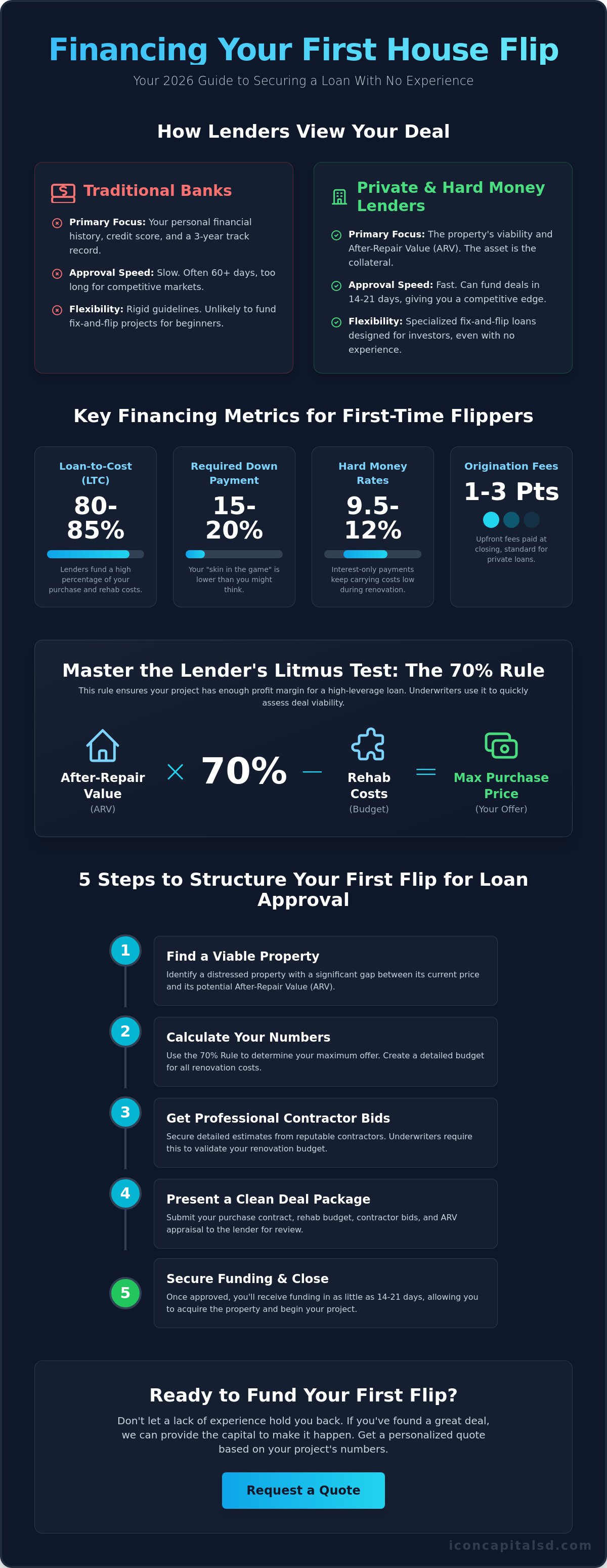
5 Steps to Structure Your First Flip for Loan Approval
Securing financing for house flipping with no experience requires a methodical approach to deal structure. Lenders in 2026 don’t just look at the property; they look at the entire business plan. To move from an application to a funded loan, you must demonstrate that the project is mathematically sound and professionally managed. Start by applying the 70% Rule. This guideline suggests you should pay no more than 70% of the property’s After-Repair Value (ARV) minus the estimated renovation costs. Maintaining this margin provides a buffer for unexpected expenses and ensures the lender’s collateral is protected.
Once you’ve identified a viable property, you must formalize your business structure. Most private lenders require you to close as a legal entity, such as an LLC. This separation of personal and business assets is a standard requirement for commercial investment loans. After forming your entity, compile a comprehensive “Deal Package.” This package should include the purchase contract, a detailed renovation budget, and the appraiser’s ARV report. A well-organized submission signals to the underwriter that you’re a serious investor despite your lack of a personal track record.
Leveraging Your Team’s Experience
As a new investor, you can “borrow” credibility by hiring a General Contractor (GC) with a proven history of successful projects. Lenders are more likely to provide financing for house flipping with no experience if they trust the professionals managing the construction. A line-itemized rehab budget is mandatory. It should detail every cost, from demolition to final finishes. For your first project, focus on properties that require cosmetic updates rather than major structural changes. Lenders view floor plan reconfigurations or foundation repairs as higher-risk ventures for novice flippers. A clean, cosmetic renovation is much easier to fund.
Presenting the Exit Strategy
Your loan approval depends on a clearly documented exit strategy. You must explain how you’ll repay the short-term debt, whether through a traditional sale or a transition into long-term financing. Many investors utilize the “Buy, Rehab, Rent, Refinance” (BRRRR) model. This involves completing the renovation and then refinancing into a DSCR loan to hold the property as a rental asset. You can find more details on these strategies in our report on Fix and Flip Loans: The Ultimate Guide for Real Estate Investors. If you’re ready to move forward, you can structure your loan today to see how these steps impact your approval odds.
Icon Capital LLC: Creative Financing for Your First Flip
Icon Capital LLC provides specialized financing for house flipping with no experience by prioritizing the mechanics of the transaction over the borrower’s resume. We understand that a strong property with a high ARV often outweighs a lack of previous investment history. Our fix-and-flip programs are structured to provide the leverage necessary to secure your first project, often reaching 85% LTC. This focus on the deal’s math allows us to act as a serious financial partner for investors who are ready to scale their portfolios from a single unit to ten or more properties.
Our fast-track underwriting is designed to help you compete with cash buyers in the May 2026 market. Speed is a critical factor when bidding on distressed assets. Icon Capital LLC minimizes the documentation burden by focusing on the property’s viability and your contractor’s track record. This pragmatic approach ensures that your first closing happens on schedule. We provide the capital and the expertise to move your project from an initial quote to a funded loan in a fraction of the time required by traditional institutions.
The Icon Capital LLC Advantage
We offer loan amounts up to $2 million for high-value redevelopment projects. This capacity allows new flippers to target more profitable assets in competitive regions. Self-employed investors benefit from our flexible Non-QM documentation options, including bank statement and P&L-based qualification. You’ll have direct access to decision-makers and underwriters who specialize in creative financing solutions. Our goal is to structure a loan that maximizes your cash on hand while minimizing personal risk.
Get Your Custom Quote Today
Our loan process is structured into four clear steps: structure the loan, submit the documentation, underwrite the asset, and close the deal. You can submit your first deal for a soft-pull review, which allows us to evaluate your project without impacting your credit score. This initial assessment provides the clarity you need to make a confident offer on a property. Icon Capital LLC focuses on the technical aspects of the financing to ensure a smooth transition from purchase to renovation.
Ready to start your first project? Request a Fix & Flip Quote from Icon Capital LLC and get a decision on your deal structure today.
Scale Your Investment Portfolio in 2026
The shift from a personal borrower to a commercial investor represents the final step in your preparation. By treating your first project as a business venture rather than a personal loan, you unlock access to the private capital markets described in this guide. Securing financing for house flipping with no experience is achievable when you lead with data and a qualified team. The 2026 market continues to favor those who can close quickly and provide the necessary liquidity to protect the lender’s position. Use the metrics and team-building strategies discussed to present a deal that underwriters can approve on its own merits.
Icon Capital LLC provides the infrastructure to turn these deal structures into active projects. Our expertise in Non-QM lending and fix-and-flip products ensures that your lack of a resume doesn’t prevent you from acquiring high-value assets. We prioritize the technical feasibility of your renovation plan and the strength of the final exit strategy. Get a custom Fix & Flip loan quote for your first deal and partner with Icon Capital LLC to execute your first closing with confidence. It’s time to move from the research phase to your first funded project.
Frequently Asked Questions
Can I get a fix and flip loan with a 600 credit score?
Yes, you can secure a fix and flip loan with a 600 credit score through private lenders who prioritize the asset’s value. While traditional banks require scores above 700, asset-based lenders focus on the project’s profit margin. In May 2026, many private firms offer financing for house flipping with no experience to borrowers with lower scores, provided the property has a high LTV and a clear, supported ARV.
How much down payment do I need for my first house flip?
You will typically need a down payment of 15% to 20% of the purchase price for your first flip. Lenders require this “skin in the game” to mitigate the risk associated with a lack of track record. While seasoned investors might access 10% down options, novices should budget for higher initial capital to secure an 80% to 85% LTC loan structure that covers the majority of purchase and rehab costs.
Do fix and flip lenders require tax returns?
Most fix and flip lenders do not require personal tax returns for qualification. They utilize bank statement loans or P&L-based underwriting to verify your liquidity and financial strength. This flexibility is essential for self-employed investors or those with complex tax situations. Lenders focus on your 12 to 24 months of deposits to ensure you can carry the monthly interest-only payments throughout the renovation phase.
Is it better to flip a house as an individual or an LLC?
It is standard practice to flip houses as an LLC to satisfy commercial lending requirements. Most private lenders will not fund a fix-and-flip loan to an individual borrower. Closing in an entity name protects your personal assets and streamlines the underwriting process. It also signals to the underwriter that the project is a professional business venture rather than a consumer purchase, allowing for faster approval.
What is the “70% rule” in house flipping?
The 70% rule is a guideline where you pay no more than 70% of the property’s After-Repair Value (ARV) minus the renovation budget. For example, if a house has an ARV of $500,000 and needs $50,000 in work, your maximum purchase price should be $300,000. This margin ensures sufficient profit to cover the 1% to 3% origination points and the 9% to 12% interest costs typical in 2026.
What happens if the rehab costs more than the loan amount?
You must cover any costs that exceed the approved rehab budget from your personal reserves. Lenders typically hold the renovation funds in an escrow account and release them in draws as work is completed. If your contractor’s final bill is higher than the initial estimate, the lender will not increase the loan amount mid-project. Maintaining a 10% cash contingency fund is a standard requirement for 2026 projects.
Can I use a DSCR loan for a fix and flip project?
No, a DSCR loan is not suitable for the active renovation phase of a flip. DSCR loans require the property to be rent-ready and often occupied by a tenant to calculate the debt service coverage ratio. To secure financing for house flipping with no experience, you must use a short-term bridge or fix-and-flip loan. Once the work is done and a lease is signed, you can refinance into a long-term DSCR product.
How long does it take to get a hard money loan funded?
Hard money loans generally fund within 14 to 21 days. This timeline is significantly faster than the 45 to 60 days required by traditional banks. The speed of execution allows you to close on distressed properties or auction deals that require a quick turnaround in the May 2026 market. Efficient lenders can sometimes close in as little as 10 days if the appraisal and title work are submitted immediately.