

Your tax returns are often a poor reflection of your actual purchasing power, especially when heavy deductions mask a seven-figure liquidity profile. You’ve likely experienced the frustration of a traditional lender rejecting a high-balance loan application because your debt-to-income ratio doesn’t account for your $3 million brokerage account. It’s a common hurdle for self-employed professionals and high-net-worth individuals who prioritize asset growth over taxable income.
The asset qualifier mortgage program solves this by treating your liquid wealth as the primary qualifying factor. In a 2026 market where the global asset-based lending sector has surpassed $1 trillion, these Non-QM solutions provide the leverage you need without the friction of traditional underwriting. You’ll learn how to secure loans exceeding $1 million while keeping your investment portfolio intact and avoiding the need for years of employment verification. This guide covers the latest May 2026 interest rate trends, which currently average around 8.25% for no-employment products, and details the specific liquidity seasoning required to turn your idle capital into immediate real estate purchasing power.
Key Takeaways
- Understand how the asset qualifier mortgage program replaces traditional DTI requirements by verifying total liquid net worth instead of tax returns.
- Learn the “asset depletion” formulas used to convert brokerage, savings, and retirement accounts into qualifying monthly income for loan approval.
- Identify current 2026 benchmarks for eligibility, including the 700+ FICO floor and 70-75% LTV limits for primary residences.
- Compare asset-based qualification against bank statement and DSCR programs to choose the most efficient leverage strategy for your portfolio.
- Review Icon Capital’s four-step framework for structuring and closing high-balance Non-QM loans with speed and precision.
What is an Asset Qualifier Mortgage Program?
An asset qualifier mortgage program is a specialized Non-QM loan product where eligibility is determined by your total liquid net worth rather than traditional income or employment history. Standard lending models rely on the “Ability to Repay” (ATR) framework, which typically focuses on monthly cash flow documented through W-2s or pay stubs. This program shifts that focus toward “Ability to Pay” through total liquidity. As of May 2026, the global asset-based lending market has surpassed $1 trillion, reflecting a broader institutional acceptance of wealth-based qualification over paper-based income.
For high-net-worth individuals, this product serves as a premier financing tool. It bypasses the friction of debt-to-income (DTI) constraints that often penalize those with complex financial structures. By using an asset qualifier mortgage program, you eliminate the requirement to provide years of tax returns or detailed profit and loss statements. The process is transactional and efficient; the lender verifies that your seasoned liquid assets are sufficient to cover the loan amount, reserves, and life of the loan according to a specific depletion formula.
Who Benefits Most from Asset-Based Qualification?
This program is specifically engineered for borrowers whose wealth isn’t reflected in a monthly paycheck. Retirees often find this ideal when they possess significant 401(k) or IRA balances but show low social security income. Similarly, self-employed entrepreneurs who utilize aggressive tax deductions to minimize taxable liability can leverage their business liquidity without adjusting their tax strategies. We also see success with recently divorced individuals who have secured substantial cash settlements but may have a temporary gap in their employment history. If you fall into these categories, you can request a quote to see how your specific asset pool scales your borrowing power.
Asset Qualifier vs. Traditional Mortgages
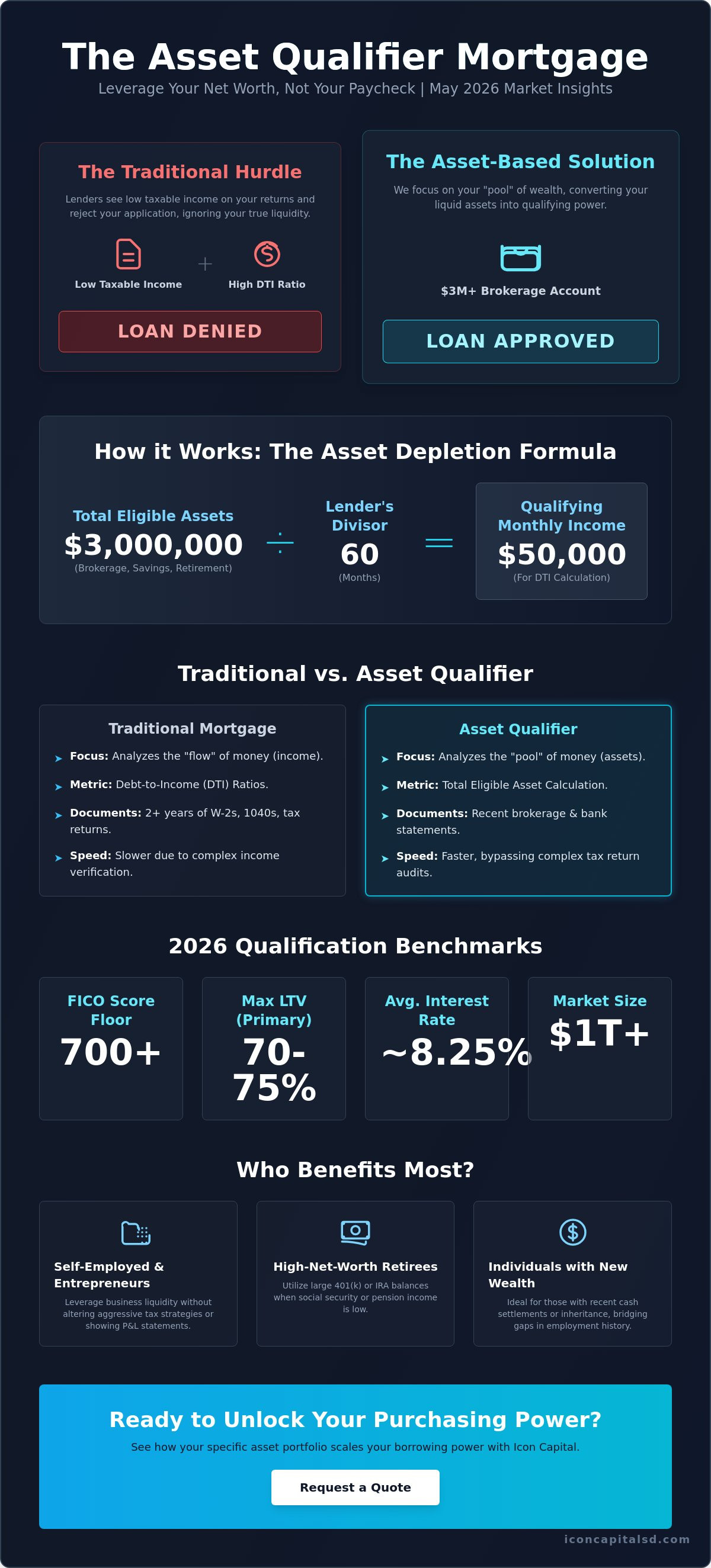
The primary difference lies in the focus: traditional mortgages analyze the “flow” of money, while asset-based lending analyzes the “pool” of money. Traditional underwriting requires a deep dive into two years of tax returns to find a consistent income trend. In contrast, an asset qualifier loan typically only requires six months of account statements to verify the stability and seasoning of your wealth.
- Documentation: Traditional loans require W-2s and 1040s; Asset Qualifier requires brokerage and bank statements.
- Qualification Metric: Traditional uses DTI ratios; Asset Qualifier uses total eligible asset calculations.
- Speed: Asset-based underwriting is often faster because it avoids the manual audit of complex business tax returns.
Under current May 2026 regulations, the CFPB has increased the asset threshold for certain creditors to $2.785 billion. This regulatory environment supports the continued expansion of Non-QM products, allowing lenders to offer more flexible terms to borrowers who maintain high levels of liquidity but don’t fit the standard income box.
The Mechanics of Asset Utilization: How Lenders Calculate Qualifying Income
Asset Utilization is the conversion of net worth into a monthly income stream for underwriting purposes. Underwriting for an asset qualifier mortgage program relies on a specific mathematical projection known as asset depletion. Lenders don’t require you to liquidate your holdings to close the deal. Instead, they calculate how much income your portfolio could theoretically generate over a set period. This process allows the underwriter to establish a debt-to-income (DTI) equivalent without looking at a single pay stub.
The math is straightforward: Total Eligible Assets / [X] Months = Qualifying Monthly Income. For example, if you have $3,000,000 in eligible assets and the lender uses a 60-month divisor, your qualifying monthly income is $50,000. This figure is then compared against your proposed mortgage payment and existing liabilities. This approach deviates from the standard “Ability to Repay” rules set for traditional loans. While the Consumer Financial Protection Bureau provides strict guidelines for what constitutes a “Qualified Mortgage,” Non-QM products like this one offer the flexibility needed for high-liquidity borrowers who don’t have traditional W-2 earnings. If you’re unsure how your portfolio translates to a specific loan amount, you can request a quote to see your qualifying figures.
The 60-Month Standard and Beyond
The 60-month divisor is the current May 2026 industry benchmark for asset-to-income conversion. It provides a conservative window that satisfies risk departments while maximizing your borrowing power. Some programs offer 84-month or 120-month divisors, which result in a lower qualifying monthly income but may be used to accommodate different risk tiers. Your total recurring monthly debt, such as car payments or existing property taxes, is subtracted from this calculated income to determine your final eligibility. A higher divisor naturally reduces your maximum loan amount, so selecting the right program structure is critical for high-balance acquisitions.
Asset Haircuts: What Your Wealth is Actually Worth to Lenders
Lenders don’t value all asset classes equally. Market volatility necessitates a “haircut” to protect the lender against price fluctuations during the life of the loan.
- Cash and Savings: These are the gold standard and are usually valued at 100% of the statement balance.
- Marketable Securities: Stocks, bonds, and mutual funds typically receive a 70% to 80% valuation. If you hold $1,000,000 in a brokerage account, the lender may only count $700,000 toward your qualification.
- Retirement Accounts: For 401(k)s and IRAs, lenders often apply a 60% to 70% haircut if you’re under age 59.5 to account for potential tax liabilities and early withdrawal penalties. For those over 59.5, the valuation often increases to 80%.
Core Requirements for Asset-Based Mortgage Qualification in 2026
Securing approval within an asset qualifier mortgage program requires meeting specific institutional benchmarks designed to mitigate the risk of non-traditional qualification. Because lenders are not verifying monthly cash flow, they rely heavily on credit history and the depth of your liquidity pool. Most programs in May 2026 set a 700 to 720 FICO score as the absolute floor. This high credit requirement ensures that while your income documentation is alternative, your debt repayment history is impeccable.
Loan-to-value (LTV) limits are tighter than conventional products. You should expect a maximum LTV of 70% to 75% for primary residences. This means a minimum down payment of 25% to 30% is standard. For investment properties or second homes, LTVs may drop further to 65%. These equity requirements protect the lender against market volatility, especially as Federal Bank Regulators recently proposed a lower risk weight floor of 15% for certain securitization exposures in March 2026.
A defining 2026 requirement is the $500,000 post-closing liquidity threshold. Lenders require you to maintain this minimum balance in your accounts after the deal closes. Seasoning is the final hurdle; every dollar used for qualification must be sourced and seasoned for at least six months. Underwriters will audit statement histories to ensure that assets haven’t been recently transferred or “gifted” to artificially inflate your profile. If your portfolio meets these seasoning standards, you can request a quote to lock in current rates.
Eligible Asset Types for Qualification
Not every asset is treated equally in the underwriting process. Lenders prioritize high-liquidity accounts that can be easily accessed if needed. Checking, savings, and money market accounts are valued at 100% of their balance. Publicly traded stocks, bonds, and mutual funds are also eligible, though they face the “haircuts” discussed in previous sections. Vested retirement funds, including 401(k)s, IRAs, and SEP-IRAs, are acceptable provided the terms of the account allow for withdrawals, regardless of your current age.
Property Types and Loan Limits
The program supports a wide range of residential real estate. This includes standard single-family homes, primary residences, and vacation properties. It is also a viable solution for non-warrantable condos and high-rise developments that often fail traditional agency guidelines. Loan amounts are designed for the jumbo market, scaling from a $150,000 minimum up to $4 million. This high ceiling makes it the preferred tool for acquiring luxury real estate without the burden of disclosing complex business tax returns.
Asset Qualifier vs. Bank Statement vs. DSCR: Choosing the Right Strategy
Selecting the right Non-QM product depends on how you choose to demonstrate your financial strength. An Asset Qualifier Home Loan is the optimal choice for borrowers with significant liquid net worth but minimal current cash flow. This approach differs from Bank Statement Loans, which serve active business owners with high monthly revenue who prefer to use 12 to 24 months of deposits to verify income. If the property is strictly an investment, DSCR Loans are more efficient because they qualify the transaction based on the property’s rental income rather than your personal finances.
The asset qualifier mortgage program offers a distinct advantage by prioritizing existing wealth over active earnings. This allows for strategic layering. You can sometimes combine asset utilization with other verified income streams to reach higher loan amounts or offset higher debt ratios. This flexibility is a primary reason why Non-QM market share grew to 9% of all mortgage activity by the end of 2025. It enables high-net-worth borrowers to scale their real estate portfolios without the friction of traditional underwriting.
The Cost of Convenience: Rates and Fees
As of May 2026, average 30-year fixed mortgage rates for conventional loans range between 6.37% and 6.56%. Asset Qualifier rates are naturally higher, with “no employment” products currently listing around 8.25%. This yield spread represents the cost of bypassing traditional documentation and DTI constraints. Your LTV remains the biggest factor in pricing. A 60% LTV often secures more favorable interest rates than a 75% LTV. For many borrowers, this premium is a small price for the ability to close high-balance deals without tax return scrutiny.
Case Study: The Retired Executive
Consider a retired executive with $2,000,000 in liquid assets and $2,000 in monthly Social Security income seeking a $1,000,000 home. A traditional lender would reject the application due to the low income. The executive could pay cash, but that creates a massive opportunity cost and drains liquidity. By using the asset qualifier solution, the borrower secures the $1,000,000 mortgage while keeping their $2,000,000 portfolio fully invested. Financing allows the portfolio to continue its growth trajectory, which often outpaces the mortgage interest rate and provides superior long-term ROI. If you need to determine which strategy fits your portfolio, request a quote to compare product terms.
Securing Your Asset Qualifier Loan with Icon Capital LLC
Icon Capital LLC specializes in structuring complex deals that traditional retail banks often decline. While a standard lender might struggle to interpret a sophisticated investment portfolio or a multi-tiered trust, our underwriting team focuses on the technical mechanics of your wealth. The asset qualifier mortgage program is a primary tool for this purpose. We prioritize speed and technical accuracy to ensure you don’t lose a property in 2026’s competitive landscape. We treat liquidity as the ultimate credit, moving beyond the rigid boundaries of conventional underwriting to empower high-net-worth borrowers.
For international investors, we provide a seamless bridge through Foreign National Loans. This is particularly effective for clients who maintain US-based liquid assets but lack a US-based income history. Icon Capital LLC understands that in May 2026, liquidity is the ultimate credit. We treat it as such by bypassing the manual audit of complex business tax returns that slows down traditional institutions.
The 4-Step Submission Process
We’ve simplified the loan lifecycle into a methodical, four-step framework designed for efficiency:
- Initial Consultation: We analyze your specific asset mix to determine the most efficient qualification path and structure the loan.
- Asset Verification: You securely upload account statements for an immediate review of seasoning and liquidity thresholds.
- Conditional Approval: Our underwriters issue a green light based on asset depletion formulas rather than tax return scrutiny.
- Closing: We fund the transaction with precision and confidence, ensuring you meet tight escrow deadlines.
Take the Next Step in Your Investment Journey
Icon Capital LLC operates with a no-nonsense, results-driven culture. We don’t waste time with unnecessary narrative; we focus on the data that gets your loan closed. If you have the liquidity and need the leverage, our specialists are ready to structure your deal. The 2026 real estate market rewards those who can move quickly with certain financing. Don’t let traditional DTI constraints limit your acquisition strategy. Request a personalized mortgage quote today to speak with a specialist and secure your next high-balance property.
Leverage Your Liquidity for Immediate Real Estate Growth
The mortgage market in 2026 has shifted to recognize that liquidity is a primary indicator of creditworthiness for high-net-worth individuals. By utilizing the asset qualifier mortgage program, you effectively convert your net worth into a qualifying income stream without the friction of traditional debt-to-income limits. This strategy allows you to acquire luxury real estate while keeping your long-term investment portfolios fully intact and seasoned. You’ve seen how asset depletion formulas and specific liquidity thresholds provide a streamlined path to ownership that big banks simply cannot match.
Icon Capital LLC stands as a specialist in Non-QM and creative financing, focusing on the technical mechanics of the deal above all else. We provide access to high-balance loans up to $4 million with no tax returns or W-2s required, ensuring your financial privacy and portfolio growth remain uncompromised. Our results-driven approach streamlines the path from initial asset verification to a successful closing with total precision. Request a Free Mortgage Quote from Icon Capital LLC today to secure your next acquisition with confidence. Your wealth is your qualification; let’s put it to work.
Frequently Asked Questions
Do I need a job to qualify for an asset qualifier mortgage?
No, you don’t need a job or verifiable income to qualify for this loan. The asset qualifier mortgage program is designed specifically for borrowers who lack traditional W-2 earnings but possess significant liquid net worth. Underwriters verify your ability to repay by analyzing your total eligible asset pool rather than your monthly paycheck or employment history. This makes it a premier solution for retirees and entrepreneurs.
What is the minimum credit score for an asset-based loan?
A minimum FICO score of 700 to 720 is the standard requirement as of May 2026. Because the lender is bypassing traditional income documentation, they require a strong credit profile to mitigate risk. This ensures that the borrower has a proven history of managing debt responsibly, even when qualifying through alternative methods. Lower scores generally won’t meet the high-leverage thresholds for this specific product.
Do I have to liquidate or spend my assets to get the loan?
You aren’t required to liquidate or spend your assets to secure the loan. Lenders use a theoretical “asset depletion” calculation to determine your qualifying income stream. Your portfolio remains fully invested in your brokerage or bank accounts and continues its growth trajectory. This allows you to maintain your investment strategy while leveraging your wealth for a high-balance real estate acquisition without losing market exposure.
Can I use retirement funds like a 401(k) or IRA to qualify?
Vested retirement accounts like 401(k)s and IRAs are fully eligible for qualification purposes. Lenders typically apply a 60% to 70% valuation haircut to these accounts if you’re under age 59.5 to account for potential tax liabilities and early withdrawal penalties. For those over 59.5, the valuation often increases to 80% of the total account balance, providing even greater borrowing leverage for the applicant.
What is the maximum loan amount for the asset qualifier program?
The maximum loan amount for this program scales up to $4 million for qualified borrowers. This high limit accommodates the needs of high-net-worth individuals seeking luxury primary residences or high-value second homes. The minimum loan amount typically starts around $150,000, making it a versatile tool for various jumbo-level financing needs across the United States in the current 2026 real estate market.
Are investment properties eligible for asset-based financing?
Investment properties are eligible for asset-based financing, alongside primary residences and second homes. While primary residences often allow for up to 75% LTV, investment properties may require a larger down payment, often capping LTV at 65%. This program is also compatible with non-warrantable condos and high-rise developments that big banks often reject due to complex structural or financial profiles that don’t meet agency standards.
How long do my assets need to be ‘seasoned’ in my account?
Assets must be seasoned in your account for a minimum of six months before you apply. Underwriters review 180 days of statement history to ensure the funds are stable and properly sourced. This requirement prevents “short-term seasoning” or recently gifted funds from being used to artificially inflate your qualifying liquidity pool. All assets must be verified as your own through documented and seasoned account statements.
What is the difference between asset depletion and asset qualification?
Asset depletion refers to the mathematical formula used to calculate monthly income, while asset qualification is the overarching loan program. In an asset qualifier mortgage program, the depletion formula is the primary underwriting tool used to establish your debt-to-income equivalent. Both terms describe the shift from income-based qualification to a model that values total liquid net worth over monthly cash flow documentation.