

The common assumption that non-permanent residents are locked out of the U.S. housing market is factually incorrect. While the May 25, 2025, policy change officially removed FHA loan eligibility for non-permanent residents, it didn’t eliminate your path to a mortgage for non us citizen with work visa. You’re likely tired of facing rigid two year U.S. work history demands or being told that your self-employed income doesn’t qualify. We understand that high-earning professionals on H-1B, L-1, or O-1 visas often possess the assets but lack the specific documentation traditional underwriters require.
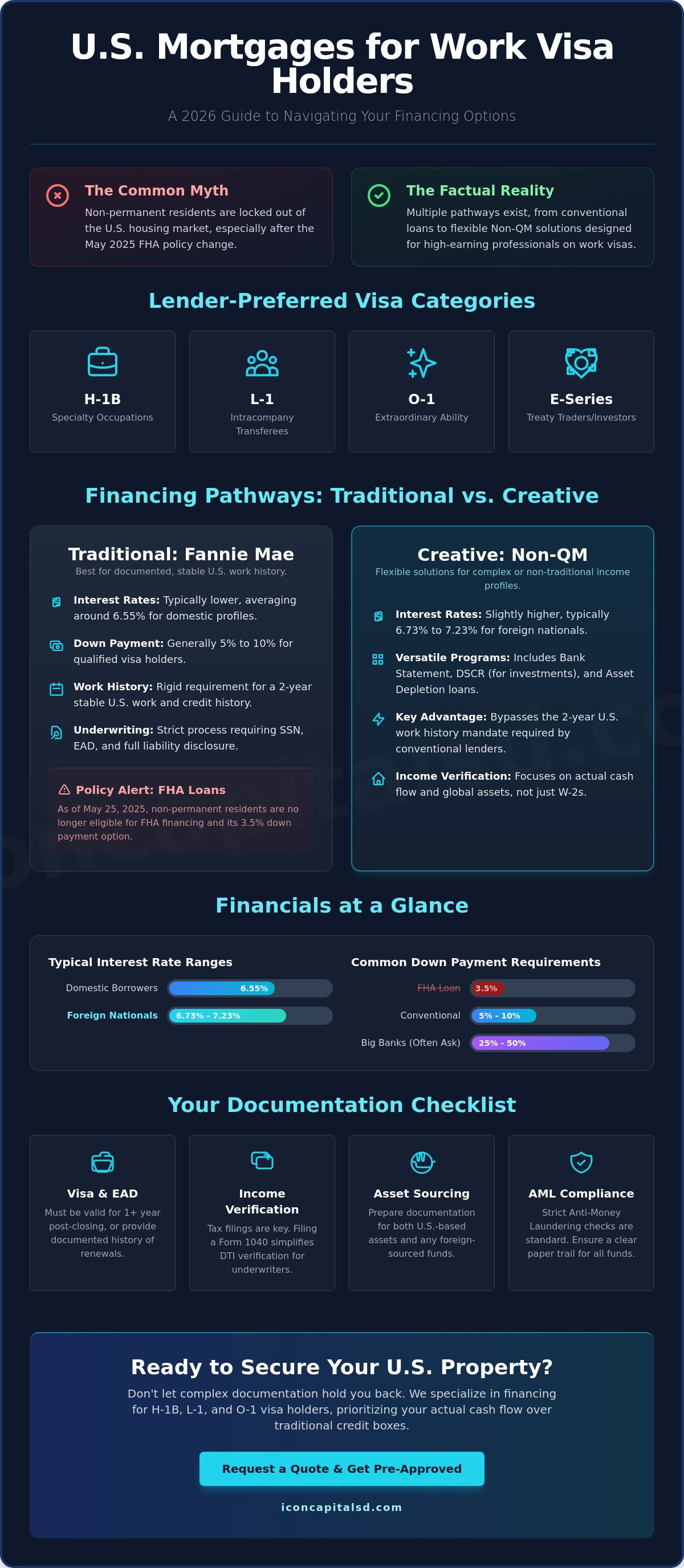
This guide delivers a pragmatic breakdown of your 2026 financing options, from Fannie Mae conventional loans to creative Non-QM solutions like Bank Statement and DSCR programs. You’ll learn how to navigate current interest rates, which average 6.55% for domestic borrowers but typically range from 6.73% to 7.23% for foreign nationals. We’ll outline how to secure competitive leverage even if you can’t meet the 25% to 50% down payment often expected by big banks. This roadmap identifies lenders who prioritize your actual cash flow over traditional credit boxes, ensuring you have the data needed to close your deal efficiently.
Key Takeaways
- Identify the legal frameworks and specific visa types that permit a mortgage for non us citizen with work visa under current 2026 lending guidelines.
- Compare conventional Fannie Mae requirements against creative Non-QM products to determine which program offers the best LTV for your financial profile.
- Master the documentation requirements for income verification, including strategies for handling foreign-sourced assets and non-traditional bonus structures.
- Navigate the specialized pre-approval process and ensure strict compliance with Anti-Money Laundering (AML) regulations to avoid closing delays.
- Leverage financing solutions specifically engineered for H-1B, L-1, and O-1 visa holders to bypass restrictive two-year U.S. work history mandates.
Qualifying for a US Mortgage on a Work Visa in 2026
A non-permanent resident alien is defined as a non-U.S. citizen who resides in the United States under a valid, temporary work visa. Under the Fair Housing Act, these individuals possess the legal right to purchase and own real property regardless of their citizenship status. In 2026, securing a mortgage for non us citizen with work visa depends heavily on verified income stability and U.S.-based asset accumulation. Since the May 25, 2025, policy shift that removed FHA eligibility for non-permanent residents, the market now prioritizes conventional and Non-QM products that reward high-earning professionals with strong U.S. credit profiles.
Underwriters use the Continuity of Residency rule to determine if a borrower is likely to remain in the country long enough to service the debt. Most conventional lenders require your visa to remain valid for at least one year after the scheduled closing date. If your visa expires in less than 12 months, you must provide a documented history of renewals or a formal letter from your employer confirming their intent to sponsor your next extension. While a Foreign National Mortgage loan is designed for those living abroad, visa holders residing in the U.S. qualify for programs with much higher leverage and lower down payments. If you’re unsure where your status places you, request a quote to get a clear assessment of your borrowing power.
Eligible Visa Types for Standard and Non-QM Loans
Lenders categorize visas by their renewal probability. High-priority categories like H-1B (Specialty Occupations) and L-1 (Intracompany Transferees) are viewed favorably because they have clear paths to permanent residency. Specialized categories like O-1 (Extraordinary Ability) and E-series (Treaty Traders) also qualify, provided the borrower can show a 24 month history of stable U.S. earnings. To prove renewal probability, underwriters often require a copy of your I-797 approval notice and a current Employment Authorization Document (EAD).
The Impact of Residency Status on Loan Eligibility
There’s a significant difference between being a Permanent Resident (Green Card holder) and a Non-Permanent Resident. Green Card holders are treated identically to U.S. citizens regarding LTV limits and interest rates. Non-permanent residents face stricter scrutiny regarding their tax filing status. If you file a Form 1040, you’re considered a resident for tax purposes, which simplifies the verification of your debt-to-income ratio. Filing a 1040-NR (Non-Resident) can trigger additional documentation requirements for traditional loans, though Non-QM programs often provide a workaround for these technical hurdles.
Evaluating Loan Programs: Traditional vs. Creative Financing
Selecting a mortgage for non us citizen with work visa requires balancing interest rate advantages against documentation flexibility. While traditional lenders focus on standardized W-2 income, creative financing products allow you to leverage your actual cash flow or global assets to secure U.S. real estate. The right choice depends on your specific visa type, your length of residency, and whether you’re purchasing a primary residence or an investment property.
Traditional Mortgage Options for Visa Holders
Fannie Mae and Freddie Mac provide the most cost-effective path for non-permanent residents who can document a stable two year U.S. work history. These conventional programs require a valid Social Security number and an Employment Authorization Document (EAD) with at least 12 months of validity remaining. If your EAD expires sooner, you’ll need documented evidence of a prior renewal to satisfy the continuity of residency requirement. While conventional rates currently average 6.55%, the underwriting process is rigid and requires full disclosure of all domestic and international liabilities.
A major shift occurred on May 25, 2025, when non-permanent residents became ineligible for FHA loans. Previously, FHA was a popular route for visa holders due to the 3.5% down payment requirement. Now, visa holders must typically provide a 5% to 10% down payment for conventional loans or explore Non-QM options. This regulatory change has made conventional financing the primary traditional route, though it remains difficult for those with complex income structures or significant foreign assets.
Non-QM and Creative Solutions for Non-Citizens
Non-QM products offer a superior alternative for visa holders who don’t fit the standard employee box. If you’re a consultant on an H-1B or a business owner on an E-2 visa, Bank Statement loans allow you to qualify using 12 or 24 months of business deposits rather than tax returns. This eliminates the qualification hurdles caused by high business expense write-offs that often lower your reported net income on tax filings.
For those building a U.S. real estate portfolio, Debt Service Coverage Ratio (DSCR) loans are the most efficient tool. These programs qualify the borrower based on the potential rental income of the property rather than personal U.S. income or employment history. This is a strategic move for visa holders who possess significant global wealth but limited U.S. tax history. Asset Qualification programs also allow you to use liquid global assets to secure a loan without traditional income verification. These creative programs provide the speed and leverage necessary to compete in a tight market. If you need to evaluate which program fits your specific visa status and income structure, request a quote to see current market terms for your profile.
Financial Requirements: Credit, Income, and Down Payments
Securing a mortgage for non us citizen with work visa requires navigating strict capital seasoning rules and credit benchmarks that differ from domestic standards. While a U.S. citizen might access 3.5% or 5% down payment programs, visa holders typically face 10% to 20% requirements for primary residences. This higher threshold offsets the perceived risk of visa non-renewal. Lenders also enforce a 60 day seasoning rule for all international wire transfers. Any funds used for the down payment or closing costs must sit in a U.S. bank account for at least two full statement cycles to comply with Anti-Money Laundering (AML) regulations and Fannie Mae requirements.
High-net-worth individuals on O-1 or L-1 visas often present complex income profiles involving foreign-sourced dividends or performance-based bonuses. Traditional underwriters frequently struggle to calculate “effective income” from these sources. If your income includes significant bonuses, you must document a two year history of receiving these payments in the same field. Non-QM programs provide a pragmatic alternative here, allowing for the inclusion of international assets and 1099 income that traditional banks might exclude. For those with significant liquid wealth, Asset Qualification loans can bypass employment verification entirely by using your global portfolio to prove repayment ability.
Building a US Credit Profile from Scratch
New arrivals often lack the three active tradelines required by traditional banks. To bridge this gap, specialized lenders utilize Nova Credit to pull international credit histories from your home country, translating them into a U.S. equivalent score. If you’re building credit from scratch, opening a secured credit card or being added as an authorized user on a domestic account can establish a profile within six months. Non-QM lenders are often more flexible with “thin” credit files, prioritizing your debt-to-income (DTI) ratio and cash reserves over a long-term FICO history.
Down Payment Tiers by Visa and Loan Type
LTV limits are strictly tiered based on property use and visa status. For a primary residence, H-1B and L-1 holders can often secure 80% to 90% LTV. Investment properties typically cap at 75% LTV, requiring a 25% down payment. Gift funds are generally acceptable for primary residences if they come from an immediate family member, but they must be fully documented with a gift letter and proof of transfer. Most programs also require 6 to 12 months of PITI (Principal, Interest, Taxes, and Insurance) reserves to stay in a liquid U.S. account post-closing.
Navigating the Mortgage Process for Non-US Citizens
The path to a mortgage for non us citizen with work visa requires a structured approach that accounts for federal compliance and visa-specific underwriting. The timeline often mirrors a standard 30-day close, but the documentation phase is more intensive than a domestic transaction. Every step, from the initial pre-approval to the final signature, focuses on verifying your legal right to remain in the U.S. and the stability of your domestic income. You’ll need to coordinate closely with your employer and your lender to ensure all visa-related deadlines align with your purchase contract.
Step 1 is a specialized pre-approval that goes beyond a simple credit check. Underwriters analyze your I-797 approval notice and the specific visa code, such as H-1B or L-1, to determine your risk profile. They verify your EAD expiration dates immediately to ensure they align with the one-year validity rule required for conventional products. Step 2 focuses on property selection and Anti-Money Laundering (AML) compliance. Lenders trace the origin of your down payment funds to ensure they haven’t been moved through restricted accounts. Step 3 is the underwriting deep dive into income stability. Underwriters evaluate the “three-year rule,” which assumes your income will continue for at least 36 months post-closing. Step 4 covers the appraisal and final document review, while Step 5 addresses the closing logistics. If you’re traveling during the close, you must coordinate with a mobile notary or a U.S. embassy for international signatories.
Essential Documentation Checklist for Visa Holders
Underwriters require a complete digital file of your legal status and financial history. You must provide a valid passport, your current visa stamp, and the I-94 Arrival/Departure record. If your work authorization depends on a specific permit, include your Employment Authorization Document (EAD). Standard income verification requires two years of W-2s or 1099s. Business owners or consultants on E-series visas can utilize P&L Home Loans to bypass the need for extensive personal tax returns.
Closing and Tax Considerations
While an SSN is the standard for credit reporting, certain Non-QM programs accept an Individual Taxpayer Identification Number (ITIN) for those without social security eligibility. You should also understand the Foreign Investment in Real Property Tax Act (FIRPTA). While FIRPTA primarily impacts the sale of a property by a foreign person, it influences how you should structure your initial purchase for future tax efficiency. To determine which documentation set fits your specific profile for a mortgage for non us citizen with work visa, Request a Quote to speak with a specialist who understands the mechanics of visa-based financing.
Why Icon Capital LLC Specializes in Visa-Based Financing
Icon Capital LLC operates as a specialist in the niche of creative financing. While traditional institutions often struggle with the complexity of non-permanent residency, our team structures and closes deals that retail banks decline. We prioritize your actual financial strength over rigid citizenship boxes. Our expertise in Non-QM products allows us to accommodate non-U.S. credit and income structures that don’t fit the standard Fannie Mae mold. This is critical in the May 2026 market, where specialized expertise is necessary to navigate the removal of government-backed options for non-permanent residents.
We have a deep understanding of the H-1B, L-1, and O-1 visa nuances. This allows for streamlined processing that accounts for your specific employment authorization timelines and renewal probability. Our proven track record with Foreign National Loans demonstrates our ability to manage international documentation and capital flows efficiently. Securing a mortgage for non us citizen with work visa requires a partner like Icon Capital LLC, who understands the mechanics of the deal, not just the basic requirements.
The Icon Advantage: Creative Financing for Investors
Visa holders are often active real estate investors looking to build domestic wealth. We facilitate portfolio growth by leveraging DSCR Loans, which qualify the property based on cash flow rather than your personal U.S. tax returns. This is an ideal solution for those with high global assets but limited domestic employment history. Our underwriters have direct access to your file, allowing for rapid decisions on no-income-verification options and asset-based qualification. We offer loan amounts up to $3 million for specialized foreign national programs, providing the scale necessary for high-value markets.
Closing Your Loan with Confidence
Speed is a requirement in competitive U.S. real estate markets. Our methodical four-step process is designed to move your mortgage for non us citizen with work visa to the finish line without unnecessary narrative. We provide flexible LTVs that reflect the current 2026 lending environment, where rates for foreign nationals typically sit 0.50% to 0.75% above the 6.55% national average. This ensures you remain competitive while maintaining the leverage needed to scale your assets.
Our focus remains on tangible outcomes and efficient deal structuring. Icon Capital LLC provides the expertise needed to navigate the complexities of non-traditional lending while ensuring full compliance with AML and residency regulations. If you’re ready to explore your financing options, contact our specialists for a personalized leverage analysis. Please give us a call or request a quote to discuss your specific loan structure.
Secure Your U.S. Real Estate Assets in 2026
Homeownership for visa holders remains a viable financial strategy despite the May 2025 regulatory shifts that impacted government-backed lending. You now have the data to navigate the 60 day seasoning requirements for international funds and the specific LTV limits associated with your visa class. Whether you’re leveraging an L-1, H-1B, or O-1 visa; the focus is on matching your unique income structure to the right debt product. Traditional banks often decline complex files; but specialized Non-QM and Foreign National programs provide the necessary flexibility for high-net-worth international clients. Understanding the mechanics of a mortgage for non us citizen with work visa ensures you can scale your portfolio or secure a primary residence with total confidence.
Icon Capital LLC acts as a pragmatic facilitator for these complex deals, providing direct access to underwriters who understand international financial nuances. We specialize in funding the transactions that retail lenders won’t touch. Request a custom mortgage quote for your visa-based loan today to begin structuring your deal with an expert partner. Your path to U.S. property ownership is open and attainable.
Frequently Asked Questions
Can I get a mortgage in the US if I am on an H-1B visa?
Yes, H-1B visa holders qualify for various U.S. financing options including conventional and Non-QM loans. You must provide a valid Social Security number and an Employment Authorization Document (EAD) to satisfy federal requirements. Lenders prioritize your income stability and the likelihood of your visa renewal over your citizenship status.
What is the minimum down payment for a non-US citizen with a work visa?
Minimum down payments typically range from 5% to 10% for primary residences under conventional guidelines. Since non-permanent residents lost FHA eligibility on May 25, 2025, the 3.5% down option is no longer available. For investment properties or specialized foreign national programs, down payment requirements often increase to between 25% and 50%.
Does my visa need to be valid for at least two more years to get a loan?
No, your visa generally only needs at least one year of validity remaining at the time of closing. If your current status expires in less than 12 months, underwriters require a documented history of renewals or a formal letter from your employer. This evidence proves your continuity of residency and satisfies the lender’s risk assessment protocols.
Can I use a DSCR loan if I am not a US citizen?
Yes, non-citizens frequently utilize DSCR loans to acquire investment properties without personal income verification. These programs qualify the borrower based on the property’s potential rental income rather than U.S. tax returns. It’s a pragmatic solution for visa holders who have significant global assets but limited domestic employment history.
Do I need a US credit score to buy a home on a work visa?
You don’t always need a U.S. credit score to secure a mortgage for non us citizen with work visa. While traditional banks rely on FICO scores, specialized lenders can utilize international credit reports to prove creditworthiness. This allows you to leverage your home country’s financial history if you haven’t yet established three active domestic tradelines.
What happens to my mortgage if my work visa is not renewed?
Your mortgage remains a valid legal contract even if your visa is not renewed and you must leave the country. You are still responsible for the monthly payments and can manage the property as a rental from abroad. Alternatively, you can sell the property to satisfy the debt, provided the loan remains in good standing during the process.
Can I buy an investment property on a work visa?
Yes, work visa holders can purchase investment properties using conventional financing or creative Non-QM products. These transactions usually require a 20% to 25% down payment and higher cash reserves than a primary residence. You can also utilize Asset Qualification programs to use your global portfolio as the primary source for loan approval.
Are mortgage rates higher for non-US citizens?
Yes, rates for non-citizens are typically 0.50% to 0.75% higher than standard domestic rates. As of May 2026, while the average U.S. mortgage rate is 6.55%, visa holders should expect rates between 6.73% and 7.23%. These premiums reflect the additional underwriting complexity and risk associated with a mortgage for non us citizen with work visa.