

In a competitive market where traditional 30-year mortgage rates hover in the mid-6% range, paying 10% or 12% for capital sounds counterintuitive. However, for the professional investor, speed is often more valuable than a low interest rate. Knowing exactly when to use a bridge loan for real estate is the difference between securing a high-value asset and losing it to a cash buyer while your bank stalls on paperwork. You understand the frustration of having capital locked in equity while a time-sensitive deal sits on the market. This guide provides the tactical roadmap you need to use short-term leverage as a competitive advantage. You will discover how to navigate the 2026 SOFR-based lending environment, utilize LTVs up to 75%, and bridge the gap between acquisition and permanent financing. We’ll break down the specific scenarios where these 12 to 18 month solutions allow you to scale your portfolio without the delays of traditional underwriting. From acquiring distressed assets to managing the new $2.785 billion CFPB escrow thresholds, this is how you maintain liquidity in 2026.
Key Takeaways
- Leverage short-term capital to provide immediate liquidity and bridge the gap between property acquisition and long-term exit strategies.
- Identify five specific tactical scenarios for when to use a bridge loan for real estate to secure high-value deals in competitive 2026 markets.
- Analyze the current mechanics of bridge financing, including interest-only payment structures and typical LTV ranges for residential and commercial assets.
- Compare bridge loans against traditional financing alternatives to determine the most efficient leverage tool for your specific deal timeline.
- Learn how specialist Non-QM lenders structure complex loans for self-employed investors who require speed over traditional bank documentation.
Defining the Bridge Loan: A Tactical Tool for Real Estate Transitions
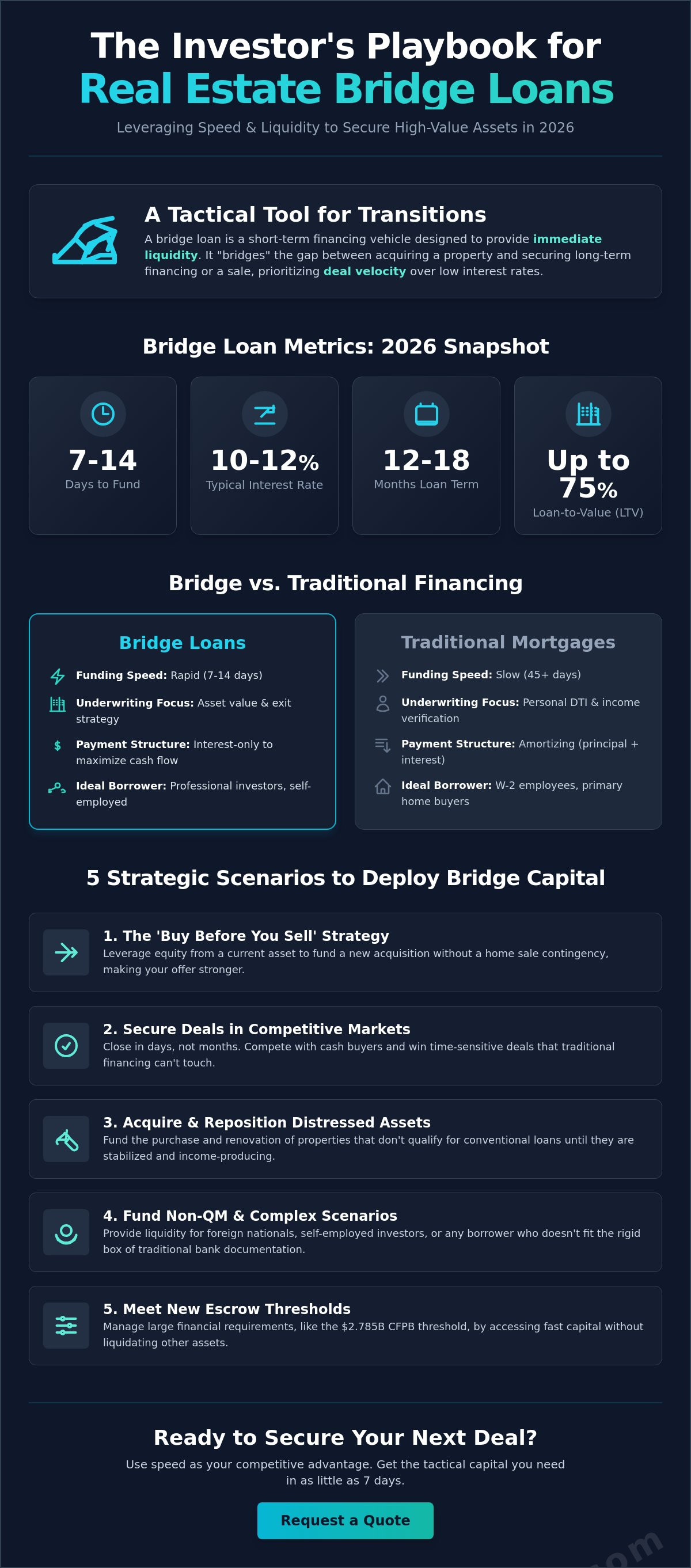
A bridge loan is a specialized, short-term financing vehicle designed to provide immediate liquidity for real estate transitions. While retail lenders focus on 30-year amortizations, bridge debt typically spans 6 to 24 months. It’s a tactical swing loan, bridging the gap between an initial property acquisition and a long-term exit strategy, such as a sale or a permanent refinance. Understanding when to use a bridge loan for real estate is essential for investors who prioritize deal velocity over the lowest possible interest rate. This capital allows you to move on high-value assets without waiting for the 45-day underwriting cycles common in traditional banking. Unlike conventional mortgages, bridge debt prioritizes the asset’s value and the viability of the project over the borrower’s personal debt-to-income (DTI) ratio.
In the commercial and investment sectors, this is often called gap financing. It provides the necessary capital to secure a deal while more permanent, lower-cost financing is arranged. In May 2026, bridge loan interest rates for investment properties generally range between 10% and 12%, with origination fees typically falling between 1.5% and 3%. While these costs are higher than standard 30-year fixed rates, the value lies in the speed of execution and the ability to close on distressed or time-sensitive opportunities that traditional lenders won’t touch. Knowing exactly when to use a bridge loan for real estate can help you capture equity that would otherwise be lost to slower competitors.
How Bridge Loans Differ from Traditional Mortgages
Traditional mortgages rely on the borrower’s personal income and extensive tax documentation. Bridge financing shifts the focus to the collateral. Funding can occur in as little as 7 to 14 days, compared to the months required by conventional institutions. Most bridge products utilize an interest-only structure. This maximizes monthly cash flow during the transition period, which is critical for projects involving renovations or stabilization. Underwriters look primarily at the exit strategy, the specific plan for how the loan will be repaid, rather than standard income verification. With the SOFR benchmark now the standard for U.S. lending, these products offer a transparent and flexible alternative for investors who don’t fit the standard conventional boxes.
The Role of Hard Money in Bridge Financing
There is significant overlap between hard money and bridge loans, as both rely on private capital and collateral value. Private lenders like Icon Capital provide the agility needed for complex deals that institutional banks avoid. Bridge leverage is the ability to secure assets without liquidating existing portfolios. In 2026, institutional bridge lenders offer more structured terms than traditional hard money, with residential bridge loans reaching up to $25 million. Leverage can go as high as 90% of the purchase price, allowing investors to scale their portfolios by using existing equity to fund new acquisitions rapidly. If you have a deal that requires immediate capital, you can request a quote to see how bridge debt fits your exit strategy.
5 Strategic Scenarios: When to Use a Bridge Loan for Real Estate
For the professional investor, capital is a tool used to buy time and speed. While traditional financing works for stabilized assets with long lead times, certain market conditions demand a more aggressive approach. Understanding when to use a bridge loan allows you to bypass the restrictive underwriting of conventional banks. In 2026, where residential bridge rates range from 8% to 14.5%, the cost of capital is secondary to the ability to close. Investors use bridge debt to secure properties in high-competition markets, acquire distressed assets, or provide liquidity for foreign national buyers who lack established U.S. credit. These scenarios prioritize the asset’s potential and the investor’s exit strategy over personal debt ratios.
Scenario 1: The ‘Buy Before You Sell’ Strategy
Liquidity is often trapped in existing portfolios. When a high-value opportunity arises, waiting for a current asset to sell can result in a lost deal. Using a bridge loan allows you to eliminate the home sale contingency, making your offer significantly more attractive to sellers. You can leverage existing equity to fund the down payment of the next acquisition. This strategy is particularly effective in 2026 as property cash extractions remain at multi-year highs. It provides a seamless transition without the logistical stress of temporary housing or double moves. Most lenders require at least 20% equity in your current property to qualify for this type of swing financing.
Scenario 2: Opportunistic Acquisitions and Auctions
Foreclosure auctions and distressed sales require capital in days, not months. Traditional lenders won’t fund these properties because they cannot meet the required condition standards or the 10-day closing window. A bridge loan provides the cash-like speed necessary to beat out competitors. Funding often occurs in 5 to 10 days, focusing on the collateral value rather than a 30-year amortization schedule. This is a natural entry point for those utilizing Fix and Flip Loans to rapidly renovate and resell assets. If you’ve identified a time-sensitive deal, you should request a quote to verify your leverage options before the auction date.
Scenario 3: Stabilizing Distressed Assets
Properties that are currently un-financeable due to vacancy or physical condition are prime candidates for bridge debt. You can use these funds to perform light renovations and stabilize the asset. Once the property is tenant-ready and generating income, you can transition into a long-term DSCR loan. This value-add approach maximizes your return on investment by using short-term capital to bridge the gap to permanent financing. Institutional bridge programs in 2026 often offer up to 75% LTV, providing the necessary leverage to execute a renovation plan without depleting your operating reserves. Knowing exactly when to use a bridge loan for real estate in these scenarios ensures you don’t miss out on high-yield, distressed opportunities.
Evaluating the Mechanics: Requirements, Terms, and Costs in 2026
Bridge financing is a transactional tool where the cost of capital is weighed against the speed of execution. In May 2026, interest rates for these products generally sit between 8% and 14.5%, which is typically 2% to 4% higher than a standard 30-year fixed mortgage. Lenders usually cap Loan-to-Value (LTV) ratios between 65% and 80% to maintain a protective equity cushion. You must identify when to use a bridge loan for real estate based on the deal’s total profit margin rather than the coupon rate. While some institutional programs offer up to 90% leverage on purchase prices, these are reserved for assets with clear value-add potential and strong exit paths.
Fee structures are more front-loaded than traditional debt. Expect to pay origination points ranging from 1.5% to 3% of the total loan amount. These costs, along with appraisal fees and closing expenses, are factored into the initial capital requirement. The underwriter’s primary focus isn’t your historical income, but your exit strategy. Whether you plan a property sale, a cash-out refinance, or a transition to permanent financing, the viability of that plan determines the loan approval. Without a documented way to retire the debt within 12 to 24 months, the deal won’t move forward.
Qualification for Non-Traditional Borrowers
Self-employed investors often use bridge debt to bypass the restrictive tax return requirements of conventional banks. Once a property is stabilized, you can use P&L Home Loans as a permanent exit strategy. This is also a critical path for international buyers who utilize Foreign National Loans to secure U.S. assets before their domestic credit profiles are fully established. Asset-based underwriting is the standard in this sector, focusing on the collateral’s market value and income potential rather than the borrower’s personal debt-to-income ratio.
Repayment Structures and Prepayment Penalties
Most bridge loans utilize an interest-only payment structure. This keeps your monthly debt service low, preserving capital for renovations or other operational costs. You’ll face a balloon payment at the end of the term, where the full principal balance becomes due. It’s vital to check for minimum interest clauses or prepayment penalties that can impact your ROI. Some lenders require at least six months of interest even if you flip the property in three. Negotiating these terms to align with your project timeline is essential for protecting your profit margins. Understanding when to use a bridge loan for real estate requires a full analysis of these short-term costs against the long-term gain of the acquisition.
Strategic Alternatives: Bridge Loans vs. Traditional Financing
Choosing the right capital source requires balancing the cost of debt against the speed of execution. While a Home Equity Line of Credit (HELOC) offers lower rates, with national averages at 7.10% as of April 2026, the approval process often exceeds 45 days. This delay is unacceptable in a competitive market. A bridge loan provides the agility to close in 7 to 14 days, effectively securing the asset while your competitors wait on bank appraisals. Unlike HELOCs or home equity loans, bridge debt is typically secured by the investment property itself. This protects your primary residence from the risks associated with a specific business venture.
Cash-out refinances are another common alternative, yet they fail when a 10-day closing window is required. If a property is already stabilized and generating rental income, you might skip the bridge phase and move directly to DSCR loans. However, most high-yield opportunities involve some level of distress or vacancy that traditional rental financing won’t cover. Personal unsecured loans are rarely a viable substitute. They typically cap at amounts under $100,000, which is insufficient for most residential or commercial acquisitions. Knowing when to use a bridge loan for real estate involves recognizing when these standard tools are too slow or too limited to meet the deal’s requirements.
When a Bridge Loan is the Only Viable Option
Traditional banks require a property to be habitable, meaning it must have functioning kitchens and bathrooms. If you are acquiring a shell or a severely distressed asset, conventional financing is off the table. Bridge loans solve this problem by focusing on the After-Repair Value (ARV). This is also the preferred tool for high net worth individuals who show low taxable income on paper, a common scenario for business owners. Additionally, the strict 45-day identification and 180-day closing rules of a 1031 exchange make bridge debt essential for meeting federal deadlines. When the clock is ticking on a tax-deferred exchange, speed becomes more valuable than the interest rate.
Calculating the Real ROI of Bridge Debt
The cost of capital is only one variable in your portfolio’s Internal Rate of Return (IRR). You must factor in the cost of a lost opportunity. Paying 12% interest for six months to secure a property with a projected $100,000 flip profit is a logical trade-off. If you lose that same deal waiting for a 6.5% bank loan that never closes, your actual return is zero. Bridge loans increase overall portfolio IRR by allowing you to deploy capital faster and more frequently. By leveraging existing equity for new acquisitions, you scale your holdings without liquidating your current assets. If you have a time-sensitive acquisition on the horizon, you can request a quote to compare your bridge options against traditional debt.
Securing Fast Capital: Why Investors Choose Icon Capital
Icon Capital specializes in the technical mechanics of non-traditional lending. We recognize that the decision of when to use a bridge loan for real estate often hinges on a 48-hour decision window. Our firm focuses exclusively on creative financing and Non-QM products designed for high-stakes deals that traditional institutions frequently reject. We provide direct access to underwriters who prioritize collateral value and the viability of your exit strategy over standard debt-to-income ratios. This level of specialization allows us to structure, submit, and fund loans while conventional banks are still reviewing basic tax documentation. Our team understands the urgency of the 2026 market and the necessity of moving at the speed of a cash buyer.
Our “Simplifying the Loan Process” methodology is designed for efficiency. We guide you through a logical, four-step overview that moves from initial deal structure to final funding without unnecessary narrative. This process ensures that you have the capital you need to scale your portfolio or stabilize a distressed asset before a competitor can intervene. We don’t rely on automated credit boxes; instead, we look at the tangible outcomes and qualifications of the specific asset and the borrower’s project plan. This results-driven approach is why professional investors, brokers, and realtors choose us as their serious financial partner.
Our Bridge Loan Program Features
The Icon Capital bridge program is built for scale. We offer residential loan amounts up to $25 million for 1-4 family homes, with flexible terms ranging from 3 to 24 months. For commercial investors, our bridge products span from $1 million to $100 million with terms up to 36 months. We provide comprehensive support for diverse property types, including multi-unit and construction projects. Our leverage models are among the most competitive in the industry, offering up to 90% of the purchase price and 100% of rehab costs, capped at 75% of the After-Repair Value (ARV). This methodology is designed to maximize your liquidity and minimize out-of-pocket expenses. By focusing on asset-based qualification, we enable you to secure high-value deals without the constraints of traditional income verification.
Next Steps for Your Real Estate Deal
To execute a bridge transaction quickly, you’ll need to provide specific deal data. This includes a clear Letter of Intent (LOI), comprehensive property details, and a documented exit plan, whether that involves a sale or a transition to a DSCR loan. Having these items ready allows our team to issue a preliminary quote, which serves as a powerful proof-of-funds to strengthen your offer. In a market where speed is the primary currency, knowing exactly when to use a bridge loan for real estate gives you a tactical advantage over slower competitors. We handle the complexities of the underwriting process so you can focus on identifying the next opportunity. Request a Quote from Icon Capital today to bridge your next investment gap and secure your capital needs for 2026.
Strategic Leverage for 2026 Real Estate Acquisitions
Real estate success in 2026 depends on your ability to move faster than traditional bank capital allows. You’ve seen that identifying exactly when to use a bridge loan for real estate is a matter of calculating the ROI of speed versus the cost of a lost deal. Whether you’re managing a 1031 exchange deadline or stabilizing a distressed asset for a future DSCR refinance, bridge debt provides the necessary liquidity to maintain your competitive edge. These interest-only solutions allow you to leverage existing equity without the 45-day delays of conventional underwriting. Icon Capital provides the specialized expertise required for complex Non-QM and Foreign National scenarios. Our data-driven underwriting process focuses on your exit strategy and collateral value. This ensures your financing is structured for a quick close and a seamless transition to permanent debt.
Secure your next deal with an Icon Capital Bridge Loan—Request a Quote
Position your portfolio for growth by securing the capital you need to execute your next high-value acquisition with confidence.
Frequently Asked Questions
What is the typical interest rate for a real estate bridge loan in 2026?
Interest rates for residential bridge loans in 2026 typically range from 8% to 14.5%. For investment-specific properties, most borrowers see rates between 10% and 12%. These rates are benchmarked against the Secured Overnight Financing Rate (SOFR). While higher than traditional debt, the cost is justified by the speed of execution and the ability to secure high-value assets without traditional bank delays.
How long does it take to get approved and funded for a bridge loan?
Funding for a bridge loan typically occurs within 7 to 14 days. In time-sensitive scenarios like foreclosure auctions, some private lenders close in as little as 5 to 10 days. This accelerated timeline is possible because underwriters prioritize the collateral’s value and the borrower’s exit strategy over the extensive documentation and 45-day cycles required for 30-year conventional mortgages.
Can I get a bridge loan if I am self-employed or a business owner?
Yes, self-employed individuals and business owners are ideal candidates for bridge financing. Because bridge lenders focus on asset-based qualification rather than personal debt-to-income (DTI) ratios, your taxable income is less critical than the property’s potential. Knowing when to use a bridge loan for real estate allows business owners to secure property quickly and later transition into long-term P&L or Bank Statement loans.
What happens if my property doesn’t sell before the bridge loan is due?
If the property hasn’t sold by the end of the 12 to 18-month term, the full balloon payment remains due. You must either refinance the debt into a permanent product, such as a DSCR loan, or negotiate a loan extension with the lender. Failure to retire the debt can lead to default, so having a viable secondary exit strategy is a core requirement during the initial underwriting process.
Are bridge loans available for foreign national investors in the US?
Bridge loans are widely available for foreign national investors looking to acquire U.S. real estate. These programs allow international buyers to secure assets before establishing a domestic credit history. Icon Capital specializes in Foreign National Loans that use the property’s income potential and the borrower’s global assets for qualification, bridging the gap to permanent U.S. capital sources.
Is it possible to get a bridge loan for a property that needs major repairs?
Yes, bridge loans are specifically designed for properties requiring significant renovations that traditional banks won’t fund. Lenders evaluate the After-Repair Value (ARV) rather than the current habitable state. Some programs provide leverage up to 100% of the rehab costs and 90% of the purchase price, making this the primary tool for executing “fix and flip” or “value-add” investment strategies.
What is the maximum LTV (Loan-to-Value) for a typical bridge loan?
Most institutional lenders cap the maximum loan-to-value (LTV) ratio at 70% to 75% for residential assets. However, some specialized programs for experienced investors reach up to 80% LTV or 90% of the purchase price. The specific leverage depends on the property type, the borrower’s credit score, which often requires a 680 minimum, and the strength of the documented exit plan.
Can I use a bridge loan for a commercial or multi-family property?
Investors can absolutely use bridge loans for commercial or multi-family properties. Commercial bridge products typically range from $1 million to $100 million with terms of 3 to 36 months. Leverage for these assets often reaches up to 80% of the total project cost (LTC) and 75% LTV, providing the liquidity needed to stabilize multi-family units or reposition commercial real estate assets.