

What if your personal tax returns weren’t the gatekeeper to your next multi-unit acquisition? For many seasoned investors, the rigid DTI limits of conventional lending stall portfolio growth exactly when they find a high-performing 4-unit property. Securing a dscr loan for 4 plex allows you to bypass personal income verification by focusing entirely on the asset’s ability to cover its own debt. It’s a pragmatic shift from qualifying the individual to qualifying the cash flow.
You likely recognize that traditional financing processes are often too slow and invasive for the competitive 2026 real estate market. This guide provides the technical roadmap to leverage rental income for qualification, enabling you to close deals in as little as 21 days while scaling your portfolio through an LLC. We’ll break down the specific LTV requirements, minimum debt coverage ratios, and the streamlined documentation process needed to secure 4-unit financing without the headache of personal debt-to-income constraints. This overview ensures you have the data to transition from complex tax-based underwriting to efficient, asset-based lending.
Key Takeaways
- Discover why 4-plex properties represent the “sweet spot” of residential financing, offering maximum unit density and superior vacancy protection.
- Learn to qualify for a dscr loan for 4 plex using property rental income and the PITIA formula instead of personal tax returns or W-2s.
- Compare the efficiency of DSCR financing against conventional loans, highlighting how to close complex multifamily deals in as little as 21 days.
- Identify strategies to maximize cash flow and ROI by leveraging 40-year loan terms and interest-only payment periods.
- Understand the Icon Capital process for structuring and funding 4-unit deals to maintain a competitive edge in high-demand real estate markets.
The 4-Plex Sweet Spot: Why DSCR Loans Are the Ultimate Leverage Tool
The 4-plex represents the highest tier of residential real estate investment. It sits exactly at the boundary where residential financing ends and commercial lending begins. For investors looking to maximize their portfolio in 2026, a dscr loan for 4 plex properties provides a specialized path to acquisition that traditional banks cannot match. While conventional lenders focus on your personal tax returns and employment history, DSCR financing prioritizes the property’s ability to pay for itself.
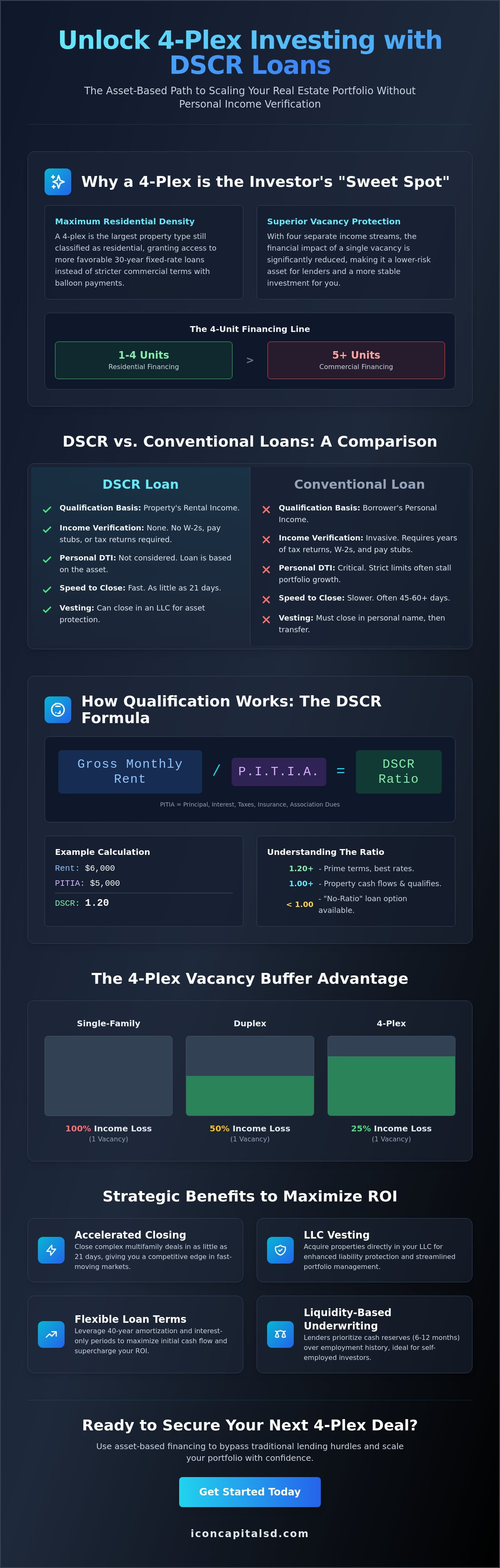
The core of this strategy lies in the Debt Service Coverage Ratio (DSCR). Lenders calculate this by dividing the gross monthly rent by the PITIA (Principal, Interest, Taxes, Insurance, and Association dues). If the property generates a ratio of 1.0 or higher, it typically qualifies. This allows investors to bypass the strict Debt-to-Income (DTI) hurdles that often stop multi-unit acquisitions in their tracks. Because the loan is asset-based, your personal debt load from other properties or personal expenses doesn’t dictate your ability to scale.
Residential vs. Commercial: The 4-Unit Limit
The 4-unit threshold is a critical dividing line in the mortgage industry. Once a property reaches 5 units, it’s classified as commercial, which triggers a shift in underwriting. Commercial loans often require 20% to 30% higher down payments and frequently utilize 5-year or 10-year balloon payments rather than long-term stability. By contrast, a 4-plex remains in the residential category. This allows investors to secure 30-year fixed-rate terms, providing predictable cash flow for decades. The residential tier for DSCR purposes is strictly defined as properties containing 1 to 4 units.
The Vacancy Buffer Advantage
A 4-plex offers a mathematical safety net that single-family homes or duplexes lack. If a single-family rental becomes vacant, the investor faces a 100% loss of income. In a duplex, one vacancy results in a 50% income drop. However, a 4-plex provides a superior vacancy buffer:
- One vacancy = 75% occupancy.
- Two vacancies = 50% occupancy.
- Three vacancies = 25% occupancy.
Lenders view the dscr loan for 4 plex as a lower-risk investment because the probability of a total income loss is statistically lower. Even with one tenant moving out, the remaining three units often cover the entire mortgage payment. This inherent stability makes 4-unit properties the ideal vehicle for high-leverage financing. To understand the foundational mechanics of these products, read our guide on What Is a DSCR Loan?.
How 4-Plex DSCR Loans Work: Qualification Without Tax Returns
DSCR lending simplifies the acquisition of multi-unit properties by removing the requirement for personal income verification. Lenders don’t request W-2s or 4506-T transcripts during the process. Instead, the property’s ability to generate revenue dictates the approval. This “stated income” approach focuses on the cash flow of the 4-plex itself rather than the borrower’s personal tax history.
The Debt Service Coverage Ratio is the primary metric used to evaluate a dscr loan for 4 plex. The calculation is straightforward: Monthly Gross Rent divided by PITIA (Principal, Interest, Taxes, Insurance, and HOA). Because the loan is tied to the asset, the underwriting process is significantly faster than conventional Fannie Mae or Freddie Mac multi-unit loans.
Calculating the DSCR Ratio for 4 Units
Consider a 4-plex deal where the total monthly rent from all four units is $6,000. If the total PITIA payment is $5,000, the ratio is 1.20 ($6,000 / $5,000). A 1.20 DSCR is the industry standard for prime terms. If the ratio falls below 1.00, meaning the rent doesn’t fully cover the debt, no-ratio loan options still exist. These typically require a higher down payment, often 25% or 30%, to offset the lender’s risk.
Asset-Based Underwriting vs. Traditional Mortgages
Traditional financing relies on employment history and strict debt-to-income (DTI) ratios. Asset-based underwriting ignores DTI entirely. Lenders prioritize liquidity and often require six to twelve months of cash reserves to cover the mortgage. This model allows self-employed investors to scale their portfolios without the limitations of their personal tax returns. For non-investment properties, investors often utilize P&L Home Loans, but for a dscr loan for 4 plex, the property’s performance is the driver.
Minimum credit scores for 4-unit deals in 2026 generally start at 620. However, scores of 720 or higher secure the most competitive LTVs and interest rates. The appraisal is the most critical part of the timeline. It must include a 1007 Rent Schedule, which is a formal document where the appraiser confirms the fair market rent for each unit. This ensures the projected income aligns with local market data. Investors ready to move forward can request a quote to see how their current credit and property rents impact their leverage options.
Comparing 4-Plex Financing: DSCR vs. Conventional Loans
Investors choosing between a conventional mortgage and a dscr loan for 4 plex acquisitions must weigh speed against documentation requirements. Conventional financing relies heavily on Debt-to-Income (DTI) ratios and personal tax returns. This verification process often pushes closing timelines to 45 or 60 days. In contrast, DSCR loans focus on the property’s cash flow rather than your personal paycheck. This streamlined underwriting allows Icon Capital to close most 4-unit deals in 21 to 30 days.
Down payment requirements for a 4-plex are strict across most loan programs. Conventional lenders typically demand 20% to 25% for multi-unit investment properties. While a dscr loan for 4 plex purchases usually requires a similar 20% to 25% down payment, the leverage remains more flexible. Conventional loans are capped by FHFA limits, which can restrict acquisitions in high-cost markets. DSCR products often extend to $2 million or more, providing the necessary capital for premium urban assets. While some buyers explore the SBA 504 loan program for owner-occupied commercial space, it doesn’t fit the model for non-owner-occupied residential 4-plexes.
LLC Ownership and Asset Protection
Conventional financing generally requires the loan to be in the borrower’s personal name. This creates a direct link between personal assets and property liabilities. Holding a 4-unit asset in a specialized entity like an LLC provides a critical layer of protection. Icon Capital supports LLC and corporate entity borrowers, allowing you to shield personal wealth from property-related litigation. This structure is a standard requirement for professional investors who prioritize risk management and long-term security.
Scalability and Portfolio Limits
Fannie Mae and Freddie Mac impose a 10-property limit on financed properties. Once an investor hits this ceiling, conventional financing is no longer an option. DSCR loans have no such limits. You can use a DSCR loan to un-trap equity from existing rentals through cash-out refinancing. This capital can then fund the next acquisition. For those managing multiple buildings, Icon Capital offers blanket DSCR loans. This structures multiple 4-plexes under a single loan, simplifying management and optimizing cash flow across the entire portfolio.
Maximizing ROI: Strategy for 4-Unit Multifamily DSCR Deals
Scaling a real estate portfolio with a dscr loan for 4 plex requires precise financial structuring. Investors often utilize 40-year loan terms to suppress monthly PITIA. By extending the amortization schedule, the debt service requirement drops, which directly inflates the DSCR ratio. This strategy allows investors to qualify for higher leverage on properties that might fall short under standard 30-year constraints. It’s a pragmatic approach for those prioritizing monthly liquidity over rapid equity buildup.
Prepayment penalty structures are a critical variable in these deals. Investors must choose between a 3-2-1 or a 5-4-3-2-1 structure. A 3-2-1 penalty is ideal for those planning a refinance or sale within 36 to 48 months. Conversely, the 5-4-3-2-1 structure typically offers a lower interest rate; this benefits long-term holders who intend to keep the asset for a decade or more. Choosing the wrong penalty can cost tens of thousands in exit fees, so aligning the loan terms with the five-year business plan is essential.
Interest-Only Strategies for Cash Flow
Interest-only (IO) periods, usually lasting the first 10 years, serve as a powerful tool for maximizing cash flow. Because the borrower pays zero principal during this phase, the monthly debt obligation remains at its absolute minimum. This lower payment improves the debt coverage ratio during the underwriting process, often making the difference between a loan approval and a denial. Investors should transition from IO to fully amortizing payments once the property has achieved significant rent growth or reached a 20% equity cushion through appreciation. For current data on how these terms affect your bottom line, Request a Quote to see current IO rate spreads.
The Short-Term Rental (STR) Hybrid Model
The dscr loan for 4 plex is increasingly used for short-term rental portfolios. Lenders now qualify these assets using AirDNA “Market Reviews” or 12 months of documented STR history. This allows the high gross revenue of a vacation rental to drive the DSCR calculation rather than lower-yielding long-term leases. In tourist-heavy markets, the appraisal must reflect the “highest and best use” for 4-plexes to ensure the valuation supports the STR income model. Managing four units under a single loan reduces per-unit closing costs and simplifies monthly accounting for the operator.
Ready to analyze your next multifamily acquisition? Get a custom DSCR quote today.
Structuring Your 4-Plex Deal with Icon Capital
Icon Capital operates as a specialized facilitator for real estate investors. We bypass the bureaucratic hurdles of traditional banking to provide creative financing solutions for multi-unit assets. Our process is linear: we structure the loan, collect essential data, underwrite the asset’s performance, and fund the deal. This efficiency is critical when securing a dscr loan for 4 plex in a high-demand market where sellers prioritize certainty of execution. We focus on the property’s ability to generate cash flow, treating your 4-unit acquisition as the business entity it is.
Speed to Close: The Investor Advantage
Multi-unit deals often fail in the 2026 market due to slow appraisal turnarounds or excessive document requests. Icon Capital solves this by focusing on the property’s income potential rather than the borrower’s personal tax returns. Our underwriters are experts in 4-unit residential appraisals, specifically analyzing the 1007 rent schedule to verify market rates against current leases. We understand that 4-plex inventory is limited; therefore, we have streamlined our internal review to move from application to clear-to-close faster than retail lenders. For investors located outside the United States, we provide specialized Foreign National Loans. These programs allow international buyers to leverage US real estate and scale their portfolios without a domestic credit history.
Get Started on Your 4-Unit Financing
Efficiency is our signature. We provide same-day term sheets to give you a competitive edge during negotiations. When you present a firm financing offer, you become the preferred buyer in a multi-offer scenario. To initiate the process for your dscr loan for 4 plex, prepare the following items for our team:
- A signed purchase contract or letter of intent.
- Existing lease agreements or a certified rent roll for all four units.
- A valid government-issued photo ID.
- An entity document if you plan to hold the title under an LLC or Corporation.
We prioritize the mechanics of the deal over personal narrative. This pragmatic approach ensures your capital is deployed where it generates the highest return. Our team is ready to structure your next acquisition with the leverage and speed your portfolio requires. Get a custom DSCR quote for your 4-plex today.
Accelerate Your 2026 Multifamily Acquisitions
Maximizing returns on 4-unit properties requires a shift from restrictive conventional underwriting to cash-flow-based solutions. A dscr loan for 4 plex investment eliminates the need for personal tax returns, allowing you to qualify based on the asset’s performance rather than your personal income. This structure is the most efficient way to leverage the residential-to-commercial sweet spot without the hurdles of traditional bank financing.
Icon Capital specializes in closing complex deals that others can’t. We offer portfolio-ready lending with no property limits and maintain programs that are friendly to both LLCs and Foreign Nationals. While traditional lenders take months, we target closings in as little as 21 days to keep your capital moving. Our process is built for speed, focusing on the mechanics of the deal so you can focus on scaling your portfolio.
Don’t let rigid lending guidelines slow your growth. Request a 4-Plex DSCR Loan Quote today to secure the leverage your portfolio requires. We’re ready to structure your next successful deal.
Frequently Asked Questions
Is a 4-plex considered a commercial or residential property for a DSCR loan?
A 4-plex is classified as a residential property because it contains four units or fewer. Most lenders categorize 1 to 4 unit properties under residential guidelines, while properties with 5 units or more fall into the commercial category. This classification allows investors to leverage a dscr loan for 4 plex programs which often feature more flexible terms and lower down payment requirements compared to true commercial multi-family loans.
Can I get a DSCR loan for a 4-plex with no down payment?
No, you cannot obtain a DSCR loan for a 4-plex with zero down payment. These investment products typically require a minimum down payment of 20% to 25% to mitigate lender risk. While some specialized programs might allow for 15% down in specific high-demand markets, 100% financing isn’t a standard feature of the DSCR lending market in 2026. Investors must have skin in the game for these non-QM products.
What is the minimum credit score required for a 4-unit DSCR loan?
The minimum credit score for a 4-unit DSCR loan generally starts at 620. However, most competitive programs require a score of 680 or higher to access the best LTV ratios and interest rates. Investors with scores below 660 may face stricter leverage limits, often capped at 70% or 75% LTV. Maintaining a score above 720 typically unlocks the most aggressive pricing and flexible debt coverage requirements from specialist lenders.
How does a lender calculate the rental income for a vacant 4-plex?
Lenders determine rental income for vacant units using the Market Rent Estimator provided in the appraisal report, specifically Form 1025 for 4-unit properties. The appraiser analyzes comparable rentals within a 1 to 3 mile radius to establish a fair market rent for each unit. Lenders then apply a standard vacancy factor, typically 25%, to these estimates to ensure the DSCR calculation remains conservative and realistic for the underwriting team.
Can I use a DSCR loan to refinance an existing 4-plex and pull cash out?
Yes, you can use a DSCR loan to refinance an existing 4-plex and extract equity through a cash-out transaction. Most programs allow for a maximum LTV of 75% on cash-out refinances, provided you’ve owned the property for at least 6 months. This strategy provides immediate capital for portfolio expansion or property improvements without requiring personal income verification. It’s an efficient tool for investors looking to scale their holdings quickly using existing equity.
Do DSCR loans for 4-plexes have prepayment penalties?
Most DSCR loans for 4-plexes include a prepayment penalty period ranging from 1 to 5 years. A common structure is the 3-2-1 penalty, where the fee is 3% in the first year, 2% in the second, and 1% in the third. Some lenders offer a buy-down option where you pay a slightly higher interest rate in exchange for a shorter or waived penalty period. This allows for greater exit strategy flexibility if you plan to sell.
Can I live in one of the units of a 4-plex financed with a DSCR loan?
No, you cannot reside in any unit of a 4-plex financed with a DSCR loan. These are strictly investment property loans intended for non-owner occupied assets. If you intend to live in one unit, you must utilize conventional or FHA financing instead. Lenders require a signed occupancy affidavit at closing confirming the property’s status as a business-purpose investment. Violating this agreement can trigger an immediate call of the loan balance.
Are DSCR interest rates higher for 4-plexes than for single-family homes?
Interest rates for 4-plexes are typically 0.25% to 0.50% higher than those for single-family homes. Lenders view multi-unit properties as higher risk due to increased management complexity and potential maintenance costs. Despite the higher rate, a dscr loan for 4 plex often provides superior cash flow because the total rental income from four units far exceeds the marginal increase in debt service costs. This makes them a preferred asset for yield-focused investors.