

Traditional lending frameworks frequently disqualify high-potential assets simply because the current rent roll doesn’t meet an arbitrary 1.20x debt service coverage ratio. For investors targeting non-stabilized properties or assets with significant vacancy, a dscr loan no ratio provides the necessary leverage by prioritizing asset value over immediate cash flow. You shouldn’t be forced to pass on a deal because a property is currently underperforming or your personal tax returns are too complex for a standard underwriter to parse.
Experienced investors recognize that the most profitable opportunities rarely come with a perfect 12 month history of stable occupancy. This article outlines exactly how to secure investment property financing when the rental income falls short of traditional debt service requirements. We’ll examine the specific criteria for no-ratio products, how they eliminate the need for personal income verification, and why this strategy is the most efficient way to close quickly on non-stabilized assets that traditional banks won’t touch. By focusing on the asset’s intrinsic value rather than current cash flow, you can maintain your acquisition momentum without the delays of a full-doc process.
Key Takeaways
- Understand how to secure financing for investment properties when current rental income falls below traditional 1.0 or 0.75 debt service thresholds.
- Identify strategic opportunities for non-stabilized assets, including high-vacancy properties and “Value-Add” projects with below-market rents.
- Evaluate the trade-offs between LTV caps and interest rate premiums when utilizing a dscr loan no ratio to scale your portfolio.
- Review the specific credit score and liquidity requirements necessary to qualify for these specialized Non-QM creative financing solutions.
- Learn how direct access to underwriters at Icon Capital can help you structure and close complex, non-traditional real estate deals efficiently.
What is a No-Ratio DSCR Loan?
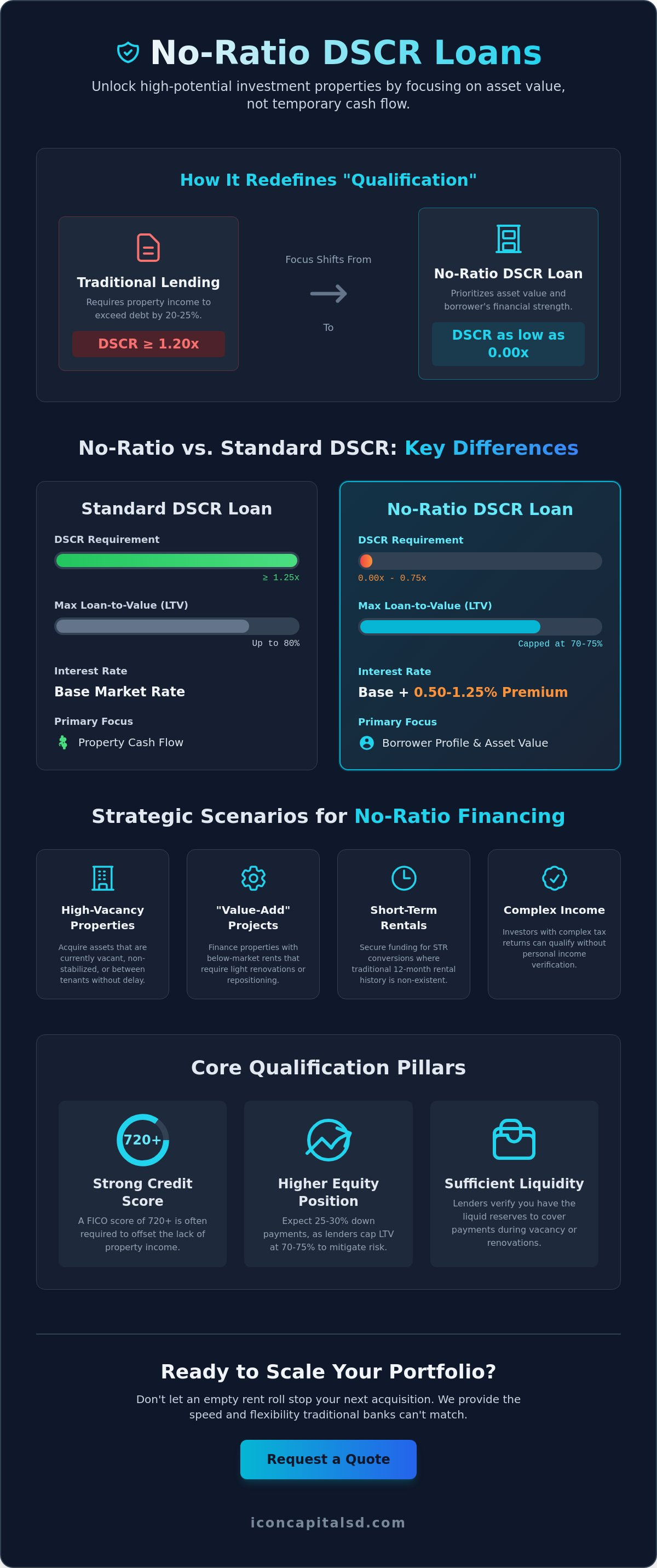
A dscr loan no ratio is a specialized Non-QM mortgage product designed for real estate investors. In a standard scenario, lenders require a property to generate enough income to cover its debt. A no-ratio DSCR loan removes this requirement. Lenders accept a ratio below 1.0 or even as low as 0.00. This means the property doesn’t have to produce any rental income at the time of closing. The underwriting focus shifts away from property cash flow. Instead, lenders prioritize the borrower’s credit profile and the property’s appraised value. It’s a pragmatic solution for non-stabilized assets or properties undergoing transition.
The Mechanics of Debt Service Coverage
The Debt Service Coverage Ratio (DSCR) is a formula used to measure a property’s ability to pay its monthly mortgage. You calculate it by dividing Net Operating Income by the total debt service. In a traditional DSCR loan, requirements typically sit between 1.20 and 1.25. This ensures the property provides a 20% to 25% profit buffer. In a no-ratio program, the math becomes irrelevant. Lenders allow a 0.00 ratio because they aren’t relying on the lease agreement to qualify the deal. This flexibility is vital for vacant buildings or short-term rental conversions where historical income data is missing.
Why Lenders Offer No-Ratio Options
Lenders mitigate the risk of missing cash flow through stricter capital requirements. You’ll typically see higher down payments, often 25% to 30%, compared to standard programs. A FICO score of 720 or higher is frequently required to offset the lack of property income. Secondary market demand for Non-QM investor assets drives the availability of these products. Investors buy these loans because they’re backed by high-equity positions and strong borrower profiles. Lenders also look at the borrower’s “Global Financial Strength.” This includes liquid reserves and total net worth. If the property doesn’t pay for itself, the borrower’s other assets act as a backstop. To see how your profile fits these requirements, you can request a quote today.
No-Ratio vs. Standard DSCR: Key Differences
Standard DSCR loans rely on a Debt Service Coverage Ratio, typically 1.0 or higher, to qualify a property. Underwriters verify this by comparing the gross potential rent against the full PITIA (Principal, Interest, Taxes, Insurance, and Association dues). A dscr loan no ratio eliminates this calculation entirely. The property’s current income or projected market rent doesn’t factor into the approval process. This allows investors to acquire properties that are currently vacant, undergoing light renovations, or underperforming compared to market averages.
LTV and Down Payment Thresholds
No-ratio programs require more skin in the game because the lender assumes higher risk. While standard DSCR products often allow for 80% Loan-to-Value (LTV) on purchases, a dscr loan no ratio typically caps leverage at 70% or 75%. In the 2026 lending market, these thresholds remain strict to offset market volatility. For a cash-out refinance, LTV limits often drop further to 65% or 70%. Property type also influences these caps. Single-family homes and 2-4 unit properties generally qualify for the highest available leverage. Investors looking to maximize their position should request a quote to see how specific asset types impact their down payment requirements.
Interest Rate and Cost Implications
Non-QM underwriters utilize a risk-based pricing model. Since the lender cannot verify the property’s ability to service its own debt, they charge a rate premium. You’ll generally see interest rates 0.50% to 1.25% higher on a no-ratio product compared to a standard 1.25 DSCR loan. Despite the higher rate, documentation remains streamlined. Both loan types omit tax returns and employment verification, but the no-ratio option also removes the requirement for a lease agreement or a Form 1007 rent schedule.
- Interest-Only (I/O) Periods: Many investors use 5-year or 10-year I/O periods to reduce monthly payments and offset the higher interest rates.
- Prepayment Penalties: These structures remain consistent across both products. Most lenders utilize a 3-year or 5-year step-down penalty (e.g., 5-4-3-2-1%) to protect their yield.
- Closing Costs: Origination fees and third-party costs like appraisals and title insurance are comparable to standard DSCR loans, usually ranging from 2% to 5% of the loan amount.
The trade-off for the higher cost is speed and flexibility. Without the need for a rent schedule, the appraisal process is faster. This allows for quicker closings on distressed assets that wouldn’t pass a traditional cash-flow analysis. The focus shifts entirely to the borrower’s credit score and the property’s valuation, simplifying the path to funding.
Strategic Scenarios for No-Ratio Financing
Standard DSCR products typically require a 1.00x or 1.25x coverage ratio to qualify for funding. A dscr loan no ratio program removes this barrier by focusing on asset value and borrower liquidity rather than the property’s current rental income. This approach is essential for non-stabilized assets where vacancy rates exceed 25 percent or where the building is undergoing a significant transition. It also serves Foreign National investors who often lack a U.S. credit history or domestic income documentation. These investors use no-ratio products to acquire U.S. real estate with 30 percent to 35 percent down payments, bypassing the need for complex international tax returns or employment verification.
The Value-Add and BRRRR Strategy
Investors using the BRRRR method often face delays during the refinance stage. Many conventional and standard Non-QM programs require a 12-month seasoning period before they allow a cash-out refinance based on the updated appraised value. The dscr loan no ratio exit strategy eliminates this wait. You can pull equity out of an underperforming asset immediately after renovations are finished, even if the units aren’t yet occupied. This speed is vital for maintaining momentum. Instead of waiting a full year to access capital, you can deploy that equity into a new project within 30 to 60 days of project completion. It bridges the gap between high-cost bridge loans used for construction and a long-term, fixed-rate solution.
Short-Term Rental (STR) Transitions
Transitioning a property into a Short-Term Rental (STR) often creates a documentation gap. Traditional lenders usually demand a 12-month historical performance record from platforms like AirDNA or VRBO. If you’re converting a long-term rental into a vacation stay, you won’t have that data. Standard DSCR underwriting also struggles with the seasonal nature of STR income, where a property might earn 70 percent of its revenue in just four months. No-ratio financing solves this by ignoring the income-to-debt calculation entirely. Qualification relies on specific asset and credit markers:
- A minimum FICO score, often starting at 680.
- Liquid cash reserves to cover 6 to 12 months of debt service.
- An appraisal that supports the loan-to-value (LTV) requirements, typically capped at 75 percent.
This allows you to secure the asset based on its market potential rather than its past performance. You can request a quote to see how these terms apply to your specific STR acquisition or refinance scenario. By focusing on the equity in the deal, this structure provides the flexibility needed to scale a portfolio without the constraints of historical cash flow requirements.
Qualification Requirements for No-Ratio Loans
Underwriting for a dscr loan no ratio program shifts the focus from property cash flow to the borrower’s financial strength and the asset’s underlying value. Since the lender accepts a Debt Service Coverage Ratio below 1.00, they mitigate risk through stricter entry barriers. These loans aren’t based on employment history or tax returns, but they do require a solid credit foundation and significant cash positions.
Credit and Liquidity Standards
Credit scores are the primary lever for determining leverage. Most programs require a minimum FICO of 660, though 680 is the standard for competitive pricing. A score of 720 or higher typically unlocks the maximum LTV, often capped at 75% or 80% for no-ratio products. Lower scores usually result in a mandatory 5% to 10% reduction in the allowable loan-to-value ratio.
Liquidity is non-negotiable. Lenders require 6 to 12 months of PITI (Principal, Interest, Taxes, and Insurance) in reserves. This ensures the borrower can carry the debt during vacancies or renovations. Acceptable reserve sources include:
- Personal checking and savings accounts.
- Brokerage accounts and stocks, often valued at 70% to 90% of market value.
- Vested 401k or IRA balances.
- Gift funds, provided they meet specific seasoning requirements of 60 to 90 days.
Property Eligibility and Appraisals
While the dscr loan no ratio model ignores current income, the appraisal process remains rigorous. Lenders still require a Form 1007 Rent Schedule to establish the property’s market rent potential. This data helps the underwriter assess the long-term viability of the asset and confirms the investment is in a high-demand rental area.
Property type restrictions apply to these products. Rural properties and large-scale mixed-use buildings typically don’t qualify. The “as-is” value must support the loan amount without relying on future “after-repair” projections. High-quality appraisals from lender-approved AMCs are mandatory to verify the asset’s condition and marketability. If an appraisal reveals significant structural issues, the property may be disqualified until repairs are completed.
Experience often dictates eligibility. While some programs allow first-time investors, most no-ratio options are reserved for seasoned professionals who have owned at least two investment properties within the last 36 months. This track record proves the borrower can manage non-stabilized assets effectively without the safety net of immediate cash flow.
Icon Capital’s Creative Financing Solutions
Icon Capital provides liquidity for assets that don’t meet traditional bank standards. Our specialized programs include the dscr loan no ratio option, specifically designed for non-stabilized properties or investors who prioritize speed over debt-coverage paperwork. We offer direct access to underwriters. This removes the layers of bureaucracy found at retail banks. It allows for the structuring of complex, non-traditional deals that require a pragmatic approach to risk. Our team evaluates the property’s potential rather than just its current performance.
Investors managing high-value portfolios can access funding up to $2 million or more. This capacity supports the acquisition of multi-unit residential properties and significant single-family portfolios. Our process is optimized for self-employed individuals and business owners. We focus on asset value and equity rather than personal tax returns. This streamlined approach ensures that capital is available when a market opportunity arises, regardless of the borrower’s personal income documentation.
The Icon Capital Advantage
Investors often face tight closing windows. Icon Capital prioritizes speed and certainty of execution. We offer customized terms across a variety of products, including P&L home loans for borrowers who prefer to use profit and loss statements instead of tax filings. Our expertise extends to structuring loans for foreign nationals and complex legal entities like LLCs, partnerships, or trusts. We understand the nuances of non-QM lending. This ensures that even the most intricate deal structures reach the closing table without the delays typical of conventional lenders.
Next Steps: Structuring Your Deal
Securing a dscr loan no ratio requires a clear roadmap. We analyze every scenario individually. You can submit your deal details for a quick pricing quote to determine eligibility and leverage levels. A well-defined exit strategy is essential for no-ratio financing. Most investors plan to refinance into a standard DSCR loan once the property is stabilized or sell the asset after value-add improvements are complete. Our team helps you evaluate these pathways during the initial structuring phase to ensure the loan aligns with your long-term investment goals.
Ready to leverage your next asset? Request a Quote from Icon Capital to get started on your customized financing solution.
Scale Your Portfolio with No-Ratio Financing
Standard DSCR requirements often stall deals on properties with high vacancy rates or those requiring significant repositioning. A dscr loan no ratio eliminates the debt-service coverage constraint; it focuses on the underlying asset value and your credit profile instead. This strategy provides a viable path for investors to secure non-stabilized properties that traditional banks won’t touch. It’s a tool built for speed and flexibility in a competitive market.
Icon Capital delivers specialized expertise in Non-QM and creative investor loans to bridge these financing gaps. We offer loan amounts up to $2 million or more for qualified assets, ensuring you have the leverage to compete and scale. Our streamlined 4-step loan submission process removes administrative hurdles, moving your deal from initial structure to final funding efficiently. We focus on the mechanics of the deal so you can focus on your next acquisition.
Explore Creative Financing: Request a Quote Today
It’s time to put your investment strategy into motion with a partner who understands complex lending.
Frequently Asked Questions
Can I get a DSCR loan with a 0 ratio?
Yes, you can obtain a dscr loan no ratio even when a property’s gross income is zero. These programs ignore the traditional debt service coverage calculation, focusing instead on your creditworthiness and the property’s appraised value. It’s a strategic choice for investors acquiring vacant units or properties undergoing light renovations that prevent immediate leasing. This flexibility allows for rapid acquisition without waiting for tenant placement.
What is the minimum credit score for a no-ratio DSCR loan?
Most lenders set the minimum credit threshold at 640 for no-ratio options. While some specialized programs accept scores as low as 620, you’ll find the most competitive terms at the 700 to 720 mark. Underwriters look for a clean 12-month payment history on existing mortgages to offset the lack of property-level cash flow. Maintaining 6 months of interest reserves is often mandatory to secure approval.
Do no-ratio DSCR loans have higher interest rates?
Yes, no-ratio DSCR loans carry higher interest rates, typically ranging from 0.75% to 2.00% above standard DSCR products. This pricing reflects the increased risk of financing a property that doesn’t meet a 1.00x or 1.20x coverage ratio. Investors accept these higher costs to secure assets with high upside potential. You can often refinance into a lower rate once the property reaches 90% occupancy and stabilizes.
How much down payment is required for a no-ratio investment loan?
You’ll generally need a down payment of 20% to 25% for a dscr loan no ratio purchase. If your credit score is below 680, some lenders might increase this requirement to 30% to mitigate risk. These equity cushions protect the lender if the property remains vacant longer than expected. High-net-worth investors often leverage these terms to close deals quickly in competitive markets where speed is critical.
Are no-ratio loans available for first-time investors?
First-time investors can access these loans, though they may face a 5% reduction in maximum LTV compared to experienced pros. Lenders define experienced as having owned at least one investment property within the last 36 months. If you’re new to the game, expect to show 12 months of liquid reserves to prove you can handle the debt service without immediate rental income from the subject property.
Can I use a no-ratio loan for a cash-out refinance?
You can execute a cash-out refinance using a no-ratio loan up to a 70% or 75% LTV limit. Most programs require the property to be owned for at least 180 days before using the new appraised value for the loan calculation. This is a common strategy for investors who’ve finished renovations and want to pull capital out before the property is fully stabilized with long-term tenants or a lease agreement.
Is personal income verified for a no-ratio DSCR loan?
Personal income is never verified for a no-ratio DSCR loan. We don’t ask for tax returns, W-2s, or debt-to-income (DTI) calculations during the underwriting process. The loan’s approval is based on the asset’s value and your personal credit score. This streamlined approach allows business owners and self-employed investors to bypass the complex documentation requirements usually found in traditional bank financing or conventional residential mortgages.
What property types are eligible for no-ratio financing?
Eligible property types include single-family homes, 2 to 4 unit residential properties, warrantable condos, and townhomes. Some programs also allow for 5 to 10 unit multi-family buildings or mixed-use properties, though these often require a 5% to 10% higher down payment. The property must be in habitable condition. If it needs a full gut rehab, a bridge or construction loan is usually the better fit for your project.