

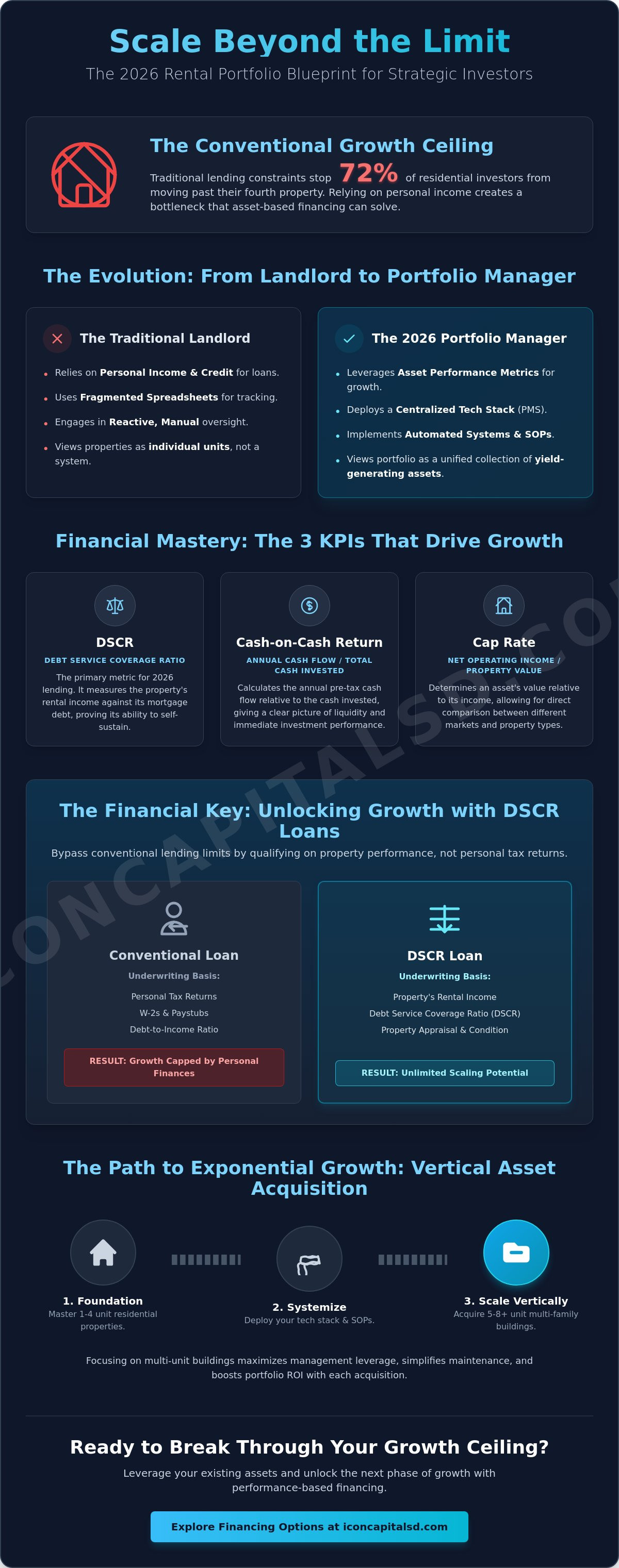
Most investors believe that a low debt-to-income ratio is the primary engine for growth, yet traditional lending constraints stop 72% of residential investors from moving past their fourth property. If you rely on conventional financing, your personal income eventually hits a ceiling that prevents further acquisition. You likely recognize that manual oversight and fragmented spreadsheets aren’t sustainable for a growing operation. Learning how to manage a rental property portfolio in 2026 requires a shift from personal credit reliance to asset-based performance metrics.
We’ll provide the specific frameworks needed to master high-level systems, financial structures, and creative financing strategies that drive portfolio performance. You’ll learn to leverage DSCR loans to bypass personal income verification and implement reporting tools that offer real-time visibility into your ROI across every unit. This article outlines the transition from active management to a streamlined, scalable operation that utilizes non-QM products to unlock your next phase of growth.
Key Takeaways
- Transition from a reactive landlord to a strategic manager by adopting a centralized philosophy built for scaling beyond three units.
- Deploy the 2026 operational tech stack and Standard Operating Procedures (SOPs) to automate rent collection and maintenance workflows.
- Master how to manage a rental property portfolio using advanced accounting frameworks that identify laggard assets and protect cash flow.
- Utilize creative financing and DSCR loans to bypass conventional lending limits and qualify based on property performance rather than personal tax returns.
- Scale efficiently through vertical asset acquisition, focusing on multi-unit buildings to maximize management leverage and portfolio ROI.
The Fundamentals of Rental Property Portfolio Management
In 2026, the distinction between a landlord and a portfolio manager is defined by scalability and systems. Managing one or two units is a job, but managing a portfolio is a business. Success depends on a centralized management philosophy. Once an investor scales beyond the 3-unit threshold, manual oversight and reactive maintenance become liabilities. Centralized management ensures that accounting, maintenance workflows, and tenant communications follow a repeatable framework across all assets. Investors must master the Fundamentals of property management to maintain LTV ratios and ensure debt coverage. Understanding how to manage a rental property portfolio requires a shift from viewing properties as buildings to viewing them as a unified collection of yield-generating assets.
Establishing key performance indicators (KPIs) is the only way to measure this yield accurately. Investors should focus on these three metrics:
- DSCR (Debt Service Coverage Ratio): This is the primary metric for 2026 lending. It measures the property’s ability to cover mortgage payments from its own rental income.
- Cash-on-Cash Return: This calculates the annual pre-tax cash flow relative to the total amount of cash invested, providing a clear picture of liquidity.
- Cap Rate: This determines the asset’s value relative to its Net Operating Income (NOI), allowing for a direct comparison between different markets and property types.
If your current portfolio metrics indicate room for expansion, you can request a quote to explore leverage options that utilize your existing equity.
Portfolio vs. Single Property: The Mindset Shift
Scaling requires removing emotion from the equation. Decisions must rely on data-driven asset acquisition rather than “gut feelings” about a neighborhood. Standardized lease agreements and strict tenant screening criteria are non-negotiable. These protocols mitigate risk and ensure compliance across different jurisdictions. Treating each property as a separate cost center is essential. This granular accounting allows you to identify if a specific unit is draining profits from the broader portfolio due to high utility costs or frequent repairs.
Defining Your 2026 Investment Thesis
Market cycles dictate whether you should prioritize immediate cash flow or long-term appreciation. In 2026, high-interest environments often favor portfolios clustered in 1-4 unit residential or 5-8 unit small multi-family buildings. Standardizing your portfolio around specific unit types simplifies maintenance because your contractors can stock universal parts and follow uniform repair protocols. The Buy Box serves as the definitive filter for all future acquisitions, ensuring every new asset aligns with pre-set financial and geographic parameters.
Implementing Scalable Operational Systems
Scaling requires rigorous systems. Manual processes fail when a portfolio exceeds 10 units. Investors must standardize the tenant lifecycle through Standard Operating Procedures (SOPs). This ensures consistency from the initial screening to the final security deposit return. By 2026, automation handles 80% of routine tenant communication. AI chatbots manage lease renewals and basic inquiries. This reduces overhead while maintaining 24/7 responsiveness. Effective systems allow investors to focus on acquisition rather than daily fires.
Vetting a reliable vendor network is critical for multi-city portfolios. Successful investors maintain a primary and secondary contractor for every trade in each zip code. As of Q1 2026, 65% of high-performing investors use centralized vendor portals to track insurance certificates and performance metrics. Learning how to manage a rental property portfolio means delegating the “doing” to specialists while you retain control of the data.
Leveraging Property Management Software (PMS)
Modern PMS platforms like AppFolio and Buildium provide real-time visibility across multi-state assets. These tools automate rent collection and enforce late fees without manual intervention. Integration is a requirement. Your PMS must sync with accounting software to ensure your books are audit-ready. Understanding the tax implications of rental income is vital for long-term profitability. Proper recordkeeping within your PMS simplifies the 1099-MISC filing process. For those looking to expand their holdings, securing a DSCR loan quote can help bridge the gap between current cash flow and future acquisitions.
Streamlining Maintenance and Inspections
Maintenance costs can erode 15% of gross rental income if left unchecked. A “Preventative Maintenance Schedule” identifies issues before they become capital expenditure shocks. Use remote inspection tools like HappyCo to conduct virtual walk-throughs. AI-driven triage software now categorizes 90% of maintenance requests by urgency. This allows for immediate dispatch of vendors in a multi-city network. Managing vendors across different time zones requires a centralized portal where contractors upload photos and invoices directly. This transparency maintains accountability. It ensures the portfolio remains a performing asset. Mastering these technical logistics is the only way to understand how to manage a rental property portfolio without becoming overwhelmed by the operational volume.
Financial Mastery: Accounting, Cash Flow, and Taxes
Many investors stop at five units because they believe managing the books for 10 or more properties is too complicated. It isn’t. The bottleneck isn’t the number of doors; it’s the lack of a centralized financial system. Learning how to manage a rental property portfolio at scale means moving away from individual spreadsheet tabs and toward consolidated reporting. This macro view allows you to identify laggard assets, properties where the ROI has dipped below 7%, that are dragging down your overall yield. If you don’t view your holdings as a single fund, you’ll miss the opportunity to reallocate capital from low-performing units into high-growth markets.
Portfolio-Level Financial Reporting
A portfolio dashboard is your primary tool for high-level decision making. You need to track your weighted average Debt Service Coverage Ratio (DSCR) and Loan-to-Value (LTV) across all holdings. If your aggregate LTV drops below 50% due to appreciation, it’s time to consider a cash-out refinance to fund new acquisitions. Monthly Profit and Loss (P&L) statements shouldn’t just record rent. They must drive exit strategies. For self-employed managers using alternative documentation, maintaining these records is vital for securing P&L Home Loans. This data allows underwriters to verify income without tax returns, keeping your expansion on track. Clear reporting ensures you’re always ready for the next deal.
Asset Protection and Tax Mitigation
Scaling requires shielding your personal wealth. Structuring properties under a Series LLC or a holding company provides a firewall between assets. If a legal issue arises at one rental, the others remain protected. Combine this with umbrella insurance policies starting at $2 million to cover gaps in standard liability. Professional asset protection is a prerequisite for anyone learning how to manage a rental property portfolio efficiently.
In 2026, tax efficiency is the difference between growth and stagnation. Since bonus depreciation rules shifted following the sunset of specific Tax Cuts and Jobs Act provisions, professional cost segregation studies are mandatory for portfolios with assets over $500,000. These studies accelerate depreciation on HVAC systems, flooring, and landscaping, which significantly reduces taxable income in the early years of ownership. Clean books also prepare you for the exit. When you decide to sell, having three years of documented, reconciled financials allows for a higher valuation and a smoother 1031 exchange process. Proactive tax planning ensures you keep more of your cash flow to reinvest in the next cycle.
Optimization Through Creative Financing and Leverage
Conventional financing usually stalls after the fourth or fifth acquisition. Traditional lenders focus on personal debt-to-income (DTI) ratios. This creates a ceiling for active investors who need to maintain liquid capital for growth. To bypass these limitations, successful managers transition to asset-based lending. This shift is a core component of how to manage a rental property portfolio effectively in 2026.
Moving away from retail banks allows for faster execution. Non-QM products provide the liquidity needed to capture off-market deals before competitors can secure funding. Managing a portfolio requires a shift from being a simple borrower to being a strategic capital allocator.
Decoupling Personal Income with DSCR Loans
Debt Service Coverage Ratio (DSCR) loans evaluate the cash flow of the property rather than the borrower’s personal tax returns. If the rental income exceeds the monthly debt service, the deal qualifies. This is the primary engine for scaling. It’s especially useful for self-employed investors who use legal deductions to reduce taxable income. For a detailed breakdown of these mechanics, read the Ultimate DSCR Guide.
Key benefits of DSCR lending include:
- No DTI Requirements: Your personal expenses and debt obligations don’t impact the property’s eligibility.
- Scalability: There’s no limit on the number of financed properties, unlike the 10-property cap often seen with conventional loans.
- Entity Borrowing: Close loans in the name of an LLC or Corp to protect personal assets and streamline accounting.
Portfolio Refinancing and Equity Harvesting
Managing ten separate mortgages creates administrative drag. Consolidating these into a single portfolio loan simplifies oversight. This is a critical tactic for those learning how to manage a rental property portfolio with high-efficiency standards. It also often unlocks better terms through cross-collateralization. Investors utilize the BRRRR method at scale to pull equity from stabilized assets. This cash-out capital funds the next acquisition without requiring new personal injections.
In 2026, managing interest rate volatility requires a proactive approach. Successful investors are currently using these strategies:
- Locking in 30-year fixed DSCR rates to hedge against future fluctuations in the credit market.
- Targeting a minimum 1.20x coverage ratio to ensure a safety buffer during economic shifts.
- Using cash-out refinancing when property values hit a 20% appreciation milestone to maintain a high return on equity.
To see current leverage options for your specific assets, Request a Quote and secure the capital needed for your next acquisition.
Scaling Your Portfolio: The Move to Multi-Unit Assets
Scaling a portfolio requires a shift from horizontal to vertical growth. Managing eight single-family homes across a city creates logistical friction. You deal with eight separate roofs, eight different tax jurisdictions, and eight distinct landscaping contracts. By consolidating these units into one 8-unit multi-family asset, you streamline operations. This transition is essential for anyone learning how to manage a rental property portfolio at scale without increasing their daily workload proportionally.
The 5-8 Unit Advantage
The 5-8 unit range represents a strategic sweet spot for growing investors. Assets in this category move from residential to commercial classification. Unlike 1-4 unit properties that rely on personal income and Debt-to-Income (DTI) ratios, 5-8 unit financing focuses on the asset’s performance. Underwriters prioritize the Debt Service Coverage Ratio (DSCR) and the property’s Net Operating Income (NOI). This allows you to scale without the constraints of personal debt limits. If you’re currently using bridge debt to build capital, reviewing Types of Loans for Flipping Houses can help you transition from short-term gains to permanent multi-unit holds.
- Operational Efficiency: One roof, one lawn, and one property tax bill simplify management.
- Simplified Logistics: You collect eight checks from a single location, reducing travel time and vendor coordination.
- Commercial Appraisal: Value is driven by income, not just neighborhood comps, giving you more control over equity growth.
Building the Team for Passive Management
Scaling past five units makes self-management a liability. You need a specialized Power Team built on three pillars: a specialized lender, a property manager, and a real estate CPA. When vetting a property management firm for a multi-unit asset, verify they handle at least 250 units in your specific asset class. Ask for their vacancy rates over the last 12 months and their process for capital expenditure (CapEx) planning. A manager who understands 5-8 unit assets will provide monthly P&L statements that your lender will require for future refinances.
A specialized lender like Icon Capital acts as a strategic partner, not just a service provider. We provide the leverage needed to close complex deals quickly. Our focus on Non-QM and DSCR programs means we prioritize the deal’s mechanics and the asset’s cash flow over traditional red tape. This speed is critical when competing for high-yield multi-family assets in a tight market.
Large portfolios offer diverse exit paths. You can sell individual assets to private investors or package the entire portfolio for a Real Estate Investment Trust (REIT). REITs often pay a portfolio premium for stabilized, high-unit-count assets because they value immediate scale. This strategy is a core component of how to manage a rental property portfolio for maximum terminal value. To discuss your next acquisition or to explore leverage options for your current assets, request a quote from our team today.
Execute Your 2026 Portfolio Expansion
Mastering how to manage a rental property portfolio requires a transition from manual oversight to automated systems and high-leverage financing. Successful investors in 2026 prioritize scalable operations and creative capital structures to maintain consistent cash flow. Transitioning into 5-8 unit assets provides a significant advantage over single-family holdings by diversifying risk across more doors. Data from the 2024 U.S. Census Bureau indicates that multi-unit housing demand continues to outpace supply in key metropolitan markets. This environment rewards investors who utilize specialized debt products rather than traditional bank loans.
Icon Capital provides the expertise needed to navigate these complex deal structures. We offer specialized DSCR and 5-8 unit loan programs tailored for high-leverage portfolio scaling. Our team builds creative financing solutions for self-employed and foreign national investors who don’t fit into traditional lending boxes. We focus on the mechanics of the deal so you can focus on growth. Request a custom portfolio financing quote from Icon Capital to secure the capital your strategy demands. Your path to a larger, more efficient portfolio starts with the right leverage.
Frequently Asked Questions
How many properties can I manage myself before needing a property manager?
Most solo investors reach a ceiling at 8 to 10 units before the workload becomes unsustainable. Beyond this point, administrative tasks like maintenance coordination and rent collection typically consume more than 20 hours per week. You’ll need to transition to professional management or robust automation software to maintain portfolio performance without sacrificing your personal time.
Can I get a loan for a rental property if I am self-employed?
Yes, self-employed investors qualify for rental loans using Non-QM products like bank statement programs or DSCR loans. These options prioritize asset cash flow and business bank statements over traditional tax returns. You’ll generally need to provide 12 to 24 months of statements to prove your income and liquidity to the underwriter.
What is a good DSCR ratio for a rental property portfolio?
A DSCR of 1.20 or higher is the standard benchmark for most professional lenders. This ratio indicates that the property’s net operating income covers 120 percent of the annual debt service. While some specialized programs accept a 1.00 ratio, maintaining a 1.25 cushion protects your portfolio against 5 to 10 percent vacancy fluctuations.
How do I manage rental properties in different states?
Successful out-of-state management requires a “boots on the ground” team and centralized digital reporting. You’ll need a reliable local property manager and a vetted list of contractors in each specific market. Mastering how to manage a rental property portfolio across state lines depends on using cloud-based software to track 100 percent of your remote maintenance requests.
What is the best way to track expenses for multiple rental properties?
Use dedicated real estate accounting software like Stessa or AppFolio to automate your financial tracking. Manual spreadsheets result in a 15 percent higher error rate during tax season according to industry data. Linking your business accounts to these platforms ensures every invoice and utility payment is instantly categorized by property for clean year-end reporting.
Is it better to have 10 single-family homes or one 10-unit apartment building?
A 10-unit building offers better operational efficiency and lower per-unit management fees, which are often 3 to 5 percent lower than scattered sites. Single-family homes often provide higher appreciation rates and easier exit strategies in liquid residential markets. Your choice depends on whether you value consolidated maintenance or long-term capital gains across diverse locations.
How do I use equity from one rental property to buy another?
A cash-out refinance allows you to tap into up to 80 percent of your property’s current appraised value to fund a new down payment. This strategy accelerates your growth rate by recycling capital into new assets. It’s a core component of how to manage a rental property portfolio when you want to scale without injecting new personal cash.
What are the 2026 tax benefits for rental property owners?
Investors can leverage 100 percent interest deductions and accelerated depreciation to offset their rental income. Based on current tax code projections for 2026, cost segregation studies remain a primary tool for front-loading depreciation expenses. These strategies can reduce your taxable income significantly, often resulting in a zero-tax liability for the first 5 years of an asset’s life.