

The success of a real estate deal isn’t determined at the closing table. It’s decided in the first 180 days of active asset management. While many investors focus exclusively on securing leverage, failing to optimize post purchase support for investment loans often leads to project stagnation and eroded margins. You recognize that capital is a tool, yet delays in renovation draws or confusion over annual DSCR reporting can turn a high-yield flip into a liquidity trap. Effective management requires a tactical shift from borrower to asset manager to protect your equity and maintain project velocity.
We agree that the technicalities of loan maintenance shouldn’t slow your momentum. This guide provides the strategic framework to streamline draw disbursements and master reporting requirements for the 2026 market. You’ll learn how to identify the precise window to transition from bridge debt to long-term financing, ensuring your portfolio remains scalable and liquid. We’ll break down the mechanics of draw schedules and exit strategies to maximize your total ROI and simplify your path to the next acquisition.
Key Takeaways
- Learn how to successfully transition from borrower to asset manager during the critical first 90 days of your investment.
- Align construction milestones with lender disbursements to ensure a steady flow of capital for fix-and-flip projects.
- Utilize ongoing post purchase support for investment loans to monitor DSCR performance and maintain rental portfolio health.
- Protect your assets by managing tax escrows and securing the correct Builders Risk insurance for active renovation sites.
- Identify the data-driven triggers for pivoting from bridge financing to long-term DSCR loans to optimize your exit strategy.
Understanding Post-Purchase Support for Investment Loans
Post purchase support for investment loans refers to the operational and strategic oversight provided after the capital has been deployed. In the commercial and non-QM sectors, this support isn’t a passive administrative function. It’s an active partnership designed to maintain liquidity and ensure the underlying asset performs according to the initial pro forma. While traditional lending ends at the closing table, non-QM lending requires ongoing engagement to manage complex debt structures and aggressive timelines.
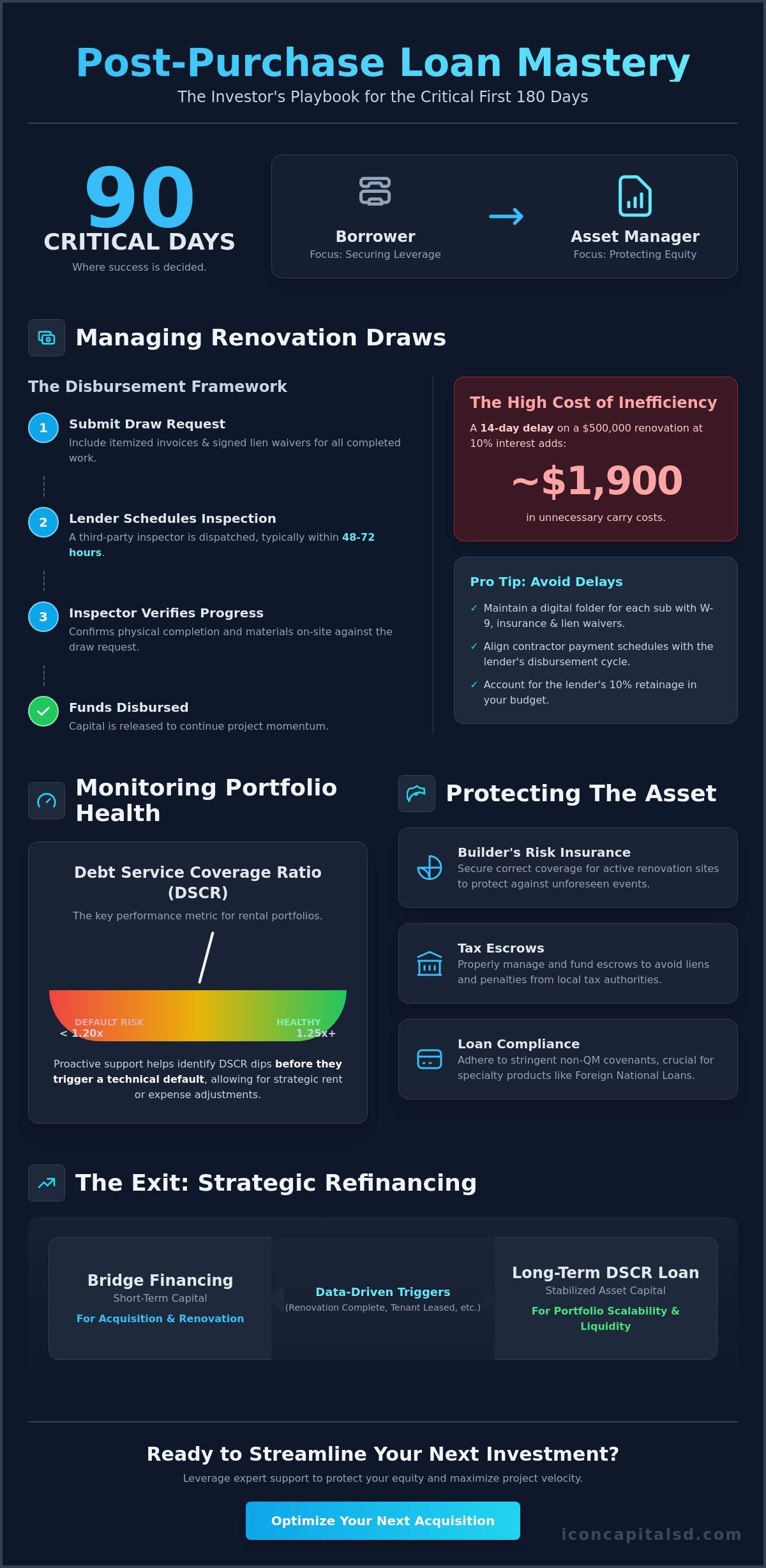
The first 90 days after funding mark a critical transition where the borrower must pivot into the role of an asset manager. During this window, the focus shifts from securing leverage to protecting it. Failure to establish reporting cadences or understand draw schedules early can jeopardize the project’s momentum. Effective post purchase support for investment loans ensures that the transition from acquisition to operation is seamless, preventing the administrative friction that often leads to cost overruns.
There’s a significant gap between residential counseling and investment loan servicing. Residential support focuses on consumer protection and escrow management. Investment servicing is built around performance metrics. A professional mortgage servicer in the investment space monitors the Debt Service Coverage Ratio (DSCR) to ensure it stays above the 1.20 or 1.25 threshold required by most loan covenants. Proactive support helps investors identify potential DSCR dips before they trigger a technical default, allowing for strategic adjustments in rent or operating expenses.
The Lifecycle of an Investment Loan After Closing
The post-closing environment involves three primary entities: the servicer handles payment processing, the asset manager monitors portfolio health, and the draw coordinator manages construction disbursements. Communication frequency typically follows a monthly reporting cycle, though fix-and-flip projects may require bi-weekly updates. Post-purchase support is the strategic management of debt to ensure project completion and ROI.
Why Investors Need Specialized Support
Investors utilizing Foreign National Loans face unique complexities, including international tax compliance and currency fluctuations that can impact repayment. Specialized support ensures these borrowers remain compliant with non-QM loan covenants, which are often more stringent than agency guidelines. As we look toward 2026, leveraging lender expertise is vital for adapting to market shifts. With interest rate volatility expected to persist into the mid-2020s, having a partner who understands the mechanics of the deal helps investors pivot their exit strategies, whether they’re moving toward a long-term hold or a quick disposition.
Managing Renovation Draws and Construction Milestones
Effective draw management is the most critical component of post purchase support for investment loans. In the 2026 market, lenders require granular detail before releasing funds to ensure the collateral’s value increases in line with the debt. For investors utilizing Fix and Flip Loans, the speed of fund disbursement directly dictates the project’s internal rate of return (IRR). Draw efficiency impacts your overall cost of capital; for instance, a 14-day delay on a $500,000 renovation budget at a 10% interest rate adds roughly $1,900 in unnecessary carry costs. You should structure your project timeline to group high-impact milestones, such as mechanical rough-ins or roofing, to trigger larger disbursements early in the cycle.
Common pitfalls leading to delays include incomplete lien waivers or failing to account for 10% retainage. To avoid these, maintain a digital folder for every subcontractor that includes their W-9, insurance certificate, and signed release of lien for every payment. This level of organization ensures that your post purchase support for investment loans remains a streamlined financial process rather than a source of friction. Aligning your contractor’s payment schedule with the lender’s disbursement cycle prevents out-of-pocket cash flow crunches that can stall a job site for weeks.
The Draw Request Process: A Step-by-Step Framework
The process begins with the submission of a formal draw request form. You must include itemized invoices and executed lien waivers for all completed work. Once the lender receives the package, they schedule a third-party inspection, typically occurring within 48 to 72 hours. These inspectors look for physical evidence of completion and materials on-site. After the inspector submits their report, the lender finalizes the disbursement. Funds are generally sent via wire transfer or ACH within 24 to 48 business hours of final approval. Consistency in this documentation prevents the back-and-forth queries that often derail construction timelines.
Verification and Quality Control Protocols
Lenders utilize the percentage of completion (POC) method to determine how much capital to release. If the electrical work is 60% finished, the lender releases 60% of the allocated line item. Most institutional frameworks include a 10% holdback on every draw, which is released only after a final inspection and a clear title search. If you are renovating a property for the rental market, reviewing HUD Landlord Resources can help ensure your quality control protocols meet federal habitability standards. Handle change orders by notifying your underwriter immediately. A $10,000 shift in budget without prior approval can freeze your funding. To see how these draw structures apply to your specific portfolio, you can request a quote to review available terms.
Monitoring DSCR and Rental Portfolio Health
Investment success doesn’t end at the closing table. Effective post purchase support for investment loans requires a disciplined approach to monitoring the Debt Service Coverage Ratio (DSCR). Lenders use this metric to verify that your asset generates enough cash flow to cover debt obligations. In the 2026 market, consistent annual reviews are the primary tool for identifying performance gaps before they become critical failures.
Your Rent-to-Debt ratio is the core metric lenders evaluate post-acquisition. They analyze Net Operating Income (NOI) against your annual debt service. Maintaining high occupancy isn’t just about cash flow; it’s often a legal requirement. Most commercial and DSCR loan covenants mandate an occupancy rate of 90% or higher. If your portfolio dips below this threshold, you risk a technical default even if your payments remain current. Addressing income fluctuations early protects your credit standing and ensures your lender remains a partner rather than a liability.
Annual Reporting and Financial Documentation
Lenders typically require an annual financial package to verify loan compliance. You’ll need to prepare detailed Profit & Loss statements, similar to those used for P&L Home Loans, to show actual income versus expenses. Keep your rent rolls and lease agreements updated and organized for immediate review. Maintaining a DSCR of 1.2 or higher is the industry standard because it provides a 20% safety margin to absorb unexpected maintenance costs or tax increases without jeopardizing the mortgage payment.
Handling Vacancies and Market Volatility
Tenant turnover is inevitable, but how you manage it determines your standing with the lender. If a major tenant leaves, communicate with your loan servicer immediately. Proactive post purchase support for investment loans involves utilizing interest reserves or debt service reserves to cover lean months. These reserves, often funded at closing, act as a bridge during 30 to 60 day vacancies. If market data shows a 5% increase in local inventory, evaluate your rental rates quickly. Adjusting rents to 95% of market value is often more profitable than carrying a vacant unit for three months and failing a DSCR audit.
- Review DSCR every 12 months to ensure compliance.
- Maintain a 20% liquidity cushion for capital expenditures.
- Notify lenders of any occupancy drops exceeding 15%.
- Audit rent rolls quarterly to track lease expirations.
Protecting the Asset: Insurance, Escrow, and Compliance
Asset protection starts after the ink dries on the closing documents. Effective post purchase support for investment loans requires a proactive approach to managing escrows and maintaining insurance coverage. Lenders prioritize the security of their collateral; any lapse in property tax payments or insurance coverage can trigger a technical default. You must monitor tax and insurance escrows to prevent tax liens from taking priority over the lender’s position.
Property tax reassessments are a common pitfall for investors. After completing significant improvements, local tax authorities often adjust the property value. In 2024, some jurisdictions saw assessment increases exceeding 15% following major renovations. Investors should prepare for these spikes in carrying costs to maintain accurate cash flow projections and avoid escrow shortages.
Insurance Compliance for Investment Properties
Insurance requirements change as a project evolves. For active renovation projects, Builders Risk insurance is mandatory. This policy covers materials on-site and specific construction risks that standard policies exclude. You must ensure the lender is listed correctly in the loss payee clause and that coverage meets the minimum limits specified in your loan agreement.
Once construction finishes, you’ll need to transition from Builders Risk to standard Landlord Insurance. This transition is critical because Builders Risk often excludes tenant-related liabilities. Managing claims and disbursements for property damage during the loan term also requires coordination with the lender’s insurance department to ensure funds are released for repairs in a timely manner. The most successful investors treat post purchase support for investment loans as a recurring operational task rather than a one-time event.
Tax and Legal Maintenance
Maintaining the borrowing entity is just as important as maintaining the physical asset. Whether you use an LLC or a Corporation, you must keep the entity in good standing with the Secretary of State. Failure to file annual reports can lead to administrative dissolution, which may violate your loan covenants. You must also update the lender immediately if there are any changes to the ownership structure or the borrowing entity.
Your choice of types of loans for flipping houses significantly impacts your tax strategy. Short-term debt interest and renovation costs are handled differently than long-term rental financing. Monitoring local property tax deadlines is essential to avoid late penalties, which can be as high as 10% in some counties. For professional guidance on structuring your next deal, request a quote from Icon Capital today.
Strategic Refinancing and Portfolio Optimization
Post purchase support for investment loans reaches its peak value when an asset transitions from the stabilization phase to long-term debt. Investors typically utilize bridge financing for the initial acquisition and renovation. Once the property achieves a debt service coverage ratio of 1.20 or higher, pivoting to a long-term DSCR loan becomes the priority. This move locks in fixed rates and eliminates the balloon payment risks associated with short-term capital.
Your post-purchase performance data serves as your strongest negotiating tool. Lenders evaluate the actual trailing 12-month (T12) income rather than pro-forma projections. If your property maintains 95% occupancy or has seen a 10% rent increase since purchase, you can leverage these figures to secure more aggressive LTV (Loan-to-Value) ratios or lower interest rate spreads. Icon Capital manages this transition by reviewing your asset’s performance metrics against current market benchmarks to identify the optimal time to refinance.
Equity harvesting is the final step in optimization. By performing a cash-out refinance at a 75% or 80% LTV, you can extract capital to fund your next acquisition. This cycle allows for rapid portfolio scaling without requiring additional out-of-pocket cash. Icon Capital facilitates this by aligning your current loan’s maturity with the capital requirements of your next project. We focus on the mechanics of the deal to ensure your capital remains fluid.
Preparing for Your Exit Strategy
Effective exit planning starts with a detailed review of your current loan documents. You must monitor prepayment penalties and yield maintenance clauses that could erode your profit margins. Icon Capital recommends gathering a track record data packet including updated rent rolls and capital expenditure receipts. This documentation proves your management capability to future underwriters. Set up a Request a Quote consultation at least 60 days before your bridge loan matures to ensure a seamless capital handoff.
Scaling with Icon Capital Support
High-touch post purchase support for investment loans reduces the friction inherent in managing multiple debt obligations. Instead of juggling different contacts for each asset, Icon Capital provides a single point of contact for your entire portfolio. This centralized approach allows for faster responses to portfolio-wide questions and quicker processing of subsequent loan applications. Streamlining your administrative tasks directly increases your borrowing power. When lenders see a clean, well-managed portfolio with consistent reporting, they are more likely to increase aggregate exposure limits for your future projects.
Mastering the Long-Term Investment Lifecycle
Securing the deal is just the initial step in a 5 to 10-year investment cycle. Success in 2026 depends on proactive asset management and maintaining strict compliance with shifting insurance mandates. Effective post purchase support for investment loans ensures your capital remains productive while you focus on the next acquisition. You’ll need to prioritize streamlined draw schedules for Fix & Flip projects to avoid 30-day delays and monitor DSCR metrics every quarter to identify optimization opportunities. Icon Capital provides the specialized infrastructure needed to manage these technical complexities. Our team delivers expertise in Non-QM and Foreign National lending, alongside streamlined draw and servicing support for investors managing 5 or more properties. Whether you’re navigating construction milestones or preparing for a strategic refinance, a partner who understands the mechanics of the deal is essential for scaling.
Your next move starts with a solid foundation and a partner who values your growth.
Frequently Asked Questions
What is post-purchase support for investment loans?
Post purchase support for investment loans involves the administrative and technical management of your debt after the initial funding date. This service covers draw inspections for renovations, escrow management, and active portfolio performance tracking. It’s designed to ensure your capital remains stable as you execute your 12 month or 30 year investment strategy. Professional asset management keeps your project compliant with the original loan covenants.
How do I request a renovation draw for my fix and flip project?
You initiate a renovation draw by submitting a formal request through the lender’s portal along with a detailed schedule of values. Most bridge loans require a 3rd party inspector to verify completed line items within 48 hours of the request. Once the inspection report confirms progress, funds are typically wired within 3 to 5 business days to reimburse your out of pocket construction costs.
Will my lender monitor my DSCR after the loan has funded?
Lenders typically review your Debt Service Coverage Ratio (DSCR) annually to ensure the property maintains its 1.20x or 1.25x minimum requirement. This monitoring involves reviewing updated rent rolls and operating statements to confirm the asset’s cash flow covers the monthly debt service. If your DSCR drops below the 1.00x threshold, the lender might require a corrective action plan to stabilize the asset’s performance.
What happens if my investment project goes over budget or schedule?
You must notify your asset manager immediately if your project exceeds its 6 month or 12 month timeline. Most investment contracts include a 3 month extension option, provided you’re current on interest payments and pay an extension fee, often 0.50% of the loan balance. For budget overages, you’ll need to deploy personal capital or secondary reserves, as lenders rarely increase the original loan amount after closing.
Can I refinance my bridge loan into a long-term rental loan early?
You can refinance into a long term DSCR loan as soon as the property is 100% leased and the certificate of occupancy is issued. Many bridge products have no prepayment penalties after the first 6 months, allowing you to lock in a 30 year rate quickly. This transition is essential for investors looking to pull out equity once the 75% LTV threshold is met through forced appreciation.
Does post-purchase support help with property tax and insurance issues?
Post purchase support for investment loans includes the active management of your escrow accounts for taxes and insurance. The servicing team monitors municipal tax deadlines and insurance expiration dates to prevent lapses that could trigger force placed coverage. If your annual tax assessment increases by 10% or more, the support team adjusts your monthly impound payments to ensure the account remains fully funded at all times.
How often do I need to provide financial updates to my lender?
Standard loan agreements require financial updates on a 12 month cycle. You’ll need to submit your current rent roll and a profit and loss statement for the preceding 4 quarters. For active fix and flip projects, updates occur more frequently, often every 30 days during the draw request process to track the progress of the $50,000 or $100,000 renovation budget and ensure the project stays on track.
What documentation is required for annual loan reviews?
Annual reviews require a certified rent roll, the last 12 months of operating statements, and proof of current hazard insurance. Lenders use these documents to calculate your current LTV and DSCR metrics to ensure the loan remains in good standing. If your property is held in an LLC, you must also provide any updated corporate documents if there’s been a change in the 20% or greater ownership structure.