

Your personal credit score shouldn’t be the collateral for your professional growth. In 2023, as traditional banks tightened lending standards, many investors found themselves trapped by exhaustive documentation requirements and personal guarantees. You’ve likely felt the anxiety of managing multi-unit cash flow while wondering if a market correction will impact your personal financial standing. Achieving true peace of mind real estate investing requires a shift away from emotional decisions toward a structured, data-driven approach to risk.
Icon Capital provides the technical expertise needed to execute these complex strategies. Our team specializes in Foreign National and Self-Employed loans, offering solutions where traditional lenders often fail. We use an efficient, data-driven underwriting process to vet every deal, focusing on the mechanics of cash flow and LTV. This methodical approach, combined with the specialized project management and asset vetting from VULPIN Capital, allows you to scale your assets with confidence and speed. Don’t let rigid lending boxes limit your growth potential.
It’s time to stop relying on legacy banking models that prioritize your tax returns over the asset’s actual performance. We’ll show you how to implement a scalable model where debt is secured by the property, not your personal history. This guide provides a clear roadmap for risk mitigation using creative financing and asset-based lending. You’ll learn how to leverage DSCR and LTV metrics to build a predictable portfolio that remains secure regardless of broader economic shifts.
Key Takeaways
- Learn how to decouple personal financial risk from asset performance to achieve true peace of mind real estate investing in the current market.
- Discover why DSCR loans serve as the primary tool for scaling portfolios by focusing on property income rather than personal debt-to-income ratios.
- Identify tactical bridge loan strategies to neutralize risk in high-stress scenarios and secure investment properties with speed and precision.
- Master a structured underwriting framework to vet lenders based on their technical ability to close complex, non-QM deals.
- Transition from emotional decision-making to a data-backed approach by leveraging a creative financing suite designed for maximum asset leverage.
Redefining Peace of Mind Real Estate Investing for 2026
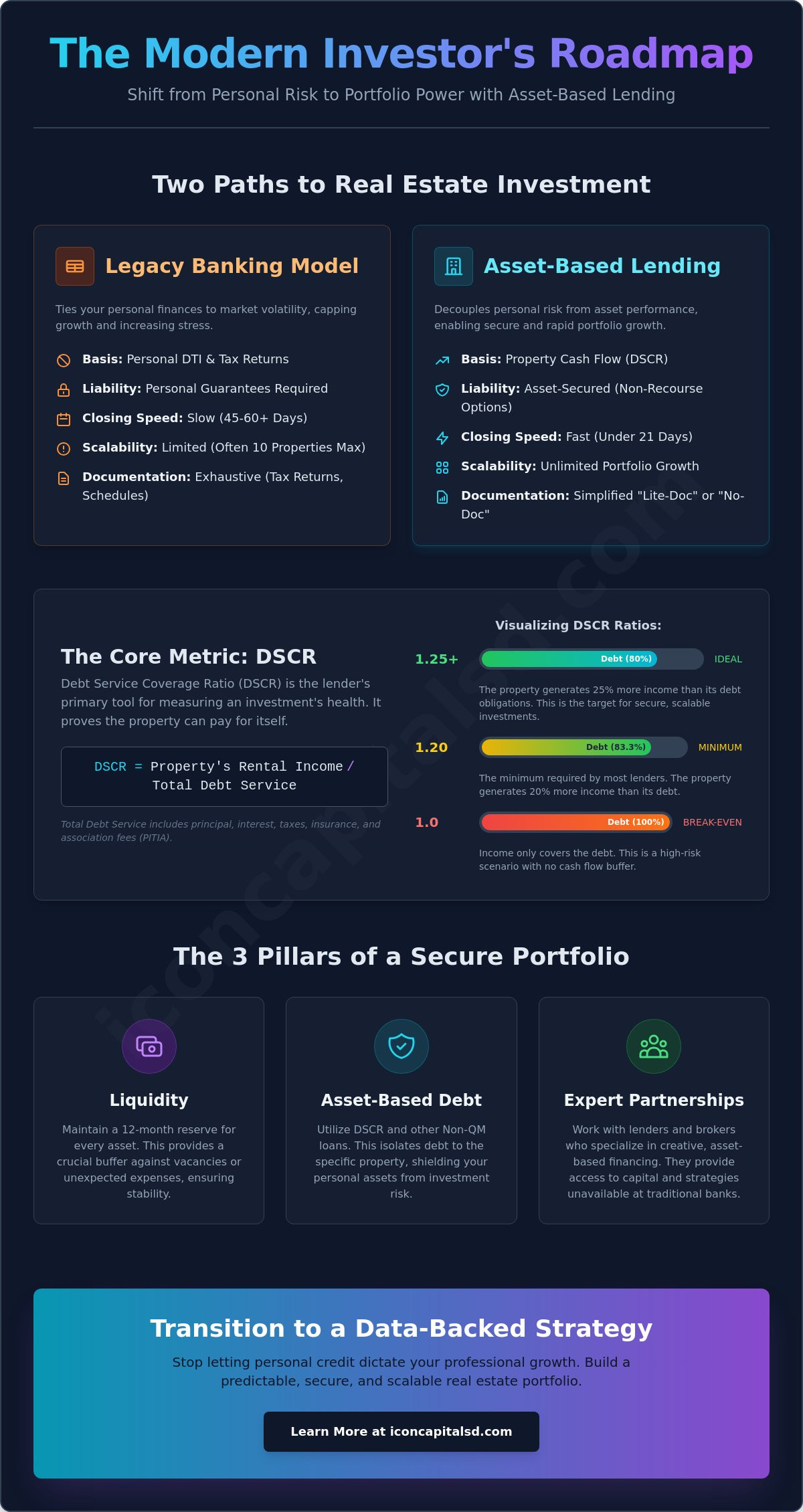
True peace of mind real estate investing isn’t a feeling. It’s a financial architecture that decouples personal risk from investment performance. By 2026, the gap between emotional investing and data-driven scaling has widened. High-volume investors now recognize that traditional 30-year fixed mortgages often create structural stress. These products rely on personal Debt-to-Income (DTI) ratios, which cap growth and tie personal credit to market volatility. When an investor manages 10 or more doors, the traditional model breaks under the weight of personal liability.
Securing a portfolio requires three specific pillars: liquidity, asset-based debt, and expert partnerships. Liquidity ensures a 12-month reserve for every asset. Asset-based debt, such as DSCR loans, focuses on the property’s income rather than the borrower’s tax returns. Expert partnerships provide the bridge to creative capital. In the 2026 market, conservative leverage at 70% LTV serves as the primary stress-reducer, allowing for sustainable growth without the threat of personal insolvency.
The Shift from Emotional to Structural Security
Hope doesn’t close deals or manage vacancies. Professional investors replace hope with predictive analytics and precise cash flow modeling. Understanding real estate investing principles requires a shift toward Non-QM loan products that isolate debt to the specific asset. Data from 2025 shows that portfolios utilizing asset-based debt structures experienced 40% fewer personal credit disruptions during market corrections. Professional debt structuring protects your lifestyle by ensuring that if a single property underperforms, your personal assets remain untouched.
Risk Mitigation vs. Risk Avoidance
Successful investors don’t avoid risk; they price it. Risk avoidance leads to stagnation, while healthy leverage builds wealth. In the initial phases of portfolio expansion, prioritizing deal safety over maximum profit is a requirement. This means targeting properties with a minimum 1.25 DSCR rather than chasing high-risk, high-yield fix-and-flip projects with thin margins. Risk mitigation is the strategic use of asset-based financing to limit personal liability. By focusing on the asset’s ability to service its own debt, you remove the burden from your personal balance sheet. If you’re ready to move toward a more secure structure, you can request a quote to see how asset-based lending fits your 2026 strategy.
Leveraging DSCR Loans for Financial Serenity
Achieving peace of mind real estate investing requires a shift from personal liability to asset performance. Debt Service Coverage Ratio (DSCR) loans represent the gold standard for this transition. Unlike traditional financing, these products prioritize the property’s ability to generate cash flow. Lenders calculate the Debt Service Coverage Ratio to ensure the rental income exceeds the mortgage payment. Most programs require a ratio of 1.20 or higher, meaning the property generates 20% more income than its debt obligations. This data-driven approach removes the stress of personal debt-to-income (DTI) scrutiny and focuses on the deal’s objective merits.
Speed is a critical factor in risk management. Traditional bank approvals often take 45 to 60 days, leaving investors vulnerable to market shifts or losing deals to cash buyers. DSCR loans streamline this, often closing in under 21 days. This efficiency allows you to secure assets before competitors can react. Investors can also scale portfolios to 20, 50, or 100 units without the technical bottlenecks of conventional lending. DSCR financing bypasses the restrictive 10-property limit imposed by government-sponsored enterprises, providing a clear path for rapid, sustainable growth.
Asset-Based Lending: Your Shield Against Personal Liability
Asset-based lending provides a structural barrier between your personal finances and your investment risks. Many specialized DSCR products offer non-recourse or limited-recourse elements. This means the lender’s primary recovery source is the property itself, not your personal assets or credit score. There’s a significant psychological benefit to knowing a property is self-sustaining. It ensures your family’s financial security remains intact even if a specific market fluctuates. For a deeper dive into these structures, consult our Ultimate Guide for DSCR Loans. This separation of assets is a fundamental strategy for peace of mind real estate investing.
Simplifying the Documentation Maze
Traditional underwriting requires years of tax returns and complex schedules. For busy entrepreneurs, this is often a source of friction. “Lite-doc” or “no-doc” programs replace this burden with efficiency. Lenders focus on 12 months of bank statements or simple P&L sheets rather than adjusted gross income figures that may be lowered by legal tax deductions. This approach is particularly effective for self-employed borrowers who need to move quickly. You can explore P&L Home Loans to see how simplified documentation accelerates the acquisition process. If you’re ready to evaluate a specific deal, you can request a quote to see current market leverage options.
Strategic Financing for High-Stress Scenarios
Capital structure determines the survival of a real estate project. In high-stress environments where market shifts or supply chain delays occur, the right financing acts as a primary risk mitigation tool. Achieving true peace of mind real estate investing requires more than just property selection; it demands a capital structure that can withstand volatility. Investors must use leverage as a tactical advantage rather than a simple source of funds. This involves selecting loan products that align with the specific lifecycle of the asset, whether it is a short-term renovation or a long-term hold.
Fix and Flip: Managing the Chaos of Renovation
Short-term renovation projects carry high execution risk. Specialized fix and flip loans provide the liquidity needed to handle the unexpected costs that often arise after demolition. These loans typically fund up to 90% of the purchase price and 100% of the renovation budget. By utilizing data-driven risk management, investors can accurately project the After Repair Value (ARV) to ensure the loan-to-value ratio remains safe. Lenders mitigate “renovation creep” through disciplined draw schedules. Funds are released only after an inspector verifies that specific milestones are met. This oversight provides peace of mind real estate investing by ensuring the project remains solvent and on schedule.
International Investors: Navigating the US Market with Ease
The US real estate market remains a global haven for capital due to its transparency and legal protections. For international buyers, foreign national loans remove the significant barrier of a domestic credit history. Underwriters for these programs focus on the borrower’s global assets and the income potential of the US property rather than a FICO score. This allows for efficient cross-border transactions. Key benefits for international investors include:
- Asset-Based Underwriting: Loans are qualified based on Debt Service Coverage Ratio (DSCR) or liquid reserves.
- Currency Hedge: Investing in USD-denominated assets protects against home-country currency devaluation.
- Streamlined Processing: Expert lenders handle the complexities of international documentation to ensure a 30-day closing timeline.
Bridge loans also serve as a critical tool for rapid acquisition. When a high-value property hits the market, investors use bridge financing to close in 10 days or less, bypassing the lengthy delays of traditional banking. For ground-up construction, structuring loans with interest reserves is essential. This setup allows the loan to pay its own interest for 6 to 18 months, protecting the investor’s cash flow during the non-income-producing phase of development. If you are ready to secure your next deal, request a quote to see available leverage options.
The Mechanics of a Secure Deal: Vetting and Underwriting
True peace of mind real estate investing is built during the underwriting phase, not after the closing. While many investors rely on “gut feelings” or personal relationships with local banks, a data-driven approach removes the volatility of human emotion. At Icon Capital, we prioritize the mechanics of the deal over conversational fluff. Our no-nonsense methodology focuses on asset performance and leverage ratios to ensure every project has a clear path to profitability.
Vetting Your Financial Partner
Your lender is more than a source of capital; they are a gatekeeper for your risk. When evaluating partners, prioritize those who specialize in hard money and leverage. Generalist banks often lack the speed or technical knowledge to close complex, non-QM deals. Ask direct questions about their fee structures. Does the lender charge “junk fees” like excessive processing or document preparation costs? What is their average closing time for a fix-and-flip loan? In 2024, a reliable partner should close in 10 days or less. A professional lender acts as a consultant, identifying flaws in your deal structure before you commit your own capital.
The Importance of Appraisal and Valuation
A conservative appraisal is a safety mechanism for the investor. While it might be tempting to chase high valuations, an inflated appraisal creates a false sense of security. You must distinguish between market value, what a retail buyer might pay, and investment value, what the asset is worth based on its specific use case and cash flow. Maintaining a strict Loan-to-Value (LTV) ratio, typically below 75%, provides a 25% equity cushion to absorb market fluctuations or unexpected renovation costs. Professional underwriting is the final sanity check for any investment, ensuring the numbers survive a worst-case scenario analysis.
To prepare your deal for a successful “yes” from an underwriter, follow these three steps:
- Detailed Scope of Work: Provide a line-item budget for all renovations to prove the After Repair Value (ARV) is realistic.
- Documented Exit Strategy: Show a clear plan for refinancing into a DSCR loan or a direct sale within a 12-month window.
- Asset Transparency: Disclose all property liens and title issues upfront to avoid delays in the final 48 hours of closing.
The Icon Capital Advantage centers on efficiency. We don’t waste time with narrative-driven connections; we focus on DSCR, LTV, and asset liquidity. This technical focus allows us to structure creative financing solutions for business owners and investors who don’t fit the traditional lending box. By removing the guesswork, you achieve peace of mind real estate investing through data, not hope.
Ready to see if your deal meets the standard? Request a quote to structure your next deal.
Executing Your Strategy with Icon Capital
Transitioning from an anxious novice to a confident investor requires shifting from emotional decision-making to a data-backed framework. Realizing peace of mind real estate investing isn’t about eliminating risk entirely; it’s about managing it through precise financing structures. As we approach the 2026 market cycle, the ability to pivot between traditional and non-traditional capital becomes the primary differentiator for successful portfolios. Icon Capital provides the creative financing suite necessary to execute these strategies with clinical efficiency.
The path to closing follows a rigorous, four-step methodology designed to eliminate ambiguity. We focus on the mechanics of the deal first. This structured approach ensures every stakeholder understands the trajectory of the loan from day one:
- Structure: We define the loan parameters based on asset performance and investor goals.
- Submit: Documentation is gathered and organized for immediate review.
- Underwrite: Our specialists evaluate the risk profile and collateral value.
- Close: Funding is deployed, allowing the investor to secure the asset.
Custom Loan Products for Every Investor Profile
Standard bank products often fail to accommodate the complexities of modern investment. We bridge this gap by matching specific financial profiles to specialized products. Whether you’re a high net worth individual, a foreign national, or a self-employed professional, we prioritize the asset’s viability over personal income tax returns. Our asset qualification and bank statement loans allow for 12 or 24-month income verification, providing flexibility for those with significant write-offs. At Icon Capital, the deal’s internal rate of return and debt service coverage ratio (DSCR) take precedence, ensuring the financing supports your long-term peace of mind real estate investing goals.
Start Your Secure Investment Journey Today
Efficiency is the currency of the 2026 real estate market. Waiting weeks for a preliminary approval isn’t a viable strategy. We provide direct, data-driven feedback on deal viability to save you time and reduce administrative stress. Investors can request a quote to view real numbers based on current market rates and LTV requirements. Our communication style is functional and transactional; we focus on the data points that get loans funded. Move from the education phase to the execution phase by securing a capital partner that understands the technical nuances of non-QM lending.
Build Your Scalable Investment Strategy for 2026
Navigating the 2026 market demands a shift from emotional speculation to data-driven precision. Achieving true peace of mind real estate investing requires prioritizing DSCR loans that emphasize asset performance over personal debt-to-income ratios. By utilizing specialized Non-QM programs, you can manage high-stress scenarios with structured, predictable results. This approach ensures your portfolio remains resilient even as market conditions fluctuate.
Icon Capital provides the technical expertise needed to execute these complex strategies. Our team specializes in Foreign National and Self-Employed loans, offering solutions where traditional lenders often fail. We use an efficient, data-driven underwriting process to vet every deal, focusing on the mechanics of cash flow and LTV. This methodical approach allows you to scale your assets with confidence and speed. Don’t let rigid lending boxes limit your growth potential.
Explore your creative financing options and request a quote today
Your next secure deal starts with the right financial partner.
Frequently Asked Questions
What is the safest way to start real estate investing for peace of mind?
The safest way to start peace of mind real estate investing is through Debt Service Coverage Ratio (DSCR) loans on stabilized rental properties. These loans focus on the property’s cash flow rather than your personal income. By targeting a 1.25x DSCR ratio, you’ll ensure the property generates 25% more income than the debt obligation. It’s a strategy that creates a solid safety buffer against vacancies or maintenance issues.
How does a DSCR loan provide more security than a conventional mortgage?
DSCR loans provide security by decoupling your personal income from the investment’s performance. Unlike conventional mortgages that rely on debt-to-income (DTI) ratios, DSCR lenders evaluate the asset itself. If an investment property fails, your personal qualifying income isn’t affected. This structure allows investors to scale portfolios without the 10-property limit typically imposed by Fannie Mae or Freddie Mac.
Can I invest in US real estate as a foreign national without a US credit score?
Yes, foreign nationals can invest in US real estate through specific Non-QM programs designed for international borrowers. These programs often waive the requirement for a US credit score; instead, they use a 12-month history of international credit or bank references. Most lenders require a minimum 25% to 30% down payment for these transactions. It’s an efficient way for global investors to access the US market using only their passport and proof of liquidity.
Why is asset-based lending better for self-employed individuals?
Asset-based lending is superior for self-employed individuals because it ignores tax returns that often show heavy deductions. Lenders use 12 or 24 months of bank statements to verify actual cash flow rather than net taxable income. According to the Bureau of Labor Statistics, 16 million Americans are self-employed. These borrowers don’t have to worry about rejection from traditional banks despite having high liquidity and strong business performance.
What is the ideal Loan-to-Value (LTV) ratio for a low-stress investment?
An LTV ratio between 65% and 75% is the industry standard for low-stress investing. Maintaining at least 25% equity provides a significant cushion against market volatility. Data from the 2008 housing crisis shows that properties with higher equity were 50% less likely to face foreclosure than those with 90% or higher LTV. Lower leverage reduces monthly debt service and increases your monthly net cash flow.
How do I protect my personal assets from my real estate investment liabilities?
You protect personal assets by holding each property within a separate Limited Liability Company (LLC). This creates a legal barrier between your personal net worth and the investment’s liabilities. Combine this with an umbrella insurance policy of at least $1 million for comprehensive coverage. Using non-recourse debt further limits lender recovery to the property itself, so your personal bank accounts and primary residence aren’t at risk.
What are the most common risks in real estate investing and how can I avoid them?
The primary risks are high vacancy rates and unexpected capital expenditures. Investors achieve peace of mind real estate investing by maintaining a 10% reserve fund for repairs and 5% for vacancies based on annual gross income. Thorough due diligence, including a professional inspection and a market rent analysis, mitigates these factors. Fixed-rate financing prevents interest rate hikes from eroding your profit margins, so you don’t face unexpected cost increases.
How long does it typically take to close a creative financing loan in 2026?
Creative financing loans typically close within 21 to 30 days in the current 2026 market. This is significantly faster than the 45 to 60 days required for traditional government-backed loans. The streamlined underwriting process for DSCR and bank statement loans focuses on asset valuation rather than extensive personal documentation. It’s why efficient investors use this speed to secure deals in competitive markets where sellers prioritize quick closing timelines.