

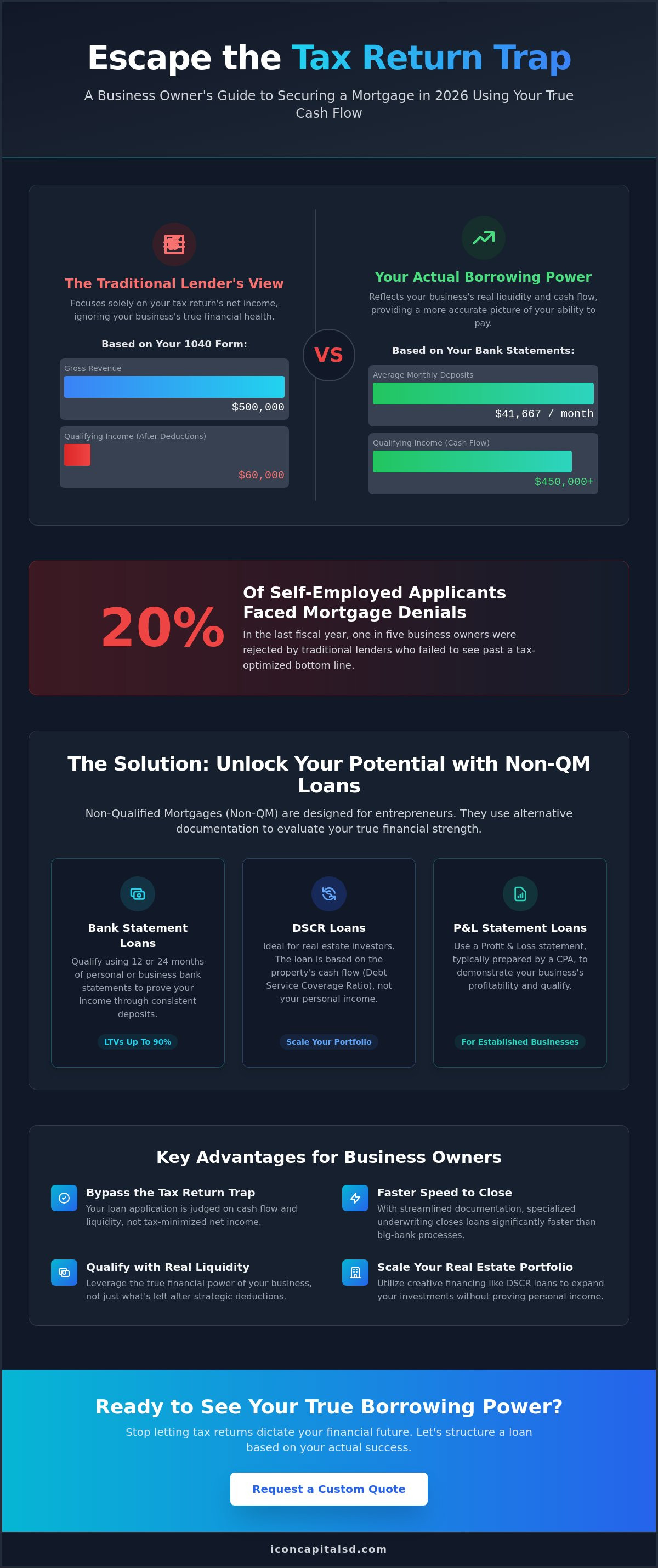
Your tax return is the least accurate measure of your actual borrowing power. While you focus on maximizing legal deductions to protect your bottom line, traditional banks look at your net income and see a risk rather than a successful enterprise. This disconnect is why 20% of self-employed applicants faced mortgage denials in the last fiscal year according to industry reports. Getting a mortgage as a business owner requires a shift away from standard 1040s toward creative, asset-based solutions that reflect your true liquidity.
You shouldn’t have to sacrifice tax efficiency to secure your next property or expand your real estate holdings. We understand that your business cash flow tells a more compelling story than a tax transcript. This guide provides a direct roadmap for leveraging bank statements and liquid assets to qualify for high-leverage financing without the typical documentation hurdles that stall most applications. We will break down the specific Non-QM products, LTV requirements, and DSCR strategies available in 2026 to help you scale your investment portfolio and secure competitive rates without traditional income verification.
Key Takeaways
- Bypass the “Tax Return Trap” by utilizing Non-QM loan products that qualify you based on bank statements and P&L reports rather than net taxable income.
- Scale your real estate portfolio using DSCR loans that focus on asset performance and debt service coverage without requiring personal income verification.
- Learn the essential documentation requirements for getting a mortgage as a business owner, including how to prepare clean bank statements and business entity filings for 2026 underwriting standards.
- Discover how specialized loan structuring and expert underwriting allow for a significantly faster speed to close than traditional big-bank processes.
Why Traditional Mortgages Challenge Business Owners in 2026
Traditional lending institutions rely on automated underwriting systems designed for W-2 employees. These systems prioritize predictable, static income streams. For entrepreneurs, getting a mortgage as a business owner often results in a “paperwork paradox.” You have the liquidity to afford the asset, but your tax strategy makes you look insolvent on paper. Retail banks generally use a “one-size-fits-all” approach that fails to account for the 33% of the U.S. workforce now operating in some form of self-employment or business ownership.
The primary hurdle is the two-year history requirement. Traditional underwriters demand 24 months of consistent or increasing net income. If your business experienced a strategic pivot or heavy reinvestment phase in 2024, the resulting 2025 tax returns might show a temporary dip. Banks interpret this as instability rather than growth. This rigidness forces high-net-worth individuals into consumer-grade loan products that don’t fit their financial reality. Professional-grade creative financing, such as Non-QM products, focuses on actual liquidity and asset strength rather than just the bottom line of a 1040 form.
The Conflict Between Tax Efficiency and Loan Eligibility
Business owners maximize legal deductions to minimize tax liability. Strategies like Section 179 depreciation or heavy marketing spend lower your net income for the IRS. However, traditional lenders use that same net income to determine your maximum loan amount. They look at Line 31 of your Schedule C or the net income on a K-1. They don’t typically “add back” the non-cash expenses that didn’t actually leave your bank account. This creates a disconnect where a business generating $500,000 in revenue might only show $60,000 in qualifying income after aggressive, legal tax planning.
The Problem with Standard Debt-to-Income (DTI) Calculations
Standard DTI calculations are often skewed for business owners. If you use a personal credit card for business expenses to earn points, those balances appear as personal debt. Even if the business pays the bill every month, the lender counts that monthly minimum payment against your personal borrowing capacity. While a commercial mortgage might evaluate the asset’s debt coverage, a residential underwriter looks at your personal debt load. Standard DTI measures personal liability against net taxable income, whereas Entrepreneurial Cash Flow analyzes the gross liquidity and add-back potential of the business entity. This distinction is the difference between a rejection and an approval.
To move past these traditional barriers, you need a partner who understands how to structure a loan based on your actual financial power. If you’re ready to see how your business cash flow translates into purchasing power, you can request a quote to explore specialized Non-QM options.
Non-QM Loan Products: Bank Statement and P&L Solutions
Non-Qualified Mortgage (Non-QM) products provide the necessary flexibility for borrowers who don’t fit the rigid boxes of traditional agency lending. For many entrepreneurs, getting a mortgage as a business owner is difficult because tax returns often show heavy deductions that lower taxable income. Non-QM loans ignore these net figures. Instead, they focus on actual cash flow and business health. These programs treat 1099 contractors and sole proprietors as viable borrowers by looking at gross revenue rather than the bottom line reported to the IRS.
While some business owners utilize SBA 7(a) loans to fund their commercial operations, Non-QM products are the standard for residential acquisition. These loans rely on alternative documentation to prove ability to repay. This shift in underwriting allows for higher loan amounts and faster approvals without the two-year tax return requirement typical of conventional products. This makes it a primary path for those with complex financial structures.
Bank Statement Loans: Qualifying via Cash Flow
Bank statement programs allow borrowers to qualify based on the average monthly deposits over a 12 or 24-month period. Underwriters typically offer two paths: personal bank statements or business bank statements. Personal statements often allow for a 100% credit of deposits. Business statements usually require a standard expense factor, often 50%, unless a CPA letter provides a more favorable expense ratio. Most Bank Statement Loans offer LTV ratios up to 90%, providing significant leverage for those with strong liquid cash flow but high paper deductions.
P&L Home Loans: The Ultimate Guide for Self-Employed
P&L loans represent the most streamlined version of creative financing. Instead of reviewing hundreds of pages of bank statements, lenders use a Profit and Loss statement prepared by a qualified CPA or licensed tax preparer. This document covers the last 12 months of business activity. It serves as the primary source of income verification. To qualify, most programs require the business to have been operational for at least two years. Borrowers must also provide a valid business license or proof of professional standing. You can find more technical details in our P&L Home Loans Guide. This method simplifies getting a mortgage as a business owner by focusing on current performance rather than historical tax filings.
- Documentation: 12 to 24 months of statements or a CPA-signed P&L statement.
- LTV Limits: Often capped at 80% to 90% based on credit score and asset reserves.
- Eligible Borrowers: 1099 earners, gig economy workers, and multi-member LLC owners.
- Loan Amounts: Often available up to $3 million or more for high-net-worth individuals.
If you are ready to see how your current cash flow translates into purchasing power, you can request a quote to review your specific scenario with an underwriter.
Scaling Your Portfolio: DSCR and Investment Loans for Owners
Separating personal debt from business investments is a strategic necessity for entrepreneurs. When getting a mortgage as a business owner, traditional lenders often scrutinize personal tax returns. These documents frequently show heavy deductions that, while beneficial for tax season, lower your qualifying income for a standard loan. Investment-specific programs bypass this hurdle by focusing on the asset’s performance rather than your personal financial history.
Scaling a portfolio requires speed and liquidity. By utilizing non-recourse or asset-based financing, you protect your personal credit and business capital. This approach allows you to acquire multiple properties simultaneously without the debt-to-income (DTI) constraints that typically stall growth in the retail banking sector. In the 2026 market, where agility is a competitive advantage, these creative structures are essential for maintaining a high internal rate of return.
DSCR Loans: Income-Independent Financing
The Debt Service Coverage Ratio (DSCR) is the primary metric for investors who want to scale without personal income verification. The formula is clear: Property Income / Debt Service = DSCR Ratio. For example, if a property generates $5,000 in monthly rent and the mortgage payment is $4,000, the ratio is 1.25. Lenders generally look for a ratio of 1.20 or higher to offer the most aggressive terms.
Business owners favor this product because it ignores personal tax returns and DTI. Qualification is based on the cash flow of the subject property. This allows for rapid portfolio expansion that isn’t capped by your personal earning statement. To understand the technical requirements and LTV limits for these products, read our pillar post: What Is a DSCR Loan?.
Fix & Flip and Construction Loans
Short-term leverage is a powerful tool for business owners entering the real estate market for capital gains rather than long-term hold. Fix and flip loans provide the necessary capital to acquire and renovate distressed assets. Unlike a standard 30-year mortgage, these are interest-only products with terms typically ranging from 12 to 24 months.
Qualification relies heavily on the After Repair Value (ARV). Lenders evaluate the projected value of the property post-renovation rather than your current W-2 or 1099 status. You can often secure up to 90% of the purchase price and 100% of the construction costs. For a detailed breakdown of the draw process and interest rates, consult our Fix and Flip Loans Guide.
Foreign National and International Structures
Many entrepreneurs operate through international business structures or hold citizenship outside the United States. Getting a mortgage as a business owner in these circumstances is difficult through traditional channels because of a lack of domestic credit history. Foreign National programs solve this by allowing investors to use their international credit or liquid asset reserves to qualify. These programs typically require a 25% to 30% down payment but offer a streamlined path to U.S. real estate ownership without a Social Security number or domestic tax residency.
If you’re ready to explore specific terms for your next acquisition, you can request a quote to see current market rates for these specialized products.
How to Qualify: A 2026 Checklist for Business Owners
Securing financing requires a shift from tax-centric reporting to operational transparency. Lenders in 2026 prioritize the structural integrity of your company over the bottom line shown on a Schedule C. You’ll need to provide your Articles of Incorporation and Bylaws to verify ownership percentages. These documents confirm you have the legal authority to leverage business cash flow for a personal mortgage. Getting a mortgage as a business owner hinges on proving that your entity is a stable, independent source of capital.
Clean bank statements are the most critical factor in a Non-QM approval. Underwriters look for consistent ending balances and a lack of administrative friction. Commingling personal and business expenses remains the primary reason for loan denials. If you pay personal rent or car notes directly from a business operating account, lenders may disqualify those statements or add those payments back into your debt-to-income (DTI) ratio. Keep your accounts strictly separated for at least 12 months before applying.
Documentation Readiness for Non-Traditional Loans
Non-traditional underwriting relies on the “Big Three” document set. You must provide a CPA letter verifying you’ve owned the business for at least two years, a current business license, and 12 consecutive months of business bank statements. Clean statements mean zero non-sufficient funds (NSF) marks during the entire 12-month look-back period. A single NSF can result in an immediate decline or a significant increase in your required down payment.
Large, non-recurring deposits require specific handling. If you receive a deposit exceeding 25% of your average monthly revenue, you must provide an invoice or a bill of sale. Underwriters exclude “unseasoned” or undocumented large deposits from your qualifying income to ensure the cash flow is sustainable and not a one-time windfall or a short-term loan from another source.
Asset Qualification: The Alternative to Income
Asset Depletion programs offer a path for owners with high net worth but low taxable income. These programs calculate a monthly income figure by dividing your total liquid assets by a set term, typically 360 months. In 2026, most lenders allow you to use 100% of personal brokerage accounts and 401ks, along with up to 70% of business reserves, to meet DTI requirements. This method bypasses the need for traditional pay stubs or tax returns entirely.
Credit score optimization dictates your interest rate tier. While some Non-QM products accept a 660 FICO, the most competitive LTV (Loan-to-Value) ratios and interest rates are reserved for borrowers with a 740 score or higher. Maintaining a low credit utilization ratio on business credit cards is essential, as these balances can still impact your personal credit profile if you’ve personally guaranteed the accounts.
Ready to see which programs fit your current financial profile? Request a custom quote from Icon Capital today.
Navigating the Creative Financing Process with Icon Capital
Traditional banks often reject self-employed borrowers because they rely on tax returns that show minimal net income after legal deductions. Icon Capital reverses this approach. We don’t wait for an underwriter to find a problem; we structure the deal correctly before the first document is even submitted. This proactive method is essential for getting a mortgage as a business owner in 2026, where market volatility requires precision and speed.
From Structure to Funding
The Icon Capital workflow reduces friction through four distinct phases designed to simplify the loan process:
- Structure: We analyze your business entity, whether it is an LLC, S-Corp, or C-Corp, to determine the most advantageous loan program.
- Submit: Our team packages the file with a clear narrative for the lender, highlighting asset strength over taxable income.
- Underwrite: We work directly with underwriters who specialize in Non-QM and creative financing products.
- Fund: We prioritize speed to ensure you don’t miss out on competitive real estate opportunities.
Understanding creative financing means knowing how to use bank statements or DSCR instead of standard W-2s. This approach allows you to leverage the actual cash flow of your business. If you are ready to see how your specific business structure impacts your borrowing power, you can Request a Quote for a custom scenario analysis.
The Specialist Advantage
Retail banks operate on rigid, automated grids. If a borrower doesn’t fit a specific LTV or DTI box, the application is denied. Icon Capital functions as a specialist enabler. We provide access to Non-QM products that accommodate the complex financial profiles of entrepreneurs. Our expertise is particularly vital for getting a mortgage as a business owner when traditional debt-to-income ratios don’t reflect your true liquid position.
For firms looking to scale, our 5-8 unit residential and bridge loan programs offer a bridge between small residential and large commercial lending. These products allow you to expand your portfolio without the restrictive 1-4 unit limits found at generalist institutions. We focus on the mechanics of the deal, ensuring your business serves as a tool for building real estate wealth. Contact Icon Capital today to explore structured financing that fits your business model.
Scale Your Portfolio with Expert Loan Structuring
The 2026 mortgage market demands a transition from traditional tax return scrutiny to modern cash-flow analysis. You don’t have to navigate these hurdles alone. Getting a mortgage as a business owner is achievable through specialized Non-QM products that recognize your true earning potential. By utilizing 12 or 24 month bank statement programs and P&L-based underwriting, you can bypass the limitations of standard debt-to-income calculations. These programs provide the leverage needed to secure primary residences or expand investment holdings without the friction of conventional bank requirements.
Icon Capital functions as a dedicated specialist in creative financing and transactional loan structuring. We provide access to DSCR programs and asset-based lending that prioritize property performance and liquidity. Our process is built on efficiency, focusing on clear benchmarks like LTV and credit qualification to move your deal toward a successful close. Whether you’re a seasoned investor or a first-time buyer, our team delivers the technical expertise required to navigate complex 2026 lending standards.
Explore Creative Financing Options with Icon Capital
Your business success should be an asset, not a barrier, to your next property acquisition.
Frequently Asked Questions
Can I get a mortgage as a business owner without 2 years of tax returns?
Yes, you can qualify for a mortgage using 12 or 24 months of bank statements instead of tax returns. These Non-QM products focus on actual cash flow rather than taxable income shown on IRS filings. Most lenders require at least 2 years of business history, but documentation requirements shift from tax transcripts to monthly deposits. Getting a mortgage as a business owner becomes more accessible when focusing on gross revenue rather than net profit after deductions.
How much of a down payment is required for a bank statement loan?
Most bank statement programs require a down payment between 10% and 20%. A 90% LTV is achievable for borrowers with strong credit profiles, while others may need 20% down to secure better terms. These requirements are higher than FHA minimums of 3.5% but reflect the increased risk of non-traditional income verification. Lenders use these equity positions to offset the lack of standard W-2 documentation and protect the investment.
What is the minimum credit score for a self-employed mortgage in 2026?
Minimum credit scores for self-employed mortgages generally start at 620 for standard programs, though 660 is the preferred floor for most Non-QM lenders. Higher scores above 720 unlock the lowest interest rates and highest LTV ratios. According to 2026 industry benchmarks, borrowers with scores below 600 face significant challenges and likely require substantial down payments of 25% or more to mitigate risk. Maintaining a clean payment history is vital for securing competitive financing.
Can I use my business bank statements for a personal home purchase?
You can use business bank statements for a personal mortgage by applying a standard expense factor to your total deposits. Lenders typically assume a 50% expense ratio for service businesses, though a CPA letter can often reduce this to 20% or 30% depending on the industry. This method allows you to leverage the full scale of your business revenue to qualify for a higher loan amount than personal tax returns would permit.
What happens if my business shows a loss on my last tax return?
A net loss on your tax return usually disqualifies you from conventional financing, but you can still qualify through alternative documentation programs. Bank statement or P&L loans ignore the bottom line of your 1040 and focus on monthly cash flow instead. This is a common strategy for business owners who utilize heavy depreciation or section 179 deductions to reduce their tax liability while maintaining high liquid revenue and strong repayment capacity.
Is the interest rate higher for business owner mortgages compared to W-2 loans?
Interest rates for bank statement loans and other Non-QM products are typically 0.5% to 1.5% higher than standard 30 year fixed rates for W-2 borrowers. This premium covers the increased cost of manual underwriting and private capital backing. While more expensive, these loans provide the necessary leverage for getting a mortgage as a business owner when traditional debt to income ratios don’t align with actual earnings or business growth.
How does a P&L loan differ from a traditional mortgage?
A P&L loan uses a year to date Profit and Loss statement, often signed by a CPA or Enrolled Agent, to verify income instead of federal tax filings. Traditional mortgages rely on the last 2 years of IRS transcripts, which may not reflect current business performance. P&L programs allow for more real time income assessment, making them ideal for businesses that have seen a 20% or higher increase in revenue recently.
Can a business owner get a DSCR loan for an investment property?
Business owners can secure DSCR loans for investment properties without providing any personal income documentation or tax returns. The underwriter calculates the Debt Service Coverage Ratio by dividing the property’s gross monthly rent by the PITIA. If the ratio is 1.0 or higher, the loan qualifies based on the asset’s performance. This allows investors to scale their portfolios regardless of their personal taxable income or complex business expenses.