

Why are you letting a tax deduction from 2024 prevent you from closing on a multi-million dollar Austin estate in 2026? For high-net-worth business owners, traditional debt-to-income ratios rarely reflect the reality of a successful enterprise. You’ve likely faced frustration with retail banks that prioritize paper losses over actual liquidity. Securing bank statement loans texas provides the necessary workaround, especially in a market where inventory often moves in less than 14 days and waiting for a manual underwriter to decode a complex Schedule C isn’t a viable strategy.
This guide demonstrates how to leverage your actual cash flow to secure primary or investment properties while maintaining your tax advantages. You’ll learn exactly how to qualify based on gross deposits rather than the net income shown to the IRS. We’ll examine the 12-month and 24-month deposit calculation models and the specific Non-QM requirements needed to secure fast pre-approvals and high LTV ratios in today’s competitive landscape.
Key Takeaways
- Bypass traditional tax return hurdles by leveraging 12 or 24 months of actual cash flow to qualify for high-value Texas real estate.
- Identify whether personal or business bank statements provide the most leverage for your specific business structure and income profile.
- Navigate Texas-specific lending nuances, including Homestead laws and high-cost county loan limits, to streamline your approval process.
- Master the essential qualification benchmarks for bank statement loans texas, including specific credit score “floors” and required asset reserves.
- Learn how to scale your real estate portfolio up to $5M+ by transitioning from bank statement programs to advanced DSCR financing solutions.
The Self-Employed Struggle: Why Conventional Texas Mortgages Fail
Bank statement loans texas serve as a critical Non-QM (Non-Qualified Mortgage) solution for the state’s 3.1 million small business owners. Since the 2010 implementation of the Dodd-Frank Act, stricter lending regulations have forced traditional banks to rely almost exclusively on IRS tax transcripts to verify ability to repay. This creates a paradox for the successful entrepreneur. You may generate $500,000 in annual revenue but show minimal taxable income after legal deductions and business reinvestment. Conventional Texas-based W-2 lenders often lack the specialized underwriting departments needed to parse complex business tax returns. They see a high-growth company and see risk, whereas a Non-QM specialist sees cash flow. Alternative documentation has become the primary tool in the 2026 lending landscape to bridge this gap for borrowers who don’t fit the Fannie Mae box.
The Gap Between Taxable Income and Actual Buying Power
Traditional underwriting penalizes business efficiency. Non-cash expenses, such as the Section 179 depreciation deduction or heavy equipment purchases, artificially lower your qualifying income on paper. Adjusted Gross Income is a tax liability metric, whereas Qualifying Cash Flow for Non-QM loans measures the actual liquidity available based on 12 or 24 months of average monthly bank deposits. Traditional Debt-to-Income (DTI) ratios are often misleading for business owners because they don’t account for the separation of business overhead and personal debt obligations. Bank statement loans texas allow us to add back those paper losses to reflect your true financial strength.
- Depreciation: Traditional lenders subtract this; we recognize it as a non-cash expense.
- Business Expenses: High overhead can disqualify you at a big bank despite high net profits.
- Consistency: We look at the health of your business deposits over a 12 to 24-month period.
The 2026 Texas Real Estate Climate
Market speed in Austin, Dallas, and Houston requires immediate action. In early 2026, prime residential listings in North Dallas often see multiple offers within 72 hours. A “contingent on tax return review” offer puts you at a significant competitive disadvantage against cash buyers or W-2 employees with simple files. Sellers in the Texas market prefer certainty and speed. Non-QM lenders like Icon Capital LLC provide a “cash-like” closing experience by eliminating the need for tax transcripts and 4506-C forms. This streamlined approach allows for rapid pre-approvals that hold weight in tight markets. You can request a quote and move toward a 21-day closing while others are still waiting on IRS verification. We focus on the strength of your business bank statements to ensure you don’t lose out on a property due to outdated underwriting standards.
Underwriting Mechanics: How Income is Calculated
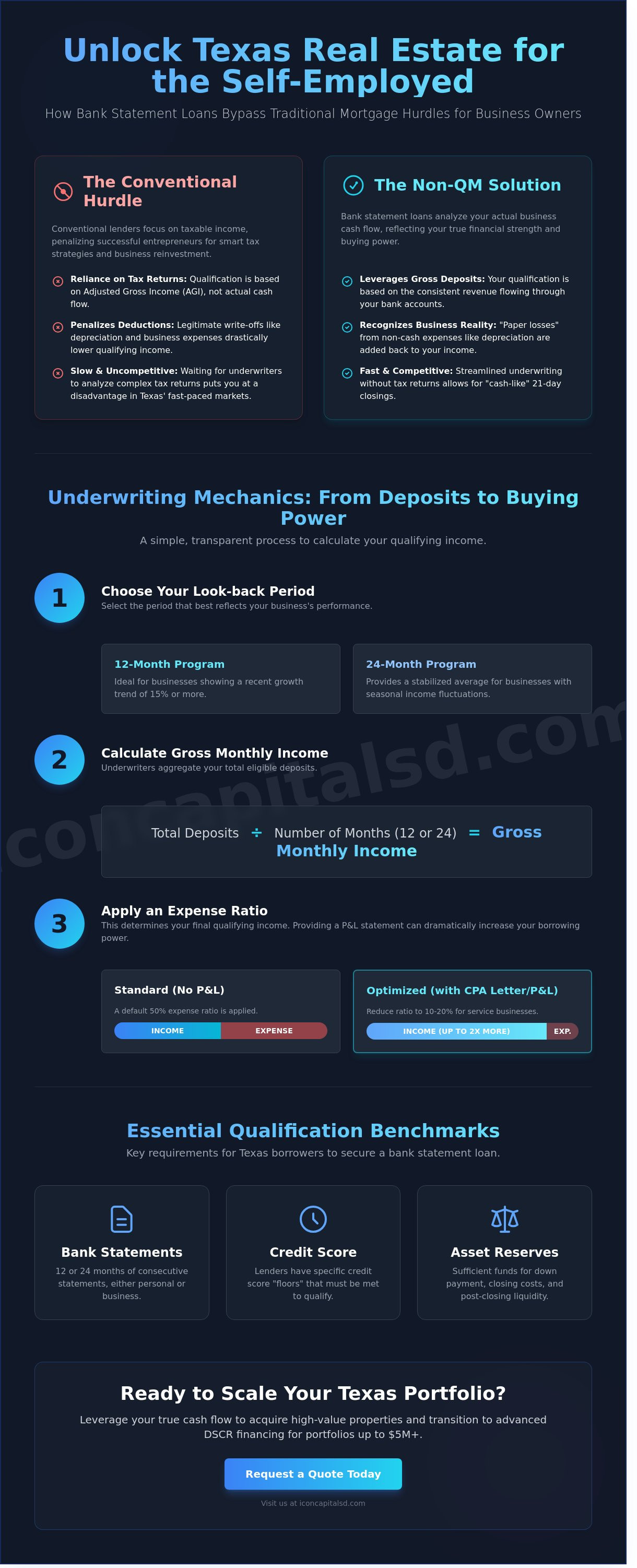
Underwriters analyze risk by examining the consistency of cash flow rather than tax return totals. For bank statement loans texas, the selection of a 12-month or 24-month look-back period is the first strategic decision. A 12-month program is often ideal for businesses showing a 15% or higher growth trend in the current year. Conversely, a 24-month look-back provides a stabilized average for businesses in industries with high seasonality. Using business bank statements is the standard practice, though personal statements are acceptable if the borrower can prove they’re the sole owner of the entity. Business statements typically require an expense ratio adjustment, while personal statements may allow for a higher percentage of deposits to be counted as income.
The Math Behind the Approval
The calculation is straightforward: underwriters aggregate all eligible deposits over the chosen period and divide by the number of months. This establishes the gross monthly income. When a borrower doesn’t provide a P&L statement, lenders apply a default 50% expense ratio to the total deposits. This standard 50% expense ratio serves as a proxy for business overhead when specific financial data is absent. To improve qualification, borrowers can submit a CPA-prepared letter or a third-party P&L. This documentation can reduce the expense ratio to as low as 10% or 20% for service-based businesses, effectively doubling the qualifying income. These Underwriting Mechanics ensure that the loan meets Ability-to-Repay (ATR) standards while providing flexibility for the self-employed.
Eligible vs. Ineligible Deposits
Lenders distinguish between operational revenue and capital injections. Underwriters look for “seasoned” funds, meaning large deposits must be present in the account for at least 60 days to be considered as assets or income. Transfers between a borrower’s own accounts are strictly excluded to avoid inflating the income calculation. One-time business windfalls, such as a legal settlement or a specific asset sale, are also removed from the monthly average. Underwriters focus on recurring revenue that demonstrates the business’s long-term viability. If your business experiences seasonal spikes, providing 24 months of data prevents a single slow quarter from derailing the application. For a precise analysis of your specific cash flow, you can request a quote to see which program fits your deposit history and maximizes your leverage in the current market.
Texas-Specific Guidelines and Property Types
Texas lending operates under unique constitutional mandates that differ significantly from other states. The Texas Homestead Law provides robust protections for homeowners, but it also creates specific regulatory hurdles for Non-QM products. While standard Fannie Mae guidelines for self-employed income focus on net profit after business deductions, bank statement loans texas prioritize gross deposits. This distinction is vital for business owners in high-growth hubs like Houston or San Antonio who show lower taxable income due to heavy reinvestment.
In 2026, loan limits for bank statement programs in high-cost counties like Travis, Dallas, and Collin frequently exceed $3 million. Self-employed borrowers should anticipate the following LTV (Loan-to-Value) benchmarks:
- Primary Residences: Up to 85% LTV for borrowers with a 740+ credit score.
- Investment Properties: Generally capped at 80% LTV to mitigate risk.
- Debt-to-Income (DTI): Lenders typically allow up to 50% DTI when using bank statement qualification.
Pricing nuances also exist between occupancy types. Investment properties in Texas carry higher interest rates than primary residences, often by 0.50% to 1.00%. However, the ability to qualify without tax returns often outweighs the increased rate for active investors.
Financing Diverse Texas Assets
Texas real estate isn’t uniform. In Austin and Dallas, the condo market includes many “non-warrantable” projects that don’t meet Fannie Mae standards due to high commercial space ratios or investor concentration. Non-QM bank statement loans provide a solution for these units. For those looking at 2-4 unit multi-family properties in urban centers, lenders use the projected rental income to bolster the bank statement deposits. Secondary homes in the Texas Hill Country or vacation rentals near the Gulf Coast also qualify under these programs, provided the borrower maintains a secondary residence.
Texas Cash-Out Refinance Rules (50(a)(6))
Texas is famous for its strict 50(a)(6) rules regarding equity extraction on homesteads. You cannot exceed an 80% LTV on a cash-out refinance for a primary residence. This is a constitutional limit, not a lender preference. Bank statement loans can be used for “rate and term” refinances to lower an interest rate without these restrictions. If you’re an entrepreneur looking to Request a Quote to leverage home equity for business expansion, you must ensure the total lien doesn’t cross that 80% threshold. For non-homestead investment properties, these cash-out restrictions don’t apply, allowing for more aggressive capital extraction to fund new acquisitions.
Requirements and Documentation for Texas Borrowers
Securing bank statement loans texas requires meeting specific Non-QM benchmarks that differ from agency guidelines. The credit score floor for most programs starts at 600, though higher scores significantly improve loan-to-value (LTV) options. Borrowers must demonstrate liquidity through asset reserves. Standard requirements dictate between 3 and 12 months of Principal, Interest, Taxes, and Insurance (PITI) in a liquid account. This ensures the borrower can maintain payments during seasonal business fluctuations.
Underwriters rely on a CPA letter to validate business vitals. This document confirms you’ve owned the business for at least 2 years and provides a professional estimate of the expense ratio. While traditional loans use tax returns to calculate income, these programs use bank deposits. Debt-to-Income (DTI) ratios offer more flexibility here, often allowing up to 50% or even 55% if the borrower has strong compensating factors like high residual income or significant cash reserves.
The 4-Step Preparation Checklist
- Step 1: Gather 12 to 24 months of consecutive, all-page bank statements. Missing a single page or month can pause the underwriting process.
- Step 2: Provide a valid business license or a letter from a CPA verifying 2 years of self-employment in the same industry.
- Step 3: Review business accounts for personal expenses. Underwriters may apply a higher expense ratio if personal and business funds are heavily commingled.
- Step 4: Evaluate your documentation style by Comparing P&L Home Loans against bank statement options to see which income calculation yields a higher qualifying amount.
Identifying Potential Red Flags
Underwriters scrutinize statements for Non-Sufficient Funds (NSF) occurrences. More than 3 NSF instances in a 12-month look-back period often lead to an automatic decline. Consistency is critical. A 20% or greater decline in year-over-year deposits suggests a struggling business, which increases perceived risk. Underwriters also perform “due diligence” by verifying the business exists online. A missing web presence, inactive Yelp profile, or lack of a Google Business listing can trigger additional verification requirements. Ensure your digital footprint matches the scale of the income you’re claiming on your bank statement loans texas application.
Ready to see how your deposits translate into purchasing power? Request a custom rate quote from Icon Capital today.
Scaling Your Portfolio: The Icon Capital Advantage
Scaling a real estate portfolio requires a shift in strategy. While bank statement loans texas provide an essential entry point for self-employed buyers, seasoned investors often transition to DSCR Loans to remove personal income from the equation entirely. Icon Capital facilitates this growth by offering loan amounts up to $5 million for high-end Texas estates and multi-property portfolios. This level of capital allows you to move beyond single-family rentals into luxury markets or larger multi-unit assets without the constraints of traditional debt-to-income ratios.
Our specialized underwriters manually review the nuances of every deal. Big-box banks rely on rigid automated systems that often reject complex files. We don’t. We look at the actual cash flow and the strength of the asset. This approach is critical for bank statement loans texas where traditional tax returns don’t tell the full story. By working with a specialist, you gain access to flexible underwriting that understands the needs of a high-net-worth investor.
We prioritize efficiency through a streamlined 4-step submission process. First, we structure the loan based on your specific goals. Second, you submit the required documentation through our secure portal. Third, our internal team handles the underwriting to ensure speed. Finally, we fund the deal. This structure eliminates the bureaucracy common in retail lending, often cutting weeks off the traditional closing timeline.
Creative Financing for the Modern Investor
Investors frequently combine bank statement qualification with Fix and Flip Loans to acquire and renovate distressed assets before moving into long-term financing. We offer cross-collateralization options, allowing you to use equity from existing properties to secure new acquisitions without a massive cash down payment. To maximize monthly cash flow, interest-only payment options are available on several products. These tools allow you to leverage your existing capital more effectively than standard 30-year fixed mortgages.
Next Steps: Get Your Texas Quote
Start your expansion by submitting 12 to 24 months of bank statements for a soft income analysis. This preliminary review provides a clear picture of your borrowing power without impacting your credit score. Most Non-QM files reach the closing table within 21 to 30 days of a completed application. Efficiency is our standard. Explore your Texas loan options with Icon Capital to secure the capital needed for your next acquisition.
Secure Your Texas Real Estate Future in 2026
The 2026 Texas real estate market requires financing that recognizes the reality of self-employment. Traditional debt-to-income ratios often fail to account for the unique cash flow of business owners. By utilizing 12 or 24 months of deposits, bank statement loans texas provide a streamlined path to homeownership or investment property acquisition without the need for tax returns. Icon Capital delivers specialized Non-QM underwriting designed specifically for these complex financial profiles.
Texas borrowers can leverage loan amounts up to $2 million or more. This capacity ensures access to high-value properties in competitive markets like Austin, Dallas, and Houston. Our team maintains a deep understanding of Texas-specific lending regulations to ensure every deal stays on track for a timely closing. It’s time to stop letting conventional underwriting constraints limit your growth. Secure the leverage you need to scale your portfolio or purchase your primary residence with a partner who understands non-traditional documentation. We’re ready to help you navigate the complexities of the current market and fund your next project with efficiency.
Request a Custom Bank Statement Loan Quote
Frequently Asked Questions
Can I get a bank statement loan in Texas with a 620 credit score?
Yes, you can qualify for a bank statement loan in Texas with a 620 credit score. Most Non-QM programs set 620 as the minimum entry point for self-employed borrowers. At this credit tier, lenders typically cap the Loan-to-Value (LTV) at 80%, meaning a 20% down payment is required. Higher scores like 720 unlock better leverage and more competitive interest rates.
Do I need a 20% down payment for a Texas bank statement mortgage?
You don’t always need a 20% down payment to secure a bank statement mortgage. Borrowers with a credit score of 700 or higher can often access 90% LTV options, requiring only 10% down. If your credit score falls between 620 and 680, lenders usually mandate a 15% to 20% equity position to offset the increased risk of the transaction.
How do lenders calculate income if I have both business and personal accounts?
Underwriters calculate income by averaging 12 or 24 months of deposits from your statements. For personal accounts, lenders typically count 100% of qualifying deposits as income. For business accounts, they apply a standard 50% expense factor unless a CPA letter or P&L statement confirms a lower overhead. This calculation determines your debt-to-income ratio for the qualification process.
Are bank statement loan rates in Texas higher than conventional rates?
Yes, bank statement loan rates in Texas are typically 1% to 2% higher than conventional mortgage rates. These products carry more risk because they don’t use tax returns to verify income. The exact rate depends on your specific credit profile and LTV. For example, a borrower putting 30% down will receive a lower rate than one putting 10% down.
Can I use a bank statement loan to buy a 4-unit investment property in Houston?
You can use a bank statement loan to purchase a 4-unit investment property in Houston. These programs apply to 1 to 4-unit residential assets, including duplexes and fourplexes. Lenders evaluate your monthly deposits to ensure you can cover the higher principal, interest, taxes, and insurance costs. This is a common strategy for investors looking to scale their portfolios without tax return documentation.
What happens if my business has a lot of cash expenses that don’t hit the bank?
Lenders only recognize revenue that appears as deposits on your verified bank statements. If your business handles cash that isn’t deposited, that income won’t count toward your qualification. Underwriters verify 12 to 24 months of consecutive statements to establish an income trend. While cash expenses paid outside the bank won’t reduce your qualifying income, the lack of deposits will limit your total borrowing power.
Is a P&L statement always required alongside bank statements?
A P&L statement isn’t always required, but it’s necessary if you want to use an expense ratio lower than the 50% industry standard. If your business has low overhead, providing a CPA-prepared P&L for the last 12 months can significantly increase your qualifying income. Some 12-month programs waive the P&L requirement entirely when you submit personal bank statements instead of business ones.
How long does the bank statement loan process typically take in Texas?
The bank statement loan process in Texas typically takes 21 to 30 days from submission to closing. Manual underwriting is required to analyze 12 or 24 months of deposits, which adds time compared to automated conventional approvals. To keep the process moving, you should provide all pages of every statement, including blank pages, during the initial document upload to the underwriter.