

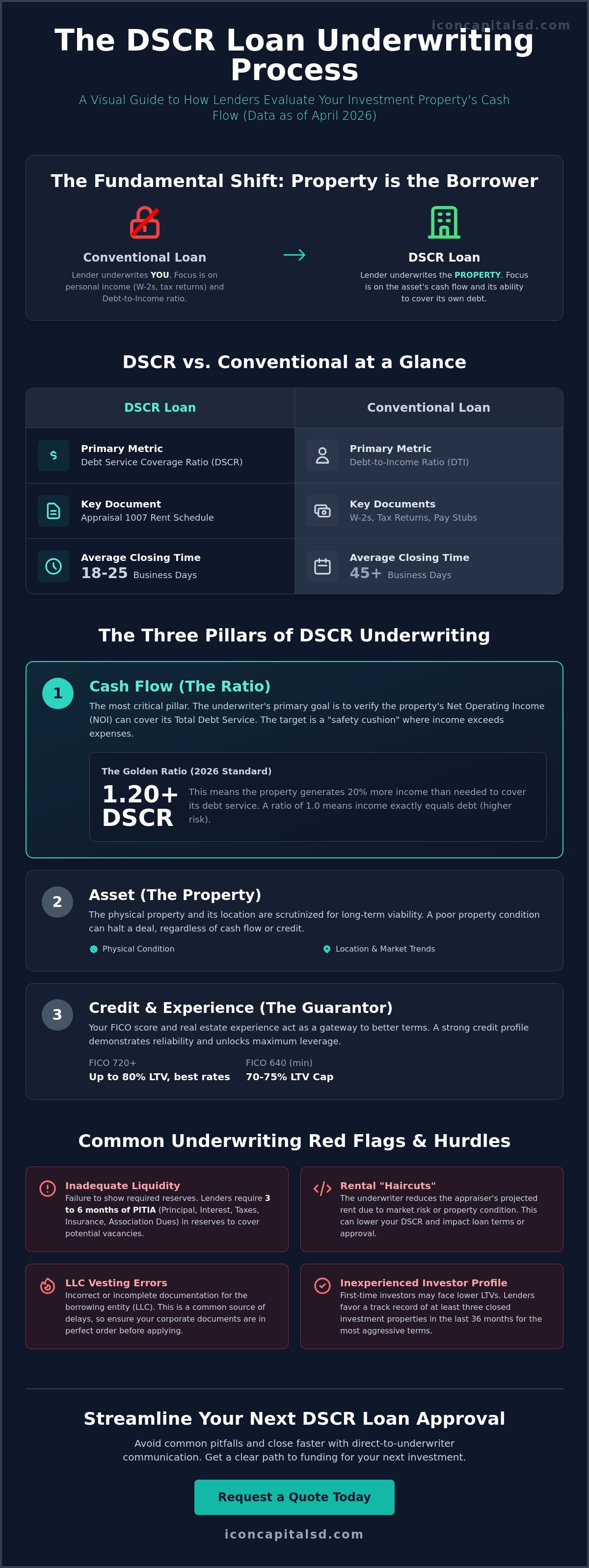
In the world of creative financing, the underwriter isn’t actually lending to you. They’re lending to your property’s cash flow, treating the asset as the primary borrower and your credit as the secondary guarantor. This fundamental shift makes the dscr loan underwriting process significantly faster than conventional financing, with average closing times of 18 to 25 business days as of April 2026. However, that efficiency often comes with unexpected hurdles like “haircut” rental estimates or sudden requests for six months of PITIA reserves.
You likely know the frustration of seeing a deal stalled by a conservative appraiser or a last minute reserve requirement that eats into your liquidity. This guide takes you behind the scenes of the DSCR underwriting process to show exactly how lenders evaluate your investment and how to secure a 1.0 to 1.25 ratio. You’ll learn how to maximize leverage up to 80% LTV, avoid common red flags that trigger denials, and establish a predictable path to closing your next deal without the typical industry delays.
Key Takeaways
- Understand how the dscr loan underwriting process prioritizes property cash flow over personal income, allowing for financing without W-2s or tax returns.
- Learn how underwriters calculate Net Cash Flow (NCF) and why they apply “haircuts” to your gross rental income estimates.
- Identify the primary underwriting red flags, such as inadequate liquidity and LLC vesting errors, that frequently cause closing delays.
- Discover the specific credit and asset benchmarks required to maximize leverage and secure the most competitive 2026 interest rates.
- Master the documentation strategies needed to move from application to a smooth closing using Icon Capital LLC’s direct-to-underwriter communication model.
The DSCR Loan Underwriting Process: Property-First Risk Assessment
Underwriting is the process of verifying a property’s ability to cover its own debt service. Within the dscr loan underwriting process, the asset acts as the primary borrower. Lenders move away from personal financial documents like W-2s and tax returns. They focus on the property’s Net Operating Income (NOI) instead. This shift enables a faster, more transactional approval cycle. In the current April 2026 market, underwriters have increased their scrutiny of liquidity. They want to see that you can handle vacancies or repairs without defaulting. Most programs now require between 3 and 6 months of PITIA reserves to move forward. The underwriter functions as a risk mitigator. Their job is to protect the lender’s capital by ensuring the deal is mathematically sound and the property is viable in its specific market.
In 2026, the underwriter’s role also includes a deeper look at the property’s location and physical condition. They aren’t just looking at spreadsheets. They are looking at the long-term viability of the asset. If a property is located in a declining area, the underwriter might “haircut” the projected rent even if the appraisal looks favorable. This proactive risk management protects the lender’s capital from potential depreciation. By focusing on the asset’s performance rather than your personal debt, the lender can scale with you as you grow your portfolio.
DSCR vs. Conventional Underwriting: The Key Differences
Conventional loans use the Debt-to-Income (DTI) ratio to measure your personal capacity to pay. The dscr loan underwriting process swaps this for the Debt Service Coverage Ratio (DSCR). You won’t need to provide pay stubs or verify employment history. The underwriter looks at the 1007 Rent Schedule from the appraisal report. This document is the single most important piece of the file. It proves the property’s income potential. While conventional loans can take 45 days to close, DSCR loans often finish in 18 to 25 business days because the documentation is significantly simpler. This speed is a primary reason investors choose DSCR when competing in hot markets.
The Underwriter’s Primary Objective
The underwriter’s first goal is verifying the ‘Safety Cushion.’ A 1.20 DSCR is the standard for 2026. This ratio means the property produces 20% more cash than the monthly debt requires. If the ratio drops to 1.0, the risk increases. In these cases, the lender may lower the Loan-to-Value (LTV) or increase the interest rate. They also assess your ‘Exit Strategy.’ Lenders want to know the plan for repayment at the end of the term. This assessment determines your maximum leverage. High-performing properties can qualify for 80% LTV. Properties with tighter margins might be restricted to 70% or 75% to protect the lender’s position and ensure the loan remains sustainable for the duration of the term.
The Three Pillars of DSCR Underwriting: Credit, Asset, and Cash Flow
The dscr loan underwriting process relies on a three pillar framework. While traditional lenders obsess over your personal income, DSCR underwriters weigh your credit profile, the asset condition, and the property’s cash flow in a specific hierarchy. These factors aren’t treated equally. A strong cash flow can sometimes offset a lower credit score, but a poor property condition will often stop a deal regardless of the borrower’s FICO. In 2026, the weighting has shifted slightly toward liquidity. Underwriters want to see that the borrower has the “skin in the game” and the cash reserves to handle market fluctuations. Understanding how these pillars interact is the key to securing maximum leverage.
Unlike a primary residence loan where your Debt-to-Income ratio is the ceiling, here the property’s performance sets the pace. The underwriter looks at the deal as a business proposition. They ask if the property can survive a 5% vacancy rate and still pay the mortgage. If you’re unsure where your current profile places you in this hierarchy, you can request a quote to see how different tiers affect your potential leverage.
Credit and Experience Tiers
Credit scores act as a gateway in the underwriting phase. A FICO score of 720 or higher typically unlocks the best interest rates and 80% LTV options. If your score sits at the 640 minimum, expect the underwriter to cap your leverage at 70% or 75%. Experience is the second half of this pillar. Lenders categorize borrowers into “tiers” based on their track record. A seasoned investor who has closed three or more investment properties in the last 36 months will receive more aggressive pricing. First-time investors are often restricted to lower LTVs and may need a higher FICO, often 700+, to compensate for the lack of a rental management history.
Appraisal and the 1007 Rent Schedule
The asset pillar is verified through the appraisal report, specifically Form 1007 for single-family homes or Form 1025 for small multi-family properties. The underwriter compares “Market Rent” against the “Actual Rent” on existing leases. They almost always use the lower of the two figures for their calculations. Property condition is equally critical. Lenders use a scale from C1 to C6. A C5 or C6 rating indicates significant deferred maintenance or structural issues. In the dscr loan underwriting process, these ratings are deal breakers. The property must be in rent-ready condition, typically C4 or better, to qualify for long-term financing. If the appraisal reveals “subject to” repairs, those must be completed and cleared before the underwriter will issue a final approval.
Income Analysis: How Underwriters Determine Net Cash Flow (NCF)
The dscr loan underwriting process isn’t as simple as comparing a lease agreement to a mortgage statement. Underwriters apply a “haircut” to gross potential rent to account for the friction of real-world property management. They don’t assume the property will be occupied 365 days a year or that every dollar of rent is profit. Instead, they calculate Net Cash Flow (NCF) by adjusting the gross income downward before comparing it to the debt service. This conservative approach ensures the property remains viable even during tenant turnovers or unexpected fee increases.
Lenders focus on the PITIA—Principal, Interest, Taxes, Insurance, and Association dues. While some investors only look at the mortgage payment, the underwriter aggregates every mandatory cost associated with the property. In 2026, many lenders also factor in a standard management fee, often 10%, and replacement reserves for capital expenditures, even if you plan to manage the property yourself. These subtractions can quickly turn a seemingly high-cash-flow deal into one that barely meets the 1.0 minimum ratio requirement.
The DSCR Formula in Action
To find the ratio, underwriters use a standard formula: (Monthly Gross Rent x Vacancy Factor) / PITIA. A typical vacancy factor ranges from 5% to 10% depending on the asset class and location. For example, if a property generates $2,500 in monthly rent and the underwriter applies a 5% vacancy factor, the adjusted income is $2,375. If the total PITIA is $2,000, the resulting DSCR is 1.18. Interest-only (IO) periods can significantly boost this ratio because they lower the monthly debt obligation in the denominator. However, be aware that some underwriters still qualify the deal based on a fully amortized 30-year payment to ensure long-term stability after the IO period ends.
Short-Term Rental (STR) Underwriting Nuances
Underwriting for Airbnb and VRBO properties requires a different data set. Lenders typically use AirDNA or similar third-party aggregators to verify projected income if the property doesn’t have a 12-month historical track record. If the property is already operating, you’ll need to provide a 12-month average of actual earnings. Because short-term rentals are more volatile than long-term leases, the dscr loan underwriting process for STRs often carries stricter requirements. You should expect a higher minimum DSCR floor, frequently 1.25 or above, and potentially lower LTV caps to compensate for the seasonal nature of the income. Success in STR underwriting depends on proving consistent performance through high-quality data rather than just optimistic projections.
Underwriting Red Flags and How to Avoid Them
Efficiency in the dscr loan underwriting process depends on your ability to anticipate conditions before they become bottlenecks. While the asset is the primary focus, underwriters still perform a rigorous audit of the transaction’s structure. Inadequate liquidity remains the primary cause of closing delays in 2026. Most lenders require a minimum of 3 to 6 months of PITIA reserves sitting in a liquid account. If your bank statements show a sudden 40% increase in cash right before application, expect a request for the source of those funds. Even though personal income isn’t verified, anti-money laundering regulations require underwriters to track the origin of your down payment.
Property type ineligibility is another common hurdle. Rural properties with fewer than three comparable sales within a five mile radius often fail to meet guidelines. Similarly, “condotels” or properties with significant deferred maintenance are frequently rejected during the initial appraisal review. Title issues, specifically related to unrecorded liens or incorrect LLC vesting, can stall a deal in the final hours. To ensure your deal is structured for a smooth approval, request a quote today and let our team review your scenario.
Vetting Your Deal Before Submission
You can avoid 90% of underwriting surprises by performing a pre-submission audit. Follow these three steps to verify your deal’s viability:
- Step 1: Run your own math using a DSCR calculator to ensure the property meets the 1.20 floor after accounting for a 5% to 10% vacancy factor.
- Step 2: Verify your liquid reserves. Ensure you have the full 3 to 6 months of PITIA available in addition to your down payment and closing costs.
- Step 3: Confirm the property is “turn-key.” The dscr loan underwriting process requires a C4 condition rating or better. If the roof or HVAC system is at the end of its life, the underwriter may require an escrow holdback for repairs.
Vesting in an LLC
Closing in an entity name is a standard practice for professional investors. It provides a layer of liability protection and allows for easier portfolio scaling. During the underwriting phase, you’ll need to provide your LLC’s Operating Agreement, Articles of Organization, and an EIN confirmation letter. While the loan is made to the entity, personal guarantees are still required from any member with 20% or more ownership. This means the underwriter will still pull a credit report for the individual guarantors to verify their FICO scores and mortgage history, even if the debt doesn’t appear on their personal DTI profile.
Streamlining Your Approval with Icon Capital LLC
Icon Capital LLC simplifies the dscr loan underwriting process by removing the layers of bureaucracy found in traditional retail banks. We facilitate direct communication with our underwriting team to eliminate the communication gaps that often stall investment deals. Our approach is methodical and built for speed. We follow a structured four-step workflow designed to move your file from initial concept to funded asset without unnecessary friction. This process includes structuring the deal metrics, submitting essential documentation, performing the property audit, and moving to a successful closing.
Our specialists don’t just process paperwork. They structure deals. We focus on creative financing solutions for complex investor scenarios that don’t fit into standard lending boxes. Whether you are managing a single-family rental or a multi-state portfolio, our national reach ensures consistent underwriting standards across your entire footprint. We understand that for a professional investor, a loan is a tool for scale. We treat it with the technical precision required to maximize your leverage and preserve your liquidity for the next acquisition.
Why Speed Matters in a Competitive Market
In the April 2026 real estate market, speed is a contingency that wins bids. While conventional investment mortgages often require 45 days to reach the closing table, our commitment to 15 to 21 day closings provides our clients with a significant competitive edge. This efficiency allows you to compete with cash buyers by offering a certain, accelerated timeline. Our expertise also extends to international markets. We specialize in Foreign National underwriting, enabling international investors to access U.S. real estate opportunities without the need for domestic credit history or tax returns.
Get Your Custom Underwriting Quote
Every investment property carries a unique risk profile. A 1.20 DSCR in a high-growth market may qualify for different terms than the same ratio in a stagnant area. We provide a no-obligation deal review to determine exactly where your property stands within the dscr loan underwriting process. Our loan specialists work with you to analyze the 1007 rent schedules and appraisal data before you commit to a contract. This proactive analysis prevents last minute surprises and ensures your exit strategy remains intact. To see the specific leverage and rates available for your next project, Request a Quote from Icon Capital LLC and speak with a specialist today.
Scale Your Portfolio with Property-First Financing
Mastering the dscr loan underwriting process is the definitive strategy for investors moving beyond the limitations of personal income caps. By shifting the focus to the asset’s performance and maintaining the 1.20 safety cushion discussed earlier, you unlock the ability to scale without the friction of traditional bank requirements. The technical hurdles, from PITIA calculations to LLC vesting, are manageable obstacles when you have a structured roadmap for approval.
Icon Capital LLC provides the specialized expertise needed for these sophisticated transactions, offering nationwide coverage for investment properties and solutions for self-employed or international borrowers. We prioritize the mechanics of the deal to ensure your capital remains deployed and productive. Our team is ready to analyze your next acquisition with the precision required for a 15 to 21 day closing. Request a custom DSCR loan quote and get underwritten faster. Your path to efficient, asset-based scaling starts with a clear underwriting strategy.
Frequently Asked Questions
What is the minimum credit score for the DSCR loan underwriting process?
The minimum credit score for the dscr loan underwriting process is typically 640. While some specialized programs may consider scores as low as 620, a FICO of 720 or higher is required to access maximum leverage and the most competitive interest rates. First-time investors often face a stricter floor of 700 to compensate for a lack of rental management history.
Do DSCR underwriters require tax returns or W-2s?
Underwriters do not require tax returns, W-2s, or pay stubs to approve your application. Approval is based on the property’s ability to generate income rather than your personal earnings. This streamlined documentation is why these loans close in 18 to 25 business days, compared to the 45-day timeline typical of conventional investment property financing.
Can I get a DSCR loan for a property I intend to fix and flip?
DSCR loans are intended for stabilized, long-term rental properties and are not suitable for fix and flip projects. If your property requires significant structural repairs or carries a C5 or C6 condition rating, you should utilize a bridge or hard money loan instead. Once the renovations are complete and a tenant is in place, you can refinance into a long-term DSCR product.
How do underwriters handle properties with high vacancy rates in the area?
Underwriters apply a standard vacancy factor of 5% to 10% to the gross rental income during their analysis. If a specific submarket shows vacancy rates exceeding 12% in 2026 market data, the underwriter may increase this “haircut” or lower the maximum LTV. They rely on the appraisal’s 1007 Rent Schedule to verify if the local market can support the projected debt service.
What are ‘reserves’ and how many months do I typically need?
Reserves are liquid assets remaining in your account after closing to cover mortgage payments during vacancies. Most lenders require 3 to 6 months of PITIA (principal, interest, taxes, insurance, and association dues) in a verified bank account. These funds must be seasoned for 60 days to ensure they are not from unverified large deposits or secondary loans.
Does the underwriter care about my debt-to-income (DTI) ratio?
Your personal debt-to-income (DTI) ratio is not a factor in the dscr loan underwriting process. Lenders ignore your personal monthly expenses and focus entirely on the property’s debt service coverage. This allows investors who may have high personal debt or complex tax returns to qualify for financing based solely on the strength of their real estate assets.
What happens if the appraisal comes in lower than the purchase price?
Lenders base the Loan-to-Value (LTV) on the lower of the purchase price or the appraised value. If the appraisal comes in lower than the contract price, you must either negotiate a price reduction or increase your down payment to maintain the required LTV ratio. Underwriters will not adjust the leverage if the asset’s valuation does not support the requested loan amount.
Can I use a DSCR loan for a multi-unit property (5-8 units)?
DSCR loans are available for multi-unit properties with 5 to 8 units, though these are typically classified as small balance commercial loans. While the underwriting principles remain similar, these deals often require a higher minimum DSCR of 1.25 and may have different appraisal requirements than residential 1-4 unit properties. Leverage for these assets is generally capped at 75% LTV.