

Your hard money lender didn’t design that 12% interest rate to be a long-term solution. If you’re facing a 12-month balloon payment or watching high interest rates erode your monthly rental margins, refinancing a hard money loan into a dscr loan is the most logical exit strategy for 2026. Most investors realize that short-term bridge debt serves its purpose during the rehab phase, but holding it past stabilization is a tactical error that limits your ability to scale. You need a permanent debt structure that prioritizes cash flow over speed.
We understand that traditional bank requirements often exclude high-growth investors due to DTI constraints or complex tax returns. This guide provides a direct roadmap for transitioning to a 30-year fixed-rate product based on the property’s performance rather than your personal income. You’ll learn how to lock in long-term stability, lower your monthly debt service, and potentially pull out equity to fund your next acquisition. We will break down the current LTV benchmarks, seasoning requirements, and the specific documentation needed to close your refinance in under 21 days.
Key Takeaways
- Establish a clear exit strategy to transition from high-interest bridge debt into sustainable, long-term financing that protects your equity.
- Navigate 2026 seasoning requirements to understand when you can leverage a property’s appraised value rather than its initial purchase price.
- Maximize monthly cash flow by refinancing a hard money loan into a dscr loan, shifting from interest-only payments to stable amortizing structures.
- Follow a professional roadmap to stabilize your asset, from finalizing rehab and securing qualified tenants to gathering the “Lease-to-Loan” documentation.
- Scale your real estate portfolio efficiently by utilizing Icon Capital’s specialized programs that bridge the gap between acquisition and permanent leverage.
Why Every Hard Money Loan Needs a DSCR Exit Strategy
Successful real estate investing requires a clear transition from high-cost bridge debt to permanent financing. A hard money loan is an effective tool for acquisition and renovation, but it’s not a long-term capital solution. Investors who don’t plan for refinancing a hard money loan into a dscr loan often find their profit margins consumed by high interest carry and looming maturity dates. A defined exit strategy ensures that the capital stack evolves as the property moves from a distressed asset to a stabilized rental.
The Debt Service Coverage Ratio (DSCR) serves as the primary metric for this transition. While hard money lenders focus on the current property condition and After Repair Value (ARV), DSCR lenders prioritize the asset’s ability to generate net operating income. This shift from physical collateral to income-producing potential marks the move from the construction phase to the stabilized rental phase. It’s the standard path for investors looking to scale their portfolios without hitting the ceiling of traditional lending limits.
The Risks of Staying in Hard Money Too Long
Staying in hard money beyond the initial project timeline creates significant financial exposure. Most bridge loans carry terms of 12 to 24 months. As these maturity dates approach, investors face balloon payments that can force a liquidation if refinancing isn’t secured. Interest rates on hard money typically range from 10% to 15%. Over a three-year period, these rates can erode 30% or more of the property’s equity compared to standard rental debt. The psychological stress of short-term maturity dates often leads to rushed, poor decision-making that compromises portfolio growth.
DSCR Loans: The Professional Investor’s Choice
DSCR loans provide the stability required for scaling a portfolio. Qualification depends on property cash flow rather than personal debt-to-income (DTI) ratios. This allows investors to close in an LLC, which provides asset protection and keeps the debt off personal credit reports. With 30-year or 40-year fixed-rate options, investors lock in predictable monthly payments, eliminating the volatility of variable bridge debt. When refinancing a hard money loan into a dscr loan, the focus moves to the property’s performance, allowing the investor to leverage the increased rental income to secure better terms. To see how your current portfolio qualifies, you can request a quote to review your options.
Understanding Seasoning Requirements and Equity Valuation in 2026
Seasoning refers to the duration an investor has held title to a property before a new lender allows a refinance based on the current market value rather than the original purchase price. In the 2026 lending environment, seasoning remains the primary hurdle when refinancing a hard money loan into a dscr loan. Most institutional DSCR programs categorize seasoning into three distinct tiers: 0 to 3 months, 3 to 6 months, and over 6 months. Understanding these windows is vital for calculating your potential cash-out or rate-and-term leverage.
The distinction between “cost basis” and “appraised value” determines your loan-to-value (LTV) limits. If you attempt to refinance too early, lenders generally cap the loan amount at 75% to 80% of your total cost basis, which includes the purchase price plus documented renovation expenses. Once you hit the 180-day mark, lenders typically shift to the full appraised value. This shift allows you to recapture the forced equity created through renovations or market appreciation.
Refinancing with Zero Seasoning
Immediate exits are possible for investors who don’t want to wait 6 months. However, zero-seasoning products usually restrict the loan amount to the lower of the appraised value or the original purchase price. This is common for investors who used bridge debt to secure a property quickly and want to lock in long-term debt immediately. If you purchased the property with 100% cash, you might qualify for “delayed financing” exceptions, allowing you to pull out your initial investment within the first 90 days without waiting for traditional seasoning periods.
For those still in the renovation phase, reviewing a Fix and Flip Loans guide can help you determine if your current project timeline aligns with these early exit strategies. Most 2026 programs require a clean title history and a valid Certificate of Occupancy before the DSCR underwriter will sign off on a zero-seasoning file.
Unlocking Forced Equity After 6 Months
The 6-month milestone is the standard “sweet spot” for the BRRRR (Buy, Rehab, Rent, Refinance, Repeat) strategy. At this point, lenders acknowledge the “new” value of the asset. To maximize your valuation, you must provide the appraiser with a detailed line-item work log and receipts for all capital improvements. This documentation proves the value increase wasn’t just market luck but a result of physical upgrades. You can request a quote to see how current 6-month seasoning LTVs apply to your specific portfolio.
- 1007 Rent Schedule: This form is a mandatory part of the appraisal process. It verifies the market rent for your property, which is the “R” in the DSCR calculation.
- Before and After Photos: Underwriters use these to justify a higher valuation if the property’s condition has improved significantly since the hard money purchase.
- Lease Agreements: Most lenders require a signed lease and proof of a security deposit to confirm the asset is performing before refinancing a hard money loan into a dscr loan.
By 2026 standards, a property with 6 months of seasoning and a 1.20 DSCR ratio typically qualifies for the most competitive tiered pricing. This timeframe provides enough data for the lender to feel confident in the property’s income-producing stability.
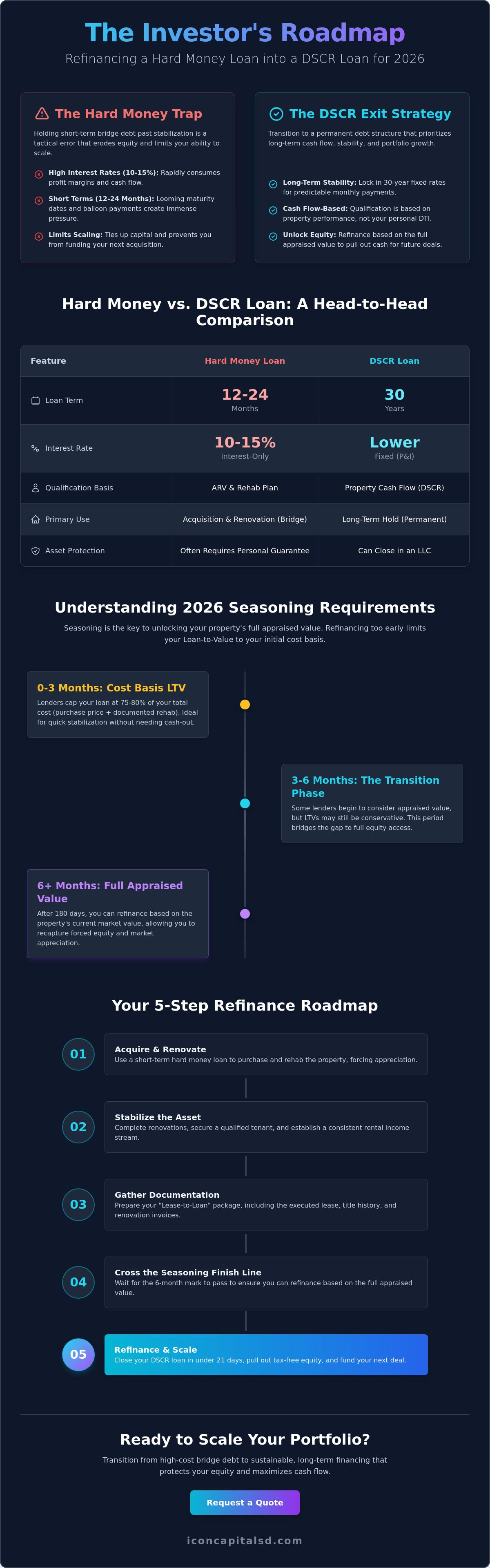
Comparing Hard Money vs. DSCR: Impact on Monthly Cash Flow
Moving from hard money to DSCR transforms a short-term liability into a stabilized cash-flowing asset. Hard money serves as a temporary bridge for acquisition and renovation, while DSCR provides the permanent capital structure required for long-term portfolio scaling. The transition involves a fundamental shift in how debt service is calculated and paid.
Most hard money loans utilize interest-only payments to keep costs manageable during the construction phase. DSCR loans usually transition to a 30-year amortizing schedule. While this adds a principal component to the monthly bill, the significantly lower interest rate typically results in a net increase in monthly cash flow. Investors must also account for exit fees. Hard money lenders often charge a minimum of three to six months of interest. DSCR loans frequently include declining prepayment penalties, such as a 5-4-3-2-1 structure, where the fee decreases each year the loan remains active.
Hard Money vs. DSCR: A Financial Breakdown
The following table illustrates the impact of refinancing a hard money loan into a dscr loan based on a $300,000 loan balance. These figures represent typical market spreads for 2024 and 2025 investment scenarios.
- Hard Money: 11.5% Interest-Only = $2,875 monthly payment.
- DSCR Loan: 7.25% Amortizing (30-year) = $2,046 monthly payment.
- Monthly Savings: $829.
On a $300,000 loan, the switch saves the investor $829 monthly. This capital can be reinvested into property management or maintenance reserves. DSCR lending focuses on the asset’s ability to cover its own debt. It allows for portfolio leverage without the constraints of personal debt-to-income ratios, making it easier to scale beyond the limits of traditional financing.
The Cash-Out Refinance Advantage
Successful investors use the cash-out refinance to pull initial capital back for their next acquisition. When refinancing a hard money loan into a dscr loan, the lender bases the new loan amount on the After Repair Value (ARV) rather than the purchase price. This is the primary mechanism for the “Refinance” step of the BRRRR strategy.
Most DSCR programs allow up to 75% LTV for cash-out refinances and 80% LTV for rate-and-term refinances. If a property appraises for $450,000 after a $300,000 hard money payoff, a 75% LTV loan provides $337,500. This covers the original loan and returns $37,500 in liquidity to the investor. For a deeper look at these mechanics, review our DSCR Loan Guide. This liquidity is essential for maintaining momentum in a competitive real estate market.
The Step-by-Step Roadmap to Refinance Your Investment Property
Transitioning from short-term debt to a long-term DSCR product requires a methodical approach. The primary objective is to maximize your cash-out potential while securing a stable 30-year term. This process typically spans 30 to 45 days, depending on the speed of the appraisal and the clarity of your documentation.
The roadmap begins with property readiness. You can’t finish refinancing a hard money loan into a dscr loan if the property is still under construction. Lenders require a certificate of occupancy or evidence that the rehab is 100% complete. Once the property is habitable, you must secure a qualified tenant. A property that’s already generating income is viewed as a lower risk, which directly impacts your available leverage and interest rate.
The appraisal is the most critical hurdle in the roadmap. Unlike standard residential appraisals, a DSCR appraisal includes Form 1007, the Single-Family Comparable Rent Schedule. This document establishes the fair market rent for your property. If the appraiser’s estimate is lower than your actual lease, it can negatively impact your DSCR ratio. Underwriters use the lesser of the actual lease or the market rent to calculate your coverage. If your ratio falls below 1.20, you may need to bring more cash to the closing table or accept a higher rate.
Lease Agreements and Rental Verification
Lenders generally require a signed 12-month lease and proof of the security deposit to fund the loan. For investors focusing on Short-Term Rentals (STR), the requirements are more stringent. You’ll need to provide a 12-month history of documented earnings or a professional AirDNA Rentalizer report. If the property is vacant at the time of the refinance, some programs will still proceed, but they often cap the LTV at 70% or 75% to account for the immediate vacancy risk. Professional property management agreements should also be included in your “Lease-to-Loan” package to demonstrate operational stability.
Working with Your Hard Money Lender
Clear communication with your current lender prevents delays at the closing table. Request a formal payoff statement at least 10 days before your expected closing date. This statement must include the principal balance, any accrued interest, and specific exit fees, which typically range from 1% to 2% of the original loan. If you plan to move the property into an LLC during the refinance, the title company must ensure the chain of title is clean. Any gaps in ownership history can trigger a secondary review that adds 7 to 10 days to the underwriting timeline. Ensure your LLC is in good standing with the Secretary of State before the file hits the underwriter’s desk.
Ready to lock in your long-term rate? Request a quote from Icon Capital today to see how much equity you can pull from your property.
Scaling Your Portfolio with Icon Capital’s DSCR Programs
Icon Capital streamlines the shift from high-interest bridge financing to stable, long-term debt. Investors often find themselves stuck with expensive capital after completing a renovation; we bridge that gap. Icon Capital understands the “Fix & Flip” lifecycle. We ensure the transition occurs before high-interest carry costs erode your project profits. Successfully refinancing a hard money loan into a dscr loan requires a lender that prioritizes property performance over personal income tax returns.
Icon Capital’s DSCR program is built for speed and efficiency. We focus on the numbers that matter to your bottom line. Key features include:
- No DTI Requirements: We don’t look at your personal debt-to-income ratio. Qualification is based on the property’s rental income.
- LLC Friendly: You can close in the name of your entity to maintain asset protection and professional structure.
- Fast Closing: Many of our DSCR loans fund within 15 to 21 business days, preventing costly delays.
- High Leverage: Access up to 80% LTV on refinances, allowing you to pull equity for your next acquisition.
Creative Financing for Non-Traditional Borrowers
Self-employed investors and business owners often struggle with traditional bank hurdles. Icon Capital removes these barriers by focusing on the asset. We provide specialized solutions for Foreign National Loans, allowing international investors to build U.S. portfolios without a domestic credit history. You get a single point of contact for complex deals. This eliminates the friction of dealing with multiple departments. Our team manages the technical aspects of the deal so you can focus on finding your next property. We handle the 2026 market’s volatility by offering fixed-rate certainty.
Ready to Exit Your Hard Money Loan?
Exiting a short-term bridge loan is the most effective way to secure your investment’s future. By refinancing a hard money loan into a dscr loan, you immediately lower your monthly interest expense. This shift increases your net cash flow and protects your equity from predatory balloon payments. Icon Capital provides the leverage you need to scale your portfolio without the stress of traditional underwriting. Don’t wait for your current lender to call the note. You can Request a Quote from Icon Capital to see your new rate today. It’s vital to lock in your permanent financing before your hard money balloon payment hits its maturity date.
Secure Your Portfolio’s Long-Term Cash Flow
Transitioning assets from high-interest bridge debt to long-term stability is a critical 2026 portfolio strategy. Success depends on navigating standard 6-month seasoning requirements and maximizing LTV through updated property appraisals. By refinancing a hard money loan into a dscr loan, you eliminate the risk of looming balloon payments while instantly improving monthly cash flow. Icon Capital specializes in these Non-QM transitions, focusing on property performance instead of personal tax returns. Our programs require no personal income verification or DTI checks, which facilitates efficient LLC-based closings for active investors. Whether you’re managing a single rental or a growing portfolio, the shift to permanent financing provides the leverage needed to scale. Don’t let bridge loan expirations dictate your investment timeline. Take control of your debt structure with a partner who understands creative financing. Your next acquisition is ready when your current financing is stable and predictable.
Get a customized DSCR refinance quote from Icon Capital today
Frequently Asked Questions
How soon can I refinance a hard money loan into a DSCR loan?
You can often start the refinance process 30 days after your initial hard money closing for rate-and-term transactions. Most lenders allow for immediate transition once the property is stabilized and ready for occupancy. If you’re seeking a cash-out option, expect a required seasoning period of 3 to 6 months to verify the property’s performance.
Do I need a specific credit score to qualify for a DSCR refinance?
A minimum credit score of 620 is typically required to qualify for most DSCR programs in 2026. Investors with scores of 720 or higher generally secure the most competitive LTV ratios and lower interest rates. Lenders pull a tri-merge credit report and use the middle score to determine your eligibility and pricing tier.
Can I do a cash-out refinance on a DSCR loan if I just finished the rehab?
Yes, you can execute a cash-out refinance once the renovation is complete and the property is leased or ready for tenants. Refinancing a hard money loan into a dscr loan allows you to access up to 75% of the new appraised value after a 6-month seasoning period. This strategy enables you to recoup your initial capital and bridge loan costs quickly.
What is the minimum DSCR ratio required for a refinance in 2026?
The standard minimum DSCR ratio is 1.00, where the property’s gross monthly rent exactly covers the PITI payment. Some specialized programs accept a ratio as low as 0.75 for borrowers with a 740+ credit score or 12 months of cash reserves. Properties achieving a 1.25 ratio or higher qualify for the most aggressive leverage and terms available.
Do DSCR lenders require a lease agreement to be in place before closing?
Most lenders require a signed 12-month lease agreement and proof of a security deposit to verify the property’s income stream. For vacant properties, lenders use the market rent projections from the Appraisal Form 1007 to calculate the DSCR ratio. Short-term rentals usually require a 12-month history from platforms like AirDNA to validate the projected annual revenue.
Are there prepayment penalties on DSCR loans when I exit hard money?
DSCR loans typically include a prepayment penalty period lasting 3 to 5 years, often structured on a declining scale like 5-4-3-2-1. You can negotiate a shorter 1-year or 2-year penalty by accepting a slightly higher interest rate during the structuring phase. Hard money loans themselves rarely carry exit fees, making the transition to long-term debt a standard exit strategy.
Can I refinance a hard money loan into my LLC’s name?
DSCR loans are commercial products designed for business entities, and lenders actually prefer the title to be held in an LLC or Corp. Refinancing a hard money loan into a dscr loan under an LLC protects your personal assets and keeps the debt off your personal credit report. You’ll simply need to provide your LLC’s Articles of Organization and an Operating Agreement during underwriting.
What documents do I need to provide for a DSCR refinance?
You must provide a completed loan application, a 12-month lease agreement, two months of bank statements, and your entity’s organizational documents. Lenders also require a professional appraisal with a rent schedule and a clear title report from the closing agent. You don’t need to submit tax returns, W-2s, or personal income verification, as the loan qualifies based on property cash flow.