

Your tax returns are the single greatest barrier to your next high-balance real estate acquisition. While you’ve spent years maximizing deductions to protect your business revenue, traditional banks use those same numbers to justify a rejection letter. A Profit & Loss Home Loan solves this by qualifying you based on your company’s actual performance rather than IRS filings. In the 2026 lending market, waiting for a two year tax history is no longer necessary to secure a primary residence or investment property.
You shouldn’t be penalized for being tax-efficient. We understand that a healthy business often shows a low taxable income, which is why we focus on your net profit margins over the last 12 months. This guide explains how to leverage a CPA-certified statement to access loan amounts up to $5 million with LTVs reaching 80%. We’ll cover the exact documentation required, current Non-QM rate structures, and our streamlined process that targets a 21 day closing.
Key Takeaways
- Learn how to qualify for high-leverage financing using business performance metrics rather than traditional IRS tax transcripts and 1040 forms.
- Discover why a Profit & Loss Home Loan is often the superior choice for business owners with high overhead compared to standard bank statement programs.
- Understand the specific credit score benchmarks and LTV requirements needed to secure up to 80% financing on purchase deals.
- Master the documentation process by learning how to coordinate with a CPA to draft 12 to 24-month statements that meet Non-QM underwriting standards.
- Explore strategies for scaling your real estate portfolio with high-balance financing options and creative structures for complex borrower profiles.
What is a Profit & Loss (P&L) Home Loan?
A Profit & Loss Home Loan is a specialized Non-QM financing solution designed for self-employed borrowers, freelancers, and independent contractors. This program evaluates creditworthiness through a business-prepared or CPA-audited financial statement instead of traditional tax transcripts. Most conventional lenders demand two years of 1040 forms and IRS filings to verify income. This program bypasses those requirements entirely, focusing instead on the actual operational health of your company. It’s a strategic tool for the 16 million self-employed workers in the U.S. who utilize legal tax deductions to minimize their taxable liability.
The core of this mortgage product is the bottom line. Underwriters review your business performance over a consistent 12 or 24-month period to determine your qualifying income. To understand the underlying document used for this process, you can research What is a Profit & Loss (P&L) Statement, which provides a detailed summary of revenues, costs, and expenses. By looking at the net income before tax-motivated depreciation and non-cash expenses, lenders get a clearer picture of your ability to service a monthly mortgage payment. This approach prioritizes current liquidity and cash flow over historical tax data that might be 18 months out of date.
The Problem with Traditional W-2 Underwriting
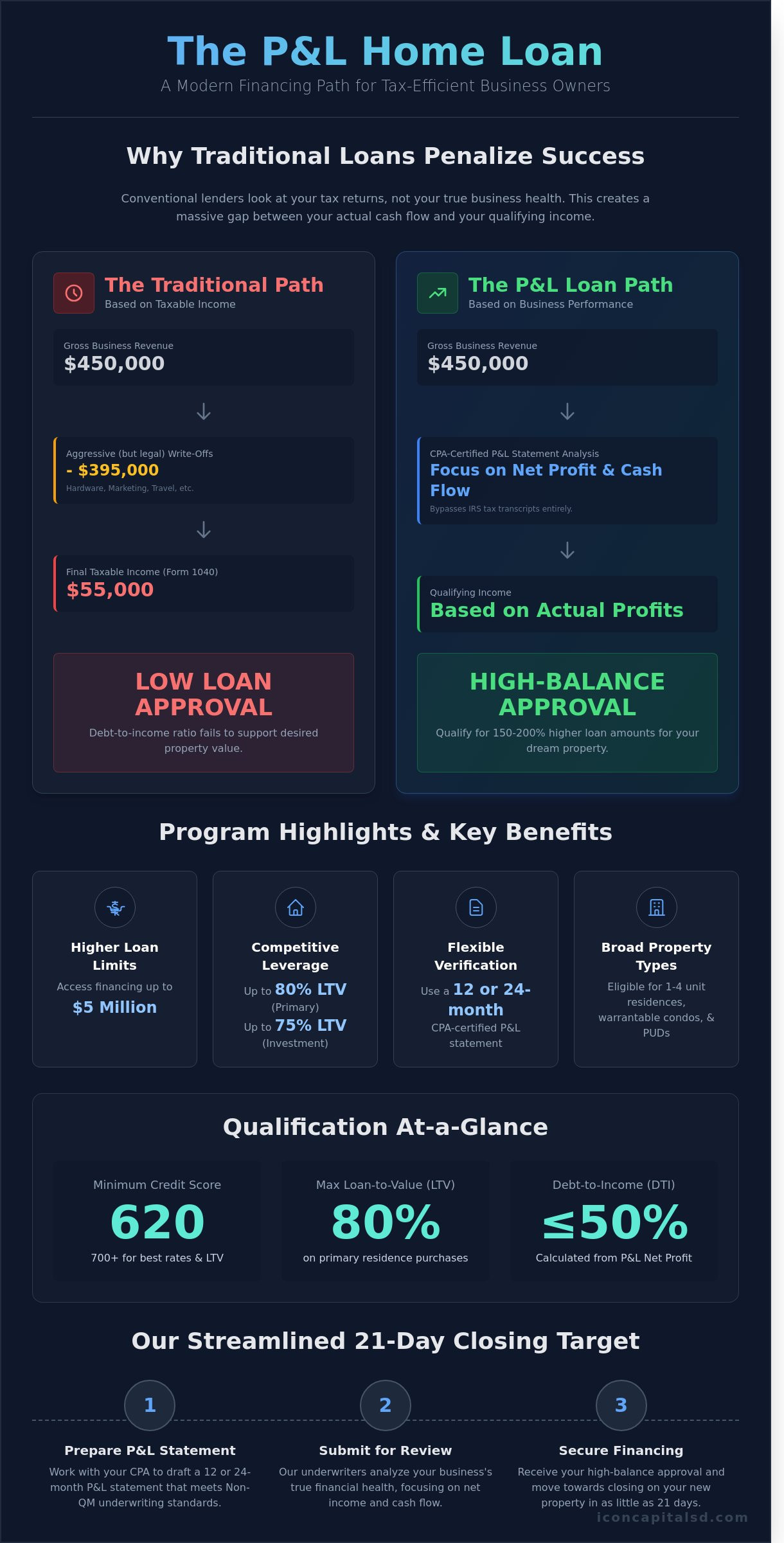
Standard underwriting relies on the final figure of a tax return. For a digital agency owner earning $450,000 in gross revenue, heavy write-offs for hardware, marketing, and travel might leave a taxable income of only $55,000. Traditional banks see that $55,000 and calculate a debt-to-income (DTI) ratio that cannot support a median-priced home in most markets. This creates a massive paper loss discrepancy. The business might have $20,000 in monthly liquid cash flow, but the tax return suggests the owner earns less than a minimum wage employee. Conventional systems don’t have the flexibility to account for these non-standard income streams. They’re bound by rigid Fannie Mae and Freddie Mac guidelines that penalize business owners for being tax-efficient.
Key Benefits of the P&L Mortgage Program
The primary advantage of the Profit & Loss Home Loan is significantly increased purchasing power. By using actual business profits, borrowers often qualify for loan amounts 150% to 200% higher than what a full-doc loan allows. The documentation burden is also substantially lower. You won’t need to provide hundreds of pages of tax schedules or K-1s. Instead, the focus remains on a clean, professional P&L statement.
- Higher Loan Limits: Access loan amounts up to $5 million for premium properties.
- Competitive Leverage: Secure LTV ratios reaching 80% for primary residences and 75% for investment properties.
- Flexible Income Verification: Qualify using a 12-month P&L if your business has shown rapid growth in the last year.
- Broad Property Eligibility: Use this program for 1-4 unit residences, warrantable condos, and PUDs.
Business owners often find that traditional banks struggle with the 20% to 35% expense ratios common in modern service-based industries. Icon Capital understands that a business with high gross revenue and high deductions can still be a low-risk borrower. This program bridges the gap between your tax strategy and your real estate goals. It provides a pragmatic path to homeownership without forcing you to change how you manage your business finances or pay unnecessary taxes just to qualify for a loan.
Qualification and Deal Mechanics: How P&L Loans Work
Qualifying for a Profit & Loss Home Loan requires a shift from traditional tax return analysis to a focus on operational cash flow. Lenders prioritize the net income reflected on your business financial statements rather than the adjusted gross income shown on IRS Form 1040. Because these products fall under the umbrella of Non-QM Financing, they provide flexibility for entrepreneurs who utilize legal tax deductions to reduce their taxable liability.
Credit score requirements for these programs typically begin at 620. Borrowers seeking the most competitive interest rates and lower down payments generally need a score of 700 or higher. For purchase deals, Loan-to-Value (LTV) ratios frequently reach 80%, meaning a 20% down payment is the standard entry point. Loan amounts are scalable to meet diverse needs, ranging from a $150,000 floor to $2,000,000 or more for well-capitalized applicants. Unlike traditional loans, the Debt-to-Income (DTI) ratio is calculated using the monthly net profit derived from your P&L statement. Underwriters typically look for a DTI of 43% or less, though some programs allow up to 50% if the borrower has significant cash reserves.
Documentation Requirements for 2026
For 2026 applications, lenders require a 12 month or 24 month Profit & Loss statement. This document must be current, often dated within 30 to 60 days of the loan application to ensure the business remains viable. Verification of business existence is mandatory. You must provide a valid business license or a Secretary of State filing showing the entity is in good standing. Most programs require a letter from a CPA or a Licensed Tax Preparer. This letter confirms the preparer has managed the business books and that the P&L is accurate and consistent with the company’s financial history.
Understanding P&L Underwriting Standards
Underwriters don’t just look at the bottom line; they analyze expense ratios to ensure they align with industry benchmarks. For instance, a consulting firm might show an expense ratio of 15% to 25%, whereas a retail operation might see 70% to 85%. If a P&L shows a 10% expense ratio for a restaurant, it’ll trigger a manual review because it deviates from the 65% average in that sector. The Reasonableness Test is a verification of industry-standard margins. If the numbers don’t pass this test, the underwriter may request additional bank statements to prove the cash flow supports the reported profit.
If your tax returns don’t reflect your true purchasing power, you can structure your loan using your actual business earnings instead. This approach allows self-employed borrowers to leverage their real-world income to secure high-value real estate without the constraints of traditional underwriting.
P&L Loans vs. Bank Statement Loans: Which is Better?
Choosing between these two Non-QM products depends entirely on how your business manages its cash flow and expenses. A Profit & Loss Home Loan relies on the net income figure calculated by your accountant, whereas bank statement loans focus on total gross deposits. This distinction is vital because lenders often apply a standard 50% expense factor to bank statement deposits if a business doesn’t provide a detailed P&L. If your actual overhead is only 15%, a bank statement loan might disqualify you by significantly underestimating your true purchasing power.
Interest rate premiums for both products generally range from 1.5% to 3.5% above conventional 30-year fixed rates. P&L loans often secure a 0.125% to 0.25% rate advantage over bank statement programs. Lenders view the involvement of a professional CPA or Enrolled Agent as a risk mitigator, which can lead to slightly more aggressive pricing. While bank statement loans are excellent for liquidity-heavy businesses, the Profit & Loss Home Loan offers a more surgical approach to income qualification.
- P&L Loans: Focus on the “bottom line” or net profit after all expenses.
- Bank Statement Loans: Focus on the “top line” or total revenue moving through the accounts.
- Expense Ratios: P&L loans use your actual data; bank statement loans often use industry averages or fixed percentages.
When to Choose a P&L Loan
A P&L loan is the superior choice for service-based businesses like consulting firms, legal practices, or software developers. These entities often maintain profit margins above 75% because they don’t carry physical inventory or heavy equipment costs. If your bank statements are “noisy” with frequent personal transfers or commingled funds, a P&L statement provides a clean, audited view of your financial health that bypasses the clutter. This route is strategically sound for Mortgage Approval for Business Owners who have a dedicated financial professional managing their books. Lenders typically require the document to be signed by a CPA who has overseen the accounts for at least 12 to 24 months.
When Bank Statement Loans Take the Lead
High-volume businesses with low margins, such as retail shops, restaurants, or e-commerce platforms, usually benefit more from bank statement programs. If your business spends $0.85 to make $1.00, your P&L will show very little qualifying income for a mortgage. However, a bank statement loan evaluates the $1.00 deposit, providing a broader base for qualification. This is also the preferred route for businesses that are too new to have a consistent, year-over-year P&L history but can show 12 months of strong, steady deposits. You can compare the specific documentation requirements for these programs by reviewing our Bank Statement Loans page. For businesses with fluctuating monthly expenses, the gross deposit method offers a more stable qualification metric than a month-by-month profit analysis.
Ultimately, the choice comes down to your net margin. If your net profit is higher than 50% of your gross revenue, the P&L loan is almost always the better financial move. If your expenses are high but your cash flow is massive, bank statements will likely get you the loan amount you need.
Preparing Your P&L Statement for Mortgage Approval
Qualifying for a Profit & Loss Home Loan hinges on the precision of your financial reporting. Lenders require a comprehensive P&L statement covering the most recent 12 to 24-month period. This document serves as the primary gauge for your debt-to-income (DTI) ratio, replacing the traditional tax return. You must ensure the statement reflects a steady or upward trend in net income. If your business shows a 15% decline in profit year-over-year, underwriters will require a detailed analysis of your operational costs. Aligning your P&L categories with Generally Accepted Accounting Principles (GAAP) ensures the lender can map your revenue to industry benchmarks without unnecessary delays. Your statement should clearly break down gross revenue, cost of goods sold, and all operating expenses to provide a transparent view of your cash flow.
- Gross Revenue: Total sales before any deductions.
- Cost of Goods Sold (COGS): Direct costs attributable to the production of the goods sold.
- Operating Expenses: Rent, utilities, payroll, and marketing costs.
- Net Operating Income: The final figure used to calculate your qualifying income.
CPA-Prepared vs. Borrower-Prepared Statements
Underwriters prioritize risk mitigation and third-party verification. Most Non-QM programs mandate a signature from a licensed CPA or Enrolled Agent to validate the P&L statement’s integrity. Professional preparation significantly impacts your loan terms. For instance, a CPA-signed statement often allows for an 80% LTV, while a borrower-prepared document might cap your leverage at 70% or 75%. Self-prepared statements frequently trigger extra scrutiny. Underwriters look for red flags like perfectly rounded numbers or the absence of standard expenses like insurance or payroll taxes. A professional signature signals that the data is audited and reliable, which can also help you secure a 0.25% to 0.50% lower interest rate compared to unverified statements.
The Importance of Consistency
Accuracy across your entire application package is non-negotiable. Underwriters will cross-reference your P&L with your business bank account balances for the last 90 days. If your P&L reports $45,000 in average monthly revenue but bank deposits only total $30,000, the file will be flagged for a manual audit. You must document the exact business name and verify your ownership percentage through an operating agreement or articles of incorporation. A 51% owner has different income attribution than a 100% owner. Consistency across P&L and bank data is the #1 factor in closing speed.
Sudden fluctuations in profitability don’t automatically disqualify you, but they do require proactive communication. If your net profit dropped by 18% in the last six months due to a $30,000 capital expenditure for new equipment, you’ll need a Letter of Explanation (LOE). This letter should be concise and supported by data. Include invoices or contracts to prove the expense was a one-time investment rather than a permanent loss of revenue. Clear documentation prevents the underwriter from making negative assumptions about your business’s long-term health. Providing a Year-to-Date (YTD) statement that shows a return to normal profit levels can also help offset a previous dip in the 24-month lookback period.
Icon Capital: Scaling Your Portfolio with P&L Financing
Icon Capital LLC specializes in creative financing for complex borrower profiles who don’t fit the rigid boxes of traditional banks. We understand that a business owner’s tax returns rarely tell the full story of their financial health. Our Profit & Loss Home Loan program bridges this gap by focusing on actual business performance rather than depreciated net income. We handle high-balance loans exceeding $2,000,000 for sophisticated investors who need to move quickly on high-value assets. You get direct access to specialists who understand business deal mechanics, ensuring your loan is structured for maximum leverage.
Our operational model prioritizes efficiency. We’ve refined a four-step workflow to ensure capital moves at the speed of your next acquisition. This process eliminates the friction common in retail lending:
- Structure: We analyze your P&L statement and business bank statements to determine the maximum debt-to-income ratio allowed for your specific entity type.
- Submit: Your file moves to our internal processing team with a complete documentation package, reducing the need for back-and-forth conditions.
- Underwrite: Specialists evaluate the risk based on 12 or 24 months of business cash flow. This removes the requirement for 4506-C tax transcripts.
- Close: We fund the deal, allowing you to scale your portfolio without the 60-day delays found at major depository institutions.
High-net-worth individuals often find themselves stuck when trying to acquire properties worth $5,000,000 or more because traditional debt-to-income calculations don’t account for complex corporate structures. Icon Capital LLC solves this by looking at the gross revenue and expense ratios of the business itself. We provide the technical expertise to translate your business success into mortgage eligibility.
Why Investors Choose Icon Capital LLC
Investors prioritize Icon Capital LLC because we focus on speed for time-sensitive real estate deals. We have extensive experience with residential 1-4 unit properties and multi-unit investment buildings. Our expertise lies in Non-QM products, specifically DSCR and P&L loans. We don’t just provide a loan; we provide a scaling strategy. By utilizing a Profit & Loss Home Loan, you keep your tax filings private while using your liquid cash flow to secure assets. We target specific LTV ratios up to 80% for qualified self-employed borrowers, providing a competitive edge in tight markets where cash-like closing speeds are required.
Get Started with a Custom Quote
Leveraging your business equity shouldn’t be a slow or painful process. Our simple four-step method removes the bureaucratic hurdles found in legacy banking. If you’re ready to use your business profits to secure your next property, we provide the technical expertise to structure the transaction. You can request a personalized P&L loan quote from Icon Capital LLC today to see exactly how much you qualify for based on your current profit margins. Our team reviews submissions within 24 hours to provide clear, actionable feedback. We focus on the numbers that matter to your business, helping you transition from a business owner to a dominant real estate investor.
Secure Your Real Estate Assets with Strategic P&L Financing
Traditional lending models often fail to account for the unique financial structures of modern businesses. By prioritizing net income over taxable income, you gain the leverage necessary to acquire assets that align with your true earning power. A Profit & Loss Home Loan provides a direct path to funding without the constraints of tax return documentation or the volatility of 12 month bank statement deposits.
Icon Capital acts as a specialist in Non-QM and creative financing. We facilitate loan amounts up to $2 million for entrepreneurs ready to scale their portfolios in 2026. Our team utilizes a streamlined 4-step approval process to ensure your deal moves from structure to submission without unnecessary delays. It’s a pragmatic solution for serious investors who value efficiency and results.
Explore your P&L loan options with Icon Capital. We look forward to helping you close your next deal.
Frequently Asked Questions
Do I need tax returns for a Profit & Loss home loan?
No, you don’t need tax returns to qualify for a Profit & Loss home loan. Lenders use a 12 or 24 month P&L statement to calculate qualifying income instead of IRS transcripts. This allows self-employed borrowers to use their actual business cash flow rather than the taxable income shown on Form 1040 after deductions. It’s an ideal solution for business owners with significant write-offs.
Can I use a P&L loan for an investment property?
Yes, you can use a P&L loan for investment properties, primary residences, and second homes. For investment acquisitions, lenders typically require a 20% to 25% down payment. These loans offer a viable alternative to DSCR programs when the property’s rental income doesn’t meet 1.2x coverage ratios but the borrower’s business cash flow is strong. Investors can leverage this product to scale their portfolios quickly.
How much higher are P&L loan rates compared to traditional mortgages?
Rates for a Profit & Loss home loan typically range from 1.0% to 2.5% higher than standard conforming rates. If a prime 30 year fixed rate is 7.0%, a P&L mortgage might start at 8.25% or 8.5%. The exact premium depends on the borrower’s credit score and the loan to value ratio. These rates reflect the increased risk associated with using non-traditional income documentation for the underwriting process.
Does my P&L statement need to be audited by a CPA?
Most programs require the P&L statement to be prepared or signed by a licensed CPA, Enrolled Agent, or professional tax preparer. While a full formal audit isn’t usually required, the preparer must verify they’ve managed the business’s books for at least 24 months. Self-prepared statements are rarely accepted in the Non-QM space. This ensures the data is accurate and follows standard accounting principles for risk assessment.
What is the minimum credit score for a P&L mortgage?
The minimum credit score for most P&L programs is 660. Borrowers with a 720 FICO or higher often secure the best pricing and higher LTV limits up to 80%. Some niche products might allow scores down to 620, but these usually require a 30% down payment to offset the increased risk. Maintaining a clean 12 month mortgage pay history is equally important for approval.
Can I qualify for a P&L loan if I have been self-employed for only one year?
No, most lenders require a minimum of 24 months of self-employment history in the same industry. A business license or a letter from a CPA confirming the business’s existence since January 2022 is standard documentation. Exceptions are rare and typically require 12 months of liquid reserves. This 2 year requirement proves the business’s stability and the consistency of the revenue stream being used for the mortgage.
How is the Debt-to-Income (DTI) ratio calculated on a P&L loan?
DTI is calculated using the net income shown on the P&L statement divided by total monthly debt obligations. Lenders look for a maximum DTI of 43% to 50%. If the P&L shows $15,000 in monthly net profit and total debts are $6,000, the DTI is 40%. This calculation ignores non-cash expenses like depreciation, which helps self-employed borrowers qualify for higher loan amounts than traditional tax return methods allow.
Are P&L loans available for foreign nationals?
Yes, certain Non-QM lenders offer P&L programs specifically for foreign national investors. These borrowers must provide a P&L statement from their foreign business, which a certified professional must translate into English. LTV is usually capped at 65% or 70% for these transactions. The lender will also require a valid passport and potentially a letter of reference from a financial institution in the borrower’s home country.