

Is “no money down” a legitimate financing strategy or just a marketing ghost designed to lure investors into high-interest traps? Most professionals realize that traditional banks won’t touch a distressed property without 25% cash on the table. With interest rates for fix and flip loans currently ranging from 9.5% to 14% as of May 2026, the no money down fix and flip loans reality is that 100% financing is a structural achievement of leverage rather than a single off-the-shelf product. You’re likely tired of high entry costs depleting your liquid reserves before the first wall is even demolished.
This guide provides the technical roadmap to structuring deals with zero out-of-pocket cash by utilizing secondary financing and cross-collateralization. We’ll explore how to maximize the 90% LTC and 100% rehab programs while staying within the 75% ARV safety margin. You’ll learn the specific lender requirements for 2026 and how to find partners that allow the creative layering necessary to scale your portfolio without hitting a capital ceiling. We’ll break down the exact costs of high leverage and the mechanics of closing with zero cash on the HUD-1.
Key Takeaways
- Understand the technical mechanics behind the no money down fix and flip loans reality and why 100% financing is a strategy of leverage rather than a single product.
- Learn how to balance Loan-to-Cost (LTC) and Loan-to-Value (LTV) ratios to minimize your initial equity contribution while maintaining a safe exit strategy.
- Discover three specific methods to bridge the capital gap, including the “Seller Second” technique and strategic cross-collateralization of existing assets.
- Identify the hidden costs associated with high-leverage flipping, from interest rate premiums to front-loaded points that impact your net ROI.
- Find out how to structure complex deals using specialized Fix & Flip programs designed for professional investors seeking maximum scale.
The Reality of No Money Down Fix and Flip Loans in 2026
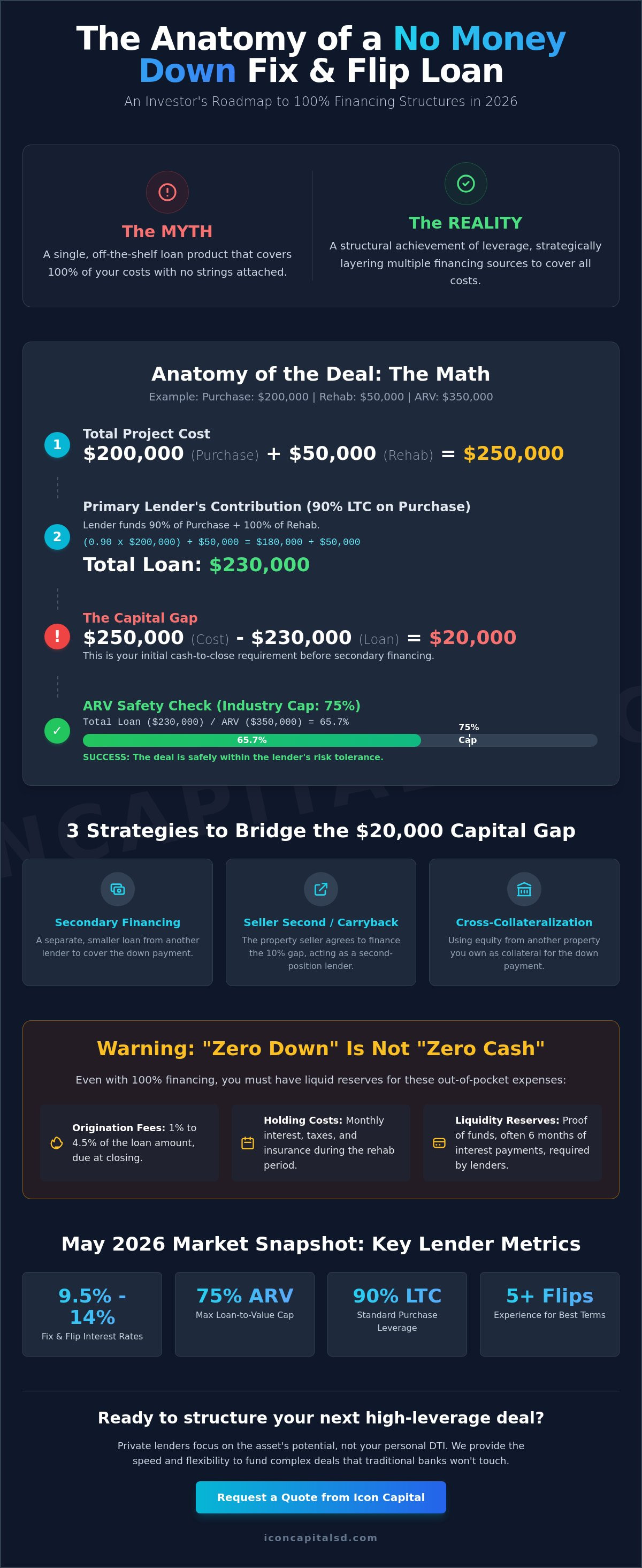
The no money down fix and flip loans reality in May 2026 is that 100% financing is a technical configuration rather than a standard retail product. While marketing headlines suggest capital is free, asset-based lenders focus strictly on Loan-to-Cost (LTC) and Loan-to-Value (LTV) metrics. Most standard programs cap at 90% of the purchase price and 100% of the renovation costs. To reach a true zero-down position, investors must bridge the remaining 10% through secondary financing, seller seconds, or cross-collateralization of other equity-rich assets.
Lenders enforce “skin in the game” rules because borrower equity reduces default risk. In the May 2026 market, several factors influence these leverage limits:
- Interest Rate Environment: With average bridge loan rates currently at 10.4%, debt service coverage is tighter than in previous years.
- ARV Safety Margins: If a project exceeds 75% of the After Repair Value (ARV), the risk of a market correction wiping out equity becomes too high for most institutional underwriters.
- Experience Level: Investors with five or more successful flips in the last 24 months receive the highest leverage and lowest rates.
You can request a quote to see how your specific deal structure fits these leverage caps and current market requirements.
Expectation vs. Reality: Zero Down vs. Zero Cost
The biggest misconception in Flipping is that zero down means zero cash. Even with 100% financing for the purchase and rehab, you’ll still face origination fees between 1% and 4.5%. You must also account for property taxes, insurance, and interest payments during the hold period. Lenders typically require proof of liquidity reserves equal to six months of interest payments before they’ll fund a high-leverage loan. Experience remains the primary currency. A flipper with a proven track record can access leverage that a novice simply cannot.
Why Traditional Banks Say No (And Why Private Lenders Say Yes)
Traditional banks prioritize Debt-to-Income (DTI) ratios and personal tax returns. This often disqualifies active real estate investors who use complex tax strategies to scale their portfolios. Private lenders focus on the asset’s potential instead. They evaluate the ARV and the feasibility of the renovation budget rather than your W-2 income. This allows for the speed necessary to close in 5 to 14 days. While a bank might take 45 days to deny a loan based on strict credit overlays, private capital provides the flexibility to fund complex deals that traditional institutions won’t touch.
How 100% Financing Actually Works: LTC vs. LTV
Lenders evaluate project risk using two primary metrics that dictate the maximum leverage you can achieve. Loan-to-Cost (LTC) represents the percentage of the total project expenses, including the purchase price and renovation budget, that a lender will fund. Loan-to-Value (LTV), specifically in the context of Fix and flip loans, refers to the After Repair Value (ARV). In the May 2026 market, the industry standard is a 75% ARV cap. This means your total loan amount cannot exceed 75% of the property’s projected worth once all repairs are finished.
Rehab funds aren’t typically distributed at the closing table. Instead, lenders hold 100% of the renovation budget in an escrow account. As you complete specific milestones, you request a “draw” to reimburse your costs. An inspector verifies the work before the lender releases the funds. This process ensures the asset’s value increases in lockstep with the capital deployed. Understanding this draw schedule is vital for managing your cash flow during the project’s lifecycle.
The Math Behind the Deal
Achieving a zero-down position occurs when the combined purchase and rehab financing covers your entire acquisition cost without exceeding the lender’s LTV ceiling.
Consider a property with a $200,000 purchase price and a $50,000 renovation budget. The ARV is appraised at $350,000. If a lender offers 90% LTC on the purchase and 100% of the rehab:
- Lender funds 90% of purchase: $180,000
- Lender funds 100% of rehab: $50,000
- Total Loan Amount: $230,000
- Total Project Cost: $250,000
- Capital Gap: $20,000
The no money down fix and flip loans reality is that even with high leverage, you still face a $20,000 gap plus closing costs. To reach 100% financing, you must solve for this specific deficit through additional leverage strategies.
Cross-Collateralization: Using Other Assets
If you don’t have the liquid cash to cover the 10% purchase gap, you can use equity in other properties you already own. This is known as cross-collateralization. The lender takes a secondary lien on your existing asset to secure the down payment for the new project. This allows you to scale your portfolio without depleting your cash reserves. Some investors use blanket loans to tie multiple properties into a single financing facility. While this simplifies debt management, it also links the risks of multiple assets. If one project fails, the collateral property is also at risk of foreclosure.
Before committing to your next acquisition, it’s helpful to structure your loan to see how your specific LTC and LTV ratios align with current 2026 underwriting standards.
3 Realistic Strategies to Achieve Zero Out-of-Pocket Cash
Bridging the 10% gap between a standard loan and the total purchase price requires tactical planning. The no money down fix and flip loans reality is that zero out-of-pocket cash is possible only when you successfully layer multiple capital sources. You aren’t looking for a single magic loan. You’re building a capital stack that covers every dollar of the acquisition and renovation costs.
Working with Gap Lenders
Gap loans are secondary pieces of capital designed to cover your down payment. In 2026, these are usually sourced from private money lenders or through personal lines of credit, such as a HELOC on a primary residence. Because these lenders sit in a second lien position, they charge a premium for the increased risk. Expect interest rates for gap capital to reach 15% or higher, compared to the 10.4% average for first-position bridge loans. You must confirm that your primary lender allows “Subordinate Financing” before signing a gap loan agreement. Many institutional underwriters will reject a deal if they see an unapproved second lien on the title.
The Seller Carryback Strategy
A seller second involves the property owner holding a portion of their equity as a loan to the buyer. This is a powerful negotiation tool for properties that have been on the market for more than 60 days. You pay the seller a higher total price in exchange for them “carrying” the 10% down payment as a secondary note. This preserves your cash while providing the seller with an interest-bearing asset. Legal documentation must include a formal promissory note and a recorded deed of trust. For a deeper look at how to coordinate these moving parts, review our guide on Fix and Flip Loans: The Ultimate Guide for Real Estate Investors.
Joint Ventures and Profit Splits
Executing a Joint Venture (JV) is a common way to address the no money down fix and flip loans reality by bringing in a financial partner. In this scenario, one partner provides the “hustle”—sourcing the deal and managing contractors—while the other partner provides the cash for the down payment and closing costs. This structure is often cleaner than a gap loan because the cash partner is usually an equity member of the borrowing LLC. Lenders often prefer this because it doesn’t add a monthly debt obligation to the project’s bottom line. Profits are typically split 50/50, but this varies based on the complexity of the renovation.
When you’re ready to present your deal structure, you can request a quote to see how our underwriters evaluate layered financing. Transparency is the key to a successful close. Provide a full breakdown of your capital stack, including any JV agreements or seller notes, during the initial submission. Lenders value investors who understand the mechanics of leverage and provide clear, documented paths to profitability.
The Hidden Costs and Risks of High-Leverage Flipping
Leveraging other people’s money to fund 100% of a project creates a massive multiplier for your capital, but it comes with a steep price tag. The no money down fix and flip loans reality is that lenders view 100% financing as a high-risk tier. To compensate, they apply an interest rate premium. While a standard 80% LTV bridge loan might carry a 10.4% rate in May 2026, a high-leverage structure often adds 2% to 4% to that base. This higher cost of capital directly reduces your net profit on the back end.
Beyond interest, points and fees are significantly higher for zero-down structures. You’ll likely face origination fees between 3% and 4.5% of the total loan amount. These costs are front-loaded. Even if you aren’t bringing a down payment, you must still fund these closing costs and any required interest reserves. If your renovation timeline slips by even 30 days, the daily interest burn on a 100% leveraged loan can quickly turn a profitable flip into a break-even project. You’re effectively trading margin for liquidity.
Analyzing the Return on Equity (ROE)
Mathematically, 100% leverage can produce an infinite ROE because you have no personal capital at risk. This looks excellent on a spreadsheet but creates a binary risk profile. You have zero equity cushion. If the real estate market experiences a minor 5% correction during your hold period, you’re effectively underwater. This is why underwriters scrutinize your exit strategy. If you plan to transition the property into a long-term rental, Understanding DSCR Loan Rates and How They’re Calculated is essential for ensuring the property can actually support the debt service once the flip is complete.
The Experience Factor
High-leverage tiers are reserved for investors who have demonstrated the ability to execute. Most lenders won’t offer 90% LTC or 100% rehab to a first-time flipper. You typically need a track record of at least three to five successful exits within the last 24 months to unlock these products. If you’re a newer investor, you can sometimes mitigate this by partnering with a General Contractor who has significant experience. The lender may use the contractor’s resume to offset your lack of project history. This allows you to scale faster than you could on your own by borrowing their credibility.
Before you commit to a high-leverage deal, you should request a quote to see exactly how the points and interest premiums will impact your projected margins.
Structuring Your Deal with Icon Capital
Navigating the no money down fix and flip loans reality requires a lending partner who prioritizes deal structure over rigid bank checklists. Icon Capital functions as a specialist in creative financing, providing the technical framework necessary for investors to achieve maximum leverage. We understand that professional flippers and business owners often have complex tax returns that traditional institutions can’t interpret. Our underwriting process focuses on the asset’s potential and your track record rather than standard DTI ratios.
We offer residential fix and flip programs for 1-4 family properties with terms ranging from 3 to 24 months. For investors seeking high leverage, we provide up to 90% of the purchase price and 100% of the renovation budget, provided the total loan stays within 75% of the ARV. We also provide commercial fix and flip options with terms up to 36 months and 80% LTC. If your strategy involves holding the property, our DSCR loan products allow for a seamless transition from a short-term bridge to a long-term rental, often with no personal income verification required.
Why Investors Choose Icon Capital
Efficiency is our primary signature. You get direct access to decision-makers and underwriters who understand the 2026 market dynamics. We don’t use a formulaic approach that disqualifies self-employed investors; instead, we look at your liquidity and experience. This expertise allows us to move from an initial quote to a closed loan in as little as 7 to 10 days. For a broader look at our product suite, see our Types of Loans for Flipping Houses: A Complete Investor’s Guide.
Get a Professional Loan Quote Today
We provide a transparent, data-driven review of your deal. To begin the process, you’ll need to provide the property address, a detailed scope of work, and a summary of your flipping experience. Our team will evaluate the LTC and LTV ratios to determine the best program for your specific capital needs. Whether you’re using a seller second or cross-collateralizing an existing portfolio, we help you structure the loan for maximum profitability. We require a minimum credit score of 660 for our hard money programs to ensure the viability of the exit strategy.
There is no obligation for a deal review. You can Request a Quote from Icon Capital to see how we can help you bridge the gap and scale your real estate business in the current high-leverage environment.
Scale Your Investment Strategy with Technical Leverage
Navigating the no money down fix and flip loans reality in 2026 requires more than just finding a lender; it requires a partner who understands how to stack capital efficiently. Successful investors prioritize the math behind the 90% LTC and 100% rehab structure while maintaining a clear exit strategy through sale or refinance. You’ve seen how gap funding and seller carrybacks can eliminate out of pocket requirements, provided the project stays within the 75% ARV ceiling. Precision in your capital stack is the difference between a stalled project and a scaled portfolio.
Icon Capital provides the specialized programs and fast funding needed to win deals in competitive markets. Our team focuses on the technical merits of your deal, offering up to 90% LTC and seamless DSCR exit strategies for those transitioning to long term holds. We move from quote to close in as little as 7 to 10 days, giving you the speed of cash with the power of high leverage. Explore Creative Fix and Flip Financing with Icon Capital today to lock in your next acquisition and maximize your return on equity. Your next successful exit starts with a properly structured loan.
Frequently Asked Questions
Can I really get a fix and flip loan with $0 down?
Yes, achieving $0 down is possible through layered financing rather than a single loan product. While standard 2026 programs cap at 90% LTC, you can bridge the remaining 10% using seller carrybacks or private capital. The no money down fix and flip loans reality is that you must still demonstrate liquidity for holding costs and closing fees. Total project leverage rarely exceeds 75% of the After Repair Value.
What credit score is needed for a no money down fix and flip loan?
A minimum FICO score of 680 is generally required to access the highest leverage tiers in May 2026. Some specialized lenders prefer scores above 720 to offer the most competitive interest rates. Icon Capital requires a 660 minimum for its hard money programs. Your credit profile serves as a secondary risk mitigator when you’re borrowing 90% or more of the purchase price.
Does a fix and flip loan cover the cost of renovations?
Most fix and flip programs cover 100% of the renovation budget once the deal is structured. These funds aren’t distributed at closing but are held in a lender-controlled escrow account. You receive reimbursements through a draw process after an inspector verifies that specific project milestones are met. This ensures the asset’s value increases in proportion to the debt deployed during the construction phase.
What is gap funding in real estate flipping?
Gap funding is secondary financing used to cover the 10% to 20% down payment required by a primary lender. This capital usually comes from private money partners or personal lines of credit. It’s more expensive than first-position debt; 2026 rates often exceed 15%. You must verify that your primary lender allows subordinate financing on the property title before securing any gap capital for your project.
How much cash reserves do I need if the loan is 100% financed?
You typically need enough liquid cash to cover closing costs and six months of interest reserves. Even with 100% financing for the purchase and rehab, origination fees range from 1% to 4.5% of the total loan amount. Lenders want to see that you can carry the property taxes, insurance, and utilities if the project timeline slips by 30 or 60 days during the renovation.
Can I use a DSCR loan for a fix and flip project?
You can’t use a DSCR loan for the active renovation phase of a flip. DSCR loans are designed for stabilized, tenant-occupied properties where the rental income covers the debt service. The standard strategy is to use a fix and flip bridge loan for the acquisition and construction. You then refinance into a long-term DSCR loan once the property is appraised, finished, and leased to a tenant.
What happens if I go over budget on a 100% leveraged flip?
You’re responsible for funding all construction overages from your own liquid reserves. Lenders base their funding on a pre-approved scope of work and won’t increase the loan amount mid-project. If your costs increase by 15% due to material prices or unforeseen repairs, you must pay those contractors directly to ensure the project reaches completion and satisfies the terms of the lien.
Is hard money the same as a no money down loan?
Hard money refers to the category of asset-based lending, while no money down refers to the specific leverage level. Most hard money lenders require a 10% to 20% down payment to minimize their risk. The no money down fix and flip loans reality involves using specific high-leverage products or a combination of hard money with other subordinate debt structures to eliminate your initial cash requirement.