

Your tax returns are optimized to reduce your IRS liability, yet traditional lenders use these same documents to disqualify your mortgage application. It’s a systemic flaw impacting the 16 million self-employed professionals who rely on legitimate business deductions. If your 1040s don’t reflect your actual purchasing power, you need a different underwriting path. Mastering how to qualify for a bank statement loan allows you to bypass standard W-2 requirements and use your real-time business deposits to secure financing.
You’ve likely found that high write-offs are a barrier at most retail banks despite your consistent monthly revenue. This guide provides a direct roadmap to loan approval by detailing the specific 12 and 24 month deposit analysis methods used in 2026. We’ll cover the exact documentation steps, from calculating net income to meeting the 660 credit score and 10% down payment thresholds required for Non-QM products. You’ll learn how to leverage your existing cash flow to scale your property portfolio without the constraints of traditional tax documentation.
Key Takeaways
- Understand why 2026 entrepreneurs utilize Non-QM products to verify income through deposits rather than traditional tax returns.
- Learn exactly how to qualify for a bank statement loan by meeting specific credit score thresholds and LTV requirements.
- Identify the underwriting differences between 12-month and 24-month reviews to determine which option maximizes your qualifying income.
- Streamline your application by organizing consecutive statements and verifying business existence via professional licensing or state filings.
- Discover how to leverage high-balance financing up to $3M+ and combine bank statement qualification with DSCR loans for real estate investment.
Understanding Bank Statement Loans in the 2026 Mortgage Market
Bank statement loans represent a critical segment of the Non-QM (Non-Qualified Mortgage) market. They function by using gross deposits as the basis for income verification instead of traditional tax returns. By 2026, data shows that over 30% of high-net-worth borrowers utilize some form of alternative documentation to secure property. This financing model favors entrepreneurs who maximize legal tax deductions, as it focuses on real-time cash flow. A Bank statement provides a transparent view of a business’s health that a two-year-old tax return cannot capture.
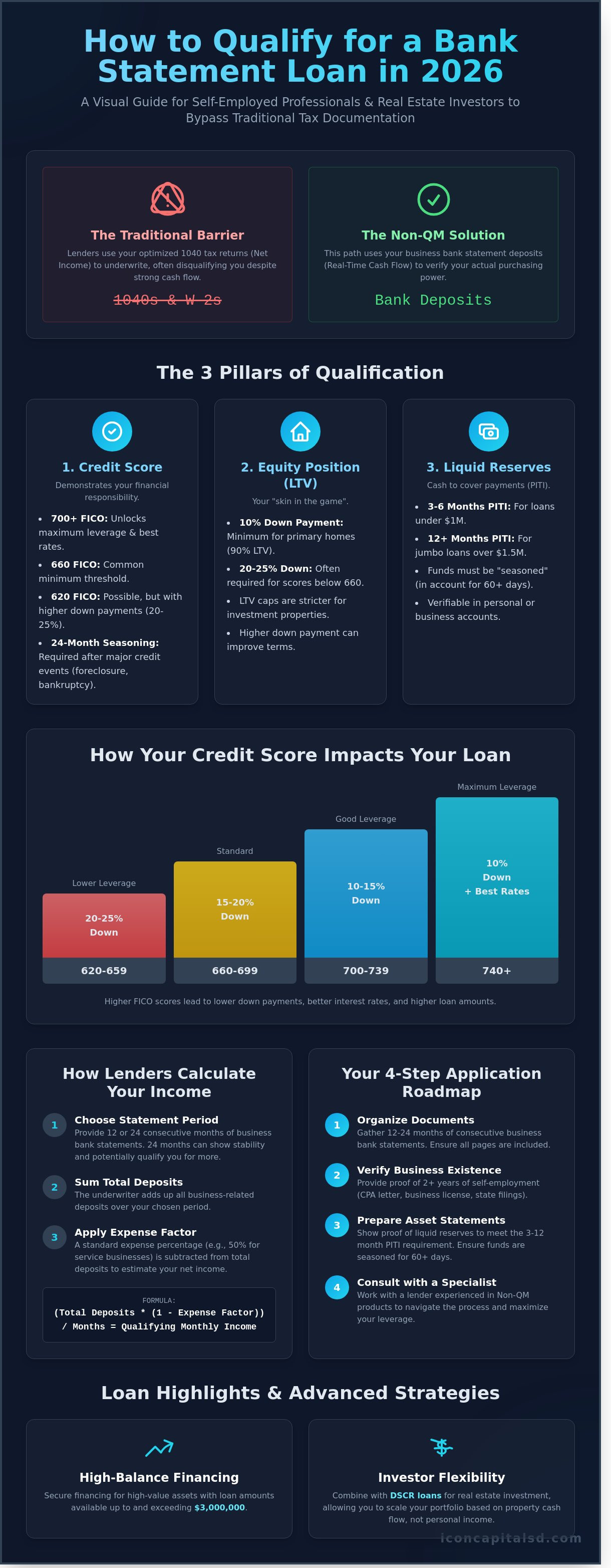
Learning how to qualify for a bank statement loan involves preparing a clean history of deposits over a 12 to 24 month period. Underwriters generally apply an expense factor, often 50% for service businesses or lower for sole proprietors, to the total deposits to determine qualifying income. This methodology allows borrowers to leverage their actual purchasing power. It’s a pragmatic shift for investors with complex tax structures who need to move quickly on acquisitions without waiting for the next tax season to reflect their growth.
Non-QM vs. Conventional: The Structural Difference
Conventional Fannie Mae and Freddie Mac guidelines remain rigid. They require net income figures that often don’t reflect an entrepreneur’s true liquidity. Non-QM products rely on private capital, which bypasses government-imposed documentation restrictions. While this flexibility is a massive advantage, it comes with a calculated trade-off. Borrowers should expect interest rates roughly 0.75% to 1.5% higher than standard conventional loans. These programs prioritize the asset and the cash flow over the tax transcript, making them a primary tool for the modern business owner.
Who Should Target This Loan Product?
This product is ideal for 1099 contractors, consultants, and business owners with high overhead costs. Real estate investors also utilize these loans for rapid scaling, as they can close deals based on business bank account activity rather than personal salary. Understanding how to qualify for a bank statement loan is essential for those who want to avoid the “paper loss” trap of traditional lending. If you maintain professional financial statements, you can explore P&L-based mortgage solutions to see how these cash-flow-based models compare to your current financing. These loans empower borrowers to use their actual revenue to secure high-value assets and scale their portfolios efficiently.
Core Qualification Requirements: Credit, Equity, and Liquidity
Understanding how to qualify for a bank statement loan in 2026 requires a focus on three specific pillars: credit depth, equity position, and liquid reserves. Non-QM lenders prioritize these factors because they lack the traditional tax return backbone used in conventional underwriting. You must demonstrate a minimum of two years of continuous self-employment. This is verified through a valid business license, a letter from a certified public accountant, or proof of membership in a professional regulatory body. Most programs in the 2026 market cap the Loan-to-Value (LTV) ratio at 90 percent, which makes a 10 percent down payment the minimum entry point for primary residences.
Liquidity is the final hurdle in the initial screening. Lenders require asset reserves to ensure you can handle income fluctuations common in business ownership. A Bank statement loan typically demands 3 to 6 months of liquid reserves for loan amounts under $1 million. For jumbo loans exceeding $1.5 million, reserve requirements often jump to 12 months of principal, interest, taxes, and insurance (PITI). These funds must be seasoned in a verifiable account for at least 60 days prior to the application.
Credit Score Impact on Leverage
A 700+ FICO score is the primary benchmark to unlock maximum leverage. While some programs allow scores as low as 620, these lower brackets face aggressive LTV restrictions, often requiring a 20 to 25 percent down payment. Tiered pricing models mean that a score of 740 might secure a rate 1.25 percent lower than a score of 660. If you have experienced a major credit event, 2026 guidelines generally require a 24-month seasoning period for foreclosures or bankruptcies before you can qualify for an 80 percent LTV product. Higher credit scores mitigate the perceived risk of these past events.
Personal vs. Business Bank Statements
The type of account you provide dictates how underwriters calculate your qualifying income. If you use personal bank statements, lenders usually count 100 percent of eligible deposits as income. For business bank statements, a standard 50 percent expense ratio is applied to all deposits. This means if you deposit $20,000 monthly, the lender only credits you with $10,000 of income. You can override this default ratio by providing a CPA-certified profit and loss statement showing lower overhead. Clean accounting is vital; co-mingling personal expenses in a business account often leads to heavy deposit disqualifications. If you are ready to review your specific numbers, you can request a quote to see which statement type maximizes your borrowing power.
The Underwriting Process: How Lenders Calculate Qualifying Income
Underwriters for Non-QM products ignore the bottom line of your tax returns. They focus on gross deposits to determine your debt-to-income (DTI) ratio. Most lenders offer two primary paths: a 12-month or 24-month look-back period. Choosing the 12-month option is strategic if your business saw a 15% or higher revenue increase in the last year. A 24-month review suits businesses with seasonal fluctuations, as it provides a stable two-year average to offset lean months. Understanding these calculation methods is a vital step in learning Bank Statement Loan Requirements before you submit an application.
Analyzing Your Deposit History
Underwriters perform a line-by-line audit of your statements to separate true revenue from “noise.” They look for consistent cash flow patterns rather than erratic spikes. Eligible Deposits are recurring revenue directly related to business operations. To ensure you meet the criteria for how to qualify for a bank statement loan, you must account for excluded items that underwriters will strip away:
- Transfers between your own business and personal accounts.
- Proceeds from personal loans or credit card advances.
- One-time insurance settlements or asset liquidation.
- Refunds or chargebacks.
Consistency is the primary metric. If your deposits show a declining trend, such as a 25% drop in the most recent quarter, the underwriter might use a “decreasing income” calculation. This often involves averaging only the most recent three months rather than the full year, which can sharply reduce your maximum loan amount.
The Default Expense Ratio vs. P&L Overlays
Lenders know that gross deposits aren’t pure profit. To account for business costs, most programs apply a standard 50% expense ratio. If your business deposits $30,000 per month, the underwriter assumes your qualifying income is $15,000. This 50% haircut can disqualify borrowers with high debt loads or those seeking luxury price points.
You can bypass this default math by providing a Profit and Loss (P&L) statement prepared by a licensed CPA or Enrolled Agent. For service-based professionals like consultants, attorneys, or software developers, actual overhead might only be 10% to 15%. By using a P&L overlay, you allow the lender to use 85% or 90% of your deposits as qualifying income. This shift significantly increases your leverage and is often the deciding factor in how to qualify for a bank statement loan at a competitive rate. If you have your statements ready for a preliminary review, you can request a quote to see how your specific expense ratio impacts your purchasing power.
How to Prepare Your Application: A Step-by-Step Roadmap
Preparation determines the speed of your approval. Business owners often fail to secure financing because of fragmented documentation rather than a lack of income. Following a structured roadmap ensures your file moves through underwriting without unnecessary delays or requests for additional information.
Step 1: Organize 12-24 months of consecutive, all-page bank statements. Underwriters require every single page of your statements, even those that are blank or contain only advertising. Missing pages trigger immediate “condition” flags that can stall a file for 48 to 72 hours. Ensure your statements are from the most recent months; a gap of even 30 days can disqualify the submission.
Step 2: Verify business existence via Secretary of State or professional license. Most 2026 lending programs require a minimum two-year history of self-employment. You must provide an active “Good Standing” certificate from the Secretary of State or a current professional license. If your industry doesn’t require a license, a 1099 history or a letter from a CPA will serve as the primary evidence of your business tenure.
Step 3: Conduct a “pre-underwriting” audit of your own deposits. Review your statements for non-revenue deposits. Large, one-time transfers from personal savings or proceeds from asset sales can skew your income calculation if they aren’t properly backed out. This step is critical to understanding how to qualify for a bank statement loan because underwriters only count recurring business revenue. Identifying these anomalies now prevents a lower-than-expected income calculation later.
Step 4: Secure a mortgage quote to lock in your LTV. Loan-to-value (LTV) ratios for bank statement products typically cap at 80% or 90% depending on your credit profile. Securing a formal quote early allows you to align your purchase price with your available liquidity. Use this quote to confirm that your 680+ FICO score matches the program’s specific pricing tier.
Documentation Checklist for 2026
- Current business license or Articles of Incorporation showing at least 24 months of activity.
- Verification of business location through a lease agreement or utility bill.
- Active web presence, such as a professional website or verified Google Business profile.
- Letters from CPAs verifying business ownership percentage and the current expense structure.
Modern Verification: Digital Statement Integration
Digital tools like Plaid have transformed the 2026 approval process. These fintech integrations allow you to link your business accounts directly to the lender’s portal. This direct-source data is 40% faster than manual PDF uploads and eliminates the risk of missing pages. Direct data feeds also provide underwriters with a cleaner view of your cash flow, often resulting in fewer “Letters of Explanation” regarding specific transactions. Data security remains a priority; these encrypted portals ensure that sensitive financial information is never stored in unsecure email threads.
Maximizing Leverage with Icon Capital’s Creative Financing
Icon Capital provides high-balance bank statement loans up to $3 million or higher for qualified self-employed borrowers. We remove the barriers created by traditional tax return requirements. Our team focuses on gross monthly deposits to determine your true purchasing power. This approach allows entrepreneurs to secure luxury properties that exceed standard conforming loan limits. We understand that your business tax write-offs shouldn’t limit your ability to build personal wealth through real estate.
Investors frequently combine bank statement qualification with DSCR loans to scale their portfolios quickly. While a bank statement loan covers your primary residence, DSCR loans allow you to acquire investment properties based solely on the asset’s rental income. If your cash flow is inconsistent, our asset-based qualification serves as a powerful “No-Income” alternative. This program qualifies you based on liquid assets like stocks, bonds, or cash reserves instead of monthly business revenue. You bypass income verification entirely when your asset base meets our required coverage ratios.
Our structure provides direct access to underwriters who specialize in entrepreneurial finance. They evaluate the logic of your business model rather than strictly following a rigid automated system. This ensures that complex income structures get the credit they deserve during the review process. Understanding how to qualify for a bank statement loan becomes much simpler when you speak directly to the decision-makers who manage the capital.
Why Icon Capital for Self-Employed Borrowers?
Speed of execution defines our service. We target a 21-day timeline from submission to clear-to-close. Our flexible LTV options reach up to 90% for primary residences and 80% for investment properties. We also maintain a dedicated desk for Foreign National Loans. This allows international investors to leverage U.S. real estate without a domestic credit history or tax presence. Our Non-QM product suite is built for the 10% of borrowers who don’t fit the standard bank box.
Take the Next Step in Your Financing Journey
Start with a strategy session. A 15-minute call with a loan specialist can clarify your debt-to-income ratio and document requirements before you start your home search. Knowing how to qualify for a bank statement loan ahead of time gives you a competitive edge in a fast-moving market. We help you move from initial qualification to a closed deal with minimal friction. Request a customized bank statement loan quote today to begin the process.
Leverage Your Cash Flow for 2026 Real Estate Success
Navigating the 2026 mortgage market requires a shift from traditional tax returns to liquid asset verification. Understanding how to qualify for a bank statement loan centers on two primary metrics: maintaining a 680 minimum FICO score and providing 12 to 24 months of consecutive business or personal bank statements. Lenders currently prioritize a 20% equity position to offset the specific risks associated with non-traditional income streams. Icon Capital specializes in these Non-QM and DSCR products. We provide direct lender access for complex financial scenarios that traditional institutional banks often reject.
Our deep expertise in 1099 and self-employed underwriting ensures your application reflects your actual buying power rather than just your taxable income. We focus on the technical mechanics of every deal to structure financing that scales with your professional portfolio. You don’t need to let standard documentation requirements stall your investment growth or homeownership goals. Secure your creative financing solution and request a quote from Icon Capital. Your business success has built the foundation, and we’re here to help you close the deal.
Frequently Asked Questions
Can I get a bank statement loan with a 620 credit score?
Yes, you can qualify with a 620 credit score. Most Non-QM programs set the floor at 600 or 620, though lower scores typically require a higher down payment. For example, a 620 score might limit your LTV to 80% compared to a 90% LTV available for borrowers with a 720 score. This ensures the lender offsets the increased risk while providing necessary capital for your purchase.
How many months of bank statements do I actually need?
You typically need 12 or 24 months of consecutive bank statements. Lenders use these records to calculate a monthly income average. If your business has seasonal fluctuations, a 24-month look-back period provides a more stable income calculation. Providing 24 months of data often results in more favorable pricing and higher leverage options from underwriters who value long-term stability in your cash flow.
Are interest rates higher for bank statement loans than traditional mortgages?
Interest rates for these programs are generally 1.00% to 2.00% higher than standard agency loans. This premium covers the manual underwriting and increased risk associated with non-traditional income verification. For a 2026 purchase, expect rates to reflect current market spreads plus this specific risk adjustment. Rates vary based on your specific credit tier, LTV ratio, and the total number of months documented.
What counts as an “unacceptable deposit” during underwriting?
Unacceptable deposits include any large, non-income credit exceeding 50% of your average monthly revenue that lacks a clear source. Underwriters flag internal transfers between your own accounts or cash deposits without documented receipts. You must provide a bill of sale or a signed letter of explanation for any one-time windfalls. Loans fail when borrowers can’t prove these funds aren’t new debt or undisclosed liabilities.
Do I need a CPA letter to qualify for a bank statement mortgage?
Most lenders require a CPA or licensed tax preparer letter to verify you’ve owned your business for at least 24 months. This letter also confirms your expense ratio, which is typically set at a 50% default unless your CPA documents a lower figure. Understanding how to qualify for a bank statement loan involves coordinating this documentation to prove your business’s operational health and net profitability to the underwriter.
Can I use personal bank statements if I am a 1099 contractor?
Yes, 1099 contractors can use 100% of their personal bank statement deposits to qualify for financing. Unlike business accounts where an expense ratio is applied, personal accounts allow for a more direct income calculation. You must show that your business expenses are paid out of a separate account. This strategy maximizes your qualifying income by avoiding the standard 50% business expense haircut often applied to business accounts.
What is the minimum down payment for a bank statement loan in 2026?
The minimum down payment is 10% for borrowers with a credit score above 700. If your score falls between 620 and 680, expect a 15% to 20% down payment requirement. These 90% LTV options are restricted to primary residences. Investment properties typically require a 20% to 25% down payment regardless of the bank statement program used. Lenders use these higher down payments to mitigate the risk of non-traditional documentation.
Is there a maximum loan amount for bank statement programs?
Maximum loan amounts generally reach $3 million, though some specialized Non-QM products extend to $5 million. High-balance loans over $2 million often require 12 months of cash reserves and a minimum 700 credit score. Learning how to qualify for a bank statement loan at these levels requires meticulous documentation of liquid assets. Lenders use these reserves to ensure you can handle the debt service on large-scale financing during market shifts.