

The U.S. real estate market presents a significant investment opportunity, yet for many non-citizens, the path to financing appears blocked. The lack of a U.S. credit history, an SSN, or familiarity with the process can make acquiring property feel impossible. These barriers, however, are not insurmountable. For the savvy global investor, the solution is a foreign national mortgage, a specialized loan product designed to bridge this exact gap and provide access to U.S. assets.
This comprehensive guide is engineered to remove the complexity and uncertainty from the equation. We provide a direct, step-by-step breakdown of the entire financing process, from initial eligibility requirements and documentation checklists to identifying the right lender and navigating the closing. Our objective is to equip you with the critical information needed to structure your deal effectively and secure the capital required to expand your real estate portfolio into the United States.
Key Takeaways
- Identify the core eligibility requirements for non-U.S. citizens and see how specialized loans bypass the need for a U.S. credit history or SSN.
- Prepare the essential documentation, from visa and passport to asset verification, required to streamline your loan application.
- Discover how non-QM lenders use Debt Service Coverage Ratio (DSCR) to qualify you based on investment property cash flow, not personal U.S. income.
- Navigate the entire foreign national mortgage process, from application to closing, and learn the key questions to ask when vetting a potential lending partner.
What Is a Foreign National Mortgage and Who Qualifies?
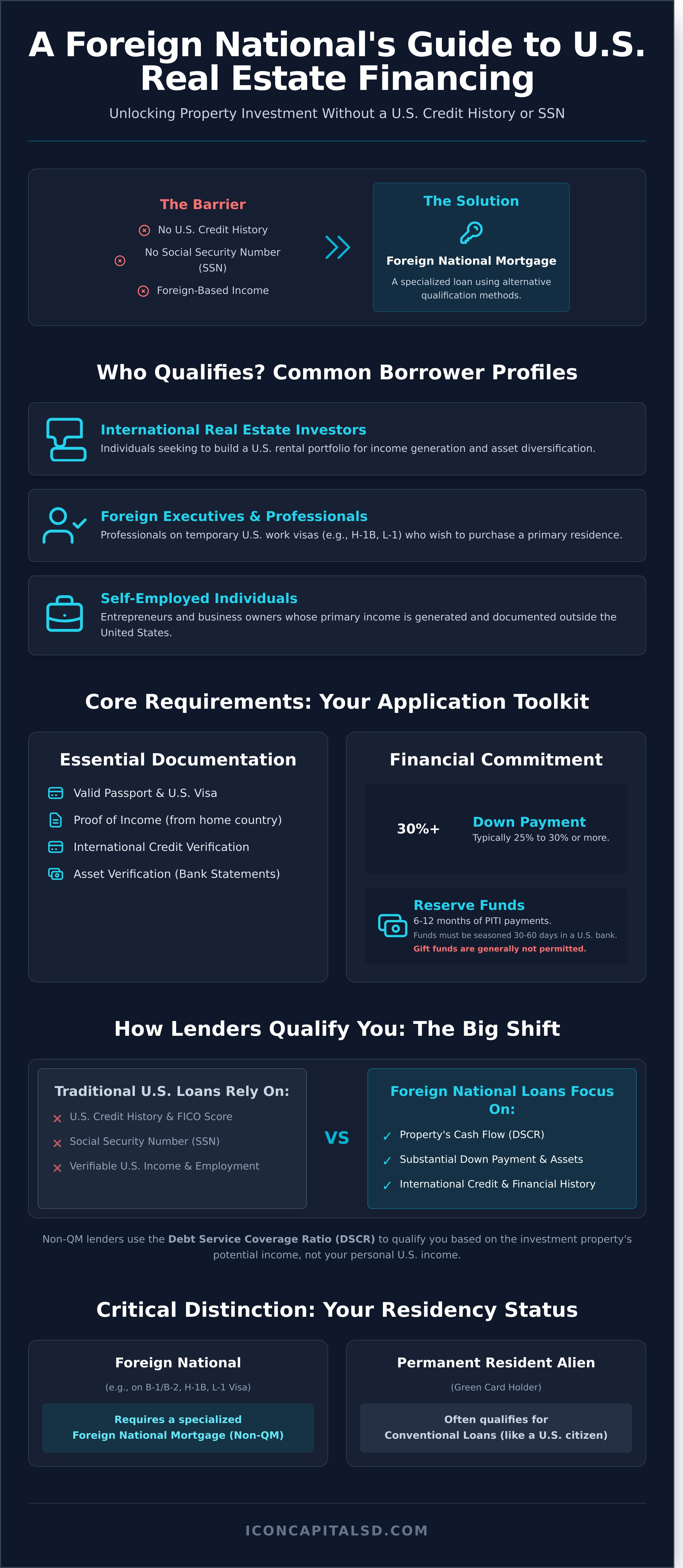
A foreign national mortgage is a specialized financing solution designed for non-U.S. citizens seeking to purchase real estate in the United States. This loan product directly addresses the primary challenges these borrowers face: the lack of a Social Security Number (SSN), a U.S.-based credit history, or verifiable U.S. income. Instead of relying on traditional metrics, these programs utilize alternative documentation to assess a borrower’s creditworthiness. As a foundational guide on what is a foreign national mortgage explains, lenders may use international credit reports, asset verification, or bank statements to qualify an applicant.
These loans are a critical tool for international investors looking to leverage the U.S. real estate market. While some programs allow for the purchase of a primary residence, the most common use is for acquiring investment properties. Lenders structure these products to mitigate risk while providing a clear path to financing for qualified individuals who fall outside the traditional lending framework.
Key Borrower Profiles
While eligibility varies by lender, several profiles commonly utilize this type of financing. The ideal candidate typically has significant assets and a clear purpose for their U.S. property purchase.
- International Real Estate Investors: Individuals seeking to build or expand a U.S. rental property portfolio to generate income and diversify their assets.
- Foreign Executives: Professionals residing in the U.S. on a temporary work visa (e.g., H-1B, L-1) who wish to purchase a primary residence during their stay.
- Self-Employed Individuals: Entrepreneurs or business owners whose primary income is generated and documented outside the United States.
Understanding a Foreign National vs. a Permanent Resident Alien
It is critical to distinguish between a foreign national and a permanent resident alien. A permanent resident, or Green Card holder, has legal permanent residency and can often qualify for conventional loans from agencies like Fannie Mae and Freddie Mac, just like a U.S. citizen. In contrast, a foreign national is a non-permanent resident alien. This status requires a specialized foreign national mortgage, which is typically a non-QM (Non-Qualified Mortgage) loan. Your specific visa status is a primary determinant of eligibility and will dictate the loan programs available to you.
Core Requirements: Documentation, Down Payments, and Assets
Securing financing as a non-U.S. citizen involves a different set of underwriting criteria compared to conventional loans. Lenders must mitigate the perceived risk associated with a lack of U.S. credit history and employment. Therefore, a successful application for a foreign national mortgage hinges on providing robust documentation of your financial standing, a substantial down payment, and significant liquid assets.
Essential Documentation Checklist
A complete and organized documentation package is critical for underwriting. Lenders require a clear paper trail to verify your identity, income, and creditworthiness from abroad. As detailed in guides covering the various Financing Options for Foreign Buyers, proper documentation is non-negotiable. Be prepared to provide:
- Valid Passport & U.S. Visa: A clear, unexpired copy of your passport and the relevant U.S. visa (e.g., B-1/B-2 for visitors, H-1B/L-1 for temporary workers) is required to confirm your identity and legal entry status.
- Proof of Income: Verifiable income from your home country, typically documented via the last two years of tax returns or a detailed letter from your employer.
- International Credit Verification: A credit report from your home country or reference letters from established foreign financial institutions where you hold accounts.
- Asset Verification: Bank or investment statements proving you have sufficient funds for the down payment and required reserves.
Down Payment and Reserve Fund Expectations
The financial requirements for foreign national loans are more stringent to offset lender risk. Expect a higher down payment, typically ranging from 25% to 30% or more of the purchase price. In addition to the down payment, lenders require “reserves”-liquid assets remaining after closing to cover unexpected costs. You must demonstrate 6 to 12 months of PITI (principal, interest, taxes, and insurance) payments in a U.S.-based bank account. These funds must be “seasoned,” meaning they have been in the account for at least 30-60 days, to prove they are legitimately yours. For this reason, gift funds from third parties are generally not permitted.
Eligible Property Types for Investment
Foreign national loan programs are primarily structured for purchasing investment properties or second homes, not primary owner-occupied residences. This focus allows investors to generate U.S.-based income and build a real estate portfolio. Eligible properties typically include:
- Single-family homes (SFRs)
- Condominiums (warrantable)
- 2-4 unit multi-family properties
Lenders strongly prefer warrantable condos, which meet stricter financial and legal guidelines, making them a more secure investment. The structure of a foreign national mortgage is built to facilitate real estate investment for non-residents seeking to capitalize on the U.S. market.
The Application and Underwriting Process: A Step-by-Step Walkthrough
Navigating the financing process for U.S. property as a non-resident can seem complex, but it follows a structured and predictable path. The key is working with a lender specializing in creative financing solutions who understands the unique documentation and qualification requirements. This walkthrough demystifies the four primary stages, from initial contact to receiving the keys to your investment property.
Step 1: Prequalification and Loan Structuring
The process begins with an initial consultation with a loan officer to define your investment goals. We review your complete financial profile, including global assets, visa status (if applicable), and the type of property you intend to purchase. Based on this assessment, we structure the optimal loan program. For many investors, a DSCR-based loan is the most efficient route, as it qualifies the property based on its cash flow rather than your personal income.
Step 2: Submitting Your Application and Documentation
Once a loan structure is determined, you will complete the official Uniform Residential Loan Application (Form 1003). You will then securely upload all required documentation. For a foreign national mortgage, this typically includes a copy of your passport and visa, proof of funds for the down payment, and verification of assets. At this stage, you will also pay for the property appraisal, which must be conducted by a U.S.-licensed appraiser.
Step 3: Underwriting and Approval
The loan file then moves to underwriting. An underwriter is responsible for verifying all the information and documentation you submitted. They will review the appraisal to confirm the property’s market value and analyze its Debt-Service Coverage Ratio (DSCR) if applicable. Upon successful review, the lender will issue a Conditional Loan Approval, which outlines any final items or “conditions” needed to move toward closing.
Step 4: Closing
With a clear approval, a U.S.-based title or escrow company prepares the final loan documents. Arrangements are made for you to sign, which can often be done at a U.S. embassy or consulate in your home country. After signing, you will wire your remaining down payment and closing costs to the escrow company. Once all funds are received and documents are finalized, the loan is funded, and you officially take ownership of the property.
Ready to begin? Explore your options with an Icon Capital LLC specialist.
How Lenders Qualify You: DSCR vs. Traditional Income Verification
Traditional banks often deny foreign nationals due to the difficulty of verifying foreign-based income and credit. They rely on standardized U.S. tax returns and pay stubs, which are often unavailable or structured differently. Specialized lenders like Icon Capital operate outside these rigid constraints. We utilize alternative qualification methods that focus on the asset’s viability or the borrower’s financial strength, not their employment paperwork. This is the key to structuring a successful foreign national mortgage.
The Power of DSCR for Foreign Investors
For investment properties, the most effective qualification method is the DSCR, or Debt Service Coverage Ratio, loan. This program bypasses personal income verification entirely. Instead, it qualifies the loan based on the subject property’s ability to generate sufficient cash flow to cover its expenses.
The calculation is straightforward:
- DSCR Formula: Gross Monthly Rental Income / Total Monthly Housing Expense (PITI)
PITI stands for the Principal, Interest, Taxes, and Insurance of the mortgage payment. Lenders typically require a DSCR of 1.0 or higher, which demonstrates that the rental income can cover the mortgage obligation. By focusing on the property’s income potential, the DSCR loan eliminates the need to document and translate complex foreign employment records, making it the ideal financing solution for international real estate investors.
Asset Qualification as an Alternative
For high-net-worth individuals who may not have traditional income streams or are purchasing a property that will not be rented, asset qualification is a powerful alternative. This method, also known as an asset depletion loan, allows borrowers to use their verified liquid assets to qualify. Lenders calculate a “qualified income” by dividing the total value of assets (such as stocks, bonds, and cash) by a set term to create a monthly figure used for qualification.
These creative financing structures are designed to provide clear pathways to approval where traditional lending fails. Whether leveraging property cash flow with a DSCR loan or qualifying with substantial assets, Icon Capital has the non-QM products to secure your foreign national mortgage. To explore which option aligns with your investment strategy, contact our loan specialists.
Choosing the Right Lender: Key Questions to Ask
Securing a foreign national mortgage requires a lending partner with specialized expertise. Not all financial institutions are equipped to handle the unique documentation and underwriting requirements of international borrowers. Your choice of lender is a critical factor that will directly impact the speed, terms, and ultimate success of your transaction.
Big Banks vs. Specialized Lenders
Large retail banks often rely on automated underwriting systems and rigid guidelines that are incompatible with foreign credit and income documentation. Their limited experience in this niche can lead to significant delays or outright denials. In contrast, specialized lenders like Icon Capital focus exclusively on non-QM and complex financing scenarios. This specialization provides access to more flexible underwriting, a wider range of loan products, and the deep expertise needed to navigate the challenges of international lending.
Questions for Your Potential Lender
To properly vet a lender, you must ask direct, targeted questions that reveal their true capability and experience. Before committing, use this checklist to assess their proficiency in handling your loan.
- How many foreign national loans have you closed this year?
This question immediately gauges their practical, real-world experience. A lender actively closing these loans will have a refined and efficient process. - What are your typical down payment and reserve requirements?
An experienced loan officer can provide clear, specific Loan-to-Value (LTV) and post-closing liquidity requirements for their various programs, demonstrating product knowledge. - Do you use DSCR to qualify investment properties?
For real estate investors, a Debt Service Coverage Ratio (DSCR) loan is a vital tool. A lender proficient in DSCR can qualify your loan based on the property’s cash flow, not your personal income. - What is your average time to close for international clients?
Time zone differences and document verification can create delays. A seasoned lender will have established systems to mitigate these issues and can provide a realistic closing timeline.
An informed decision starts with asking the right questions. Partnering with a specialist who can confidently answer them is essential for a smooth and successful property acquisition. For creative financing solutions and expert guidance on your foreign national mortgage, contact Icon Capital to explore your options.
Secure Your U.S. Real Estate Investment with the Right Partner
Navigating the U.S. real estate market as an international investor is a strategic move, not an insurmountable challenge. As this guide has shown, success hinges on understanding the core requirements: comprehensive documentation, a significant down payment, and verifiable assets. Modern qualification methods like DSCR focus on the property’s income potential, creating a clear path to approval for investors. Ultimately, securing a foreign national mortgage is most efficient when you work with a specialist who understands the nuances of these transactions.
At Icon Capital, we are direct lenders specializing in Non-QM and investor loans. We deliver creative financing solutions for international clients through a streamlined, transparent process designed for speed and efficiency. Don’t let conventional lending barriers prevent you from scaling your portfolio. Get pre-qualified for your U.S. investment property today. Your next acquisition is closer than you think.
Frequently Asked Questions About Foreign National Mortgages
What are the typical interest rates for foreign national mortgages?
Interest rates for foreign national mortgages are typically 1-3% higher than conventional U.S. loans due to the increased perceived risk for lenders. The final rate depends on several key factors, including the loan-to-value (LTV) ratio, the size of the down payment, property type, and the borrower’s overall financial profile. A larger down payment and substantial liquid assets can help secure a more competitive rate. Lenders assess each application individually to determine the specific terms.
Can I get a foreign national loan if I don’t have a U.S. bank account?
While a U.S. bank account is preferred and can streamline the process, it is not always a mandatory requirement. Many lenders specializing in these loans can verify funds held in established international financial institutions. However, you should be prepared to provide more extensive documentation, such as translated bank statements and letters of reference from your foreign bank. Opening a U.S. account is often recommended to simplify the down payment, closing costs, and future mortgage payments.
How long does the foreign national mortgage process typically take?
The timeline for a foreign national mortgage is generally longer than for a domestic loan, typically ranging from 45 to 60 days from application to closing. This extended timeframe accounts for the complexities of verifying international income, assets, and identity documentation. The process can be expedited if the borrower is organized and provides all requested documentation promptly. Delays are most often caused by incomplete paperwork or slow responses from third-party international institutions.
Are there restrictions based on my country of citizenship?
Yes, restrictions do apply. Lenders must adhere to U.S. federal regulations, including guidelines from the Office of Foreign Assets Control (OFAC), which prohibits transactions with individuals from certain sanctioned countries. Additionally, some lenders may have their own internal policies regarding specific countries based on their risk assessment. It is essential to consult directly with a loan officer to confirm your eligibility based on your country of citizenship before beginning the application process.
Can I finance a property held in an LLC as a foreign national?
Yes, financing a property through a U.S.-based Limited Liability Company (LLC) is a common and often recommended strategy for foreign national investors. This structure can provide liability protection and potential tax advantages. Lenders accustomed to working with international clients are well-equipped to handle these transactions. The underwriting process will require a review of the LLC’s formation documents, operating agreement, and a clear outline of its ownership structure in addition to your personal financial information.
Is a U.S. credit score required to get a foreign national loan?
No, a U.S. credit score is not a prerequisite for a foreign national mortgage. Lenders understand that non-residents will not have a FICO score or U.S. credit history. Instead, creditworthiness is assessed through alternative means. This can include obtaining an international credit report, providing reference letters from your current banking institutions, and documenting a strong history of consistent rental or mortgage payments in your home country. Strong asset verification is a primary factor in the approval process.