

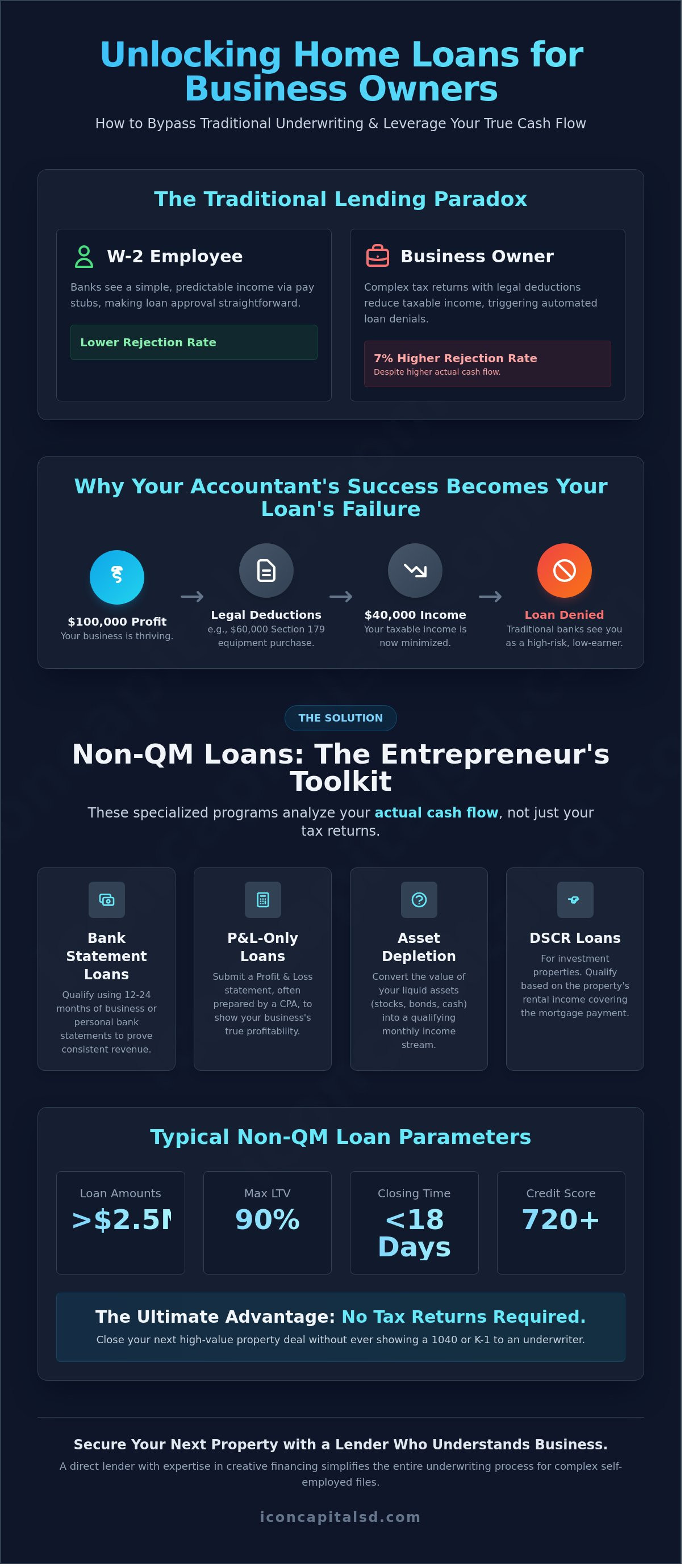
Your 2025 tax return is likely the primary barrier to your next high-value property acquisition. While you’ve spent years maximizing legal deductions to protect your bottom line, data from 2024 indicates that self-employed borrowers face a 7% higher mortgage rejection rate than their W-2 counterparts. It’s a frustrating paradox where business success leads to a traditional bank rejection. You’ve built a profitable enterprise; you shouldn’t be penalized for your accountant’s efficiency.
This guide demonstrates how to secure Home Loans for Business Owners by leveraging creative financing solutions like 12-month bank statement programs and P&L-only loans. We’ll show you how to utilize your actual cash flow to access loan amounts exceeding $2.5 million with LTV ratios as high as 90%. We’ll preview the specific Non-QM requirements and streamlined approval workflows that allow you to bypass bureaucratic delays. By the end of this article, you’ll have a clear roadmap to close your next deal in under 18 days without disclosing a single tax return to an underwriter.
Key Takeaways
- Understand why traditional tax-return underwriting often fails entrepreneurs and how to bypass the “W-2 bias” using actual business cash flow.
- Explore specialized Home Loans for Business Owners that utilize P&L statements and bank records instead of restrictive federal tax filings.
- Learn the strategic differences between primary residence financing and using DSCR loans to scale your investment property portfolio.
- Identify the specific credit score and liquid reserve requirements necessary to qualify for Non-QM financing in the 2026 market.
- Discover how a direct lender’s expertise in creative financing can simplify the underwriting process for complex self-employed files.
The Hidden Barrier: Why Traditional Home Loans Penalize Business Owners
Standard mortgage underwriting is built for the 60% of Americans who receive a predictable bi-weekly paycheck. This rigid framework creates a systemic disadvantage for entrepreneurs. Retail banks rely on “Taxable Income” as the primary metric for creditworthiness; however, successful business owners intentionally minimize this figure through legal tax strategies. While a W-2 employee provides a simple pay stub, a business owner submits K-1s, Schedule C filings, and 1120-S corporate returns. Most retail loan officers lack the specialized training to interpret these complex documents accurately, leading to unnecessary denials for profitable enterprises.
The 2026 lending landscape has seen a 15% increase in non-traditional borrower applications as the gig economy and small business sectors expand. Despite this growth, the mortgage origination process at big-box banks remains tethered to Fannie Mae and Freddie Mac guidelines. These agencies require a two-year history of stable, high taxable income. If your 2024 returns showed a massive reinvestment into equipment or marketing, your 2026 loan eligibility disappears under traditional rules. This gap is bridged by Non-QM (Non-Qualified Mortgage) products. These loans use alternative data to prove creditworthiness, allowing for a more nuanced look at a borrower’s financial health. Common Non-QM data points include:
- 12 to 24 months of personal or business bank statements to verify cash flow.
- Asset depletion models that calculate qualifying income based on liquid wealth.
- Profit and Loss (P&L) statements signed by a certified accountant.
- Debt Service Coverage Ratios (DSCR) for investment-minded business owners.
The Tax Deduction Paradox
Tax efficiency is the enemy of traditional Home Loans for Business Owners. When you use Section 179 to deduct a $60,000 equipment purchase, you reduce your tax liability, but you also slash your qualifying income in the eyes of a bank. An underwriter sees a $100,000 profit reduced to $40,000 after depreciation and one-time capital expenses. To a retail lender, you look like a low-earner who cannot afford a mortgage. To a Non-QM specialist, that $60,000 is “added back” to your income because it’s a non-cash expense or a one-time event that doesn’t reflect your actual liquidity or ability to pay.
The Debt-to-Income (DTI) Struggle
Business owners often face inflated DTI ratios because personal credit reports frequently include business liabilities. If you personally guaranteed a $50,000 line of credit for inventory, a retail lender counts that entire monthly payment against your personal income. They rarely separate business-purpose debt from personal consumer debt, even if the business has paid that bill for 12 consecutive months. DTI for business owners is a metric often misunderstood by retail banks because it fails to account for the entity’s independent ability to service its own debt. Icon Capital LLC structures Home Loans for Business Owners by excluding these verified business expenses, providing a realistic view of your true leverage. We focus on liquid assets and actual cash flow to ensure your business success isn’t used as a reason to deny your home purchase.
Alternative Mortgage Programs Designed for Entrepreneurs
Standard lending models often fail self-employed borrowers because they rely on taxable income. Business owners typically use legal deductions to reduce tax liability, which lowers the “bottom line” on a 1040. Non-QM (Non-Qualified Mortgage) products solve this by shifting the focus to actual cash flow and liquid reserves. Before diving into complex structures, it’s vital to understand the basic premise of What is a mortgage? and how these alternative pathways meet the same legal standards through different documentation. These programs offer a way to secure financing without the constraints of traditional debt-to-income calculations.
Creative financing toolkits for entrepreneurs now prioritize asset-based and cash-flow-based lending over traditional filings. High-net-worth individuals often maintain credit scores above 720 but show minimal personal income on paper. We structure these deals using Loan-to-Value (LTV) ratios up to 80% or 90% for primary residences, with loan amounts frequently exceeding $2.5 million. This allows Home Loans for Business Owners to remain accessible without requiring the borrower to sacrifice tax efficiency or business reinvestment strategies.
Bank Statement Loans: Proving Income Through Cash Flow
Bank statement programs analyze 12 or 24 months of business deposits to determine qualifying income. Lenders apply a standard expense ratio, often 50%, to total deposits to estimate “Effective Income.” If your actual costs are lower, a CPA letter can sometimes reduce this ratio to 15% or 20%, which significantly increases your buying power. This is the primary vehicle for consultants and freelancers who have high margins and low overhead. It bypasses the depreciation and write-offs that typically disqualify these borrowers from conventional financing paths.
P&L Statement Mortgages: The Accountant-Certified Solution
A Profit and Loss (P&L) statement mortgage relies on a document prepared and signed by a licensed CPA or tax preparer. It covers the most recent 12-month period or the current year-to-date. This program suits businesses with seasonal spikes or recent rapid growth that isn’t yet reflected on a two-year tax history. Underwriters look for stable net income trends. If your 2023 revenue doubled compared to 2022, a P&L loan captures that current strength rather than averaging it with older, lower figures from previous years.
1099 and Asset Qualification Options
Independent contractors with steady, high-value contracts can use 1099 forms from the last 2 years to qualify. This avoids the need for full business tax returns entirely. For those with significant liquidity, Asset Qualification allows for loan approval based on total eligible assets. Lenders divide the total liquid balance by a set period, often 60 or 84 months, to “create” a monthly income figure for the application. If you’ve reached a point where your portfolio outweighs your monthly draw, you should request a quote for a program tailored to your specific asset base. Most Asset Qual programs require at least $500,000 in post-closing liquidity to remain competitive on rates. These loans often feature 5/1 or 7/1 ARM structures to provide lower initial payments while the business continues to scale.
Investment vs. Primary Residence: Structuring the Right Deal
Strategic financing requires a clear distinction between personal shelter and income-producing assets. Business owners often struggle with traditional Home Loans for Business Owners because aggressive tax planning reduces their reported net income. Standard lenders see low net income as high risk. Investment property financing ignores these personal tax returns. It shifts the focus entirely to the asset’s capability. While SBA-backed business loans provide excellent utility for operational expenses or owner-occupied commercial space, they aren’t designed for rapid residential real estate scaling. Private capital fills this void by prioritizing the deal’s math over the borrower’s 1040 forms.
Investors frequently utilize business entities to hold these assets. Establishing an LLC for property acquisition provides a layer of liability protection. It also streamlines the transition of debt from personal credit reports to corporate entities. This separation is vital for maintaining a clean balance sheet when seeking future capital. By keeping investment debt inside an LLC, entrepreneurs protect their personal borrowing power for future Home Loans for Business Owners intended for primary use. Most non-QM lenders actually require the loan to be closed in the name of an entity to ensure the transaction is classified as a business-purpose loan.
Bridge loans play a critical role in this structure. These are short-term, interest-only vehicles used to acquire or stabilize a property before long-term financing is secured. When a business owner identifies a distressed asset or a time-sensitive opportunity, a bridge loan provides the speed necessary to close in as little as 7 days. This agility allows the investor to bypass the 45-day window typical of retail banks.
DSCR Loans: The Ultimate Tool for Investors
Debt Service Coverage Ratio (DSCR) loans evaluate a property based on its ability to pay for itself. Lenders calculate this by dividing the gross monthly rent by the monthly PITIA, which includes principal, interest, taxes, insurance, and association dues. A ratio of 1.2x is a common benchmark for approval. Because the property’s cash flow is the primary underwriting factor, personal income documentation is completely waived. DSCR loans allow business owners to scale portfolios without affecting personal DTI. This enables an investor to close 10 properties simultaneously without hitting the debt limits imposed by conventional Fannie Mae guidelines. It’s a pure asset-based play that rewards the quality of the investment rather than the size of a paycheck.
Fix & Flip and Construction Financing
Short-term capital serves as the engine for development and renovation. Fix & Flip loans typically offer 12-month terms with 85% to 90% Loan-to-Cost (LTC) leverage. These products provide the purchase price and 100% of the renovation costs. This leverage allows business owners to preserve liquidity for other operations. The underwriting focuses on the After Repair Value (ARV), which is the projected value of the home once improvements are finished.
Integrating new construction loans into a long-term strategy provides a path for portfolio diversification. Ground-up construction financing facilitates the creation of built-to-rent communities. These loans often transition into long-term DSCR debt once the certificate of occupancy is issued. This “Buy, Rehab, Rent, Refinance, Repeat” cycle relies on bridge and construction loans to provide the initial speed. It’s a methodical way to build equity without exhausting the cash reserves of the primary business.
Qualification Criteria: What Lenders Look for Beyond the Tax Return
Lenders evaluating Home Loans for Business Owners prioritize liquidity and credit depth over the net taxable income shown on a 1040. Non-QM underwriting in 2026 focuses heavily on a borrower’s ability to weather market fluctuations. This means your liquid runway often matters more than the specific deduction strategy your accountant employed last year. We look for a consistent trajectory in your business deposits and a credit profile that suggests responsible debt management despite the complexities of self-employment.
Credit and LTV Benchmarks
A 680 to 720 FICO score is the standard benchmark for securing competitive Non-QM rates. While programs exist for scores as low as 620, these typically require a 30% to 35% down payment to offset the increased risk. For most borrowers, a 20% to 25% down payment is the baseline for 12-month or 24-month bank statement programs. High-leverage options at 90% LTV are accessible for those with a 740+ credit score and at least 12 months of verified reserves. Pricing typically improves at every 20-point credit interval, so it’s vital to clear any small collections or high revolving balances before submission.
Reserves and Liquidity Requirements
Underwriters use reserves to measure risk. These are liquid assets remaining in your account after the down payment and closing costs are paid. Standard requirements range from 3 to 6 months of the full mortgage payment, including principal, interest, taxes, and insurance. If you’re seeking an LTV above 80%, expect a 12-month reserve requirement. Lenders accept funds in personal or business checking accounts. Business funds are often subject to a 50% haircut to account for potential operational expenses unless a CPA letter clarifies that the withdrawal won’t impact the entity’s health.
The Documentation Checklist
The approval process for Home Loans for Business Owners hinges on verifying the entity’s existence and your specific ownership stake. We require proof that the business has been active for a minimum of 24 months. A clean submission includes:
- Current business license or Secretary of State filing.
- Articles of Incorporation or a signed Operating Agreement.
- CPA letter confirming at least 2 years of self-employment and a minimum 25% ownership stake.
- 12 or 24 months of consecutive bank statements from the same account.
- Most recent two months of asset statements for all accounts used for reserves.
- Valid government-issued identification for all borrowers on the application.
Verification of Business Health
Underwriters don’t just check if a business exists; they verify it’s currently operational and stable. This involves a verbal verification or a search of public records within 10 days of the loan closing. If your business shows a declining trend in monthly deposits exceeding 15% year-over-year, lenders will require a written explanation or a year-to-date profit and loss statement. Stability is the goal. Providing a clear narrative for any large one-time expenses helps the underwriter see the true strength of your cash flow.
Securing Your Loan with Icon Capital’s Creative Financing
Traditional retail banks often struggle with the tax complexities inherent in entrepreneurship. When self-employed borrowers utilize legal deductions to minimize tax liability, their adjusted gross income frequently falls below standard debt-to-income requirements. Icon Capital operates as a direct lender to solve this specific friction point. We specialize in the technical execution of Non-QM products that prioritize cash flow and asset strength over bottom-line tax returns. Securing Home Loans for Business Owners requires a lender who understands that a business’s health isn’t always reflected on a 1040 form.
Working with a direct lender provides a distinct advantage in speed and certainty. We maintain internal control over the underwriting process; this means you aren’t waiting on a third-party broker to relay messages from an anonymous bank committee. Our team evaluates complex files, including those involving multiple K-1s or intricate corporate structures, to provide a clear path to funding. We focus on the math of the deal, utilizing 12-month or 24-month bank statements to prove actual liquidity and repayment capacity.
Our 4-Step Simplified Process
We’ve engineered our workflow to respect the schedule of a busy founder. The process moves from initial discovery to wire transfer without the bureaucratic delays common in legacy banking. Most of our clients move through these stages in approximately 21 days.
- Structure Loan: We analyze your specific financial profile to identify the optimal program. This involves determining if a P&L-only loan, a DSCR program, or a Bank Statement loan provides the highest leverage for your current assets.
- Submit Loan: Our digital infrastructure allows for the efficient gathering of documents. You won’t deal with physical paperwork; instead, you’ll use our secure portal for encrypted uploads of your digital records.
- Underwrite & Approve: You gain direct communication with the decision-makers. We address potential hurdles immediately, ensuring the underwriter understands the nuances of your business revenue before issuing a formal approval.
- Close: We focus on the final logistics to fund the deal. Whether you’re purchasing a primary residence or scaling a real estate portfolio, we ensure the capital is deployed on schedule.
The Icon Capital Advantage
Our firm specializes in high-leverage, high-balance financing that exceeds the capabilities of most local lenders. We regularly facilitate loan amounts exceeding $2 million for entrepreneurs who need substantial capital to secure luxury residences or investment properties. While other lenders shy away from complexity, we lean into technical execution for 5-8 unit multi-family properties and foreign national files. These niche areas require a deep understanding of LTV ratios and asset-based qualification that traditional institutions simply don’t possess.
Communication is our primary tool for efficiency. We provide no-nonsense updates to borrowers and realtors, focusing on data points rather than fluff. If a deal has a path to closing, we find it; if it doesn’t, we tell you why immediately. This transparency allows you to manage your capital and your time with precision. We offer up to 80% LTV on many Non-QM products, providing the leverage necessary to keep your business capital working for you while you acquire new real estate assets.
The final step in your journey is preparing for future market shifts. Requesting a quote today allows you to lock in your 2026 strategy and ensure your financing is ready when the right opportunity appears. Home Loans for Business Owners don’t have to be a source of stress when you have a partner who speaks the language of enterprise and investment.
Scale Your Real Estate Portfolio with Creative Financing
Traditional lending frameworks often fail to account for the actual cash flow of a successful enterprise. In 2026, relying on standard tax returns can lead to a 30% lower qualification limit than your liquid revenue justifies. By utilizing Non-QM solutions and DSCR programs, you can leverage your assets without the constraints of conventional debt-to-income ratios. Icon Capital specializes in these complex income situations, offering loan amounts up to $5 million with direct access to underwriting for approvals in as little as 48 hours.
Securing Home Loans for Business Owners requires a partner who understands how to structure deals for maximum leverage. Whether you’re targeting a primary residence or a 10-unit investment portfolio, our team focuses on the mechanics of the deal to ensure fast execution. We provide the expertise needed to navigate high LTV requirements and non-traditional documentation. Take control of your real estate goals today. Request a Creative Financing Quote from Icon Capital to get started. Your next acquisition is within reach when you have the right financing structure in place.
Frequently Asked Questions
Can I get a home loan if my tax returns show a loss?
Yes, you can qualify for a mortgage even if your tax returns show a net loss by using a Bank Statement loan program. These Non-QM products focus on gross deposits rather than taxable income. We typically analyze 12 or 24 months of business bank statements to determine your actual cash flow and ability to repay. This allows business owners to leverage their actual liquidity instead of their IRS-reported figures.
Do home loans for business owners have higher interest rates?
Home loans for business owners using alternative documentation often carry interest rates 0.75% to 1.5% higher than traditional agency loans. This premium accounts for the increased risk and manual underwriting required for Non-QM products. However, these rates are competitive compared to hard money and allow for higher LTV ratios up to 90%. You’re essentially paying for the flexibility to bypass standard tax return requirements and secure capital quickly.
How many months of bank statements are required for a self-employed mortgage?
Most lenders require 12 or 24 consecutive months of business bank statements to verify income for a self-employed mortgage. We use these statements to calculate a monthly average of qualifying deposits. A 50% expense factor is standard, though a letter from a CPA can often reduce this to 20% or 30% depending on the business type. Providing 24 months of records often yields better interest rates and more favorable loan terms.
Can I use a P&L statement instead of tax returns for a mortgage?
Yes, you can use a P&L statement to qualify for a mortgage through specific Non-QM programs. This option is ideal for business owners whose 2023 or 2024 tax filings don’t reflect current profitability. The P&L must typically be prepared and signed by a licensed CPA or Enrolled Agent to verify the last 12 months of business activity. This method bypasses the need for tax returns entirely, focusing on your current year’s performance.
What is the minimum credit score for a business owner home loan?
The minimum credit score for home loans for business owners is generally 620 for most Non-QM programs. Higher scores unlock better terms; for instance, a 720 FICO often secures a lower interest rate and a 10% down payment requirement. Some specialized DSCR or asset depletion programs may accept scores as low as 580 with a 25% down payment. Your credit score directly dictates your maximum LTV and the overall cost of the loan.
Can I buy an investment property under my LLC?
You can buy an investment property under your LLC using a DSCR loan. This structure protects personal assets and simplifies tax reporting for real estate investors. Most Non-QM lenders allow the LLC to be the borrower, provided the entity is in good standing with the Secretary of State and has an established EIN. This strategy is common for investors looking to scale their portfolios without impacting their personal debt-to-income ratios or credit.
How long do I need to be in business to qualify for a Non-QM loan?
Most Non-QM programs require a minimum of 2 years of self-employment in the same industry. We can occasionally provide exceptions for borrowers with 12 months of business ownership if they have significant prior experience in the same field. Documentation like a business license or a CPA letter serves as proof of the business’s start date. Demonstrating stability is key for underwriters to approve high-balance loans for entrepreneurs and independent contractors.
What happens if I have a 1099 but not a full business entity?
If you’re a 1099 contractor without a formal business entity, you’re still classified as self-employed for mortgage purposes. You can qualify using 1099 forms from the last 2 years or bank statement programs. Lenders treat your 1099 income similarly to a sole proprietorship, focusing on your net earnings after basic business expenses are deducted. This path provides access to the same competitive financing products available to larger corporations and established LLCs.