

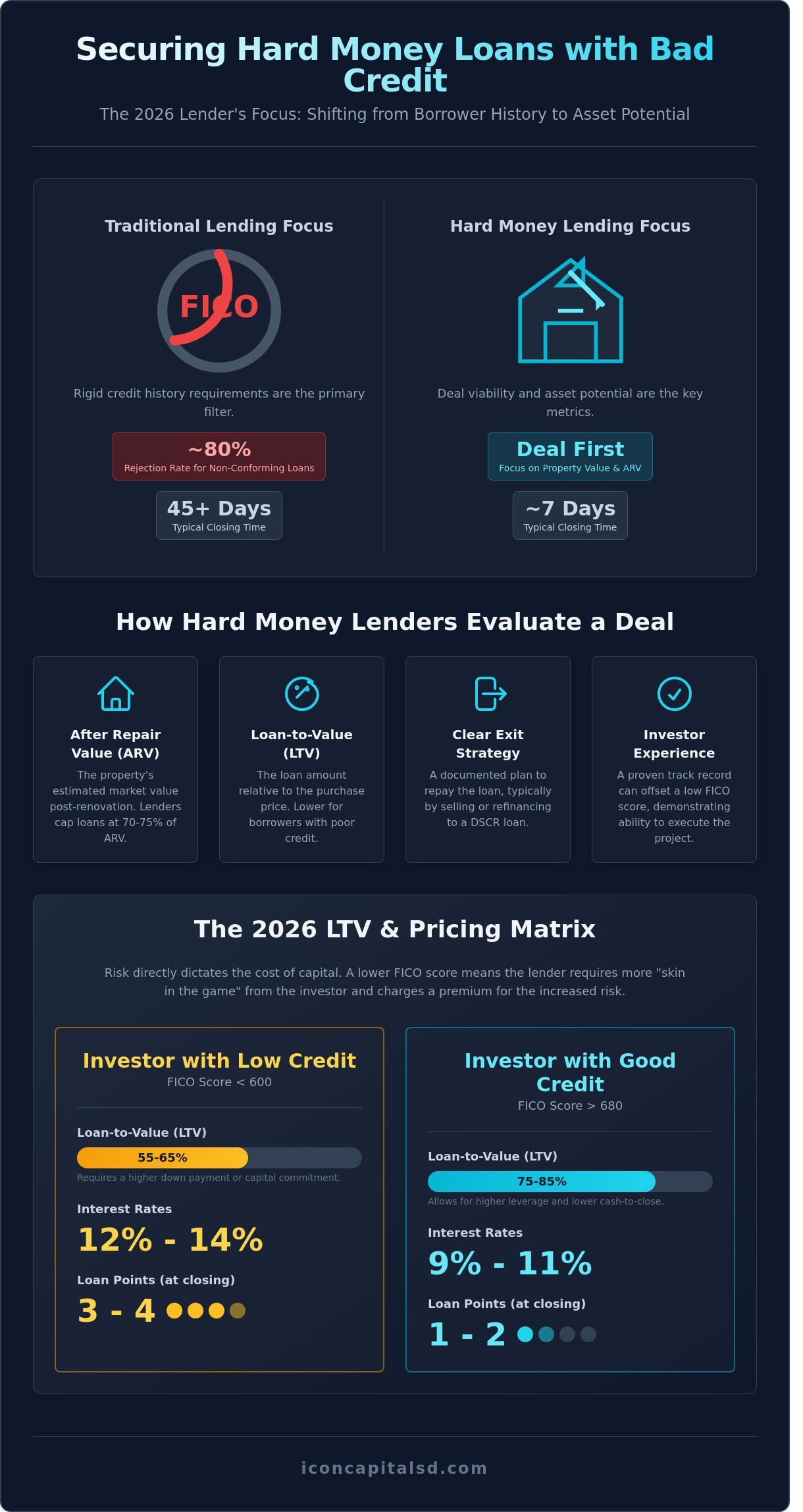
Your FICO score is the least important metric for securing your next investment property in 2026. While traditional institutions reject approximately 80% of non-conforming loan applications due to rigid credit history requirements, experienced investors prioritize asset-based liquidity. You’ve likely seen profitable deals vanish because a bank’s underwriting process moved too slowly. It’s frustrating to lose a high-yield opportunity over a number that doesn’t reflect the property’s actual potential.
Finding hard money lenders for bad credit is about shifting the focus to the deal’s viability rather than your personal financial history. This guide details how to secure funding based on property value and ARV, enabling you to close in as little as 7 days. You’ll learn how to structure your loan for maximum leverage and identify a clear path to refinancing once the property is stabilized. We’ll examine the specific 2026 loan structures and LTV ratios that allow you to scale your portfolio without a perfect credit score.
Key Takeaways
- Understand how asset-based lending models prioritize property equity and After Repair Value (ARV) over traditional FICO scores.
- Learn to leverage LTV and ARV metrics to secure financing, even when credit challenges require a higher capital commitment.
- Compare the speed and cost of DSCR, bridge, and fix-and-flip loans to identify the most effective hard money lenders for bad credit.
- Discover how to build lender confidence using a professional experience resume and a rigorous property scope of work.
- Identify creative financing strategies that streamline the underwriting process for complex, high-potential real estate deals.
What Are Hard Money Lenders for Bad Credit?
Hard money lenders for bad credit are private financing entities that prioritize property equity and After Repair Value (ARV) over a borrower’s FICO score. In the 2026 real estate market, where traditional interest rates remain higher than the 2020 lows, these lenders provide critical liquidity for non-conforming deals. Unlike traditional banks that rely on the Dodd-Frank framework for consumer protection, hard money firms focus on the asset’s exit strategy and the viability of the project itself.
The core difference between these loans and traditional subprime mortgages lies in the intent and duration. Subprime mortgages are usually 30-year consumer products designed for primary residences. Hard money is a short-term, commercial tool used by investors to scale portfolios. Lenders in this space typically ignore minor credit blemishes. They focus on whether the property can support the debt service or provide enough equity to protect the capital in a default scenario.
The Mechanics of Asset-Based Lending
Lenders use the property as the primary collateral to mitigate personal risk. This process shifts the internal focus from Borrower Qualification to Deal Qualification. An investor with a 580 FICO score but 20% liquidity and a history of 4 successful exits in the last 18 months is often more bankable than a high-credit novice. Underwriters evaluate the Loan-to-Value (LTV) ratio, often capping it at 70% of the purchase price. This cushion ensures the lender remains protected if the market shifts. Experience often carries more weight than a credit report because it proves the borrower can execute the renovation and sale within the typical 12-month loan term.
When to Use Hard Money Despite Low Credit
Speed and flexibility are the primary drivers for using hard money lenders for bad credit. Investors often choose this route in high-competition environments where traditional financing takes 45 days to close. Common scenarios include:
- Fix-and-flip projects: High-margin deals where the renovation budget is funded by the lender, allowing the investor to preserve their own cash for other acquisitions.
- Bridge scenarios: Situations where a property needs immediate stabilization, such as a multi-family unit with 40% vacancy, before it can qualify for a long-term DSCR loan.
- Auction acquisitions: Bidding on distressed assets at trustee sales where cash-like speed is required to secure the deed within 24 to 48 hours.
If you have a deal that requires immediate funding, you can request a quote to see how the asset’s equity can offset credit challenges and provide the leverage needed to close.
How Lenders Evaluate “Bad Credit” Real Estate Deals
Hard money lenders for bad credit focus on the asset’s liquidation value rather than the borrower’s personal financial history. The primary metric for any deal is the After Repair Value (ARV). This figure represents the estimated market value of the property once all renovations are finished. Most lenders cap the total loan amount at 70% to 75% of the ARV to ensure the project remains profitable even if market conditions shift. When a borrower presents a FICO score below 600, lenders typically reduce the initial Loan-to-Value (LTV) ratio. Instead of the standard 80% purchase price coverage, a high-risk borrower might only receive 60% to 65% coverage. This adjustment ensures the investor has significant “skin in the game,” which reduces the likelihood of default.
A documented exit strategy is the most critical component of the underwriting process for high-risk loans. Lenders don’t want to own the property; they want their principal returned with interest. A viable exit usually involves selling the property for a profit or transitioning into long-term financing. For investors with poor credit, the transition to a Debt Service Coverage Ratio (DSCR) loan is a common path. Lenders will scrutinize the projected rental income to ensure it covers the new mortgage payments. Past performance also dictates the deal structure. An investor who has successfully completed 4 flips in the last 24 months can often bypass credit score requirements that would stop a novice. Experience proves the ability to manage contractors and stay within budget, which are the two biggest risks in a fix-and-flip project.
The 2026 LTV and Pricing Matrix
Risk directly dictates the cost of capital in the 2026 market. Borrowers with credit scores under 600 generally face LTV limits of 55% to 65% and interest rates between 12% and 14%. In contrast, investors with scores of 680 or higher can access 75% to 85% LTV with rates ranging from 9% to 11%. Loan points also vary based on the risk profile. Low-credit deals often require 3 to 4 points at closing, whereas prime borrowers might only pay 1 to 2 points. Securing capital through hard money lenders for bad credit sometimes requires cross-collateralization. By pledging a second property as additional security, an investor can often secure a higher LTV on the primary deal and reduce the total cash required at the closing table.
Risk Mitigation and Protective Equity
Lenders look for a 20% to 30% protective equity cushion to insulate the investment against sudden market corrections. Protective equity is the gap between the loan amount and the forced-sale value. This cushion ensures the lender can recover their capital even if the property must be sold quickly at a discount. Recent financial setbacks like bankruptcies or foreclosures don’t lead to an immediate denial, but they do require a seasoning period. Most private firms require at least 12 months to pass since a bankruptcy discharge before they will consider an application. They will also verify that no new 30-day or 60-day delinquencies have appeared on the credit report since the event. To see how your specific property qualifies for these terms, you can request a quote and receive a preliminary term sheet within 24 hours.
Hard Money vs. DSCR vs. Bridge Loans for Low Credit
Real estate investors with credit scores below 620 often find traditional bank financing inaccessible. Choosing between hard money, DSCR, and bridge loans depends on your exit strategy and the property’s current condition. Investors frequently rely on hard money lenders for bad credit when speed is the priority, but different assets require different structures. For a deeper dive, see our Ultimate Guide to DSCR Loans.
- Hard Money: Best for fix-and-flip projects. Closing occurs in 7 to 10 days. Interest rates typically range from 10% to 13% with 2 to 4 points.
- DSCR Loans: Best for long-term rentals. Qualification hinges on property cash flow. Rates are lower than hard money, usually between 7.5% and 9%.
- Bridge Loans: Best for short-term liquidity. These loans provide 12 to 24 months of capital to stabilize a property or wait for better market conditions.
Hard money is the fastest option because it ignores personal debt-to-income ratios. Lenders focus on the After Repair Value (ARV) and the experience of the investor. While hard money lenders for bad credit charge higher fees, the ability to secure a deal in under two weeks often outweighs the cost of capital.
DSCR Loans for Rental Portfolios
Debt Service Coverage Ratio (DSCR) loans are the ultimate workaround for investors with low credit scores. Instead of verifying your personal tax returns or W-2s, the underwriter analyzes the property’s ability to cover the mortgage payment. A ratio of 1.2x means the property generates 20% more income than the monthly debt obligation. If the property’s cash flow is strong, your personal credit history becomes a secondary factor. Check out our DSCR Loan Requirements Checklist for more details.
Bridge Loans for Immediate Liquidity
Bridge financing serves as a temporary solution to secure a property while you work on repairing your personal credit. These loans typically carry a duration of 12 to 24 months. They offer more flexibility than a standard 30-year mortgage and faster funding than a traditional bank. Investors use bridge loans to acquire distressed assets or to pay off maturing debt. Once the property is seasoned, usually after 6 to 12 months of rental history, you can transition from bridge financing into a long-term DSCR loan at a lower interest rate. This strategy allows you to scale your portfolio without being hindered by a temporary dip in your credit score.
While real estate bridge loans address property-level liquidity, investors who need immediate personal funding for smaller gaps during their projects can use QuickCashDirect to access a variety of short-term financial solutions.
5 Steps to Secure a Hard Money Loan with Bad Credit
Hard money lending is primarily asset-based, but a low credit score increases the lender’s perceived risk. To mitigate this, your loan package must be mathematically undeniable. Investors with scores below 620 can still secure funding by shifting the focus to the property’s potential and their own operational competence. Follow these five steps to secure a commitment from hard money lenders for bad credit.
- Step 1: Perform a Rigorous Deal Analysis. Your After Repair Value (ARV) needs to be backed by at least three comparable sales within a 0.5-mile radius, sold within the last six months. If the equity isn’t there, the credit score becomes a bigger hurdle.
- Step 2: Prepare a Comprehensive Experience Resume. List every project completed in the last 24 months. Include purchase prices, renovation budgets, and final sale prices. Proven success reduces the underwriter’s reliance on your personal credit history.
- Step 3: Verify Your Cash Reserves. Liquidity solves many problems. You’ll need to show bank statements with enough cash to cover 6 to 12 months of interest payments and the required down payment. Most lenders expect 15% to 25% skin in the game.
- Step 4: Present a Bulletproof Exit Strategy. Clearly define how you’ll pay back the loan. If you plan to sell, provide a marketing timeline. If you’re holding the property, show that it meets DSCR requirements for a future refinance.
- Step 5: Partner with a Creative Financing Specialist. Choose a lender that looks beyond the FICO. Specialized firms focus on the “why” behind the credit score and the “how” of the deal’s profitability.
Professionalizing Your Loan Package
A detailed Scope of Work (SOW) is a mandatory tool for reducing lender anxiety. It should itemize every expense, from flooring to permits, leaving no room for “hidden costs.” Use third-party appraisals to validate your ARV assumptions rather than relying on automated valuation models. For detailed project planning tips, review our Fix and Flip Guide to ensure your numbers align with industry standards.
The Importance of Transparency
Hiding credit issues is a fast way to get a denial. Disclose financial hurdles upfront so your loan officer can structure the deal correctly from day one. Draft a Letter of Explanation for past credit events, such as medical collections or a previous foreclosure, focusing on the steps you’ve taken to stabilize your finances. Transparency builds the trust necessary for creative approvals. You can request a quote here to start a direct conversation about your specific scenario and property details.
Ready to leverage your next investment property? Contact Icon Capital today to discuss your deal with a specialist who understands hard money lenders for bad credit.
Icon Capital: Creative Financing for High-Potential Deals
Icon Capital operates as a direct, data-driven lender focused on the underlying value of the asset rather than the borrower’s historical credit hurdles. In the 2026 market, traditional banks often reject files based on rigid FICO requirements. We specialize in providing liquidity for complex scenarios. Investors searching for hard money lenders for bad credit find that we prioritize deal structure and property equity. Our underwriting team analyzes local US real estate trends to ensure every loan supports a viable exit strategy. We don’t let a low score stop a high-potential project.
Our approach is pragmatic and solution-oriented. We understand that real estate cycles move faster than bank committees. By the start of 2026, the demand for non-QM lending increased by 14% as self-employed individuals sought alternatives to standard income verification. We meet this demand by looking at the numbers that matter: cash flow, loan-to-value ratios, and market demand. Our goal is to enable your growth through professional-grade leverage.
Our Product Suite for Investors
We offer a specialized range of financing products designed for speed and scale. Our loan amounts reach up to $2 million for multi-unit residential and commercial projects. This capacity allows investors to leverage larger assets without the red tape of institutional finance. Our product suite includes:
- DSCR Loans: Qualification based on property cash flow, not personal income.
- Fix & Flip: Rapid funding for acquisition and renovation costs.
- Bridge Loans: Short-term capital to stabilize assets or seize immediate opportunities.
Our process is built for efficiency. We follow a four-step method: Structure, Submit, Underwrite, and Close. This linear flow removes ambiguity. We frequently work with foreign nationals and self-employed business owners who lack standard tax documentation. By focusing on LTV and asset performance, we provide capital where others see risk. It’s about the asset’s future, not the borrower’s past. As hard money lenders for bad credit, we provide the tools necessary to compete in high-velocity markets.
Get Your Deal Funded Today
You need a lender that understands the mechanics of the deal. Icon Capital provides direct access to decision-makers and specialized underwriters. This eliminates the delays common in brokerage environments. Every evaluation is a no-nonsense look at what your investment property can achieve. We focus on the math, not the narrative.
Whether you’re scaling a portfolio or closing your first flip, our team focuses on tangible outcomes. We provide the expertise required to navigate 2026’s unique market dynamics. Don’t let traditional lending constraints stall your project. Our underwriters are ready to review your deal structure and provide a clear path to closing.
Request a Quote from Icon Capital to explore your options.
Scale Your Portfolio with Asset-Based Financing
Success in the 2026 real estate market depends on your ability to move faster than the competition. Traditional banks often reject files based on a FICO score, but hard money lenders for bad credit prioritize the property’s equity and your specific exit strategy. By focusing on asset-based lending rather than personal financial history, you can secure the leverage needed for high-yield opportunities. Icon Capital provides national coverage across the United States, offering specialized DSCR and Fix & Flip programs tailored for complex scenarios. Our process removes the friction of conventional underwriting; this allows you to close deals that others simply can’t. Whether you’re looking to renovate a distressed property or build a long-term rental portfolio, the right structure makes the difference. Don’t let a credit score limit your growth when the numbers on the deal make sense. We’re ready to help you capitalize on your next investment opportunity.
Request a Quote for Your Next Investment Deal
Frequently Asked Questions
What is the minimum credit score for a hard money loan?
Most hard money lenders for bad credit don’t enforce a strict minimum credit score, though many look for a 500 FICO or higher. Because these are asset-based loans, the equity in the property serves as the primary security. An investor with a 520 score can often secure a loan if the property’s LTV stays below 65%.
Can I get a hard money loan with a recent bankruptcy or foreclosure?
You can secure a hard money loan the day after a bankruptcy discharge or a foreclosure auction. Unlike conventional lenders that require a 36 to 84 month waiting period, private lenders prioritize the collateral’s value. We look at the 25% to 30% equity cushion rather than your previous credit history or financial distress events.
How much down payment is required for a bad credit hard money loan?
A down payment of 20% to 35% is standard for borrowers with credit scores below 600. Higher risk profiles require more capital from the investor to protect the lender’s position. For a $300,000 purchase, expect to bring at least $60,000 to the closing table to satisfy LTV requirements and secure the deal.
Do hard money lenders check my income or employment?
Hard money lenders don’t typically check personal income, employment history, or debt-to-income ratios. The underwriting process centers on the asset’s performance, such as a DSCR of 1.2 or higher. We care about the property’s ability to cover the debt and the strength of the exit strategy, not whether you have a 9 to 5 job.
How fast can a hard money loan close when credit is an issue?
Hard money lenders for bad credit often close within 7 to 10 days because the process bypasses traditional documentation requirements. Credit issues don’t slow the timeline since the appraisal and title work are the primary bottlenecks. This speed allows investors to compete with cash buyers and secure distressed assets before the competition can react.
Are interest rates significantly higher for low-credit borrowers?
Interest rates for low-credit borrowers are typically 2% to 4% higher than standard private money rates. While a high-credit investor might see 10%, a borrower with significant credit challenges might face 12% or 14% interest. This reflects the increased risk the lender takes on by financing a sub-600 FICO borrower in a volatile market.
Can I use a hard money loan for a primary residence?
Hard money cannot be used for a primary residence due to consumer protection laws like the Dodd-Frank Act. These products are strictly for business-purpose loans, including fix and flips or bridge financing for rentals. If you intend to live in the property for more than 14 days a year, you won’t qualify for this capital.
What happens if I cannot refinance my hard money loan due to credit?
If you can’t refinance due to credit, your primary options are to sell the property or request a 6 to 12 month loan extension. Most hard money contracts include a balloon payment after 12 months. Selling the asset is the most common exit strategy for investors who cannot bridge into a long-term Non-QM or conventional loan.