

Real estate deals don’t die because of bad properties; they die because of slow capital. You’ve likely felt the frustration of losing a high-yield asset to a cash buyer while a traditional bank spends 45 days scrutinizing your personal tax returns and debt-to-income ratios. It’s a bottleneck that prevents even the most experienced investors from scaling. Hard Money Home Loans offer the necessary pivot. By prioritizing the asset’s value over the borrower’s personal financial history, these loans allow you to compete with cash offers and secure properties that others simply can’t reach.
We agree that the current lending landscape is often too rigid for the fast-paced 2026 market. This guide will teach you how to master the mechanics of private capital to close deals in 7 to 10 days with total transparency. You’ll learn to use leverage to your advantage and navigate a simple, predictable underwriting process. We’ll cover everything from LTV thresholds to the specific documentation needed to move from application to funding in record time.
Key Takeaways
- Understand how asset-based lending prioritizes the tangible value of the property over borrower credit to secure immediate capital.
- Navigate the 2026 market by mastering the specific interest rates, LTV ratios, and points associated with Hard Money Home Loans.
- Compare financing tools to see how a 7-day closing window and no-doc requirements provide a competitive edge over traditional bank delays.
- Identify the essential liquidity and exit strategy requirements that drive private capital approvals more than a high FICO score.
- Learn to scale your portfolio using specialized underwriting designed for rapid fix-and-flip, bridge, and multi-unit project execution.
What is a Hard Money Home Loan? Asset-Based Lending Explained
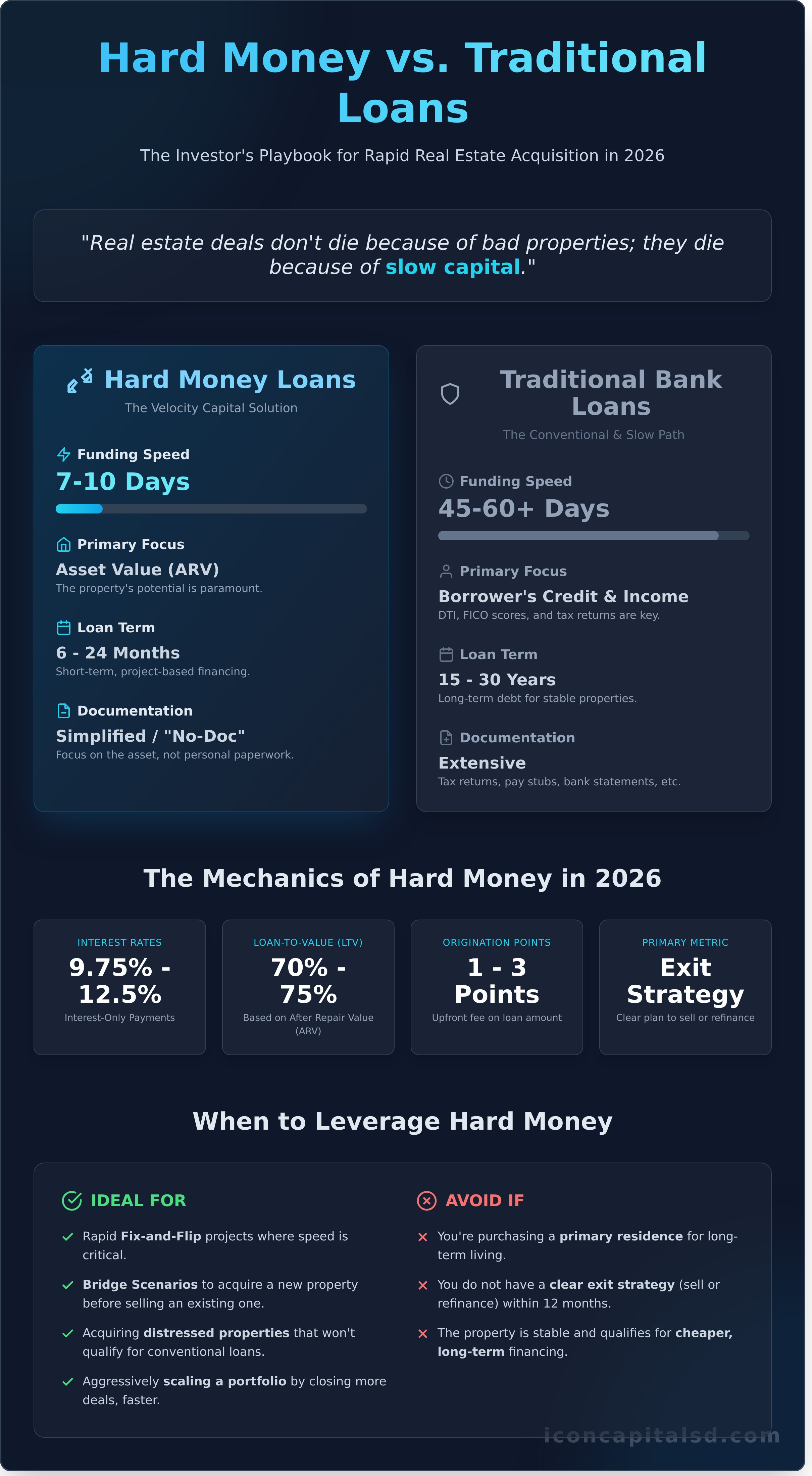
A hard money loan is a specific class of asset-based financing where a tangible real estate asset serves as the primary collateral. Unlike traditional mortgages that depend on a borrower’s credit score and personal income, hard money lenders prioritize the property’s value. The “hard” in the name refers to this physical security. These loans are short-term instruments designed for speed and flexibility. Hard Money Home Loans provide the liquidity needed for rapid acquisitions, typically funding in 7 to 10 business days. This contrasts sharply with the 45 to 60 days required by conventional banks.
Speed is the primary value proposition for professional flippers and developers. In a competitive market, an investor who can close in a week often beats a higher offer that requires 2 months of bank underwriting. While interest rates for these products range from 8% to 12%, the cost is a calculated expense for a specific project timeline. Private money often comes from individuals or small groups with varying terms. Hard money is more institutional, offering structured draws for renovations and clear LTV (Loan-to-Value) requirements. Traditional mortgages remain the standard for long-term debt, but they lack the agility required for distressed property acquisitions.
The Core Philosophy: Asset vs. Income
Hard money lenders prioritize the After Repair Value (ARV) rather than your personal tax returns. If a property is purchased for $200,000 and will be worth $350,000 after a $50,000 renovation, the lender focuses on that $350,000 exit. Traditional DTI (Debt-to-Income) ratios are secondary to the project’s equity. Lenders require “skin in the game,” often capping the loan at 70% to 75% of the ARV. This ensures the investor is committed to the project. These loans are not meant for decades; they typically carry terms of 6 to 24 months. The goal is to renovate, sell, or refinance into a long-term product like a DSCR loan once the property is stabilized.
When to Use Hard Money (and When to Avoid It)
This financing is ideal for fix-and-flip projects, bridge scenarios, and properties that don’t meet habitability standards. A house missing a kitchen or roof won’t qualify for an FHA or conventional loan, but it is a prime candidate for hard money. Investors use it to scale their portfolios quickly without waiting for bank approvals. However, hard money is rarely suitable for a primary residence. The high interest rates and points, usually 1 to 3 percent of the loan amount, make it expensive for long-term holding.
The decision to use this capital comes down to opportunity cost. If a bank delay causes an investor to lose a deal with a $60,000 projected profit, the $15,000 in interest paid over 6 months becomes a minor cost of doing business. Closing in 7 days allows an investor to secure properties at a discount. This discount often exceeds the total cost of the loan. Use hard money when the speed of execution and the condition of the asset prevent traditional financing. Avoid it if you don’t have a clear exit strategy within 12 months. The risk increases significantly if the project stalls and the loan enters a high-interest extension period.
- Typical Interest Rates: 8% to 13%
- Origination Points: 1% to 3%
- Loan Terms: 6 to 24 months
- Funding Speed: 5 to 10 days
- Primary Metric: LTV and ARV
The Mechanics of Hard Money: Rates, LTV, and Terms in 2026
In 2026, the cost of private capital remains tied to institutional liquidity and local inventory levels. Interest rates for Hard Money Home Loans currently range from 9.75% to 12.50% based on the borrower’s track record and the specific asset class. Most lenders charge between 1 and 3 points at closing. These points are upfront fees calculated as a percentage of the total loan amount. Understanding the Hard Money Loan Definition is essential for calculating the true cost of capital over a six to twelve month hold period. While these rates are higher than traditional mortgages, the speed of execution provides a competitive advantage in low-inventory markets.
Interest-only structures are the standard for these products. You don’t pay down the principal during the renovation phase. This maximizes monthly cash flow, allowing you to divert capital toward materials and labor rather than loan amortization. Most terms last between 6 and 24 months. Experienced flippers use Hard Money Home Loans to secure properties before traditional buyers can mobilize, then refinance into long-term debt once the property is stabilized.
Draw schedules manage the distribution of renovation funds. Lenders don’t release the full construction budget at the closing table. Instead, they release funds in stages as specific milestones are reached. You complete a phase of work, such as plumbing or framing, and then request an inspection. Once the lender’s representative verifies the work, the funds are reimbursed to your account. This process ensures the project stays on track and the lender’s collateral is protected.
Calculating Loan-to-Value (LTV) and ARV
Lenders prioritize the 70% rule to mitigate risk. This means the total loan amount usually won’t exceed 70% of the After Repair Value. ARV is the estimated market value of a property after all renovations are completed. While LTV focuses on the current value, many lenders also look at LTC (Loan-to-Cost). LTC typically covers up to 85% or 90% of the total purchase and renovation costs. Lenders use the lower of these two metrics to determine your required down payment.
Common Fees and Hidden Costs
Transparency in the closing statement is vital for project profitability. Beyond points, expect to pay for a specialized investment appraisal, which costs roughly $600 to $900 in 2026. Document preparation and processing fees can add another $1,500 to the total. Prepayment penalties are rare in the hard money sector because lenders value capital velocity. However, if your project exceeds the agreed timeframe, you’ll likely face an extension fee. This is typically 1% of the loan balance for every 30-day extension granted.
If your project requires a rapid close with a clear path to exit, you can review our specific loan programs to see which leverage model fits your asset. Effective capital management requires a deep understanding of these variables before you sign the term sheet. Every point and fee impacts your final ROI.
Hard Money vs. DSCR vs. Traditional Loans: Choosing Your Tool
Successful investors select financing based on the specific phase of their project. A Hard money loan serves as a high-speed bridge for immediate acquisition; meanwhile, DSCR and traditional loans provide long-term stability. Speed and documentation requirements represent the primary dividers between these three paths.
- Hard Money Home Loans: 7-day closing window. No-doc requirements. Focuses on asset value and equity rather than borrower income.
- DSCR Loans: 30-day closing window. Light-doc requirements. Focuses on the property’s Debt Service Coverage Ratio (rental income vs. mortgage debt).
- Traditional Loans: 60-day closing window. Full-doc requirements. Focuses on W2s, tax returns, and personal debt-to-income (DTI) ratios.
In the 2026 market, liquidity is the ultimate differentiator. Investors targeting a 12% annual growth rate must deploy capital faster than the 45 to 60 days required by retail banks. If you’re competing against four other bidders for a distressed property in a high-demand zip code, the 7-day hard money close acts as a cash-equivalent offer. It secures the deal when a 60-day bank timeline would lose it.
Hard Money for the Buy and Rehab
Hard money is the undisputed king of the acquisition phase for distressed assets. Traditional banks often refuse to lend on properties with significant deferred maintenance or structural issues; however, hard money lenders prioritize the After Repair Value (ARV). This allows you to secure properties that are currently unfinanceable by standard measures.
Speed functions as a powerful negotiation lever. In a typical 6-month fix-and-flip timeline, an investor might purchase a property for $215,000 in January, spend $45,000 on renovations by March, and list it for $340,000 in June. Closing the initial purchase in under a week often secures a 7% to 10% discount from sellers who value a guaranteed, rapid exit over a slightly higher, but uncertain, bank-financed offer.
Refinancing into DSCR for Long-Term Wealth
The transition from high-interest short-term debt to stable long-term financing defines the BRRRR method: Buy, Rehab, Rent, Refinance, Repeat. Once a renovation is complete and a tenant is placed, you don’t want to keep 11% or 12% interest rates on your books. You transition into a 30-year DSCR loan to lock in cash flow and protect your margins.
Icon Capital specializes in this precise pivot. We move investors from the “Buy and Rehab” phase into permanent financing without requiring personal income verification or tax returns. For a property generating $2,800 in monthly rent with a $2,000 mortgage payment, the 1.40 DSCR ratio qualifies the deal. This strategy allows you to pull your initial capital back out, enabling you to scale your portfolio to 15 or 20 units by the end of 2026. Hard Money Home Loans get you in the door; DSCR loans keep you in the game for the long haul.
What Do You Seriously Need? The 2026 Hard Money Checklist
“No money down” is a marketing myth that leads to rejected files. Hard money lenders aren’t charities; they require skin in the game to mitigate risk. While some programs offer 90% Loan-to-Cost (LTC), you still need liquid cash for the 10% down payment and closing costs which typically range from 2% to 4% of the loan amount. For 2026, expect to show bank statements with at least 25% of the total project cost in liquid reserves to cover interest carry and unforeseen delays.
Your exit strategy carries more weight than your FICO score. Lenders prioritize how they’ll be repaid over your personal credit history. If you plan to transition into a long-term rental, we analyze the Debt Service Coverage Ratio (DSCR) to ensure the property cash flows. If your plan is to sell, we look at the absorption rate in that specific zip code. A 620 FICO score with a solid 30% equity position is often more bankable than a 780 score on a property with a thin profit margin.
Documentation for the subject asset must be exhaustive. You’ll need a detailed, line-item Scope of Work (SOW) and 3 to 5 sold comparables from the last 180 days. These “comps” should be located within a 0.5-mile radius of the property. Vague estimates like “kitchen remodel: $20,000” don’t pass underwriting anymore. You need specific material costs and labor bids to secure Hard Money Home Loans in today’s tighter credit market.
Experience level directly dictates your cost of capital. Investors with zero completed projects in the last 36 months often face 12% interest rates and 2.5 points. Once you hit the five-flip milestone, rates typically compress to 9% or lower. We track your track record through HUD-1 settlement statements or recorded deeds to verify your proficiency in managing Hard Money Home Loans and completing renovations on schedule.
The 5 Essential Application Steps
Efficiency is the key to closing in 7 to 10 days. Follow this sequence to avoid delays:
- Step 1: Get the property under contract with a clear, line-item Scope of Work.
- Step 2: Provide Proof of Funds for the 20% down payment and initial mobilization costs.
- Step 3: Secure a preliminary title report and an insurance binder naming the lender as loss payee.
- Step 4: Request a Quote to lock in your term sheet and pricing.
- Step 5: Submit entity documents for your LLC, including the Operating Agreement and Articles of Organization.
Common Pitfalls to Avoid
Underwriters focus on the “as-is” value versus the After Repair Value (ARV). A common mistake is using active listings as comps; only use sold data. Another trap is the rehab draw process. Hard money lenders reimburse for work completed. If your first phase of plumbing costs $15,000, you need that $15,000 in cash to pay the contractor before the lender sends an inspector and releases the funds. Always include a 15% contingency fund in your budget to handle 2026 labor price spikes.
Ready to secure your next investment property with speed and certainty? Apply for a Hard Money Home Loan and get a decision in 24 hours.
Scale Your Real Estate Portfolio with Icon Capital
Icon Capital LLC operates on a simple premise: the asset dictates the opportunity. Traditional banks spend 45 to 60 days scrutinizing personal debt-to-income ratios; we focus on the property’s potential and the exit strategy. Our underwriting is built for speed. We provide Hard Money Home Loans that prioritize Loan-to-Value (LTV) and After-Repair Value (ARV) over a borrower’s tax returns from 2022 or 2023. This asset-based approach allows us to fund deals that others simply can’t process.
Investors targeting fix-and-flip projects or multi-unit acquisitions need capital that moves at the speed of the market. Icon Capital LLC offers up to 90% LTC (Loan-to-Cost) for renovations and 75% LTV for bridge financing. By removing the bureaucratic layers found in institutional lending, we provide direct access to decision-makers who can approve a $1.5 million loan in under 48 hours. Our creative financing solutions bypass the 20-page document checklists required by retail banks, focusing instead on the equity and the deal’s viability.
- Direct Access: Speak directly to the people signing the checks, not a middle-management loan officer.
- Rapid Funding: Move from initial submission to a clear-to-close status in as little as 5 to 10 business days.
- Customized Terms: We structure interest-only payments and flexible durations to match your project’s specific timeline.
Specialized Programs for Investors
Foreign National programs are a core specialty at Icon Capital LLC. We facilitate financing for international investors who lack a U.S. credit history but have a 35% down payment ready for domestic assets. For those scaling into the 5 to 8 unit space, our commercial bridge options fill the gap where residential lenders stop. We’ve reduced the submission-to-funding timeline to 10 business days for qualified multi-unit projects, ensuring you don’t lose the property to a cash buyer.
Getting Started Today
Market projections indicate 2026 will be a pivotal year for real estate acquisition. With inventory shifts and a 12% projected growth in urban multi-family demand, securing high-leverage Hard Money Home Loans now positions your portfolio for maximum appreciation. Waiting for traditional bank approvals means missing the window of opportunity that 2026 presents. Our experts are ready to analyze your pro-forma and structure a loan that maximizes your cash-on-cash return.
Structuring a complex loan requires a partner who understands the mechanics of leverage. Whether you’re consolidating a portfolio or jumping on a distressed multi-unit property, the right capital stack makes the difference between a stalled project and a profitable exit. Reach out to our team to discuss your specific LTV requirements and closing timeline. Ready to close your next deal? Request a quote from Icon Capital LLC now.
Accelerate Your Real Estate Strategy with Targeted Capital
Success in the 2026 market requires more than just finding the right property; it demands the right financial architecture. Hard Money Home Loans offer the necessary speed to close deals in days rather than the standard 30 to 45 days required by traditional institutions. By leveraging asset-based lending, you prioritize the property’s value and equity over rigid personal income verification. Icon Capital operates as a direct lender specializing in complex Non-QM deals and creative capital solutions. We provide tailored programs for 5-8 unit residential buildings and offer specialized paths for Foreign National investors seeking US assets. Our expertise covers the full spectrum of investment needs, including DSCR models and Fix & Flip financing. We focus on the mechanics of the deal so you can focus on the next acquisition. Don’t let capital constraints limit your portfolio’s potential. Our team is ready to structure your next high-leverage transaction with precision and efficiency.
Secure your next investment with Icon Capital and request a quote today.
Frequently Asked Questions
Can I get a hard money loan with a 500 credit score?
Yes, you can secure funding with a 500 credit score because hard money lenders prioritize the property’s value over personal credit history. Most programs focus on the After Repair Value (ARV) or current Loan-to-Value (LTV) ratio. While a 500 score is acceptable, expect the LTV to be capped at 65% to 70% to mitigate risk. Lenders prioritize the asset’s liquidity and the borrower’s exit strategy over historical credit hiccups.
How much of a down payment is typically required for hard money?
Investors typically need a down payment between 10% and 25% of the purchase price. For experienced flippers with 5 or more successful exits in the last 24 months, some lenders offer 90% Loan-to-Cost (LTC) and 100% of renovation funds. First-time investors should prepare for a 20% to 25% cash contribution at closing to secure the deal. This ensures the borrower has sufficient skin in the game.
Are hard money loans only for fix-and-flips?
Hard money loans serve various investment strategies beyond fix-and-flips, including bridge loans for stabilized rentals and ground-up construction. Investors use these products to secure properties quickly before transitioning to long-term DSCR financing. This flexibility allows for 12 to 24-month terms on residential, multi-family, or commercial assets. These loans provide the necessary capital to stabilize an asset before seeking permanent financing through traditional or non-QM channels.
What happens if I cannot pay back a hard money loan on time?
If you can’t repay the loan by the maturity date, you’ll face default interest rates or foreclosure proceedings. Most lenders offer 3-month or 6-month extensions for a fee, usually ranging from 1% to 2% of the principal balance. Communication is critical; lenders prefer a paid extension over a legal battle to seize the collateral property. Defaulting typically triggers a 5% to 10% increase in the interest rate until the balance is settled.
Is hard money more expensive than a DSCR loan?
Hard money is generally more expensive than a DSCR loan, with interest rates typically 2% to 4% higher. While DSCR loans currently average 7% to 9%, hard money rates often range from 10% to 13%. Additionally, hard money usually carries 2 to 3 origination points, whereas DSCR products might only require 1 to 2 points. The higher cost reflects the speed and increased risk the lender accepts for short-term projects.
How long does it take to get funded once the property is inspected?
Funding usually occurs within 3 to 7 business days once the property inspection is complete. Because Hard Money Home Loans bypass the 30-day requirements of traditional banks, the process is streamlined. If the title is clear and the valuation meets the 75% LTV threshold, closing can happen in as little as 72 hours. This speed allows investors to compete with all-cash buyers in competitive markets where timing is critical.
Do hard money lenders require an appraisal?
Most lenders require a full appraisal or a Broker Price Opinion (BPO) to verify the asset’s worth. For Hard Money Home Loans, the lender focuses on the 70% ARV rule to ensure the project’s viability. Some private funds use internal valuations for repeat borrowers with 10 or more active deals to accelerate the closing timeline. This valuation determines the maximum leverage the lender will provide to protect their capital position.
Can I use hard money to buy a primary residence?
You can’t use hard money to purchase a primary residence due to federal Dodd-Frank regulations. These loans are strictly for business purpose investments, meaning the borrower doesn’t intend to occupy the property. Lenders require a signed affidavit at closing confirming the property is for investment use to comply with consumer protection laws. Financing a primary residence requires traditional or Non-QM products that follow different regulatory guidelines and disclosure requirements.