

Why are top-tier investors intentionally opting for 10% interest rates when traditional bank financing sits significantly lower? In the 2026 commercial landscape, the answer is clear: a funded deal at a premium rate beats a lost opportunity at 6% every time. You’ve likely watched a prime asset slip away because a legacy bank spent 45 days analyzing your debt-to-income ratio. Utilizing Hard Money Commercial Loans allows you to bypass these institutional bottlenecks by focusing on asset value rather than personal paperwork.
This guide provides the strategic framework to master these specialized lending tools for immediate execution. You’ll learn how to secure funding in as little as 7 to 10 days while navigating the specific LTV requirements and exit strategies used by professional firms. We’ll analyze current asset-based qualification standards and provide a roadmap for using flexible capital to acquire distressed or unique properties that traditional lenders won’t touch.
Key Takeaways
- Understand why asset-based financing is the preferred tool for investors prioritizing property equity and speed over personal credit history.
- Learn how to navigate the specific LTV and term structures of Hard Money Commercial Loans to maximize leverage on 5-8 unit and mixed-use properties.
- Discover the tactical advantage of closing deals in as little as 48 hours with minimal documentation compared to traditional 60-day bank timelines.
- Identify the critical components of a winning loan application, including the essential role a clear exit strategy plays in securing immediate approval.
- Explore creative financing solutions for 2026, including specialized programs for foreign nationals and non-traditional commercial assets.
What Are Hard Money Commercial Loans and Why Use Them?
Hard money commercial loans provide short-term, asset-based capital secured by real estate. Unlike traditional bank products, the primary underwriting focus remains on the property’s underlying value and equity rather than the borrower’s personal credit history. Hard money serves as a tactical bridge to permanent financing. Investors utilize these tools for opportunistic acquisitions or rapid stabilization projects where timing is the critical factor. Because these loans are funded by private investors or specialized firms, the approval process bypasses the bureaucratic hurdles typical of institutional lenders.
Asset-Based Lending vs. Traditional Commercial Mortgages
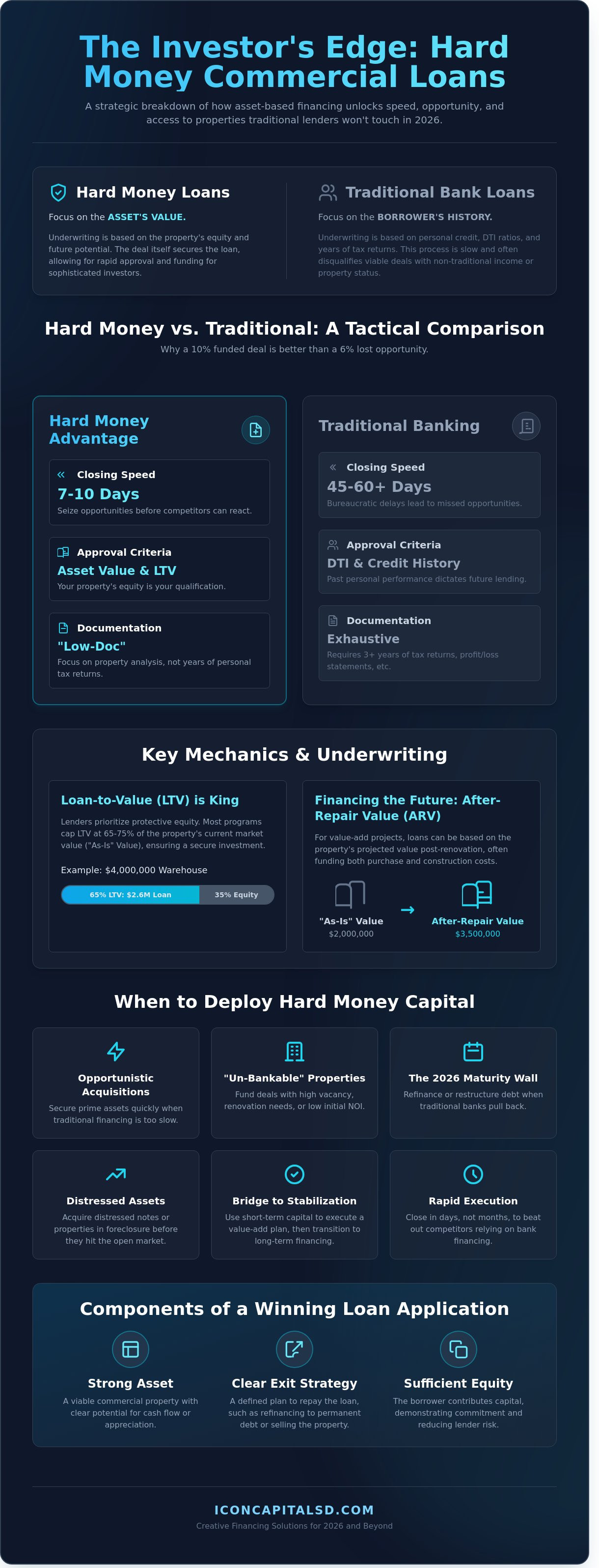
Traditional lenders prioritize Debt-To-Income (DTI) ratios and require three years of historical tax returns. They focus on the borrower’s ability to repay based on past earnings. Hard money underwriters prioritize the Loan-to-Value (LTV) and the specific property potential. Most hard money programs cap LTV at 65% to 75% of the current market value. This equity cushion protects the lender while allowing the borrower to leverage the asset itself for capital. It’s a solution for business owners who have high cash flow but show limited taxable income on paper.
While often described as “no-doc” or “low-doc” lending, this doesn’t mean a lack of underwriting. The process simply shifts. Instead of verifying personal income, the lender conducts a deep analysis of the asset’s cash flow potential and the borrower’s exit strategy. Underwriters examine the property’s condition, location, and the feasibility of the proposed business plan. It’s a pragmatic approach that values the deal’s future over the borrower’s paper trail. This allows for funding on properties that don’t yet meet the strict debt-service coverage ratio (DSCR) requirements of a bank.
The Role of Bridge Capital in a Volatile Market
The commercial sector faces a significant challenge with the 2026 Maturity Wall. Approximately $2.8 trillion in commercial mortgages will come due between 2024 and 2028 according to recent industry data. Many of these properties won’t qualify for traditional refinancing due to increased interest rates or temporary dips in occupancy. Hard Money Commercial Loans allow sponsors to refinance or restructure debt quickly when traditional banks pull back their lending appetite. This capital provides the necessary runway to reach stabilization before seeking long-term debt. It functions as a safety valve for the commercial real estate market.
Speed is a decisive advantage in competitive markets. Hard money deals can close in 5 to 10 days. This timeline allows investors to beat out competitors who are tethered to 45 or 60-day bank cycles. This financing is also essential for “un-bankable” properties. This includes:
- Buildings with 40% vacancy or higher.
- Properties requiring major re-tenanting or structural renovations.
- Assets in transition where the current Net Operating Income (NOI) doesn’t meet bank requirements.
- Distressed notes or properties in foreclosure.
By using bridge capital, investors can acquire distressed assets, execute a value-add strategy, and then transition into a permanent 30-year loan once the property is performing. It’s a tool for growth that prioritizes execution speed and asset quality over standard credit boxes. This flexibility makes it the preferred choice for sophisticated investors managing complex portfolios.
Key Mechanics: Underwriting, LTV, and Term Structures
Hard money commercial loans operate on the strength of the underlying asset rather than the personal credit profile of the borrower. This asset-centric approach allows for a streamlined underwriting process that focuses on protective equity and exit strategies. In the current lending environment, speed is the primary commodity. Private lenders bypass the exhaustive documentation requirements of traditional banks, often closing deals in 10 to 14 days. This efficiency is critical for investors competing in high-demand markets where delays result in lost opportunities.
Understanding Loan-to-Value (LTV) Ratios
Typical LTV ratios for these products range from 60% to 75%. For a commercial warehouse appraised at $4,000,000, a lender providing a 65% LTV will offer a $2,600,000 loan. Underwriters distinguish between “As-Is” value, which is the current market price, and “After-Repair Value” (ARV). ARV is essential for value-add projects where an investor plans to renovate a property to increase its net operating income. If a $2,000,000 office building is projected to be worth $3,500,000 after a $500,000 renovation, the lender may fund a portion of the purchase and the renovation costs based on that future valuation.
Equity is the primary driver of approval in this space. Lenders want to see that the borrower has enough “skin in the game” to discourage default. To increase borrowing power, many investors use cross-collateralization. This involves pledging a second property as additional security for the loan. By tying two assets together, an investor might achieve a higher total loan amount while keeping their cash out-of-pocket to a minimum. This strategy is particularly effective for scaling portfolios quickly without liquidating existing holdings.
2026 Market Trends: Rates and Fees
The interest rate environment for private commercial debt in 2026 has stabilized between 10.5% and 13.75%. These figures represent a premium over conventional rates, but they provide the liquidity necessary for complex transactions. Hard money rates reflect the risk and speed of the capital. Beyond the interest rate, investors must account for specific fee structures that impact the total cost of capital:
- Origination Points: Most lenders charge 1.5% to 3% of the total loan amount at closing.
- Processing and Underwriting Fees: These typically range from $1,500 to $3,000 to cover third-party reports and document preparation.
- Draw Fees: For renovation projects, lenders charge $250 to $500 per site inspection to release funds for completed work.
Loan terms usually span 12 to 36 months. These are not intended for long-term holds; they are bridge solutions designed to get an investor from acquisition to a permanent refinance or a sale. A central feature of these loans is the interest-only payment structure. Because the principal balance doesn’t amortize during the term, the monthly debt service is significantly lower than a traditional principal-and-interest loan. This structure maximizes investor cash flow, allowing more capital to be diverted toward property improvements or other investments. Investors who leverage creative financing structures often find that the interest-only period is the key to maintaining liquidity during the critical first year of a project. By the time the 24-month or 36-month term expires, the property is typically stabilized and ready for a conventional 25-year mortgage.
Hard Money vs. Traditional Loans: A Tactical Comparison
Traditional bank financing often requires a 60 to 90 day window for commercial closings. Hard money commercial loans bypass this latency with 48 hour approvals and funding in as little as 10 business days. While a bank demands three years of personal and corporate tax returns, private capital focuses on the asset’s current value and exit strategy. This shift in priority allows for a more streamlined underwriting process that favors speed over exhaustive historical data. It’s a pragmatic shift for those who don’t fit the rigid boxes of institutional lending.
Speed of Execution as a Competitive Advantage
Investors in high velocity markets like Florida or Texas know that a 45 day closing period is a liability. Buyers with access to rapid capital often secure 12% to 15% discounts on distressed or time sensitive assets by offering cash like closing speeds. Our Turbo Close process moves from initial submission to a firm term sheet in 24 hours. By the 72 hour mark, the appraisal is ordered and title work is underway. This efficiency lets active investors scale portfolios by recycling capital three times faster than those reliant on institutional lenders.
Documentation and Credit Flexibility
Private lending doesn’t use credit scores as a primary hurdle. A 600 FICO score won’t trigger an automatic rejection if the loan stays within a 65% loan to value (LTV) ratio. We prioritize bank statement programs and profit and loss (P&L) statements for self employed borrowers. These borrowers often show strong monthly cash flow but use legal tax deductions that lower their reported net income on traditional returns. Asset based qualification looks at the property’s debt service coverage ratio (DSCR) rather than the borrower’s personal debt to income ratio.
Flexible deal structuring is a hallmark of the private space. Traditional lenders don’t typically offer interest reserves, which hold 12 months of interest in escrow to protect the project’s cash flow during a heavy renovation. We also utilize custom draw schedules that align with specific construction milestones. This tactical approach ensures the loan supports the business plan instead of creating a bottleneck. Using hard money commercial loans effectively means viewing the financing as a tool for growth rather than just a debt obligation.
The cost of capital is a common objection, yet it’s often secondary to the cost of a missed opportunity. If a developer can acquire a property for $1.2 million that has a $2 million after repair value (ARV), a 10% interest rate is a minor expense compared to the $800,000 in potential equity gain. Profit is captured through execution, not just low rates. The most successful investors focus on the following metrics when choosing their financing path:
- Opportunity Cost: The potential profit lost if a bank takes 90 days to close and the seller walks.
- Capital Velocity: How quickly the loan can be settled to move to the next acquisition in the pipeline.
- Execution Certainty: The probability of the loan funding without last minute committee rejections or changes.
A bridge loan with a 12 month term is designed for transition. It provides the necessary leverage to stabilize an asset, increase its value, and eventually refinance into a long term, lower interest product once the property’s performance is proven. This staged approach maximizes return on equity while maintaining the agility needed in a competitive real estate environment.
How to Structure Your Commercial Deal for Hard Money Approval
Securing Hard Money Commercial Loans depends on the strength of the asset and the clarity of the repayment path. Lenders prioritize the exit strategy over the borrower’s personal income because these are bridge solutions meant for short-term use. A deal that looks profitable on paper can still face rejection if the transition from bridge debt to permanent financing or a sale isn’t clearly defined. You must demonstrate exactly how the lender gets their principal back within the 12 to 36-month term.
To move a deal through underwriting, you should request a quote to see how your deal structures against current market benchmarks. Providing a detailed property pro forma shows you understand the asset’s current performance and its future potential. Pro forma data should include a line-by-line breakdown of operating expenses, current rent rolls, and projected Net Operating Income (NOI) after stabilization. Underwriters use these figures to determine if the property can support a future refinance or command a high enough sale price to satisfy the debt.
Evaluating the Exit Strategy
The exit strategy is the most critical component of your application. Most borrowers use one of two primary paths. First, refinancing into a long-term DSCR or Non-QM loan is common for buy-and-hold investors. For example, a lender may provide a bridge loan at 75% LTV to fund a value-add project, expecting the borrower to move into a 30-year product once the property hits a 1.20 DSCR. Second, the commercial fix and flip strategy involves selling the asset for a profit. If you’re repositioning a multi-family complex with 40% vacancy, your plan must show the specific steps to reach 90% occupancy before the loan matures. Vague repayment plans lead to immediate denials because they represent unquantifiable risk.
The Executive Summary: Selling the Deal
Your executive summary acts as a roadmap for the underwriter. It should highlight property strengths while addressing known risks like deferred maintenance or high tenant turnover. If a warehouse requires $250,000 in roof repairs, explain how the loan proceeds cover those costs and how those improvements increase the asset’s market value. A clear timeline is essential. Break down the project into quarterly milestones, such as completing renovations by month 6 and achieving full lease-up by month 18.
Borrower experience plays a decisive role in the final decision. Lenders prefer sponsors who have completed at least 3 similar projects in the last 5 years. If you’re new to commercial investing, partnering with an experienced property manager or a seasoned co-sponsor can mitigate the perceived risk. Underwriters look for a track record of successful exits to ensure the project stays on schedule. Focus on these three pillars for a stronger application:
- Liquidity: Showing enough cash reserves to cover 6 to 9 months of interest payments.
- Asset Quality: Providing recent photos and a 2024 third-party appraisal.
- Market Data: Including comparable sales within a 2-mile radius from the last 12 months.
Structure your deal with precision to ensure a fast closing. You can start the process by submitting your deal details here.
The Icon Capital Advantage: Creative Financing for 2026
Investors entering the 2026 market face a lending environment where traditional banks remain restricted by rigid balance sheet requirements. Icon Capital LLC fills this liquidity gap by offering specialized Hard Money Commercial Loans tailored for mid-market assets. We focus specifically on 5-8 unit multifamily buildings and mixed-use properties. These asset classes often fall into a “gray area” where they’re too large for standard residential financing but too small for institutional CMBS execution. Our programs provide the speed necessary to capture these opportunities, often closing in as little as 10 to 14 days.
Our approach to mixed-use properties prioritizes the asset’s actual performance over the borrower’s personal income. We provide up to 75% LTV for acquisitions and can go up to 80% LTC for value-add projects requiring significant renovation. This flexibility allows sponsors to stabilize a property before seeking long-term debt. If you’re ready to see how these numbers work for your specific scenario, you can Get a custom mortgage quote for your next project through our streamlined intake portal.
Foreign National Commercial Loans
International investors often find themselves locked out of the US market because they lack a domestic credit history or Social Security number. Icon Capital LLC solves this through asset-based lending that ignores FICO scores in favor of property economics. We’ve facilitated over $45 million in foreign capital placements in the last 24 months by focusing on the Net Operating Income (NOI) of the target asset. Documentation is kept to a minimum to ensure efficiency. Requirements typically include:
- A valid passport and visa from the country of origin.
- Proof of 12 months of interest reserves held in a US-based escrow account.
- A bank reference letter from the investor’s primary financial institution.
- A comprehensive appraisal and environmental report for the subject property.
This program allows global investors to expand their US real estate portfolios without the need for a 24-month US credit footprint. It’s a pragmatic solution for those who have the capital but don’t fit the traditional banking box.
Scaling Your Portfolio with Non-QM Solutions
The most effective way to build wealth in 2026 is through a strategic transition from short-term debt to permanent financing. Icon Capital LLC facilitates this by moving borrowers from a Hard Money Commercial Loans bridge into a 30-year DSCR loan once the property is stabilized. This “exit” is handled internally, which eliminates the need for a new set of third-party reports or a second full underwriting cycle. We look for a minimum Debt Service Coverage Ratio of 1.20x to qualify for the 30-year fixed-rate term.
Scaling also requires the ability to unlock equity from existing assets. We offer portfolio lending options where multiple properties are cross-collateralized. This strategy allows you to use the 30% or 40% equity in an existing 6-unit building to fund the down payment on a new 8-unit acquisition. It’s a high-leverage move that doesn’t require personal cash outlays for every new deal. Icon Capital LLC is a specialist in creative financing for complex deals. We don’t just provide capital; we structure the debt to ensure your portfolio remains liquid and ready for the next opportunity.
Our process is designed for the busy investor who values data over narrative. We use a four-step submission system that moves from initial structure to funding without the typical delays of a committee-based bank. Whether you’re dealing with a mixed-use property in a primary market or a multifamily building in an emerging suburb, our team provides the certainty of execution you need to scale.
Maximize Your 2026 Portfolio Growth with Precision Funding
Success in the 2026 real estate market requires moving faster than the 45 day timelines standard at traditional banks. Hard Money Commercial Loans provide the liquidity needed to close deals within 7 to 10 days; this speed is a critical advantage when competing for high-yield assets in tight markets. By prioritizing LTV ratios and asset value over personal tax returns, you can leverage capital without the constraints of conventional lending boxes.
Icon Capital operates as a specialized enabler for investors who demand efficiency. We provide fast, data-driven underwriting for DSCR and Non-QM products, ensuring your application doesn’t stall in a committee. Our team builds creative structures for foreign nationals and self-employed borrowers, groups that typically face 35% more documentation hurdles at retail banks. We focus on the mechanics of your deal to provide the leverage you need to scale. It’s time to stop waiting on bank approvals and start closing on your terms.
Request a Quote for Your Commercial Hard Money Loan
We’re ready to help you secure your next asset.
Frequently Asked Questions
What is the typical interest rate for a commercial hard money loan in 2026?
Interest rates for 2026 typically range from 9.5% to 13.5% based on the asset’s risk profile and the borrower’s equity. Lenders generally charge 2 to 4 points as an origination fee at closing. These rates stay higher than traditional bank debt because they prioritize speed and flexible underwriting. Multi-family assets often secure the 9.5% floor, while specialized industrial properties sit at the higher end.
How fast can a commercial hard money loan be funded?
We fund Hard Money Commercial Loans in 5 to 10 business days once the title report is received. This timeline is 85% faster than traditional commercial banks that often require 60 to 90 days for due diligence. Our process focuses on the property’s value rather than your personal tax returns. This efficiency allows investors to close on time-sensitive opportunities that traditional lenders can’t handle.
Can I get a hard money loan for a commercial property with bad credit?
Yes, you can secure financing with a credit score as low as 500 since these are asset-based loans. We prioritize the property’s value and the 35% equity stake over your personal FICO history. If the collateral is strong, the deal moves forward regardless of past financial hurdles. This structure is ideal for investors who don’t fit the rigid boxes of conventional institutional lending.
What is the difference between a bridge loan and a hard money loan?
Bridge loans usually offer lower rates between 7% and 9% for stabilized properties, while Hard Money Commercial Loans carry 10% to 14% rates for distressed assets. Bridge financing typically requires a 660 credit score and more documentation. Hard money focuses almost exclusively on the collateral’s liquidation value. Both products serve as short-term capital solutions with 12 to 24-month durations to facilitate a quick transition.
Do commercial hard money lenders require an appraisal?
Lenders require a third-party valuation, which is usually a full MAI appraisal or a Broker Price Opinion (BPO). A BPO costs approximately $300 and provides a 48-hour turnaround for smaller deals. Full commercial appraisals for larger complexes cost between $3,000 and $5,500. These reports confirm the property’s current market value to ensure the loan stays within our mandatory 65% LTV safety threshold.
What are the typical LTV requirements for commercial hard money?
Typical LTV requirements range from 55% to 70% of the property’s current appraised value. Multi-family and office buildings usually qualify for the 70% maximum, while raw land is restricted to 35% LTV due to higher market risk. If you’re buying a $2 million warehouse, expect to provide a $700,000 down payment. We calculate these ratios strictly to protect the capital position during the loan term.
Is an exit strategy required for hard money approval?
A documented exit strategy is a mandatory requirement for every loan approval we issue. You must prove exactly how the debt will be retired within the 12 to 24-month term. Common strategies include refinancing into a permanent DSCR loan or selling the asset after completing a value-add program. We won’t fund a deal if the path to full repayment isn’t clear and supported by data.
Can foreign nationals apply for commercial hard money loans?
Foreign nationals can apply and often receive approval with a 35% to 40% down payment. You don’t need a US credit history or a Social Security number to qualify for this program. We require a valid passport and proof of funds for the closing costs. This allows international investors to leverage US real estate assets quickly using our streamlined, asset-based underwriting process.