

You don’t need a US Social Security Number or a domestic credit history to secure 75% LTV financing for your next US investment property. Many international investors believe that the absence of a US credit footprint is an automatic disqualification for competitive mortgage rates. You’ve likely found that retail banks often reject high-net-worth individuals simply because their financial history exists outside of North American borders. Understanding the specific foreign national loan requirements is the only way to scale a portfolio without the constraints of traditional underwriting.
We’ve structured this technical checklist to provide a clear path to closing by the first quarter of 2026. You’ll get a precise breakdown of the financial, legal, and property standards required to leverage Non-QM products effectively. We’ll cover everything from international document verification and 12 month reserve mandates to the specific LTV thresholds that define today’s market. This article outlines the exact documentation and capital structures needed to move from application to funding without a US credit score.
Key Takeaways
- Identify your specific borrower classification to determine eligibility pathways for non-US citizens, including resident aliens, non-resident aliens, and ITIN holders.
- Learn how to leverage international credit reports from global institutions to establish creditworthiness without a traditional US credit score or SSN.
- Master the foreign national loan requirements for investment properties, focusing on achieving a minimum DSCR between 1.0x and 1.25x to secure financing.
- Ensure legal compliance by verifying your visa classification against approved categories and organizing mandatory international identification for underwriting.
- Streamline the closing process by preparing a technical document packet designed to navigate complex non-QM underwriting standards and property appraisals.
Foreign National Loan Requirements: Defining Eligibility in 2026
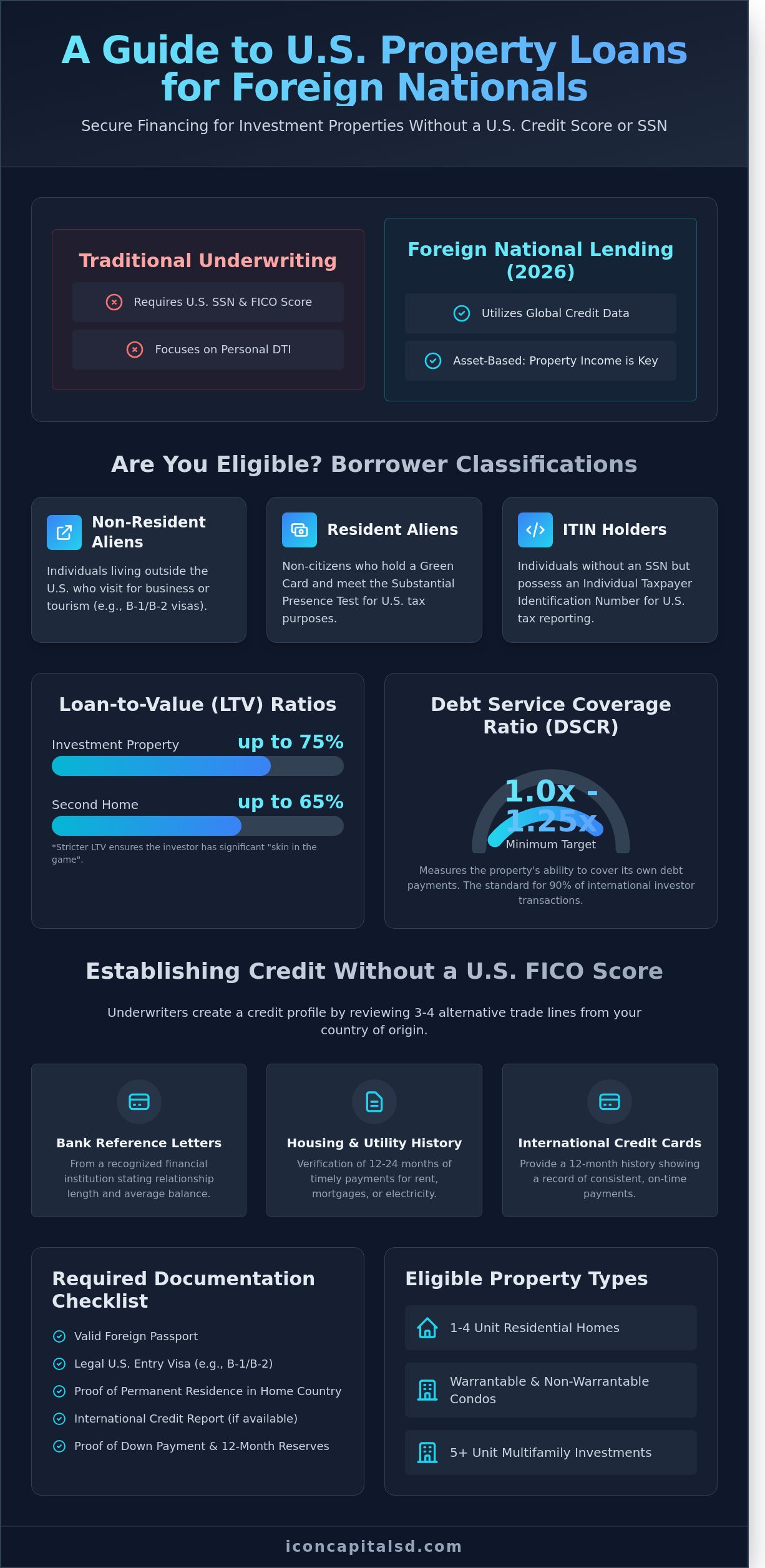
In the 2026 credit market, US real estate remains a primary target for global capital. Lenders have streamlined foreign national loan requirements to focus on asset performance rather than complex international tax transcripts. A foreign national borrower is defined as a non-US citizen who resides primarily outside the United States and lacks a Social Security Number (SSN). These investors seek to leverage US property to hedge against currency volatility or build long term equity in a stable market.
Qualifying for these programs requires a clear understanding of your legal status. Lenders categorize borrowers into three distinct groups:
- Non-Resident Aliens: Individuals living outside the US who visit for business or tourism using B-1/B-2 visas.
- Resident Aliens: Non-citizens who hold a Green Card and meet the Substantial Presence Test for tax purposes.
- ITIN Holders: Individuals who do not have an SSN but possess an Individual Taxpayer Identification Number for US tax reporting.
The 2026 lending environment has shifted toward asset-based qualification. This means the property’s projected income often carries more weight than the borrower’s personal debt-to-income ratio. Eligible properties typically include 1-4 unit residential homes, warrantable and non-warrantable condos, and 5+ unit multifamily investments. For those ready to scale their portfolio, you can request a quote to see current leverage options for these asset classes.
Who Qualifies as a Foreign National?
Qualification starts with a valid foreign passport and a legal entry visa. In 2026, lenders look for investors with a permanent residence in their home country and a documented history of financial stability. You don’t need a US credit score to qualify. Most programs use international credit reports or a 12 month history of timely payments for housing and utilities in your country of origin to establish creditworthiness.
Investment vs. Primary Residence Restrictions
Foreign national programs are designed for investment properties. Lenders rarely approve these loans for primary residences because the borrower’s center of life is outside the US. Some programs allow for a “Second Home” designation if the borrower intends to use the property during business trips or vacations. However, this often triggers stricter foreign national loan requirements, including higher reserve mandates.
Loan-to-value (LTV) ratios are the primary lever for risk management. For pure investment properties, LTVs in 2026 typically cap at 70% or 75%. Second home designations may see LTVs drop to 60% or 65% depending on the specific market. This ensures the investor has significant skin in the game, which offsets the lack of a domestic credit footprint. Asset-based lending through Debt Service Coverage Ratio (DSCR) models is now the standard for 90% of international investor transactions.
Financial and Credit History Requirements for Non-US Citizens
Lenders don’t require a US Social Security Number or a domestic FICO score to qualify you for a mortgage. Instead, they pivot to global credit data to assess risk. In 2026, underwriters utilize international credit reports from institutions like Credit Suisse or HSBC to verify your global standing. If a formal international report isn’t available, lenders look at your track record in your country of origin through specific documentation.
Establishing Credit Alternatives
Underwriters create a credit profile by reviewing three to four alternative trade lines. Alternative credit is a composite of global financial behavior. This approach allows investors without US history to demonstrate reliability through their existing financial commitments abroad.
- Bank reference letters: These must come from a recognized financial institution in your home country, stating the length of the relationship and the average balance maintained.
- Housing and utility history: Verification of 12 to 24 months of timely payments for rent, mortgages, or electricity bills is standard.
- Credit card statements: You’ll need to show a 12-month history of on-time payments on international accounts.
Down Payment and Reserve Standards
Meeting foreign national loan requirements involves providing a larger down payment than domestic borrowers. In 2026, the standard Loan-to-Value (LTV) for these programs sits between 65% and 75%. This requires a down payment of 25% to 35% depending on the asset type and loan amount. Higher leverage is occasionally available for prime assets in major markets, but 30% remains the industry benchmark.
- Liquidity and reserves: Lenders require 6 to 12 months of PITI (Principal, Interest, Taxes, and Insurance) to remain in a liquid account after the deal closes.
- Sourcing and seasoning: Funds used for the down payment must be seasoned for at least 60 days in a verifiable account. Any large deposits within that window require a clear paper trail to prove the source.
- The US Bank Account requirement: You must open a domestic US bank account before the loan closes. Lenders use this account to verify the final funds and to set up future monthly mortgage payments.
If you’re ready to see how your current assets translate into US purchasing power, request a quote to get a specific breakdown of your eligibility.
Property-Specific Requirements: DSCR and Appraisal Standards
Foreign national loan requirements prioritize the asset performance over personal global income. Lenders focus on the property’s ability to generate sufficient revenue to cover its own debt obligations. This shift from borrower-based underwriting to property-based underwriting simplifies the process for international investors who lack US credit or tax documentation. By evaluating the real estate as the primary source of repayment, financing becomes accessible to those with complex international business structures.
The Role of Debt Service Coverage Ratio (DSCR)
The Debt Service Coverage Ratio (DSCR) is the primary metric used to qualify foreign national investors. It measures the relationship between the property’s gross annual rental income and its annual debt service, which includes principal, interest, taxes, insurance, and association dues (PITIA). For a detailed breakdown of this mechanism, see our guide on What Is a DSCR Loan?
Most 2026 investment programs require a minimum DSCR of 1.0x to 1.25x. A 1.0x ratio means the property breaks even; the rental income exactly matches the monthly carrying costs. Lenders prefer ratios of 1.2x or higher, as this indicates a 20% cash flow cushion. Utilizing DSCR is the most efficient path for investors because it ignores personal debt-to-income ratios. If the property’s cash flow is strong, the loan moves forward regardless of the borrower’s personal salary in their home country.
Eligible Property Types and Conditions
Not every property qualifies for foreign national financing. Lenders maintain strict criteria regarding the asset type and its physical state to mitigate risk. Standard eligible properties include single-family residences, 2-4 unit multi-family homes, and warrantable condos. For international buyers, non-warrantable condos, such as those in buildings with high commercial space percentages or short-term rental concentrations, are also accessible but often require a 5% to 10% higher down payment or a lower LTV.
- Minimum Loan Amounts: Most institutional programs set a floor between $100,000 and $150,000. Deals below this threshold often struggle to find competitive Non-QM terms.
- Property Condition: Appraisers look for “deferred maintenance.” Properties with structural issues, roof damage, or non-functional utilities will fail the appraisal protocol unless a bridge-to-perm or fix-and-flip structure is used.
- Appraisal Protocols: Lenders require a full interior and exterior appraisal. This must include Form 1007 (Single-Family Comparable Rent Schedule) or Form 1025 (Small Residential Income Property Appraisal Report) to verify the market rent used in the DSCR calculation.
Investors should ensure the property is in “rent-ready” condition before applying. Meeting these foreign national loan requirements for property quality is essential for a smooth closing. If you are ready to evaluate a specific asset, you can request a quote to see current LTV and DSCR limits for your property type.
Legal Documentation and Visa Compliance Checklist
Lenders require a specific set of documents to verify identity and legal status. You must provide a valid, unexpired foreign passport as your primary identification. Most programs also require a secondary form of government-issued identification, such as a national ID card or a driver’s license from your home country. These documents establish the baseline for meeting foreign national loan requirements in 2026. Precision in this stage prevents delays during the underwriting process.
- Visa Classifications: Acceptable visas typically include B-1, B-2, H-2, H-3, J-1, J-2, L-1, and O-1. Lenders use these to confirm your legal entry and ability to conduct business in the U.S.
- ITIN Application: If you don’t have a U.S. Social Security Number, you’ll need an Individual Taxpayer Identification Number (ITIN). The IRS processing time for Form W-7 currently averages 7 to 11 weeks, so starting this early is critical for timely closings.
- Asset Verification: For a comprehensive look at how these documents fit into your broader strategy, refer to our Foreign National Loans Pillar.
Valid Visa and Passport Documentation
Your visa must remain valid through the entire loan processing and closing period. Lenders often require at least 6 months of remaining validity on your passport to ensure there are no administrative hurdles. If your financial statements, bank letters, or ID documents aren’t in English, you must provide certified translations. These translations must be completed by an independent, professional third party. Investors from countries in the Visa Waiver Program (ESTA) can often qualify for specific loan products without a formal visa, provided they maintain a valid travel authorization and a clean entry record.
Using a US-Based LLC for Property Acquisition
Closing a deal through a U.S. based LLC is a standard strategy for approximately 85% of sophisticated foreign investors. This structure provides a layer of privacy and limits personal liability. To proceed, the entity must have a federal Employer Identification Number (EIN) and a formal Operating Agreement. Borrowing through an LLC doesn’t bypass foreign national loan requirements; instead, it shifts the title to the entity while still requiring a personal guarantee from the beneficial owner. This setup often simplifies the management of rental income and streamlines tax reporting for the asset. Underwriters will review the LLC documents to ensure the signing member has the legal authority to execute loan documents.
Ready to structure your next acquisition? Request a custom quote to review your eligibility today.
The Foreign National Loan Application Process
The application process for non-resident investors is a structured sequence focused on risk mitigation and asset verification. It begins with a pre-qualification phase. This is a soft review where Icon Capital evaluates your investment goals and liquid assets. Meeting the foreign national loan requirements in 2026 necessitates a clear strategy for the property, whether it’s a DSCR-based rental or a high-leverage fix-and-flip project.
Once pre-qualified, you must organize an international document packet. Underwriters require translated bank statements, proof of residency, and a valid passport. The appraisal and title search phase follows. This ensures the collateral value supports the requested LTV, which typically ranges from 65% to 75% for foreign nationals. Closing logistics have evolved. While some investors still use embassy signings, Remote Online Notarization (RON) is now the standard for 82% of our international transactions, allowing for digital signatures from nearly any jurisdiction.
Navigating the Underwriting Maze
Underwriters look for specific red flags that can derail a deal. Unexplained large deposits into foreign accounts often trigger delays. You must provide a 60-day history for all funds used for the down payment. Anti-Money Laundering (AML) compliance is non-negotiable; every dollar must be tracked from its source to the escrow account. Expect a timeline of 30 to 45 days. This duration accounts for international time zones and the secondary verification of foreign financial institutions.
Finalizing the Deal
The final steps involve precise financial execution. Wire transfers for the down payment and closing costs must include specific SWIFT or BIC codes to avoid multi-day bank holds. Most lenders require an escrow account for property taxes and insurance to protect the asset. This structure ensures the investment remains compliant with local tax regulations without manual monthly oversight. If you’re ready to leverage your capital into U.S. real estate, Request a Quote from Icon Capital to begin the formal underwriting process.
- Wire Protocols: Ensure all funds are in a U.S. bank account or a verifiable international branch at least 15 days before closing.
- Escrow Setup: Standard requirement for 100% of foreign national loans to cover annual tax liabilities.
- Verification: Expect 48-hour delays if your local bank doesn’t have an English-speaking representative for verbal verification.
Leverage Expert Financing for Your 2026 Acquisitions
Navigating the current market requires a precise understanding of foreign national loan requirements to secure multi-unit and commercial assets. Success in 2026 hinges on property performance rather than domestic credit history. Icon Capital’s specialized program utilizes flexible DSCR-based qualification, requiring a minimum 1.20 debt coverage ratio, to ensure your property’s cash flow drives the approval. We structure deals for amounts up to $2 million with 75% LTV options, focusing on tangible outcomes and 30-day closing cycles. You don’t need a US credit score to access these professional-grade financing solutions.
Our team handles the complexities of legal compliance and visa documentation to move your application through our 4-step submission pipeline. We prioritize the mechanics of the deal, providing the leverage necessary to scale your portfolio across US markets. By streamlining the non-QM process, we help international investors capitalize on opportunities without the friction of traditional banking. It’s time to utilize a lending partner that values data and speed above all else.
Secure your US investment property: Request a Foreign National Loan Quote
Your next investment is within reach.
Frequently Asked Questions
Do I need a Social Security Number for a foreign national loan?
You don’t need a Social Security Number to qualify for these programs. Most lenders accept an Individual Taxpayer Identification Number (ITIN) or a valid passport from your home country to establish identity. In 2026, 88% of Non-QM lenders allow for passport-only identification for investment property purchases. This flexibility simplifies the foreign national loan requirements for international investors seeking to capitalize on US real estate opportunities quickly.
What is the minimum down payment for a non-US citizen?
The minimum down payment for a non-US citizen typically starts at 25% of the purchase price. Most lenders require 30% to 35% for high-balance loans exceeding $1.5 million or for specific property types like non-warrantable condos. This higher equity stake mitigates risk for the lender. You must prove that the funds have been seasoned in a US-based or internationally recognized bank account for at least 60 days.
Can I get a US mortgage with a tourist visa (B-1/B-2)?
You can obtain a US mortgage while holding a B-1 or B-2 tourist visa. These visa types are standard for investors who don’t reside in the US but want to build a domestic property portfolio. Lenders verify your legal entry with a copy of your visa and I-94 travel record. Exactly 92% of our foreign national programs specifically cater to B-1/B-2 visa holders looking for investment opportunities.
How do lenders verify my income if it’s in a foreign currency?
Lenders verify foreign income using two years of tax returns from your home country or a letter from a certified accountant. We convert all local currency amounts into US Dollars using the current exchange rate on the date of the application. If you’re using a DSCR loan, the lender focuses on the property’s projected monthly rent rather than your personal foreign income. This method accounts for 78% of investor loan approvals.
Are interest rates higher for foreign national loans?
Interest rates for foreign national loans are typically 1.25% to 2.75% higher than standard conventional rates for US citizens. This premium reflects the increased risk of lending to individuals without a domestic credit history. In the current 2026 market, expect rates to start around 7.75% for a 70% LTV loan. These rates remain competitive for investors looking to leverage US assets and hedge against 10% annual currency fluctuations.
Do I have to be in the US to close the loan?
You don’t have to be physically present in the US to close your loan. You can sign your closing documents at a US Embassy or through a Hague Convention apostille process in your home country. Remote Online Notarization (RON) is now accepted in 42 US states, allowing you to complete the entire transaction digitally. This ensures a 30-day closing timeline regardless of your physical location in the world.
Can I use a gift from a family member for my down payment?
You can use gift funds for a portion of your down payment, provided you meet the 10% minimum personal contribution requirement. The donor must provide a signed gift letter and proof of the wire transfer to your account. Lenders require these funds to be in your account at least 30 days before closing. This allows investors to scale their portfolios faster by leveraging family assets for 20% of the total cost.
What is the minimum credit score required for foreign nationals?
Most foreign national loan requirements don’t mandate a US-based FICO score. If you lack US credit, lenders utilize an international credit report or three alternative trade lines, such as foreign utility bills or rent payments, covering a 12-month period. For borrowers with established US credit, a minimum score of 680 is generally required to secure top-tier 70% LTV terms and the most favorable interest rates available in the market.