

A lack of a U.S. FICO score shouldn’t be the 30% barrier that stops your acquisition of prime American assets in 2026. Most traditional institutions reject international investors because they can’t verify foreign tax returns or require 40% down payments to mitigate perceived risk. This friction is why sophisticated investors prioritize specialized foreign national lenders who understand international P&L statements and complex global wealth structures. You’ve likely felt the frustration of losing a deal because a bank couldn’t move at the speed of the market.
This guide provides a professional framework for evaluating and selecting the right financing partner for your U.S. portfolio. We’ll analyze high-LTV Non-QM products, DSCR qualification for international borrowers, and the tactical steps required to close cross-border deals in under 21 days. By the end, you’ll have a roadmap to leverage your global assets and scale your U.S. real estate holdings without the constraints of traditional banking.
Key Takeaways
- Identify the shift toward specialized private credit and how to verify international assets for U.S. acquisitions.
- Compare DSCR cash-flow models against asset depletion strategies to determine the optimal qualification path for your global wealth.
- Evaluate the most competitive foreign national lenders using a technical checklist focused on LTV flexibility and international documentation.
- Master the streamlined application process to secure preliminary term sheets and accelerate deal execution.
- Utilize direct access to creative Non-QM products to achieve professional-grade scaling and rapid deal closure.
The Evolution of Foreign National Lenders in the 2026 U.S. Market
Foreign national lenders are specialized financial institutions providing non-QM (Non-Qualified Mortgage) products to non-U.S. citizens who lack a domestic credit history. These entities focus on the borrower’s global liquidity and the income-generating potential of the U.S. asset rather than traditional domestic metrics. In the 2026 lending environment, a Foreign National Mortgage loan serves as the primary gateway for international capital entering the American real estate market. This sector has transitioned from a niche banking desk to a 150 billion dollar private credit powerhouse as of early 2026.
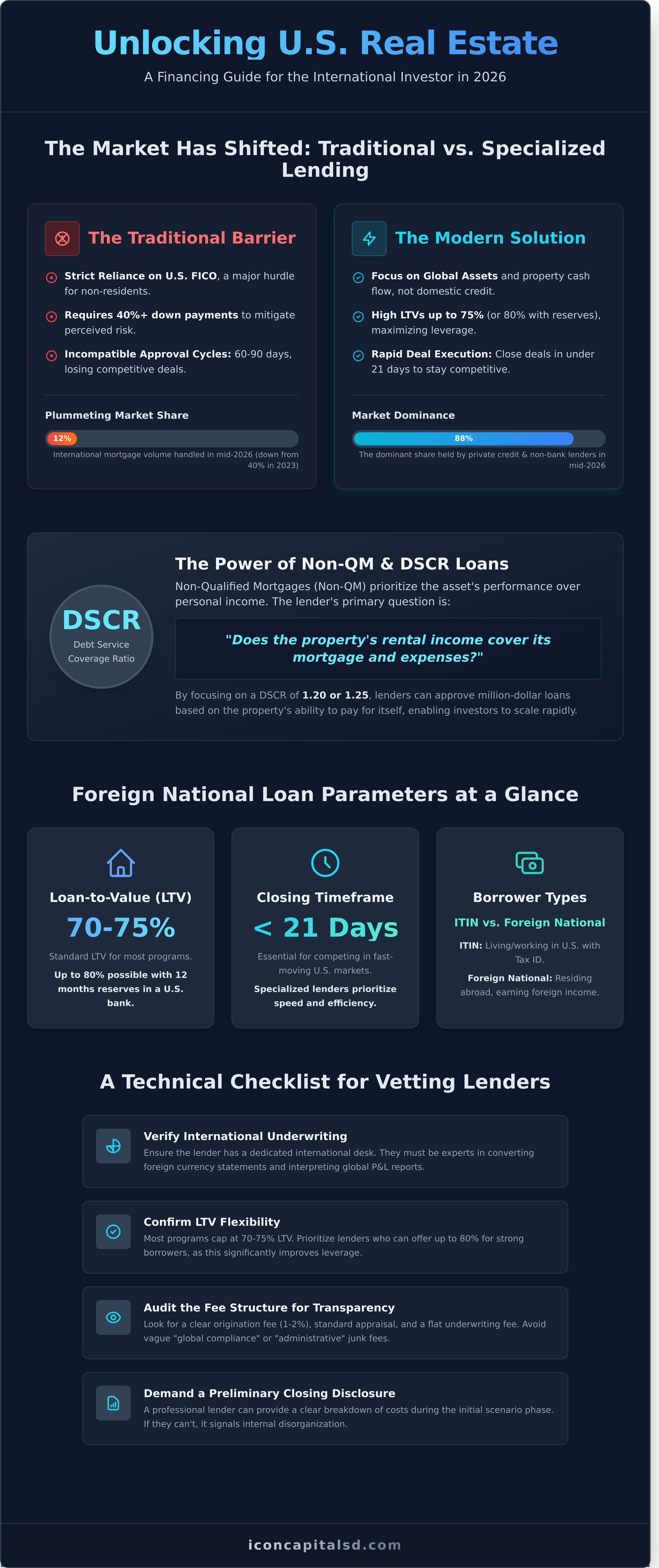
The market landscape has shifted away from depository institutions. In 2023, traditional retail banks handled 40% of international mortgage volume, but that number dropped to 12% by mid-2026. Private credit firms and non-bank lenders now dominate the space. These foreign national lenders prioritize speed and asset performance over the borrower’s residency status. For investors looking to scale a portfolio across state lines, these loans offer the only viable path to high-leverage financing without a Social Security Number or established domestic footprint.
Distinguishing between program types is critical for effective deal structuring. ITIN programs are designed for individuals living and working in the U.S. who file taxes using an Individual Taxpayer Identification Number. Standard foreign national mortgage products are for true foreign nationals. These are individuals who reside abroad, earn income in foreign currency, and seek to deploy capital into U.S. residential or commercial real estate. Most 2026 programs allow for 70% to 75% LTV (Loan-to-Value) ratios for these borrowers provided they meet liquidity requirements.
Why Traditional Banks Fail International Investors
Retail banks remain tethered to the Dodd-Frank framework, which mandates a strict reliance on U.S. FICO scores and domestic tax returns. If an investor from London or Dubai doesn’t have a three-year U.S. credit history, a traditional bank will issue a denial within 48 hours. These institutions cannot effectively underwrite international bank statements or foreign P&L reports. This creates a 60 to 90-day approval cycle that is incompatible with the 2026 real estate market, where competitive deals often require closing in under 21 days.
The Rise of Non-QM Solutions for Global Capital
Non-QM lenders have filled this void by creating flexible underwriting standards for self-employed and foreign borrowers. Asset-based qualification is the standard in 2026, where the property’s Debt Service Coverage Ratio (DSCR) takes precedence over personal income. Non-QM is a flexible alternative to government-backed securities that allows for customized loan structures outside of traditional Fannie Mae or Freddie Mac guidelines. By focusing on the 1.20 or 1.25 DSCR of the target property, foreign national lenders can approve million-dollar loans based on the asset’s ability to pay for itself. This pragmatic approach has enabled international investors to capture 18% more market share in high-growth hubs like Miami and Austin compared to the previous decade. Using these tools, investors can secure financing with minimal documentation, focusing instead on the property’s cash flow and the borrower’s global assets.
Vetting Foreign National Lenders: A Technical Checklist
Selecting the right partner requires a rigorous analysis of their operational capacity. Many foreign national lenders claim global expertise, but few possess the infrastructure to verify international assets without causing 30 day delays. You must prioritize firms that employ dedicated international desk underwriters. These specialists understand how to convert foreign currency statements and interpret non-U.S. tax documentation into a format that meets 2026 Non-QM standards. Recent data on foreign investment in U.S. real estate indicates that while transaction volumes fluctuate, the demand for sophisticated debt structures remains high among global investors.
Technical vetting starts with Loan-to-Value (LTV) limits. Most programs cap at 70% or 75% for foreign nationals, though some aggressive lenders allow 80% if the borrower maintains 12 months of reserves in a U.S. bank account. You should also audit the fee schedule for transparency. Avoid lenders that hide “junk” costs under vague labels like “administrative processing” or “global compliance fees.” A professional fee structure typically includes a clear origination fee between 1% and 2%, a standard appraisal fee, and a flat underwriting fee. If a lender cannot provide a clear Closing Disclosure (CD) breakdown during the initial scenario phase, their internal systems are likely insufficient for complex international deals.
Documentation and Eligibility Standards
Eligibility hinges on visa status and asset liquidity. Lenders should explicitly accept a wide range of visa types, including B-1, B-2, H-2, H-3, J-1, and J-2. For 2026, the standard for liquid cash reserves has tightened. Expect to show 12 months of Principal, Interest, Taxes, and Insurance (PITI) in a domestic or international account. While some foreign national lenders require a full foreign credit report, others utilize asset-only qualification models. This approach relies on the property’s Debt Service Coverage Ratio (DSCR) rather than the borrower’s personal income, simplifying the process for investors with complex global portfolios.
The ‘Mechanics of the Deal’ Evaluation
You must determine if the lender is a direct balance sheet lender with in-house underwriting or a broker-intermediary. Direct lenders control the timeline; they don’t wait for a third party to approve the file. This distinction is critical when managing 5 to 8 unit multi-family properties, which require more intensive scrutiny than single-family residences. In-house teams can often slash closing timelines from 45 days down to 21 days by keeping all functions under one roof. Efficiency is the primary metric of success in this niche. To streamline your initial assessment, use a request-a-quote tool to get an instant analysis of your specific scenario. This allows you to compare leverage and rates against your investment goals without manual back-and-forth. If you’re looking to scale your portfolio quickly, you can view our current product matrix to see how we structure these high-leverage deals.
Speed of execution is the final filter. A capable lender provides a pre-approval letter within 24 hours of receiving a passport and proof of down payment. They should also have established relationships with international title companies and attorneys who understand the Foreign Investment in Real Estate Tax Act (FIRPTA) requirements. If the lender seems confused by the mechanics of a cross-border wire transfer or the necessity of an Individual Taxpayer Identification Number (ITIN), they aren’t equipped to handle your transaction.
Comparing Loan Programs: DSCR vs. Asset-Based Qualification
Foreign national lenders categorize risk through two primary lenses: the property’s income potential or the borrower’s global liquidity. Selecting the right program depends on your ability to document international income versus the property’s projected yield. Each path carries specific leverage constraints and documentation requirements that dictate the speed of the closing process.
The DSCR Advantage for International Landlords
The Investor Cash Flow or DSCR model is the most efficient path for non-residents. This program ignores personal income and focuses on the property’s ability to cover its own debt. Lenders calculate the ratio by dividing the gross monthly rent by the PITIA (Principal, Interest, Taxes, Insurance, and Association fees). In a 7.5% to 8.25% interest rate environment, the math requires careful analysis of local market rents. A DSCR > 1.0 is the baseline for most professional lenders. If a Miami condo generates $4,500 in monthly rent and the total debt obligation is $4,200, the 1.07 ratio meets the minimum threshold. Investors seeking the best pricing typically aim for a 1.20 ratio or higher. This model is ideal for foreign nationals who don’t have U.S. credit or tax returns, as it relies on a Form 1007 rent survey rather than personal financial history.
Asset Qualification and Bank Statement Programs
High-net-worth individuals often prefer asset-based qualification to leverage global wealth. This model doesn’t require a traditional job or monthly salary. Instead, lenders use asset depletion math. They take the total value of your liquid portfolios, including stocks, bonds, and cash, and divide them by a set period, usually 36 to 60 months, to create a “monthly income” figure. You must provide 12 or 24 months of bank statements to prove liquidity and the source of funds. LTV limits are tighter for these programs. Expect a 65% LTV cap for pure asset-based loans, whereas standard DSCR programs often allow up to 75% LTV. For self-employed international business owners, P&L loans are the standard. These require a 12-month profit and loss statement prepared and signed by a qualified accountant in your home country. This allows you to bypass the complexities of international tax treaties while still proving the strength of your business operations.
Interest rate selection remains a critical factor for 2026 projections. Most foreign national lenders offer a choice between 30-year fixed rates and Adjustable-Rate Mortgages (ARMs), such as 5/1 or 7/1 products. Currently, ARM options sit approximately 0.625% lower than fixed-rate counterparts. By 2026, many investors who secured short-term financing in 2021 will face their first rate resets. If you plan to hold the property for more than five years, the fixed-rate option eliminates the risk of a 2026 market spike. If your strategy involves a 36-month exit, the ARM provides immediate cash flow benefits.
- DSCR Loans: Best for high-yield rentals; 75% max LTV.
- Asset Depletion: Best for retirees or high-net-worth individuals; 65% max LTV.
- P&L Loans: Best for business owners with complex tax structures.
- Fixed vs. ARM: Fixed for stability; ARM for short-term liquidity.
The choice between these programs impacts your down payment requirements. A DSCR loan might require a 25% down payment, while an asset-based loan for a high-value property over $2 million could require 35% to 40% down. Foreign national lenders use these structures to mitigate the lack of a U.S. credit footprint, ensuring the deal is backed by tangible value or verified liquidity.
The Step-by-Step Application Process for Non-U.S. Citizens
The path to securing U.S. real estate financing as an international investor is structured and data-heavy. It begins with an initial scenario submission where you outline the property type, purchase price, and intended use. Reliable foreign national lenders evaluate these variables to issue a preliminary term sheet, usually within 24 to 48 hours. This document isn’t a guarantee of funding; it’s a roadmap detailing the estimated interest rate, required down payment, and closing costs based on the current market data. You’ll typically see loan-to-value (LTV) ratios capped at 70% or 75% for these specialized products.
Once you accept the terms, the documentation phase starts. You’ll need to provide a valid passport with a U.S. visa or a Visa Waiver Program (ESTA) authorization. Lenders also require two months of bank statements to verify the source of funds for the down payment. These funds must often “season” in a U.S.-based account for 30 to 60 days before closing. Additionally, you’ll need a credit reference letter from a financial institution in your home country to establish a track record of fiscal responsibility. This letter replaces the traditional U.S. FICO score that most domestic borrowers rely on.
The appraisal phase is the next critical hurdle. A licensed U.S. appraiser will visit the property to determine its fair market value and, for investment properties, its potential rental income. Underwriters use the Debt Service Coverage Ratio (DSCR) to ensure the property’s cash flow can cover the debt obligations. A ratio of 1.0x or higher is generally required. If the appraisal comes in lower than the purchase price, you may need to increase your capital contribution to maintain the required LTV ratio.
Final underwriting review involves a comprehensive audit of all submitted files. The underwriter verifies your global liquidity and ensures the deal complies with all internal risk parameters. This stage concludes with a final loan commitment. From submission to commitment, the process usually spans 21 to 35 days, depending on the complexity of the international documentation provided.
Simplifying the Submission Phase
Structure your loan scenario by highlighting the property’s income potential and your available liquid assets. Clear communication with the underwriter prevents delays during the initial 48-hour review period. Providing translated documents upfront saves significant time. Actionable tip: Use a quote request to lock in preliminary rates early and establish a baseline for your investment’s ROI. This proactive step helps foreign national lenders prioritize your file in a competitive market.
Navigating the Closing Table from Abroad
Closing logistics require coordination with U.S. title companies that specialize in international transactions. You don’t always have to be physically present in the U.S. to sign. Many borrowers utilize a Power of Attorney (POA), which must be notarized at a U.S. Embassy or through an apostille process. This legal step can add 7 to 10 days to your timeline. Managing wire transfers is equally vital; initiate the transfer of your down payment at least 72 hours before the closing date to account for international banking delays and currency exchange fluctuations.
Ready to secure your U.S. investment property with a streamlined process? Apply for a foreign national loan today and leverage our expertise in international financing.
Why Icon Capital is the Professional Choice for Foreign National Loans
Icon Capital LLC operates as a direct conduit to creative financing and Non-QM products. We don’t prioritize personal narratives or long-term banking relationships; we prioritize the transaction. For investors seeking foreign national lenders, the primary hurdle is often the rigid documentation required by retail institutions. We eliminate this friction by focusing on the asset’s performance and the borrower’s liquid reserves rather than domestic credit scores or US-based tax history. Our approach is built for speed, transparency, and execution.
International clients often face rejection from traditional banks due to complex income structures or self-employment status in their home countries. We’ve engineered our platform to handle these complexities. Whether you’re managing a multi-unit project or a high-value single-family rental, our team evaluates the deal based on its economic viability. We have a proven track record of closing high-value loans, often exceeding $2.5 million, for clients who don’t fit the standard institutional box. Our focus remains on your ability to leverage assets to build wealth in the US market.
- Direct access to liquidity without the 60-day wait times typical of retail banks.
- High-leverage options including 75% LTV on purchases and 70% for cash-out refinances.
- Specialized programs for self-employed international investors and multi-unit commercial projects.
- A track record of managing over $150 million in annual volume for non-resident clients since 2021.
The Icon Capital LLC Underwriting Edge
Our underwriting team removes bureaucratic layers that stall traditional closings. We focus on tangible data: debt service coverage ratios (DSCR), loan-to-value (LTV), and cash-on-hand. For foreign capital, we specialize in DSCR models where the property’s rental income covers the debt; this often requires zero personal income verification. Our Fix & Flip programs provide up to 85% of purchase costs and 100% of renovation budgets. This allows investors to preserve their capital for additional acquisitions. We don’t ask for 2 years of US tax returns because it’s an unrealistic requirement for global investors. We look at the numbers that actually matter to the deal’s success.
Getting Your Deal Funded in 2026
The lending environment in 2026 demands speed and high-leverage asset evaluation. Retail banks currently reject approximately 68% of foreign national applications due to “unverifiable” international income or lack of domestic credit history. Icon Capital LLC bypasses these hurdles by evaluating the collateral’s market value and the projected exit strategy. We’ve streamlined our pipeline to achieve 14-day clear-to-close milestones on standard investment properties. This efficiency is vital when competing for prime real estate in high-demand markets.
Working with a results-driven partner allows you to secure assets before competitors tied to slower institutional capital can react. We understand that as one of the specialized foreign national lenders, our role is to act as an enabler for your portfolio growth. We provide the leverage; you provide the vision. Professional investors should request a quote to explore current leverage options and secure funding for their next US acquisition. It’s time to move past the limitations of retail banking and work with a specialist who understands the mechanics of international investment.
Secure Your Stake in the 2026 U.S. Real Estate Market
Navigating the 2026 U.S. property market demands a strategic shift toward specialized financing. Successful investors are moving away from traditional banks and toward foreign national lenders that prioritize DSCR and asset-based qualification. These programs allow non-U.S. citizens to secure up to 80% LTV on acquisitions without standard domestic credit histories. Mastering the technical checklist for vetting and the streamlined 4-step application ensures your capital remains liquid and your closings stay on schedule.
Icon Capital delivers the professional expertise required for these complex transactions. We provide direct-to-underwriter communication and specialized non-QM products, including 12-month Fix & Flip programs and DSCR loans for portfolios of 5 or more units. Our team focuses on the mechanics of the deal, ensuring you get the leverage needed to scale. Don’t let traditional lending barriers limit your growth in the world’s most robust real estate market.
Explore your financing options and request a personalized loan quote today.
We’re ready to help you close your next deal with confidence and speed.
Frequently Asked Questions
Can a foreign national get a mortgage in the U.S. without a Social Security number?
Yes, foreign nationals can obtain U.S. financing without a Social Security number (SSN) by using a valid passport or an Individual Taxpayer Identification Number (ITIN). Specialized foreign national lenders structure these deals based on international credit reports or alternative documentation. You’ll need to provide a valid visa or participate in the Visa Waiver Program. Most programs require at least two years of residency history in your home country to verify identity and creditworthiness.
What is the typical down payment required by foreign national lenders in 2026?
Most foreign national programs in 2026 require a minimum down payment of 25% to 30% for residential properties. For higher-risk assets or luxury units, lenders often mandate a 35% or 40% down payment to offset the lack of domestic credit history. These LTV (Loan-to-Value) ratios ensure the deal remains secure for the lender. You must also demonstrate 12 months of cash reserves in a liquid account to cover debt service.
Do foreign national lenders require a U.S. bank account to close a loan?
Yes, you’ll need a U.S. based bank account to facilitate the closing and future monthly mortgage payments. Lenders require funds for the down payment and closing costs to be seasoned in a domestic account for 30 to 60 days. This step ensures compliance with Anti-Money Laundering (AML) laws and the Patriot Act. Opening an account with a global financial institution can simplify this transfer process before you submit your application.
Is an ITIN number required for all foreign national mortgage programs?
No, an ITIN isn’t mandatory for every foreign national mortgage program. Many lenders accept a valid foreign passport as the primary form of identification for non-resident alien borrowers. However, obtaining an ITIN can expand your options to include more competitive secondary market products. If you’re earning rental income from a U.S. property, the IRS will eventually require an ITIN for tax reporting purposes regardless of the loan structure.
Can I use a DSCR loan if I am a non-resident alien?
Yes, non-resident aliens frequently use Debt Service Coverage Ratio (DSCR) loans to acquire investment properties. These loans focus on the property’s rental income rather than your personal income or employment. You’ll need a minimum DSCR of 1.15 to 1.25 to qualify for standard terms. This product is ideal for international investors because it eliminates the need for complex foreign tax return verifications and focuses on the asset’s cash flow.
How long does the approval process take for a foreign national loan?
The typical approval and closing timeline for a foreign national loan ranges from 30 to 45 days. While traditional domestic loans might close in 21 days, the extra time is necessary for international wire transfers and third-party document translations. Providing a complete package with bank statements and credit reference letters in the first 48 hours helps prevent delays. Efficient foreign national lenders use streamlined digital portals to accelerate the underwriting of your assets.
What are the interest rates for foreign national loans compared to traditional mortgages?
Interest rates for foreign national loans are generally 1.5% to 3% higher than standard conventional rates for U.S. citizens. If the current market rate for a 30-year fixed mortgage is 6.5%, expect a foreign national rate between 8% and 9.5%. This premium accounts for the increased risk and the lack of a domestic credit score. Rates fluctuate based on your LTV and whether you choose a fixed-rate or an Adjustable-Rate Mortgage (ARM).
Can I purchase a multi-unit investment property as a foreign national?
Yes, you can purchase multi-unit properties including 2 to 4-unit residential buildings or larger commercial portfolios. Most lenders cap the LTV at 65% or 70% for multi-unit acquisitions to mitigate risk. These properties often require a higher DSCR, typically 1.25 or more, to ensure the rental income covers all operating expenses and debt obligations. You can hold the title in an LLC for added liability protection and tax efficiency.