

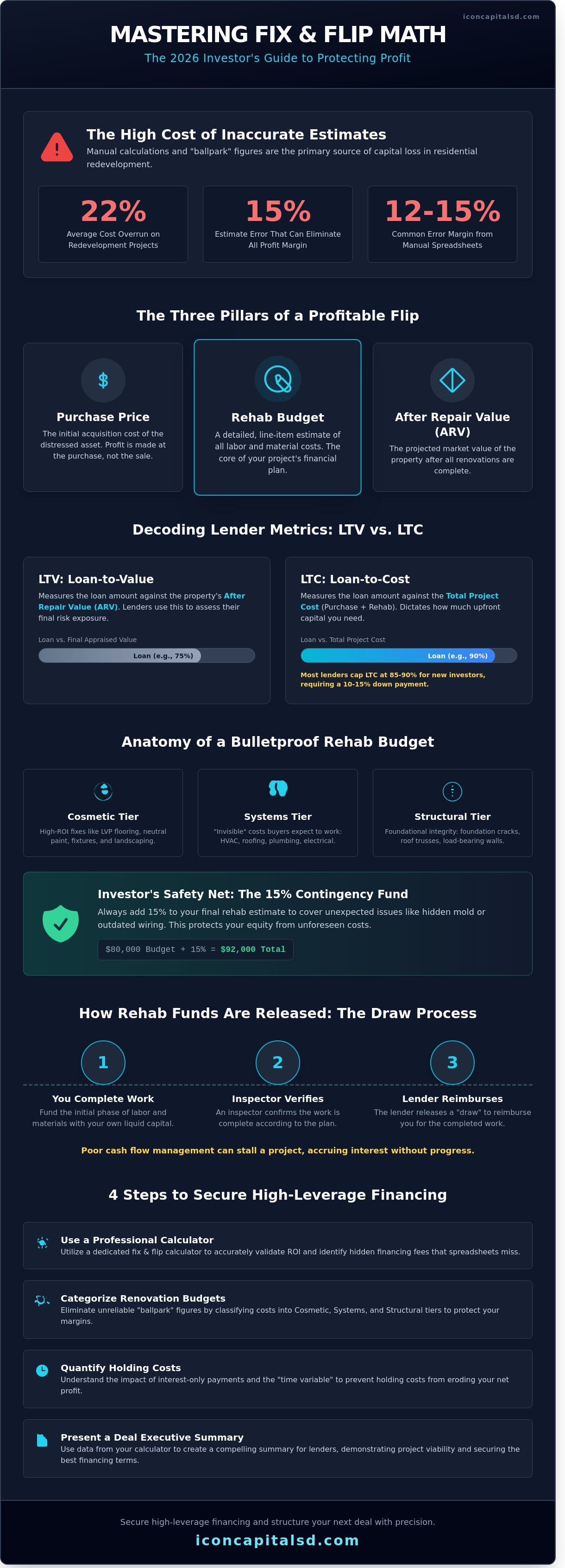
A 15% error in your initial renovation estimate can completely eliminate the projected profit margin on a $400,000 property. Experienced investors know that the difference between a high-yield exit and a capital loss isn’t just the purchase price; it’s the precision of the carry costs and renovation math. Using a professional fix and flip loan calculator with rehab costs is the only way to account for the 22% average cost overrun seen in residential redevelopment projects.
You’re likely looking for a way to move beyond basic estimates and secure a reliable Go/No-Go decision. This 2026 guide provides the formula to master your deal math, detailing how to calculate After Repair Value (ARV) and financing leverage to protect your equity. We’ll break down the technical differences between LTV and LTC while identifying the specific holding costs that often sink investment projections. By the end, you’ll understand exactly how to structure your next deal for maximum scale and find a lending partner that values the technical mechanics of your investment.
Key Takeaways
- Utilize a professional fix and flip loan calculator with rehab costs to accurately validate ROI and identify hidden financing fees that manual spreadsheets often overlook.
- Categorize renovation budgets into cosmetic, systems, and structural tiers to eliminate unreliable “ballpark” figures and protect your investment margins.
- Quantify the impact of interest-only payments and the “time variable” to prevent holding costs from eroding your net profit during the flip.
- Learn how to present a Deal Executive Summary to lenders to demonstrate project viability and secure high-leverage financing for your next acquisition.
- Master a streamlined four-step loan process designed to move your deal from initial structure to closing with maximum efficiency.
The Mechanics of a Fix and Flip Loan Calculator with Rehab Costs
A fix and flip loan calculator with rehab costs is more than a simple math tool; it is a strategic ROI validator. Professional investors use these calculators to stress-test their assumptions before committing capital. Relying on basic manual spreadsheets often results in a 12% to 15% error margin because DIY models frequently miss hidden financing fees, such as origination points, processing fees, and inspection draws. In the 2026 market, where capital costs remain a primary concern, precision is the difference between a profitable exit and a capital loss.
The foundation of every deal relies on three pillars: the purchase price, the rehab budget, and the After Repair Value (ARV). Understanding What is flipping? in a professional context means recognizing that profit is made at the purchase, not the sale. Current market volatility requires investors to build in a 15% to 20% profit buffer. This conservative approach accounts for potential shifts in buyer demand or sudden increases in material costs that can occur during a six-month project timeline.
- Purchase Price: The initial acquisition cost of the distressed asset.
- Rehab Budget: A detailed line-item estimate of all labor and material costs.
- ARV: The projected market value of the property once all renovations are complete.
Key Metrics: LTV vs. LTC Explained
Loan-to-Value (LTV) and Loan-to-Cost (LTC) are the primary metrics used to structure leverage. LTV measures the loan amount against the property’s appraised value, often used by lenders to determine the final exposure at the end of the project. Conversely, LTC is the metric that dictates how much of the “buy and fix” phases the lender will fund. Most private lenders cap LTC at 85% or 90% for new investors. This means you must bring 10% to 15% of the total project cost as a down payment. Experienced investors with a track record of 5 or more successful exits may qualify for higher leverage. You can request a quote to see which leverage tiers apply to your specific experience level.
Understanding After Repair Value (ARV)
ARV is the most critical variable in the fix and flip equation. It determines your Maximum Allowable Offer (MAO). To calculate a realistic ARV, you must analyze 3 to 5 comparable sales (comps) within a 0.5-mile radius that have sold within the last 90 days. A common mistake in a shifting market is using “active” listings as comps. Active listings don’t represent value; only closed sales provide the data needed for an accurate calculator input. Overestimating ARV by just 5% can lead to a project that fails to meet the debt service requirements or results in a break-even scenario.
Deep Dive: Estimating Rehab Costs for Accurate Calculations
Investors often fail because they rely on “ballpark” estimates. A $5,000 error in a kitchen remodel can wipe out 10% of your projected net profit. When using a fix and flip loan calculator with rehab costs, precision is the only way to protect your equity. You must categorize every expense to ensure the After Repair Value (ARV) supports the loan-to-value (LTV) ratios required by private lenders. Reliable data prevents over-leveraging on properties that cannot support the debt service.
Effective budgeting for homeownership costs involves distinguishing between cosmetic, systems, and structural repairs. Cosmetic fixes like LVP flooring or neutral paint offer the highest ROI. Systems like HVAC or roofing are “invisible” costs that buyers expect to work. Always include a 15% contingency fund. In 2026, hidden mold or outdated wiring behind walls can increase a budget by $12,000 overnight. If your budget is $80,000, your calculator should reflect a $92,000 total to account for these variables.
Hard money lenders release funds in stages called draws. You don’t get the full rehab budget at closing. You complete work, an inspector verifies it, and the lender reimburses you. This means you need enough liquid capital to cover the first phase of labor and materials. Poor cash flow management here can stall a project for 30 days; this causes you to accrue interest without making progress on the site.
The Three Phases of a Professional Rehab Budget
Phase 1 focuses on demolition and structural integrity. This is the foundation of your budget where you address foundation cracks or roof trusses. Phase 2 involves rough-ins and mechanical systems. These are the high-cost items like 200-amp electrical panels or copper plumbing. Phase 3 covers finishes and staging. These are the items that drive the final ARV and attract buyers. A fix and flip loan calculator with rehab costs should break down these phases to track draw schedules accurately.
Labor and Material Inflation in 2026
Labor shortages in 2026 have pushed general contractor rates up by 8.5% compared to 2025. Sourcing materials 60 days before demolition protects your margins from sudden supply chain spikes. Understanding the mechanics of flipping houses with hard money requires matching your budget to these current market realities. If you are ready to see how these costs impact your next deal, you can request a quote to get a clear picture of your financing options.
Calculating Holding Costs: The ‘Hidden’ Profit Killers
Profit margins in real estate aren’t just determined by the purchase price and the renovation budget. The time variable is equally critical. Investors often overlook the daily burn rate, which is the amount of capital required to keep a project running while it’s in progress. A robust fix and flip loan calculator with rehab costs must include these holding expenses to provide an accurate ROI projection.
Monthly holding costs typically include property taxes, utilities, and specialized insurance. Property taxes vary by municipality but generally range from 1.1% to 2.5% of the assessed value annually. Utilities for a standard 2,000 square foot renovation often run between $250 and $500 per month depending on the season. You also need Builder’s Risk insurance. This coverage protects the asset during construction and usually costs 25% to 40% more than a standard landlord policy because of the increased risk of theft, vandalism, or fire on vacant sites.
Selling costs represent the final hit to your profit. Budget 5% to 6% for Realtor commissions and an additional 1.5% for title insurance, escrow fees, and transfer taxes. On a $450,000 exit price, these costs can exceed $33,000. Failing to account for these exit leaks is a common mistake for novice flippers who only look at the spread between purchase and sale price.
The Interest Carry Cost Formula
Interest-only payments are the standard for fix and flip financing. To calculate your monthly carry, multiply your total loan amount by your annual interest rate and divide by 12. For example, a $400,000 loan at a 10.5% interest rate results in a $3,500 monthly payment. If a project scheduled for 6 months takes 9 months instead, that 90 day delay costs you $10,500. This extension can easily erase 40% to 50% of your projected net profit. Efficient project management and reliable contractors aren’t just about quality; they’re your best tools for protecting your margin.
Closing and Origination Fees
Lenders charge origination fees, often called points, at the closing table. These typically range from 1 to 3 points of the total loan amount. If you’re borrowing $300,000, 2 points will cost you $6,000 upfront. You should also expect fixed costs like underwriting and processing fees, which generally fall between $1,000 and $1,800. These fees impact your initial liquidity and should be factored into your fix and flip loan calculator with rehab costs before you sign the term sheet. To see how these fees impact your total leverage, you can request a quote for a detailed breakdown of your specific project costs.
How to Use Calculator Data to Secure Financing
Generating numbers with a fix and flip loan calculator with rehab costs is the first step toward funding. The next phase involves translating that data into a professional presentation that mitigates lender risk. Underwriters don’t just look at the potential profit; they look for the logic behind your projections. You must move from raw data to a structured proposal to secure the best terms in 2026.
- Step 1: Present a Deal Executive Summary. Convert your calculator outputs into a one-page summary. This includes the acquisition price, a 15% contingency-adjusted rehab budget, and a conservative ARV backed by three comparable sales closed within the last 120 days.
- Step 2: Prove Execution Capability. If you haven’t completed at least 3 flips in the last 24 months, provide a vetted contractor’s resume and a fixed-price contract. Lenders want to know the rehab budget isn’t a guess.
- Step 3: Align ARV with Appraisal Realities. If your fix and flip loan calculator with rehab costs assumes a 25% price increase over the highest local comp, the appraisal will likely fail. Keep your projections within 5% to 10% of verified market data to avoid last-minute loan-to-value (LTV) cuts.
- Step 4: Select the Correct Product. Use a Fix and Flip loan for heavy renovations requiring 12 to 18 months. Opt for a Bridge loan if the project is a “light touch” renovation that you’ll exit in under 6 months.
What Lenders Look for in Your Pro Forma
Icon Capital underwriters prioritize the viability of your exit strategy. A detailed line-item budget builds trust because it shows you’ve accounted for permits, materials, and labor costs. We also require “skin in the game,” which usually means a cash contribution of 10% to 20% of the total project cost. This ensures the investor is committed to seeing the project through to the final sale or refinance.
Non-QM Solutions for Self-Employed Flippers
Many successful investors don’t qualify for traditional bank loans because their tax returns show heavy deductions. We solve this by using Non-QM products. We can qualify you using 12 months of bank statements or a simple Profit and Loss (P&L) statement instead of tax transcripts. For international investors, our foreign national programs allow US-based fix and flips with a 35% down payment and no US credit score required.
Ready to move from calculations to capital? Request a Quote today for a personalized deal review and expert feedback on your project pro forma.
Structuring Your Next Deal with Icon Capital
Icon Capital provides the capital infrastructure necessary for high-volume real estate investment. While a fix and flip loan calculator with rehab costs delivers the baseline numbers, professional execution requires a lender that doesn’t rely on rigid bank boxes. We focus on the asset’s potential and the investor’s track record to provide leverage where traditional institutions see risk. Our team specializes in the mechanics of the deal, ensuring your capital stack is optimized for maximum return on equity.
Our streamlined 4-step process eliminates the friction found in traditional lending:
- Structure: We define the loan-to-value (LTV) and loan-to-cost (LTC) parameters based on your specific exit strategy.
- Submit: You provide the property details and experience level through our secure portal for immediate review.
- Underwrite: Our internal team reviews the appraisal and rehab budget within 48 to 72 hours.
- Close: We fund the deal, often within 7 to 10 days of receiving a completed file.
We specialize in Non-QM and creative financing for investors who don’t fit the standard credit profile. This includes 90% LTC options and financing for 5-8 unit residential properties. These products allow investors to maintain liquidity while scaling from a single flip to five simultaneous projects. By using our capital to fund 100% of the rehab costs, you preserve cash for your next acquisition.
The Icon Capital Advantage
Investors choose Icon Capital for direct access to decision-makers and specialized loan products. We don’t use automated algorithms to decline complex deals. Our portfolio includes DSCR, Fix & Flip, and small-balance commercial options. For a deeper look at our specific programs, read our guide on Types of Loans for Flipping Houses. We prioritize speed and certainty of closing, which are the two most critical factors in the 2026 market.
Getting Started: From Calculation to Closing
A pre-approval letter is essential when submitting offers in a competitive environment. Sellers often ignore bids that lack proof of funds or a verified lender letter. You can move from your fix and flip loan calculator with rehab costs results to a formal term sheet in less than 24 hours. Submit your property address for a rapid preliminary review and secure the leverage needed to scale your business. Contact Icon Capital at our Request a Quote page to fund your vision today.
Scale Your Portfolio with Precision Financing
Profitable investing in 2026 hinges on your ability to model every variable before the first hammer swings. Utilizing a robust fix and flip loan calculator with rehab costs allows you to stress-test your margins against rising material prices and extended timelines. You’ve seen how identifying hidden holding costs and refining your rehab estimates can be the difference between a 15% return and a capital loss. Icon Capital bridges the gap between your data and your next acquisition. We provide specialized expertise in Non-QM and creative financing for investors who demand speed and flexibility. Our product suite covers everything from 1-4 unit single-family homes to 5-8 unit residential buildings. We’ve eliminated traditional lending friction by implementing a streamlined 4-step closing process designed for the modern professional. When you’re ready to move from analysis to action, we have the tools to structure your deal for maximum leverage. Let’s get your next project funded and on schedule.
Ready to fund your next flip? Request a custom quote from Icon Capital today.
Frequently Asked Questions
How do I estimate rehab costs for a fix and flip calculator?
Accurate estimates require a detailed Scope of Work (SOW) broken down by trade, including electrical, plumbing, and structural components. Investors should calculate costs per square foot based on 2026 market averages, which currently range from $60 to $160 depending on the renovation depth. Inputting these figures into a fix and flip loan calculator with rehab costs ensures your ROI projections remain realistic. Always include a 15% contingency reserve to account for unforeseen structural issues or material price spikes.
What is the 70% rule in house flipping, and is it still relevant in 2026?
The 70% rule suggests an investor should pay no more than 70% of the After Repair Value (ARV) minus renovation expenses. In the 2026 market, this baseline has shifted to 75% or 80% in high-demand urban corridors where inventory remains tight. While it’s a useful starting point, your fix and flip loan calculator with rehab costs must account for current 9% interest rates and local appreciation trends. Tight margins require more precise data than a simple percentage rule can provide.
Can I get a fix and flip loan with no money down?
Most lenders require a down payment of 10% to 20% of the purchase price to ensure the investor has skin in the game. Zero-down options are rare in 2026 and typically reserved for experienced investors with a track record of 10 or more successful exits. If you’re a high-volume flipper, you might qualify for 100% financing by providing additional real estate collateral. Most first-time borrowers should expect to bring at least 15% cash to the closing table.
Do fix and flip loans cover 100% of the renovation costs?
Many fix and flip products cover 100% of the renovation budget, provided the total loan amount doesn’t exceed 75% of the ARV. Lenders release these funds in stages through a draw schedule after third-party inspectors verify completed work. You’ll need to fund the initial phase of construction out of pocket before the first reimbursement occurs. This structure ensures the project stays on track and the asset value increases according to the proposed 6-month timeline.
How does the ARV affect my loan amount?
The After Repair Value (ARV) is the primary metric used to determine your maximum leverage. Lenders typically cap the total loan amount at 75% of the ARV to mitigate market risk. If an appraiser values the finished property at $500,000, your total funding for purchase and rehab won’t exceed $375,000. Accurate ARV projections are vital because a 5% variance in the appraisal can significantly reduce your available liquidity during the project.
What happens if my rehab project takes longer than the loan term?
Fix and flip loans usually carry terms of 6 to 12 months. If you exceed this window, you’ll likely face extension fees ranging from 0.5% to 1% of the loan balance per month. It’s critical to request an extension 30 days before maturity to avoid technical default and penalty interest rates. Lenders prefer a proactive approach and will usually grant 3-month extensions if the project shows documented progress and the local market remains stable.
Are interest rates for fix and flip loans higher than traditional mortgages?
Rates for short-term bridge and flip financing are higher than 30-year conventional loans because of the increased risk and speed of funding. In 2026, expect rates between 8.5% and 12.5% depending on your credit score and experience level. These are interest-only loans, which keeps your monthly carrying costs lower during the construction phase. The higher rate is a trade-off for the ability to close in 7 to 10 days without traditional income verification.
What documents do I need to provide for a fix and flip loan application?
You’ll need to provide a detailed Scope of Work, the executed purchase contract, and 2 months of bank statements to verify liquidity. Lenders also require entity documents like an Operating Agreement and an IRS EIN letter. If you’ve completed projects in the last 24 months, provide a track record or settlement statements from previous sales. This documentation allows underwriters to verify your capability and the deal’s viability within 48 hours.