

Relying on personal credit to finance a real estate project is a strategic ceiling that separates hobbyists from professional investors in May 2026. You likely understand the frustration of watching a prime deal slip away because a traditional lender moved too slowly or demanded excessive personal liability. Securing fix and flip funding for llc entities is no longer just an asset protection strategy. It’s a functional requirement for any investor who intends to compete against cash buyers and institutional players.
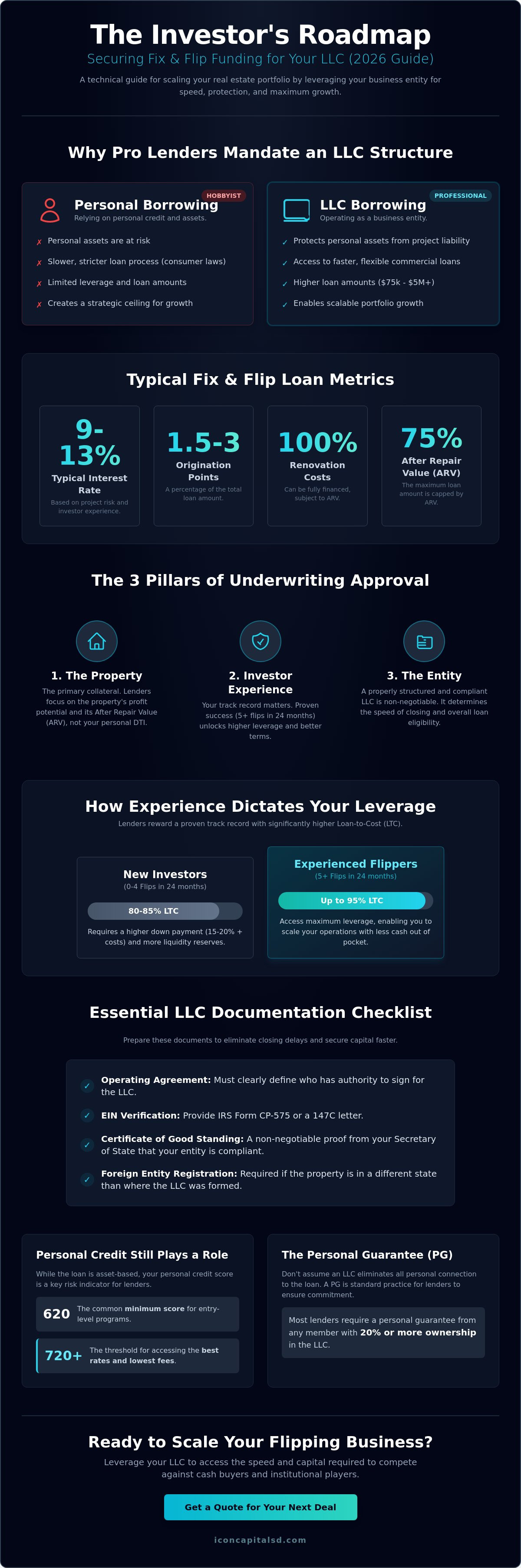
This guide provides the technical roadmap to leverage your business entity for maximum growth. You’ll learn how to navigate a market where rates typically range from 9% to 13% and origination fees sit between 1.5 and 3 points. We will detail the mechanics of securing up to 100% of renovation costs while maintaining a 75% ARV cap. From entity documentation requirements to mastering rehab draw schedules, we provide the data you need to scale your portfolio with professional efficiency and speed.
Key Takeaways
- Understand why professional lenders mandate LLC structures to leverage usury law exemptions and enhance asset protection for all parties.
- Identify the “Three Pillars” of qualification—Property, Experience, and Entity—to ensure your loan package meets 2026 underwriting standards.
- Compare hard money and bridge loan options to select the most efficient fix and flip funding for llc based on your project’s renovation scope.
- Master the documentation process, including EIN verification and Operating Agreements, to eliminate closing delays and secure capital faster.
- Learn how creative financing solutions provide the leverage needed to scale your portfolio without the constraints of traditional bank requirements.
What Is Fix and Flip Funding for LLCs?
Professional fix and flip funding for llc is an asset-based, short-term capital solution designed for business entities rather than individual homeowners. Unlike a 30-year fixed mortgage, these loans focus on the projected After Repair Value (ARV) of a property. Lenders prioritize the viability of the real estate flipping project over the borrower’s personal debt-to-income ratio. Most professional lenders require an LLC to categorize the loan as a commercial-purpose transaction. This classification exempts the lender from many consumer usury laws and provides a streamlined path to capital that traditional banks cannot match.
Risk mitigation drives this entity requirement. By lending to an LLC, the financial partner ensures the loan is strictly for a business purpose. This protects individual investors by creating a legal firewall between their personal wealth and the investment property. If a project encounters legal or financial hurdles, the liability is typically confined to the entity. This structure is a fundamental requirement for investors who want to move beyond single-deal cycles and build a scalable enterprise.
The Shift from Personal to Entity Borrowing
In 2026, lenders prioritize deal fundamentals over the borrower’s personal financial narrative. While a credit score of 620 to 680 remains a common baseline, the property’s profit potential is the primary driver of the approval. Borrowing through an LLC enables investors to access higher loan amounts, often ranging from $75,000 to $5 million. This structure allows for a level of leverage that personal lines of credit simply cannot support. It separates investment liabilities from personal assets, ensuring that your home and personal savings aren’t at risk if a market shift impacts a specific project.
Commercial vs. Residential Loan Standards
LLC-based loans follow Non-QM or commercial standards, which prioritize speed and flexibility. These are business-purpose loans, meaning they are strictly prohibited for owner-occupied properties. By signing a business-purpose declaration, investors bypass the lengthy disclosure periods and federal regulations required for consumer mortgages. This efficiency is critical in a competitive market. These loans typically carry rates between 9% and 13%, reflecting the high-leverage nature of the capital. If you are ready to move your business forward, you can request a quote to see how these commercial standards apply to your next deal.
Key Requirements for LLC Fix and Flip Loans in 2026
Securing fix and flip funding for llc requires more than a profitable property. Underwriters in 2026 evaluate the “Three Pillars” of a deal: the asset, the investor’s experience, and the legal entity structure. While the property serves as the primary collateral, the strength of your LLC determines the speed of the closing and the final leverage offered. A Certificate of Good Standing from your Secretary of State is a non-negotiable requirement. It verifies that your business is compliant and legally authorized to enter into a binding financial contract. Without this current certification, most institutional lenders will pause the file immediately.
Investors frequently use these structures to protect their personal assets from project-specific liabilities. However, don’t assume personal credit is irrelevant. Most lenders require a personal guarantee from any member with 20% or more ownership. A credit score of 620 is the common floor for entry-level programs. Reaching a score of 720 or higher is the threshold for accessing the best rates and the lowest origination points, which typically range from 1.5 to 3 points in today’s market.
Essential Entity Documentation Checklist
Lenders require a complete entity package to verify the borrower’s identity and authority. The Operating Agreement is the most critical document; it must explicitly state who has the authority to sign for the LLC. You must also provide IRS Form CP-575 or a 147C letter to verify your EIN. If your property is located in a state other than where your LLC was formed, you must show proof of Foreign Entity Registration. This ensures your entity is recognized by the local jurisdiction where the property sits.
Financial and Experience Benchmarks
Leverage thresholds depend heavily on your track record. New investors might see a Loan-to-Cost (LTC) of 80% to 85%, while experienced flippers with five or more successful exits in the last 24 months can secure up to 95% LTC. Liquidity is equally critical. You must prove the LLC has the cash for the 15% to 30% down payment plus closing costs. You can consult our Fix and Flip Loans guide to see how experience levels dictate your specific leverage options. If you have a deal ready for review, you can request a quote to confirm your eligibility based on these 2026 benchmarks.
Comparing Funding Options for Your LLC
Selecting the appropriate fix and flip funding for llc requires a direct match between the loan product and your project’s specific exit strategy. Hard money is the tactical choice for acquisitions involving distressed assets or auction purchases where speed is the primary objective. These loans provide the capital needed for heavy renovations, often funding 100% of the rehab budget. Bridge loans offer a slightly lower cost of capital for properties that are closer to being “turnkey” but still require stabilization before they qualify for permanent financing. For investors building a rental portfolio, the BRRRR method uses these short-term loans as the initial leverage before transitioning into a 30-year DSCR product.
High-volume business entities managing multiple concurrent projects should consider a revolving line of credit. This structure eliminates the friction of individual loan applications for every new deal. Instead, the LLC is approved for a total limit, potentially ranging from $1 million to $5 million, based on its track record and liquidity. This allows the investor to draw funds as needed to secure properties instantly, effectively acting like a cash buyer in the eyes of the seller.
Hard Money vs. Private Money for LLCs
Execution speed is why hard money is the industry standard for competitive bidding. While interest rates generally range from 9% to 13% in May 2026, the ability to close in 7 to 10 days allows LLCs to beat out traditional buyers. Unlike amortized bank loans, these products use interest-only payments to maximize monthly cash flow during the construction phase. You can learn more about how to finance a property flip using these specialized private debt structures to ensure your capital remains fluid.
The Reality of Personal Guarantees
Most fix and flip loans are recourse debt. This means the lender requires a personal guarantee (PG) from the LLC members, even though the loan is in the entity’s name. Non-recourse options exist but are typically reserved for institutional-scale borrowers with massive balance sheets. Even in recourse lending, “Bad Boy” carve-outs protect the lender against fraud, gross negligence, or the unauthorized sale of the collateral. To move toward non-recourse options, focus on building the LLC’s credit profile by maintaining a consistent track record of on-time interest payments and successful exits. If you need to evaluate which structure fits your current portfolio, you can request a quote to see our current terms and leverage options.
The Step-by-Step Funding Process for LLCs
The transition from deal identification to funded acquisition follows a structured sequence. Efficiency in this process is what allows professional investors to compete with cash buyers. When securing fix and flip funding for llc, the timeline generally spans 7 to 14 days, depending on the speed of the valuation and the completeness of the entity’s documentation.
- Step 1: Entity Verification. Before a loan is structured, the lender verifies the LLC is in good standing and the signers have the legal authority to bind the business.
- Step 2: Deal Submission. You provide the executed purchase contract and a detailed Scope of Work (SOW). The SOW must break down costs by line item to ensure the rehab budget is realistic.
- Step 3: Valuation. An appraisal is ordered to determine the After Repair Value (ARV). This is the most critical component, as it dictates the maximum loan amount, typically capped at 75% of this value.
- Step 4: Underwriting. The underwriter reviews the “spread” between the purchase price, rehab costs, and ARV. They focus on the project’s profit potential rather than your personal income.
- Step 5: Closing and Draw Schedule. Once approved, the loan closes at a title company or attorney’s office. Funds for the purchase are wired, and the rehab portion is set aside in a dedicated holdback account.
Managing the Rehab Draw Schedule
Rehab funds are rarely disbursed upfront. Most lenders use a reimbursement model where the LLC pays for a phase of work and then requests a “draw” from the lender. After you submit a draw request, a third-party inspector visits the site to verify the work is complete. This inspection typically occurs within 24 to 48 hours. Once verified, funds are released to the LLC. Efficient draw management is vital for maintaining contractor momentum and minimizing the interest carry on your capital.
Closing as an Entity
Closing as a business entity requires specific legal formalities. All authorized members or managers named in the Operating Agreement must be present or provide a power of attorney. The most important document at this stage is the “Resolution to Borrow.” This is a formal corporate document stating that the LLC’s members have met and agreed to take on the debt. It confirms the signer’s authority to execute the mortgage or deed of trust on behalf of the company. If your entity is structured and your deal is ready, Request a quote here to start the professional underwriting process immediately.
Why Icon Capital LLC is the Partner for LLC Investors
Icon Capital LLC provides the specialized infrastructure required to secure fix and flip funding for llc entities that don’t fit into standard lending boxes. We specialize in creative financing solutions for self-employed investors and foreign nationals who require high-leverage capital without the red tape of traditional banks. Our underwriting process is engineered for speed. We understand that in May 2026, a delay of 48 hours can cost you a deal. We prioritize the technical mechanics of the loan, focusing on asset quality and entity structure to ensure a rapid closing. Whether you’re managing a single project or a high-volume portfolio, our team delivers the liquidity you need to execute your business plan.
Our expertise extends beyond simple acquisitions. We navigate the complexities of non-traditional lending by offering products that accommodate unique borrower profiles. This includes investors with significant assets but complex tax returns, as well as entities with multiple members. We focus on the “all-in” cost of capital, ensuring you understand the impact of leverage on your project’s bottom line. Our goal is to act as a serious financial partner, providing the liquidity that allows your LLC to move with the same agility as a cash buyer.
Beyond the First Flip
Scaling a real estate business requires a lender that can support your long-term growth strategy. Icon Capital LLC helps you transition from short-term debt to long-term wealth by providing a clear path to permanent financing. Once your renovation is complete and the property is stabilized, you can move into DSCR-backed rentals to build a passive income portfolio. Understanding the nuances of hard money leverage is essential for this transition. We simplify the loan process by keeping your entity documentation on file, making subsequent deal approvals even faster as your track record grows.
Getting Your Quote Today
Icon Capital LLC takes a no-nonsense approach to communication. You won’t deal with layers of bureaucracy; you’ll speak directly with specialists who understand the mechanics of fix and flip funding for llc structures. To expedite your request, have your purchase contract, a detailed rehab budget, and your LLC’s Operating Agreement ready for review. We provide clear terms and direct feedback so you can make informed decisions about your capital. When you’re ready to secure professional leverage for your next project, request a quote and experience a more efficient way to fund your investment business.
Secure Your Next Professional Acquisition
Success in the May 2026 market hinges on the speed of your capital and the strength of your entity structure. You’ve seen how professional fix and flip funding for llc entities provides the asset protection and high-leverage ratios necessary to outperform cash buyers. By mastering the “Three Pillars” of qualification and maintaining a transparent rehab draw schedule, you position your business for consistent, scalable growth.
Icon Capital LLC serves as a specialized partner for self-employed and foreign national investors who need creative financing solutions beyond traditional bank boxes. Our streamlined, 4-step loan process is designed to move your project from deal submission to funded acquisition in days. Whether you’re executing your first flip or building a portfolio of DSCR-backed rentals, we provide the technical expertise to simplify your financing. Take the next step in your investment strategy today.
Get a Professional Fix & Flip Quote for Your LLC
Frequently Asked Questions
Can I get a fix and flip loan for a brand new LLC?
Yes, you can secure capital for an entity formed as recently as May 2026. Lenders prioritize the property’s After Repair Value and your personal experience over the age of the business entity. You will simply need to provide your Articles of Organization and EIN verification to begin the underwriting process.
Does an LLC protect me from a personal guarantee on a flip loan?
No, an LLC does not typically eliminate the requirement for a personal guarantee. Most private lenders require any member with 20% or more ownership to personally guarantee the debt. While the entity protects your personal assets from slip-and-fall lawsuits or contractor disputes, you remain responsible for the loan repayment.
What is the minimum credit score for LLC fix and flip funding?
A score of 620 is the common floor for most institutional programs. While fix and flip funding for llc is primarily asset-based, your credit score dictates your specific interest rate and points. Investors with a score above 720 generally qualify for the most competitive rates, which currently start near 9%.
How much down payment does an LLC need for a fix and flip?
Expect to provide a down payment between 15% and 30% of the purchase price. Some lenders offer higher leverage, requiring only 10% down for investors who have completed five or more successful flips in the last 24 months. You will also need cash reserves to cover closing costs and the first few months of interest payments.
Can my LLC use a DSCR loan for a fix and flip project?
No, DSCR loans are strictly for stabilized rental properties that are already tenant-occupied. You should use fix and flip funding for llc to handle the purchase and renovation phases first. Once the rehab is complete and the property is leased, you can refinance that short-term debt into a long-term DSCR loan.
How quickly can an LLC close on a fix and flip loan?
Closings typically occur within 7 to 14 days of a complete application. The timeline is primarily driven by the speed of the ARV appraisal and the title search. Having your entity documents, such as your Operating Agreement and Certificate of Good Standing, ready for submission can shave several days off the process.
What documents does my LLC need to provide for a loan?
You must provide the Articles of Organization, an EIN verification letter from the IRS, and a comprehensive Operating Agreement. Lenders also require a Certificate of Good Standing to prove the entity is active. On the property side, you will need the executed purchase contract and a line-item rehab budget.
Is it better to flip houses under an LLC or personally?
Flipping under an LLC is the professional standard for scaling a real estate business. It allows you to access commercial-purpose loans that are exempt from many consumer regulations, providing faster closings and higher leverage. It also creates a clear separation between your business liabilities and your personal wealth.