

In the competitive fix and flip market, the right financing is the difference between closing a profitable deal and watching it go to another investor. Traditional loans are often too slow and restrictive, leaving you unable to fund both the purchase and renovation or qualify without standard W-2 income. This forces a critical decision: how do you secure capital quickly and efficiently? Navigating the various fix and flip financing options-from hard money to specialized loans-is the single most important step in structuring a successful project.
This practical comparison is designed for the serious real estate investor. We will dissect the leading loan products, analyzing the pros and cons of each based on speed, cost, and qualification requirements. You will learn the definitive differences between hard money and other asset-based solutions and gain a clear framework for choosing the optimal loan structure. By the end, you will have the confidence and clarity to secure the right funding, partner with a reliable lender, and capitalize on your next investment opportunity without delay.
Key Takeaways
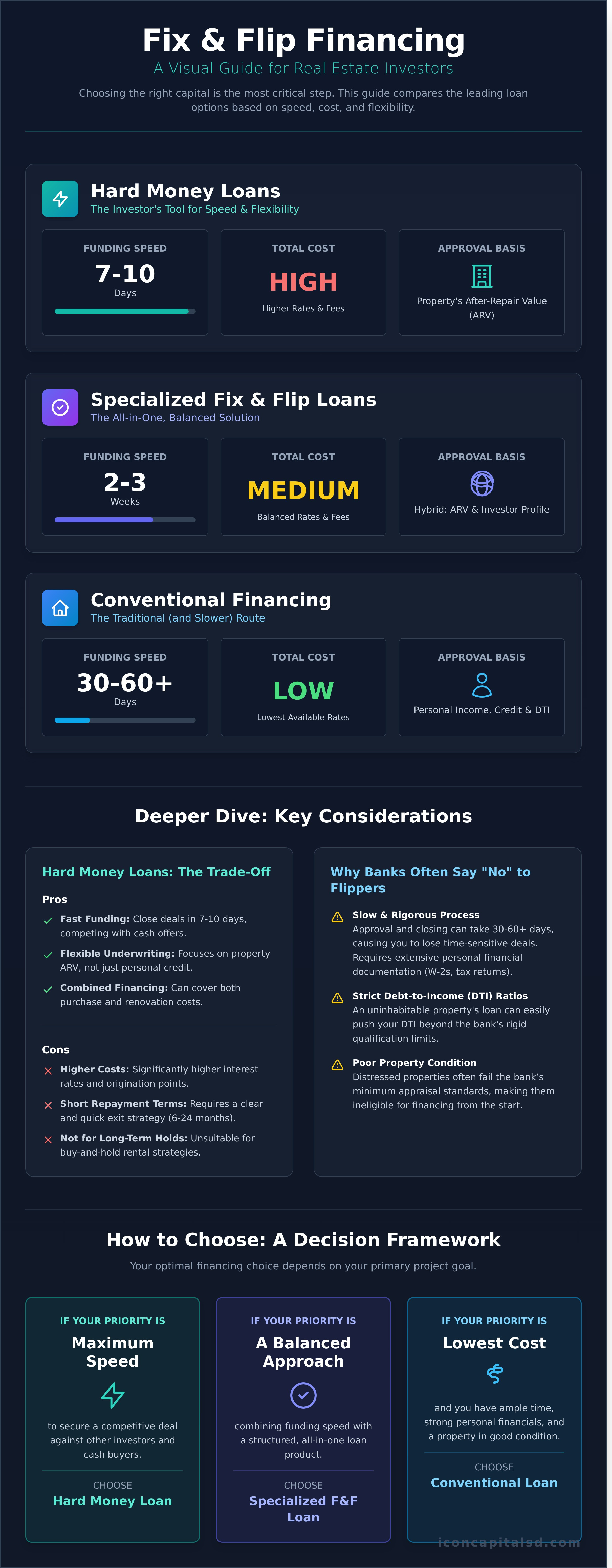
- Hard money loans provide the speed necessary to secure competitive deals, leveraging the property’s after-repair value over personal income verification.
- Conventional financing offers lower rates but involves a rigorous documentation process that may not align with the timeline of a quick flip.
- Specialized fix and flip financing options are engineered to balance the speed of hard money with the structure of traditional loans, often including renovation funds.
- The optimal financing choice depends on a clear assessment of your priorities, balancing speed to close against the total cost of capital for the project.
Hard Money Loans: The Investor’s Tool for Speed and Flexibility
When evaluating fix and flip financing options, hard money loans stand out for their unique structure. These are short-term, asset-based loans provided by private lenders rather than traditional banks. Their core advantage lies in speed. In the competitive world of property rehabilitation, commonly known as flipping (for a foundational understanding, see What is Fix and Flip?), the ability to close a deal in days-not months-can be the deciding factor.
Unlike conventional mortgages that heavily scrutinize a borrower’s personal income and credit history, hard money underwriting focuses primarily on the asset itself. Lenders evaluate the deal based on the property’s After Repair Value (ARV)-the estimated market value once renovations are complete. This asset-centric approach allows for more flexible qualification criteria, making it an accessible solution for seasoned and new investors alike.
Typical loan terms are brief, ranging from 6 to 24 months, and often feature interest-only payments to keep carrying costs low during the renovation phase. This structure is designed to align with an investor’s goal: acquire, renovate, and sell the property for a profit within a defined timeline. Many hard money loans can be structured to cover both the purchase price and a portion of the renovation budget, streamlining the funding process.
Pros of Hard Money Loans
- Fast Funding: Close on properties in as little as 7-10 days, providing a competitive edge against cash buyers.
- Flexible Underwriting: Approval is based on the quality of the real estate deal and the property’s ARV, not just personal credit scores.
- Combined Financing: Lenders can finance both the property acquisition and renovation costs within a single loan structure.
- Investor-Focused: Designed for investors who need to act decisively and cannot wait for the lengthy process of traditional bank financing.
Cons of Hard Money Loans
- Higher Costs: Interest rates and origination points are significantly higher than those of conventional loans to compensate for the lender’s increased risk.
- Significant Fees: Expect to pay origination fees, typically 1-5% of the loan amount, in addition to other closing costs.
- Short Repayment Terms: The brief loan duration demands a well-defined and achievable exit strategy, whether it’s selling the property or refinancing.
- Not for Long-Term Holds: The high cost and short term make this financing unsuitable for buy-and-hold rental strategies.
Conventional Financing: The Traditional (and Slower) Route
Conventional financing refers to standard mortgage products offered by traditional banks and credit unions. While a familiar route for homebuyers, it presents significant hurdles for real estate investors seeking capital for a fix and flip project. The process is defined by rigorous documentation requirements and slow timelines, making it a poor fit for the fast-paced investment market. While it is one of many fix and flip loan options, investors must understand its limitations.
Lenders will require a comprehensive review of your personal financial history, including W-2s, multiple years of tax returns, and recent pay stubs. Approval and closing can take anywhere from 30 to 60 days or more, a delay that can cost you a time-sensitive deal. Furthermore, this option is often unavailable to full-time investors operating under an LLC, as banks prefer to lend to individuals with stable W-2 income.
Using Home Equity (HELOCs & Cash-Out Refinancing)
One conventional strategy is to leverage the equity in your primary residence through a Home Equity Line of Credit (HELOC) or a cash-out refinance. The primary advantage is securing capital at a lower interest rate than other investment loans. However, this method carries substantial risk by securing a speculative business venture with your personal home. It also may not provide sufficient capital to cover both the property acquisition and the full scope of renovation costs.
Why Banks Often Say No to Flippers
Traditional lenders are risk-averse and their underwriting models are not designed for the realities of property flipping. Banks frequently deny fix and flip applications for several key reasons:
- Strict Debt-to-Income (DTI) Ratios: The proposed loan on an uninhabitable property can easily push an investor’s DTI beyond the bank’s rigid qualification limits.
- Property Condition: A distressed property often fails to meet the bank’s minimum appraisal standards for collateral, making it ineligible for financing from the start.
- Seasoning Requirements: Many conventional loans have rules against selling a property within a short period, directly conflicting with the business model of a fix and flip.
- Income Verification: Self-employed investors often have difficulty proving the stable, predictable income that conventional underwriters require.
For these reasons, most serious investors find that conventional loans are not viable fix and flip financing options and instead turn to specialized lenders who understand the asset class.
Specialized Fix & Flip Loan Programs: The All-in-One Solution
While traditional funding methods have their place, the modern real estate investment landscape demands more efficient fix and flip financing options. Specialized loan programs have emerged as the definitive solution, engineered specifically for the rapid pace of property flipping. These are not conventional mortgages; they are hybrid products offered by dedicated non-bank lenders like Icon Capital LLC that combine the closing speed of hard money with the structure and reliability of institutional capital.
Unlike bank loans that focus heavily on personal income, underwriting for these programs prioritizes the deal’s viability-including the after-repair value (ARV)-and the investor’s experience. This asset-based approach is a key reason why they are among the most effective fix and flip loan options for serious investors looking to scale.
Key Features and Benefits
These all-in-one loan products are structured to maximize leverage and streamline project execution. Key benefits for the borrower include:
- Comprehensive Funding: Finance up to 90% of the property’s purchase price and 100% of the renovation costs, minimizing your out-of-pocket cash requirements.
- Streamlined Draw Process: Access your rehab funds through a simple, transparent draw schedule that keeps your project on track and contractors paid on time.
- Low Holding Costs: Make interest-only payments during the renovation phase, preserving capital and improving your project’s net profitability.
- Simplified Management: Consolidate your acquisition and construction financing into a single loan with clear terms and one dedicated point of contact.
Who Should Consider This Option?
This type of financing is an ideal fit for investors who value speed, efficiency, and a reliable capital partner. Consider this solution if you are:
- A new or experienced investor seeking a structured, repeatable funding process to build or scale your portfolio.
- A borrower who needs to close on a competitive deal quickly but does not want to sacrifice favorable terms.
- An investor who wants to leverage a lender’s expertise to validate a deal’s potential and secure comprehensive financing.
Ready to see your options? Request a personalized quote today.
How to Choose the Right Financing Option: A Decision Framework
Selecting the optimal financing for your project is a strategic decision, not a one-size-fits-all problem. The right choice depends on a clear assessment of your priorities, your experience, and the specifics of the deal. This framework helps you analyze the key variables to identify the most effective loan for your situation.
Use this table as a quick reference guide to compare the primary fix and flip financing options:
.styled-table {
border-collapse: collapse;
margin: 25px 0;
font-size: 0.9em;
font-family: sans-serif;
min-width: 400px;
width: 100%;
box-shadow: 0 0 20px rgba(0, 0, 0, 0.15);
}
.styled-table thead tr {
background-color: #003366;
color: #ffffff;
text-align: left;
}
.styled-table th,
.styled-table td {
padding: 12px 15px;
text-align: left;
}
.styled-table tbody tr {
border-bottom: 1px solid #dddddd;
}
.styled-table tbody tr:nth-of-type(even) {
background-color: #f3f3f3;
}
.styled-table tbody tr:last-of-type {
border-bottom: 2px solid #003366;
}
| Factor | Hard Money Loan | Specialized Fix & Flip Loan | Conventional Loan |
|---|---|---|---|
| Speed to Close | Very Fast (Days) | Fast (1-3 Weeks) | Slow (30-60+ Days) |
| Overall Cost | High | Moderate | Low |
| Experience Required | Low / Not Required | Preferred | Extensive |
| Property Condition | Any Condition | Most Conditions | Good / Livable |
Factor 1: Speed vs. Cost
In competitive real estate markets, speed is leverage. If closing quickly is critical to securing a property, a hard money loan is your most effective tool, though it comes at a premium cost. Conversely, if you have a longer timeline and an excellent credit profile, a conventional loan offers the lowest interest rates. Specialized fix and flip loans are designed to strike a balance, providing faster funding than a bank at more competitive rates than a traditional hard money lender.
Factor 2: Your Experience Level
Lenders evaluate risk, and your track record is a primary indicator. New investors may find that specialized lenders offer more structural guidance and are more willing to finance a first project. Experienced investors with a proven portfolio can leverage their history to secure more favorable terms, higher loan-to-value (LTV) ratios, and lower rates. Conventional banks almost always require an extensive and verifiable history of successful real estate projects.
Factor 3: Project and Documentation
The property itself dictates many of your options. A heavily distressed property that cannot pass a traditional bank appraisal will require asset-based lending from a hard money or specialized lender. If you have immaculate personal and financial documentation and the property is in relatively good condition, a conventional loan is a possibility. For a streamlined process built for the realities of property flipping, specialized lenders are the most efficient. To ensure your deal is structured for success, it is critical to get expert advice. Talk to our loan specialists to analyze your specific project and needs.
Finalizing Your Fix and Flip Financing Strategy
Navigating the landscape of fix and flip financing options is critical to maximizing your return on investment. The optimal path is rarely one-size-fits-all. As we’ve detailed, your decision hinges on a strategic trade-off: the rapid execution of hard money loans, the lower rates of conventional financing, or the comprehensive structure of specialized loan programs. Your project timeline, deal specifics, and long-term business goals should always guide your selection.
When traditional lenders cannot meet the demands of a fast-paced market, a specialist partner provides the necessary leverage. Icon Capital delivers creative financing solutions engineered for serious real estate investors. We bypass the delays of traditional banking with a fast, asset-based underwriting process. As specialists in Non-QM and investor loans, we structure deals that align with your objectives. Ready to secure funding for your next project? Explore Your Fix & Flip Financing Options with Icon Capital.
With the right capital partner, you are positioned to execute deals efficiently and scale your investment portfolio with confidence.
Frequently Asked Questions About Fix and Flip Financing Options
What is the minimum credit score required for a fix and flip loan?
Most lenders look for a minimum credit score between 620 and 660 for a fix and flip loan. While the property’s potential is the primary focus, a stronger credit profile can secure more favorable terms, such as higher leverage and lower interest rates. Borrowers with scores below this range may still qualify, but lenders will require other compensating factors like significant cash reserves or a proven track record.
Can I get 100% financing for a fix and flip project?
While uncommon, 100% financing is possible for experienced investors with a strong project. This structure typically covers up to 90% of the purchase price and 100% of the renovation costs, but the total loan amount is capped at a specific loan-to-ARV, often around 75%. To qualify, the deal must demonstrate a significant profit margin and the borrower must have a verifiable history of successful flips.
How is the After Repair Value (ARV) determined by lenders?
Lenders determine the After Repair Value (ARV) through a professional, independent appraisal. The appraiser assesses the property’s current state, analyzes the borrower’s detailed scope of work and renovation budget, and evaluates recent sales of comparable renovated properties in the same market. This data-driven valuation is a critical component of the underwriting process and dictates the maximum loan amount the lender will offer.
What’s the difference between a fix and flip loan and a bridge loan?
A fix and flip loan is a specialized type of bridge loan designed specifically for acquiring and renovating a property. Its key feature is a built-in mechanism for funding construction, typically through a draw schedule. A general bridge loan is a broader short-term financing tool used to cover a funding gap, such as purchasing a new primary residence before selling the old one, and does not inherently include a renovation budget.
How are renovation funds distributed in a fix and flip loan?
Renovation funds are held in an escrow account and disbursed in draws, not as a lump sum. After completing a pre-defined stage of work, the borrower requests a draw. The lender then typically sends an inspector to verify the completed work before releasing the funds for that phase. This structured process protects the lender’s collateral and ensures the project progresses as planned according to the scope of work.
Can I get a fix and flip loan if I am a first-time investor?
Yes, first-time investors can obtain fix and flip loans. Lenders will place greater emphasis on the viability of the specific deal, the investor’s liquid reserves, and the experience of their hired general contractor. Terms for a first-time flipper may be more conservative, potentially requiring a larger down payment or a lower loan-to-value (LTV) ratio until a successful track record is established.
What kind of documentation is needed for a specialized fix and flip loan?
The documentation for most fix and flip financing options is asset-based. Lenders require a detailed scope of work with a line-item budget, the executed purchase contract, and entity documents (e.g., LLC operating agreement). Borrowers must also provide bank statements to verify liquidity for the down payment, closing costs, and interest reserves. A real estate investor resume detailing any relevant experience is also beneficial.