

High interest rates are compressing cash flow, and traditional lenders continue to reject qualified investors based on W-2 income alone. For self-employed investors and portfolio builders, this financing gap can halt expansion. The solution lies in leveraging an asset’s income potential, not personal tax returns. The Debt Service Coverage Ratio (DSCR) loan is the primary tool for this strategy, but navigating the fluctuating landscape of dscr loan rates today is critical for protecting your margins and ensuring profitability.
This 2026 investor’s guide provides a strategic analysis of the variables driving current rates. We will break down how to structure your financing for maximum leverage, secure competitive terms without providing tax returns, and master the critical trade-off between LTV and interest rate. The objective is clear: to equip you with the data-driven insights needed to scale your rental portfolio efficiently, even in a complex and demanding market. Master the mechanics of your next deal and unlock your portfolio’s potential.
Key Takeaways
- Understand the direct impact of your property’s DSCR ratio and LTV on your interest rate, giving you control over financing costs.
- Macro-economic factors like Fed policy directly influence dscr loan rates today; learn how to navigate the current pricing environment.
- Discover specific strategies to structure your deal, including targeting the optimal LTV “sweet spot” for the best balance of leverage and rate.
- Evaluate why investors choose DSCR financing over conventional loans for benefits like rapid closing times and the ability to scale portfolios beyond 10 properties.
Current Landscape of DSCR Loan Rates Today (2026)
Understanding dscr loan rates today requires a clear view of the current market mechanics. Unlike conventional mortgages, DSCR loans are underwritten based on a property’s cash flow rather than a borrower’s personal income. The core of this qualification is the Debt Service Coverage Ratio (DSCR), a metric that compares a property’s net operating income to its total debt service. In the 2026 financial environment, these rates are heavily influenced by Federal Reserve policy adjustments and their direct impact on the Secured Overnight Financing Rate (SOFR), the primary index for many Non-QM loans.
As a rule, investors can expect DSCR loan rates to be approximately 1% to 2% higher than a comparable 30-year fixed conventional mortgage. This spread accounts for the increased risk associated with Non-QM lending and the different capital structures that fund these loans. The prevailing economic conditions in 2026 have also impacted investor-grade liquidity, tightening or loosening lender appetite and directly affecting the pricing and availability of DSCR financing solutions.
Why ‘Today’ Matters in DSCR Financing
The term ‘today’ is critical because DSCR rates are not static. They fluctuate daily based on trading in the secondary market for Non-QM mortgage-backed securities (MBS). To protect against this volatility during the closing process, investors utilize rate lock-in periods, typically for 30, 45, or 60 days. This secures the quoted rate against mid-escrow hikes. Furthermore, the rate you are quoted often includes a ‘yield spread premium,’ which is a factor in how mortgage brokers are compensated and can influence the final interest rate offered.
Fixed-Rate vs. Adjustable-Rate (ARM) DSCR Options
The current rate environment has led to a resurgence of Adjustable-Rate Mortgage (ARM) products, particularly the 5/6 and 7/6 SOFR ARMs. These options offer a lower initial “teaser” rate for the first five or seven years, which can significantly improve initial cash flow. However, for investors prioritizing long-term stability and predictable returns, the 30-year fixed-rate DSCR loan remains the superior choice.
- 30-Year Fixed: Ideal for buy-and-hold investors seeking consistent monthly payments and simplified cash flow projections over the life of the loan.
- ARM (e.g., 5/6, 7/6 SOFR): Best suited for investors with a shorter holding period or those executing a value-add strategy who plan to refinance or sell before the initial fixed period ends.
The Mechanics of Interest: What Drives Your DSCR Loan Rate?
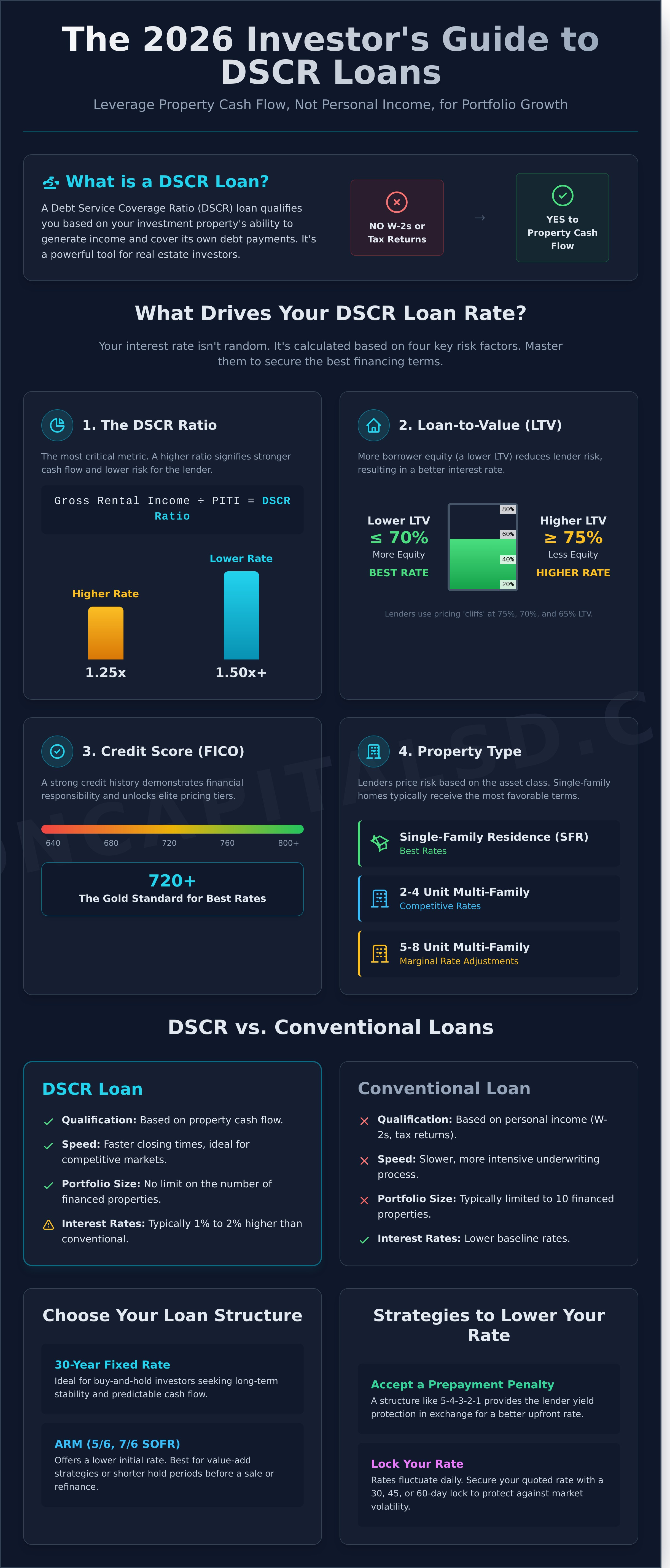
While broad macroeconomic factors that drive interest rates, like federal policy and Treasury yields, set a baseline for all lending, the final rate you secure is determined by your deal’s specific risk profile. The DSCR loan is a data-driven product, and lenders price your loan based on a clear set of metrics. Mastering these components is key to obtaining the most competitive financing.
Four primary levers directly impact your interest rate:
- The DSCR Ratio: This is the most critical metric. A higher ratio signals stronger cash flow and lower risk. An investor with a property demonstrating a 1.50x DSCR will secure a significantly lower rate than one with a 1.25x ratio.
- Loan-to-Value (LTV): Lenders use LTV tiers as pricing ‘cliffs’. Crossing below a key threshold like 75%, 70%, or 65% LTV can unlock substantial rate improvements, as more borrower equity reduces the lender’s exposure.
- Credit Score (FICO): A FICO score of 720 or higher remains the gold standard for accessing elite DSCR loan pricing. While programs exist for lower scores, they come with a notable rate premium.
- Property Type: Lenders price risk based on the asset. Single-family residences (SFRs) often receive the best rates, with marginal pricing adjustments for 2-4 unit and 5-8 unit multi-family properties.
Calculating the Debt Service Coverage Ratio
The formula is straightforward: Gross Rental Income ÷ PITI (Principal, Interest, Taxes, Insurance). Underwriters may also factor in HOA dues or a vacancy/management fee, which can impact your final ratio. For assets without verifiable cash flow, such as a new short-term rental, ‘No-Ratio’ DSCR loans are an option but carry a significant rate premium to compensate for the risk.
Prepayment Penalties and Rate Trade-offs
Accepting a prepayment penalty is a direct strategy to lower your interest rate. A common 5-4-3-2-1 structure, where the penalty declines each year for five years, provides the lender with yield protection in exchange for a better upfront rate. Alternatively, investors can ‘buy down’ the rate by paying points at closing. Understanding these levers is essential for structuring a deal that qualifies for the most competitive dscr loan rates today.
Comparing DSCR Rates vs. Conventional Financing
Investors often focus solely on the interest rate, but the true cost of a loan is more than its percentage. While conventional financing typically offers lower rates, the higher dscr loan rates today afford speed, scalability, and streamlined qualification that are critical for serious investors. The choice depends entirely on your strategy: long-term cost savings versus immediate opportunity and portfolio growth.
The fundamental differences between these loan types directly impact an investor’s ability to operate and scale. Consider these four critical distinctions:
- Speed of Execution: DSCR loans can often close in 21 days or less. This speed is a competitive advantage in a fast-moving market, allowing investors to secure properties quickly. This efficiency is a primary reason investors pay a rate premium over a 45-60 day conventional closing.
- Scalability: Conventional financing through Fannie Mae and Freddie Mac imposes a strict limit of 10 financed properties per borrower. DSCR loans have no such limitations, enabling investors to scale their portfolios without restriction.
- Documentation Requirements: Conventional loans require extensive personal income verification, including tax returns and W-2s. DSCR loans bypass this entirely, focusing instead on the property’s income potential, primarily evidenced by a lease agreement or rental analysis.
- Closing in an Entity: For asset protection and liability purposes, most professional investors hold property in an LLC. DSCR loans are designed for this, while conventional loans almost always require the borrower to hold title in their personal name.
When Conventional is Better (and When it Isn’t)
For an investor planning a 30-year hold on a single property, the lower interest rate of a conventional loan may result in a lower total cost of capital. However, this ignores the “hidden cost” of tying up your personal Debt-to-Income (DTI) ratio, which can prevent you from securing other financing. High-net-worth investors often prefer DSCR loans because they isolate debt to the asset, preserving personal borrowing capacity for other ventures.
DSCR for Foreign Nationals and Self-Employed
DSCR loans provide a vital financing path for borrowers who don’t fit the conventional box. For investors without a U.S. credit history, pricing adjustments are made to account for the alternative risk profile. This opens the U.S. property market to a global audience. View our Foreign National Loan programs to see specific options. Similarly, self-employed borrowers can use DSCR to qualify without tax returns, often finding that the current dscr loan rates today are competitive with Bank Statement loan programs.
Strategies to Secure the Lowest DSCR Rates in a Volatile Market
While market volatility influences baseline interest rates, savvy investors retain significant control over their final pricing. The key is to present a de-risked, high-quality deal to the underwriter. The best dscr loan rates today are reserved for borrowers who proactively optimize their loan file before submission.
Before applying, focus on these four critical levers to strengthen your application:
- Optimize the DSCR Ratio: Increase projected rents through minor renovations or document lower operating expenses. Every dollar improved directly strengthens your file’s cash flow profile.
- Target the ‘Sweet Spot’ LTV: A loan-to-value (LTV) of 70-75% often secures the best rate. It demonstrates sufficient borrower equity (“skin in the game”) without requiring the higher risk premiums associated with maximum leverage.
- Boost Your FICO Score: Consolidate consumer debt to lower credit utilization at least 30 days before your application. This simple action can provide a meaningful FICO score increase, unlocking better pricing tiers.
- Align Prepayment Penalty with Strategy: A 5-year prepayment penalty typically offers a lower rate, ideal for a long-term hold. For a fix-and-flip or short-term hold, a 1-year or 0-year penalty provides flexibility, albeit at a slightly higher rate.
The Power of the 1.25x Ratio
Most lenders use a DSCR of 1.25x as the threshold for their most competitive pricing. Falling below this can trigger significant rate increases. To meet this target, consider using projected income from short-term rentals (via AirDNA) or structuring the loan with an initial interest-only (IO) period. An IO payment temporarily lowers the “I” (interest) in your PITI calculation, artificially boosting your ratio to secure a better long-term fixed rate.
Working with Specialist DSCR Lenders
Retail banks often struggle with asset-based lending, whereas specialist Non-QM lenders like Icon Capital are built for it. We understand how to evaluate a property’s cash flow independent of personal income. To secure the lowest risk premium, present your loan officer with a “Deal Memo”-a one-page summary highlighting the property’s strengths, your experience, and the market opportunity. This helps the underwriter see the full picture beyond the raw numbers. To understand where your deal might be priced, you can request a custom DSCR quote and see how our current par rates apply to your specific scenario.
Navigating the Loan Process with Icon Capital’s Creative Financing
Securing competitive dscr loan rates today is only one part of a successful investment strategy. The right lending partner provides speed, certainty, and creative solutions that a standard rate sheet cannot. At Icon Capital LLC, we specialize in financing complex deals for serious investors, from 5-8 unit properties to large multi-family portfolios, through a clear and efficient process.
Our simplified 4-step process is designed for execution:
- Structure: We analyze your asset and goals to design the optimal loan structure.
- Submit: Our streamlined portal makes document submission straightforward and secure.
- Underwrite: Our experienced team moves quickly, focusing on asset performance, not personal income.
- Close: We coordinate all parties to ensure a timely and predictable closing.
This efficiency is built on our ‘Asset Qualification’ advantage. We move beyond simple rental income calculations to understand the true potential and value of your property. For a professional investor, the certainty of closing a deal is far more valuable than chasing a 0.125% rate difference. A missed opportunity costs more than a few basis points.
Beyond DSCR: Bridge and Fix & Flip Integration
Our expertise extends to integrated financing strategies. We can structure a Bridge loan to help you acquire and stabilize a property, then seamlessly refinance you into a long-term DSCR loan. For investors scaling their holdings, we utilize Cross-Collateralization to leverage equity across your entire portfolio. In the final 72 hours before funding, our team is hyper-focused on coordinating with title and escrow to review final documents and ensure your funds are wired on schedule.
Get Your Custom DSCR Rate Quote
Ready to leverage your assets with a lender who understands your objectives? We provide direct financing solutions with high loan amounts (up to $2M+) and options for cash in hand. Your quote will be based on your specific deal structure, not a generic online calculator. Stop searching for standard dscr loan rates and start building a relationship with a true financing partner.
Explore your creative financing options today.
Secure Your Next Investment with Expert DSCR Financing
Navigating the 2026 market requires a clear understanding of rental property financing. The key takeaway is that your interest rate is not static; it’s a direct result of your property’s performance, your investor profile, and your financing strategy. By focusing on strong cash flow and partnering with a specialist lender, you can secure favorable terms. Understanding the variables that affect dscr loan rates today empowers you to make strategic decisions that maximize your return on investment.
At Icon Capital, we specialize in structuring these deals. Our expertise in 5-8 unit multi-family financing and creative non-QM solutions for self-employed and foreign national investors provides a distinct advantage. We utilize a streamlined 4-step closing process to ensure efficiency and clarity from application to funding. Don’t let conventional lending barriers limit your portfolio’s growth.
Discover the financing options available for your next acquisition. Request a Personalized DSCR Loan Quote to receive a clear, data-driven assessment from our team. Take the decisive step to scale your real estate assets.
Frequently Asked Questions About DSCR Loan Rates Today
What is a good DSCR ratio for the best interest rates?
To secure the most competitive interest rates, lenders typically look for a Debt-Service Coverage Ratio (DSCR) of 1.25 or higher. This figure indicates that the property’s gross rental income is 25% greater than its total debt obligations, representing lower risk. While some programs allow for ratios as low as 1.0, or even slightly below with compensating factors, a stronger ratio directly correlates with more favorable loan terms and pricing from most non-QM lenders.
Are DSCR loan rates higher than standard mortgage rates?
Yes, DSCR loan rates are generally higher than conventional mortgage rates. As a non-QM (Non-Qualified Mortgage) product, these loans are underwritten to the property’s cash flow, not the borrower’s personal income. This asset-based qualification carries a higher perceived risk for lenders, which is reflected in the interest rate. The premium paid is the trade-off for the flexible documentation requirements and the ability to scale an investment portfolio more rapidly.
Can I get a DSCR loan with a 620 credit score in 2026?
While market guidelines for 2026 cannot be guaranteed, a 620 FICO score is often the minimum threshold for many DSCR lenders in the current environment. Securing a loan with this score typically requires compensating factors, such as a lower loan-to-value (LTV) ratio, a higher DSCR, and significant cash reserves. Borrowers with scores below 680 should expect to see higher interest rates and potentially more restrictive terms compared to those with stronger credit profiles.
Do DSCR loans require personal income verification or tax returns?
No, the primary feature of a DSCR loan is the absence of personal income verification. Lenders do not require W-2s, pay stubs, or personal tax returns. The loan qualification is based on the subject property’s ability to generate enough income to cover its proposed monthly payment (PITI). This makes it an ideal financing solution for self-employed investors, real estate professionals, and borrowers with complex or difficult-to-document personal finances.
What are the typical closing costs for a DSCR loan?
Closing costs for a DSCR loan generally range from 2% to 5% of the total loan amount. These costs typically include lender origination fees, which can be 1-2 points, along with standard third-party fees for appraisal, title insurance, and escrow services. The final amount depends on the lender, property location, and loan size. Investors should carefully review the Loan Estimate provided by their lender for a detailed breakdown of all associated costs before closing.
Is there a limit to how many DSCR loans I can have at once?
Unlike conventional financing, which often imposes a limit of ten financed properties, there is generally no strict cap on the number of DSCR loans an investor can hold. DSCR lenders specialize in financing for portfolio investors. Your ability to acquire more loans is based on the performance of your existing assets, your liquidity, and the viability of each new property deal, not on an arbitrary number of loans in your portfolio.
How do prepayment penalties affect my DSCR loan rate?
Opting for a prepayment penalty is a common strategy to secure a lower interest rate. Lenders provide a rate reduction in exchange for the assurance that you will not pay off or refinance the loan within a specified term, such as 3 or 5 years. This can be an effective way for buy-and-hold investors to optimize cash flow and get more competitive DSCR loan rates today. However, it reduces flexibility for investors who may want to sell the property in the short term.
Can I use a DSCR loan for a short-term rental or AirBnB property?
Yes, many lenders now offer specialized DSCR loan programs for short-term rental (STR) properties like AirBnBs and VRBOs. The underwriting process will analyze projected income from data sources like AirDNA or a specialized appraisal report rather than a standard lease agreement. Terms may differ slightly from long-term rental loans, potentially with lower LTV limits or specific reserve requirements, but it is a widely accepted use for this type of financing.