

Your personal debt to income ratio is likely the single biggest obstacle preventing you from scaling your portfolio in 2026. Traditional lenders often stall multi-family deals for 60 days or more while scrutinizing tax returns that don’t reflect your actual liquidity. It’s a bottleneck that keeps experienced investors from moving on time-sensitive opportunities. We agree that a property’s ability to generate revenue should be the primary factor in its financing, not your personal 1040s.
This guide explains how a dscr loan for multi family property allows you to bypass personal income verification by leveraging a property’s cash flow. You’ll discover how to secure 75% or 80% LTV financing and close deals in as little as 21 days without the 10-loan limit imposed by conventional programs. We’ll break down the specific underwriting mechanics, including 1.20x coverage requirements and non-recourse options, to help you scale your assets efficiently through 2026 and beyond.
Key Takeaways
- Bypass traditional debt-to-income (DTI) limitations by shifting the focus from personal tax returns to the property’s actual cash flow.
- Discover how a dscr loan for multi family property uses gross rental income to qualify deals, allowing for faster scaling of your real estate portfolio.
- Identify the specific underwriting differences in LTV and interest rates when financing 2-4 unit residential assets versus 5+ unit commercial properties.
- Evaluate the “Bridge-to-DSCR” strategy to determine if it offers better leverage than traditional Fannie Mae or Freddie Mac Small Balance loans.
- Master the precise DSCR calculation and minimum thresholds required to secure a pre-approval and close your multi-family deal with confidence.
Why Traditional Financing Fails Multi-Family Investors
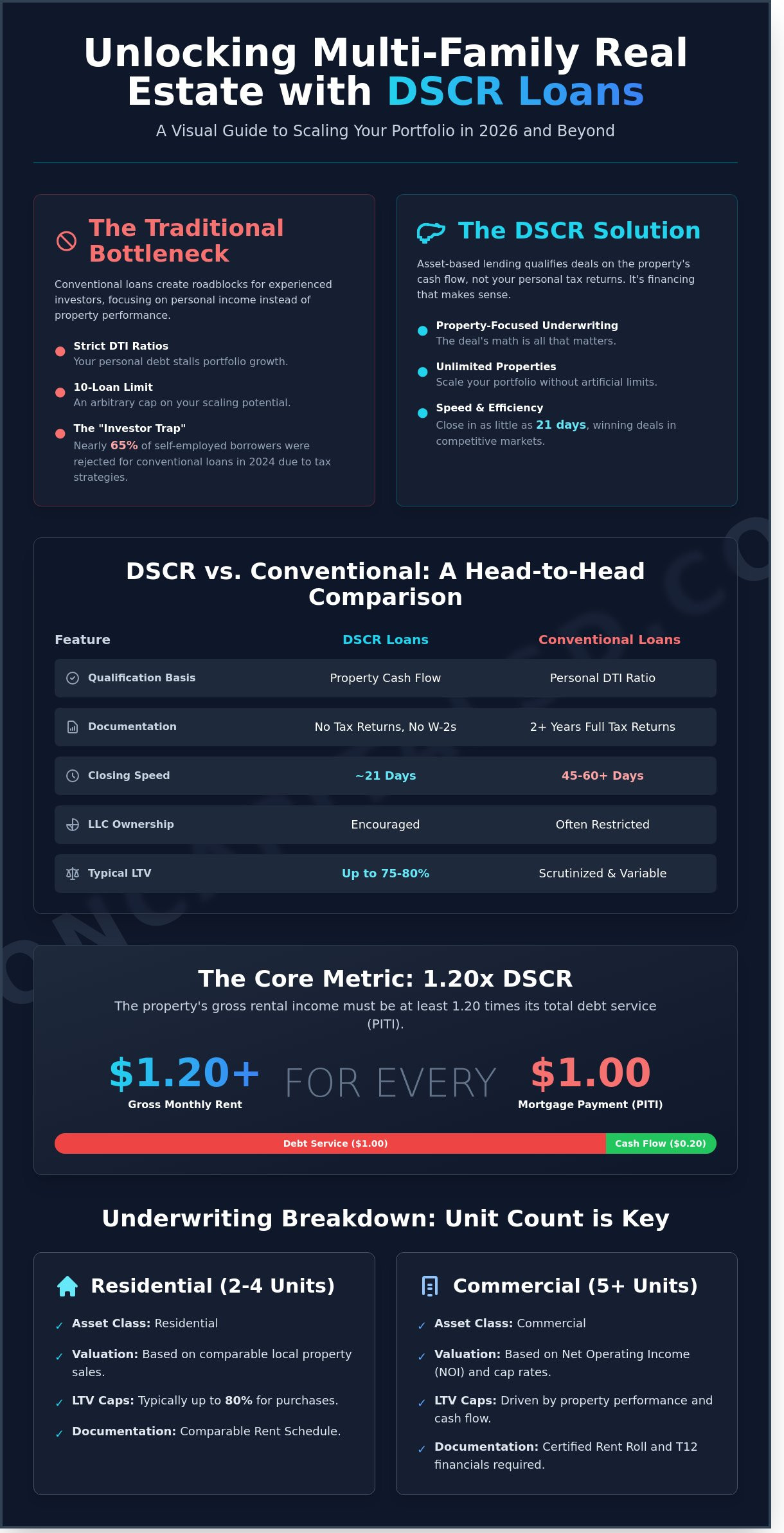
Traditional banks rely on personal Debt-to-Income (DTI) ratios. This metric often hits a hard ceiling after an investor acquires 3 or 4 properties. A dscr loan for multi family property shifts the focus from the borrower to the building. This asset-based approach qualifies the deal based on the property’s ability to generate enough rental income to cover its own debt obligations. It’s a fundamental shift in how risk is assessed, prioritizing the deal’s math over the individual’s paycheck.
High-earning self-employed individuals face a specific challenge known as the “Investor Trap.” They use legal tax deductions to lower taxable income, but big banks use those same tax returns to deny loan applications. In 2024, data showed that nearly 65% of self-employed borrowers were rejected for conventional mortgages despite having high net worths. This conflict between IRS tax strategies and bank underwriting creates a barrier that only asset-based lending can bridge. By removing the DTI calculation, the investor’s personal lifestyle expenses don’t hinder the acquisition of a 5-unit or 10-unit building.
The Problem with DTI in Scaling Portfolios
Personal DTI ratios ignore the actual profitability of a multi-family asset. Conventional lenders typically enforce a 10-loan limit, which caps portfolio growth regardless of cash flow. Once an investor hits this number, they’re often forced into commercial bank products with 5-year balloons and floating rates. Non-QM underwriting bypasses traditional bank committees, offering a significant speed advantage. While a retail bank might take 45 to 60 days to close, asset-based specialists often fund in 21 days or less. This efficiency is critical in competitive 2026 markets where speed wins deals.
DSCR vs. Conventional Multi-Family Mortgages
Conventional loans require two years of tax returns and strict full doc verification. DSCR programs streamline the process by focusing on the asset’s performance. This creative financing model allows for much greater flexibility in how the deal is structured. Key differences include:
- Documentation: No tax returns, W2s, or 4506-C forms are required for qualification.
- LLC Ownership: Investors can close in the name of an LLC to protect personal assets, a move conventional guidelines often restrict.
- Asset-Based Underwriting: Qualification is based on a 1.20x or higher coverage ratio rather than personal earnings.
- Leverage: Access to 75% or 80% LTV without the intrusive personal financial scrutiny of a big bank.
Investors looking to bypass these hurdles can request a quote to see how asset-based lending fits their next multi-family acquisition. By focusing on the numbers that matter, you can scale your portfolio without the constraints of traditional banking limits.
Underwriting the Deal: 2-4 Units vs. 5+ Commercial Units
Investors often assume all multi-family properties use the same math. They don’t. The difference between a four-unit property and a five-unit building represents a shift from residential to commercial underwriting standards. This distinction dictates your leverage, your documentation requirements, and your final interest rate margin. Unit count is the primary factor that determines which appraisal form an underwriter orders and how they calculate your property’s value.
Residential Multi-Family (2-4 Units)
Properties with 2-4 units are the primary entry point for a dscr loan for multi family property. Underwriters treat these as residential assets. They rely on the 1004D appraisal and a Form 1025 Small Residential Income Property Appraisal Report. This process includes a comparable rent schedule to determine the gross potential rent based on similar local listings.
- LTV Caps: In the 2026 market, LTV caps for 2-4 unit properties typically max out at 80% for purchases and 75% for cash-out refinances.
- Valuation: These products use standard residential appraisal metrics, comparing your property to similar buildings sold within a 1-mile radius over the last 6 months.
- Accessibility: These are considered entry-level products because they don’t require complex profit and loss statements from the previous owner.
Commercial Multi-Family (5+ Units)
Once a building hits 5 units, underwriters stop looking at residential comps. The value is driven almost entirely by the asset’s ability to generate cash flow. Underwriting focuses on the Net Operating Income (NOI) and current market cap rates. You’ll need to provide a certified rent roll and a trailing 12-month (T12) financial statement to prove the property’s performance.
Icon Capital specializes in the 5-8 unit “Small Balance Commercial” niche. These properties often fall into a gap where they’re too large for residential lenders but too small for institutional commercial banks. We bridge this gap with streamlined documentation and aggressive debt yield requirements. Commercial margins are usually 50 to 150 basis points higher than residential counterparts. LTVs in 2026 for 5+ units generally hover between 70% and 75%.
Mixed-use properties, such as a building with ground-floor retail and upper-floor apartments, require a specialized dscr loan for multi family property approach. Most lenders require the residential component to account for at least 51% of the total square footage to qualify for standard terms. If you’re looking to scale your portfolio through these complex assets, you can request a quote to see how your unit count impacts your specific leverage options.
- 2-4 Units: Based on comparable sales and market rents.
- 5+ Units: Based on NOI, Cap Rates, and T12 data.
- Mixed-Use: Requires 50% or more residential income or square footage for standard DSCR pricing.
Comparing DSCR to Agency and Bridge Options
Choosing the right debt for a multi-family acquisition requires a trade-off between cost and flexibility. A dscr loan for multi family property fills the gap between high-barrier Agency debt and high-cost short-term bridge financing. Investors must evaluate the specific needs of the asset, whether it is a stabilized 10-unit building or a distressed 20-unit value-add project.
DSCR vs. Agency (Fannie/Freddie) Loans
Fannie Mae and Freddie Mac Small Balance Loans (SBL) provide the lowest interest rates in the market, often 125 to 175 basis points below DSCR rates. However, Agency capital is restrictive. Borrowers typically need a net worth equal to the loan amount and 12 months of liquidity. A dscr loan for multi family property removes these hurdles. Lenders in the DSCR space don’t require tax returns or prior landlord experience, focusing instead on the property’s 1.20x or 1.25x debt service coverage ratio. While Agency deals take 60 to 90 days to fund, DSCR loans close in 21 to 30 days.
Stabilizing Assets with Bridge Loans
If a property has an occupancy rate below 80% or requires 15% of the purchase price in renovations, it won’t qualify for permanent financing. In these scenarios, investors use a fix and flip loan or a bridge loan to bridge the gap to stabilization. These products offer 12 to 24-month terms with interest-only payments. This strategy allows the investor to renovate units, raise rents, and improve the DSCR ratio before refinancing into a 30-year fixed DSCR loan. This “Bridge-to-DSCR” pivot is a standard play for scaling portfolios quickly.
Speed is often a primary driver for non-QM financing. Investors frequently pay a premium for the ability to close in 21 days, which allows them to compete with all-cash buyers. Traditional banks and Agency lenders cannot match this pace due to extensive “red tape” and global cash flow analysis. DSCR lenders streamline the process by looking at the asset first and the borrower second.
Prepayment penalty structures are another critical variable in the decision-making process. Most DSCR products utilize one of two models:
- 5-4-3-2-1 Model: A 5-year step-down penalty. If you refinance in year one, the penalty is 5%. It drops 1% annually. This model usually offers the lowest available interest rate.
- 3-2-1 Model: A 3-year step-down. This provides more flexibility for investors planning to exit or refinance within 36 to 48 months, though it may carry a 0.25% rate premium.
Understanding these structures ensures the financing aligns with the projected hold period. For those ready to move forward, the next step is to request a quote to compare current market spreads across these different loan types.
Qualifying for a Multi-Family DSCR Loan
Qualification for a dscr loan for multi family property focuses on the asset’s ability to generate cash flow rather than the borrower’s personal income. Lenders prioritize the Debt Service Coverage Ratio (DSCR) to ensure the property sustains its own debt obligations. The calculation is precise: Gross Rental Income divided by the total PITIA (Principal, Interest, Taxes, Insurance, and HOA dues). For example, a property generating $10,000 in monthly rent with $8,000 in total monthly debt obligations results in a 1.25 DSCR.
Most lenders set a minimum threshold of 1.20 for standard pricing. If your ratio falls below 1.0, the property is technically cash-flow negative. You can still secure financing in these scenarios through “no-ratio” programs, but expect to provide a larger down payment. These high-leverage exceptions typically require a 35% to 40% equity stake and may carry interest rates 0.5% to 1% higher than standard DSCR products.
Credit scores remain a critical factor in determining your interest rate and maximum Loan-to-Value (LTV). A FICO score of 620 is the common floor for multi-family financing. Investors with scores above 720 access the most aggressive leverage, often up to 80% LTV. Because this is an asset-based loan, you won’t provide W2s or tax returns. Instead, the underwriter qualifies the deal based on the property’s appraised value and your liquid reserves. Most programs require 6 months of PITI to be held in a verifiable account at closing.
Documentation Checklist for Investors
Efficiency in documentation speeds up the closing process. You’ll need to provide current rent rolls, executed lease agreements, and any existing property management contracts. If you’re closing under an entity, provide the LLC Operating Agreement, Articles of Organization, and an EIN confirmation letter. Proof of reserves is mandatory, typically shown through three months of bank statements or brokerage accounts.
Ensuring the tenants behind those lease agreements are reliable is fundamental to maintaining cash flow. Many investors use professional screening services like Instant Background Checks to vet applicants thoroughly before signing a lease.
Foreign National Multi-Family Financing
Non-US citizens can leverage a dscr loan for multi family property to build a US-based real estate portfolio. These programs don’t require a US credit score or Social Security number. Lenders instead use international credit reports or a letter of reference from a foreign financial institution. These loans usually cap at 65% to 70% LTV and require 12 months of reserves held in a US bank. For a deeper analysis of these requirements, view our Foreign National Loans guide.
Structuring Your Multi-Family Deal with Icon Capital
Icon Capital operates with a pragmatic, deal-first mindset. While traditional banks often reject applications because a borrower doesn’t fit a narrow profile, we focus on the mechanics of the asset and the cash flow it generates. Successful investors know that a dscr loan for multi family property depends on the property’s ability to cover its debt obligations rather than the owner’s personal income. You can request a quote through our portal and receive a formal pre-approval within 24 to 48 hours. This speed allows you to move on high-value assets before competitors can even get a callback from a retail lender.
Our specialized programs for 5-8 unit properties bridge the gap between residential and commercial lending. These mid-sized assets often fall into a “no man’s land” for many lenders, but we’ve structured our criteria to maximize cash-in-hand for these specific deal sizes. We utilize a streamlined 4-step submission process to ensure transparency:
- Structure: We evaluate the property’s income and your specific leverage goals.
- Submit: You provide the core documentation, including the rent roll and property expenses.
- Underwrite: Our in-house team moves through the file without the bureaucratic delays of a committee.
- Close: We fund the deal and get you to the finish line.
Maximizing Leverage and LTV
Liquidity is the lifeblood of a growing portfolio. We offer aggressive cash-out refinancing options that allow you to extract equity from a stabilized dscr loan for multi family property to fund your next acquisition. If you’re looking at “un-stabilized” properties, such as those with occupancy rates below 80 percent or assets requiring immediate capital improvements, we provide creative bridge solutions. These short-term options allow you to stabilize the asset before transitioning into a long-term, fixed-rate DSCR product. Icon Capital is dedicated to closing complex multi-family deals in under 30 days regardless of the structural hurdles involved.
Next Steps for Your Investment
The current market cycle indicates that locking in rates for 2026 multi-family assets now is a strategic move for long-term wealth preservation. Waiting for a perfect market often means missing out on the appreciation of the asset itself. Icon Capital serves investors nationwide across the United States, providing a consistent lending partner whether you’re buying in Florida, Texas, or Ohio. You should speak with an underwriter today to discuss your specific LTV requirements and see how our non-QM products can scale your holdings. Don’t let rigid lending boxes stop your growth; contact us to structure a deal that works for your specific financial objectives.
Scale Your Multi-Family Portfolio in 2026
Success in the 2026 rental market depends on your ability to bypass the restrictive debt-to-income requirements of traditional banks. A dscr loan for multi family property shifts the focus to asset performance, allowing you to secure financing based on rental income rather than personal tax returns. This strategy is essential for investors managing 2-4 unit residential properties or those moving into the 5-8 unit commercial space where liquidity and speed are critical.
Icon Capital provides the specialized expertise required to navigate these non-traditional deals. We offer nationwide lending coverage across all 50 U.S. states and maintain a specific focus on the 5-8 unit niche that many lenders overlook. Our underwriting team prioritizes efficiency to deliver fast closings for borrowers who don’t fit the standard institutional box. You’ll get the leverage you need without the bureaucratic delays common in legacy banking.
Request a custom DSCR loan quote for your multi-family property today to see how our creative financing solutions can accelerate your growth. It’s time to put your capital to work with a partner who understands the mechanics of your next deal.
Frequently Asked Questions
What is the minimum DSCR required for a multi-family property?
Most lenders require a minimum 1.20 debt service coverage ratio for a multi-family property. This means the property’s net operating income must be 20% higher than the annual debt service. Some programs allow for a 1.00 ratio or even “no ratio” options if you provide a 30% down payment. We focus on the cash flow of the asset rather than your personal income.
Can I get a DSCR loan for a 5-unit apartment building?
You can secure a dscr loan for multi family property through our commercial programs for any building with 5 or more units. Properties with 5 to 20 units fall under commercial guidelines rather than residential rules. This specific loan type uses commercial appraisals and income valuations. It’s a standard solution for investors scaling beyond small residential portfolios into larger apartment blocks.
Do I need a personal guarantee for a multi-family DSCR loan?
Most multi-family DSCR loans require a personal guarantee from any member with 20% or more ownership in the LLC. While we offer non-recourse options, they usually require a lower LTV of 60% and higher liquidity reserves. A standard full-recourse loan allows for higher leverage up to 80% LTV. We’ll structure the guarantee based on your specific portfolio needs and risk profile.
How much down payment is required for a multi-family DSCR loan?
A typical down payment for a multi-family DSCR loan is 20% to 25% of the purchase price. For investors with a 720 credit score or higher, we can often push the leverage to 80% LTV. If the property’s DSCR is below 1.15, expect to put down closer to 30% to mitigate lender risk. This capital ensures you have skin in the game while maximizing your ROI.
Can I use a DSCR loan to refinance and pull cash out of my multi-family property?
You can use a dscr loan for multi family property to refinance and pull cash out once you’ve held the title for 180 days. Most cash-out programs limit the LTV to 70% or 75% depending on the property’s units and location. This strategy allows you to recapture capital for your next acquisition without the need for tax returns or employment verification. It’s an efficient way to scale.
What is the difference between a residential and commercial DSCR loan?
The primary difference is the unit count and the appraisal method used for the property. Residential DSCR loans cover 1 to 4 units and use standard residential appraisal forms like the 1004 or 1025. Commercial DSCR loans cover 5 or more units and require a commercial appraisal that focuses heavily on the income approach. Rates for 5 unit properties are typically 0.25% to 0.50% higher than residential products.
Are DSCR loans available for foreign national investors?
DSCR loans are available for foreign national investors who don’t have a US credit history or Social Security Number. These borrowers usually face a maximum LTV of 65% to 70% and must provide 12 months of reserves. We use the property’s projected income to qualify the deal instead of your international tax documents. It’s the most accessible path for global investors to enter the US market.
What are the typical interest rates for multi-family DSCR loans in 2026?
Typical interest rates for multi-family DSCR loans in 2026 range from 6.5% to 8.25% based on your credit and LTV. These rates usually sit 150 to 300 basis points above the 10-year Treasury yield. Your final rate depends on the property’s coverage ratio and your experience as a landlord. We provide fixed-rate terms for 30 years to ensure your long-term cash flow remains predictable.