

Traditional debt-to-income ratios are a relic of the past for the modern short-term rental investor. If you’ve tried to scale your portfolio in 2024 or 2025, you’ve likely found that conventional banks don’t understand seasonal cash flow. They see your high gross revenue but remain fixated on personal debt limits. A dscr loan for airbnb property solves this by shifting the underwriting focus from your tax returns to the property’s projected income. This allows you to bypass the restrictive 43% DTI ceiling that stops most investors after their third or fourth acquisition.
You’ve probably realized that high-interest hard money is a margin killer that makes long-term scaling impossible. We agree that your financing should reflect the actual value of your business assets. This 2026 guide provides the roadmap to master the mechanics of debt service coverage ratios so you can secure high LTV financing without the paperwork headache. We’ll examine how to replace expensive bridge loans with 30-year fixed products and leverage an LLC to build a scalable STR empire that operates independently of your personal credit profile.
Key Takeaways
- Understand how to qualify based on property cash flow rather than personal income by utilizing a dscr loan for airbnb property.
- Explore the evolution of income verification, moving beyond standard rent schedules to leverage real-time data from aggregators like AirDNA and Rabbu.
- Evaluate the strategic advantages of Non-QM products over conventional loans for properties with unique “commercial-lite” features.
- Master the 2026 requirements for credit scores and LTV ratios to ensure your next short-term rental acquisition meets strict underwriter criteria.
- Learn how to scale your investment footprint efficiently through portfolio loan facilities designed for multiple STR assets.
What is a DSCR Loan for Airbnb and How Does it Differ from LTR Financing?
A Debt Service Coverage Ratio (DSCR) loan is a specialized non-QM mortgage product designed for real estate investors. Unlike traditional financing, it doesn’t require tax returns, pay stubs, or debt-to-income (DTI) calculations. Instead, the qualification hinges on the property’s ability to generate sufficient cash flow to cover its own debt. For those seeking a dscr loan for airbnb property, the lender evaluates the projected or historical short-term rental (STR) income rather than the borrower’s personal W-2 earnings.
By 2026, the lending market has evolved to treat Airbnb and VRBO income as a primary qualification metric. Traditional lenders often view the daily rate volatility of vacation rentals as a risk, but DSCR lenders use data-driven hospitality projections to determine loan eligibility. The fundamental difference lies in the lease structure. Long-term rental (LTR) financing typically requires a signed 12-month lease to prove income. In contrast, STR financing uses daily rate averages and occupancy percentages to calculate potential revenue, allowing investors to leverage high-yield hospitality assets that don’t fit the standard 12-month tenant model.
The Mechanics of Asset-Based Lending
Asset-based lending shifts the underwriter’s focus from the individual to the collateral. This structure is a preferred choice for business owners and self-employed investors who may have high gross income but significant tax deductions that lower their adjusted gross income. Because the loan attaches to the property’s performance, your personal credit remains secondary to the asset’s profitability.
Investors frequently use an LLC to close these transactions. This provides several strategic advantages:
- Protects personal assets from property-related liabilities.
- Allows for cleaner accounting when managing multiple STR units.
- Enables investors to scale their portfolios without hitting the 10-property limit common with conventional Fannie Mae or Freddie Mac loans.
The process is built for speed and efficiency. Since the lender isn’t digging through years of personal financial history, the timeline from submission to closing is often 50% faster than traditional bank financing.
STR vs. LTR: Calculating the Coverage
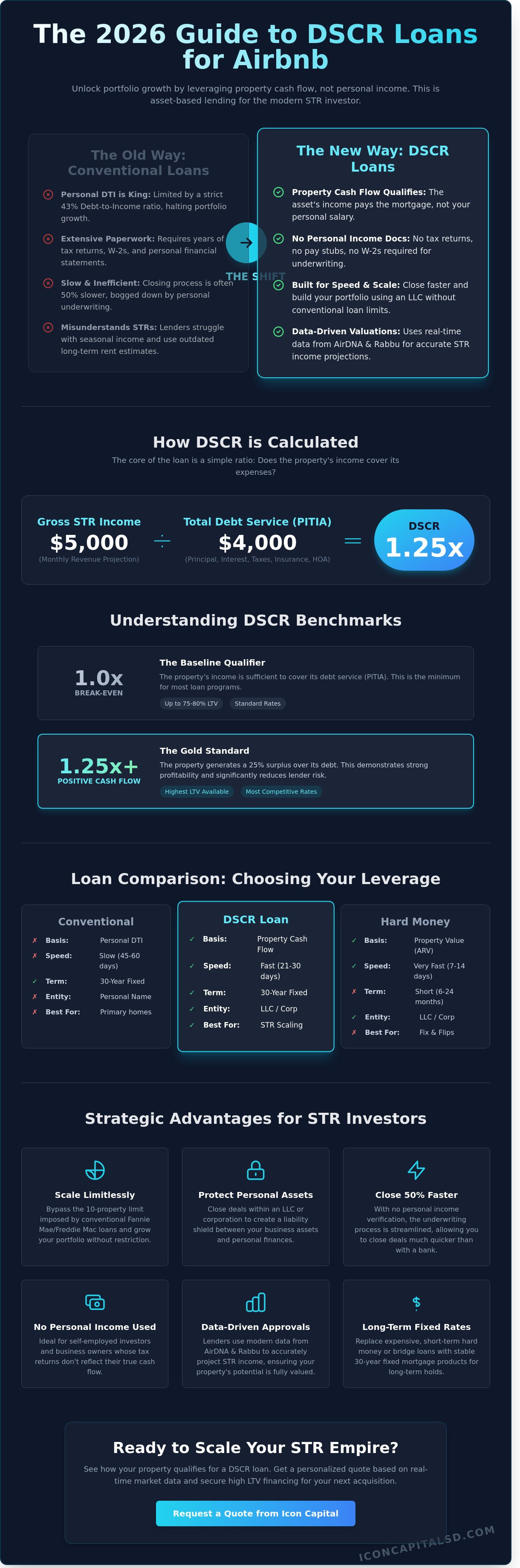
The core of the underwriting process is the coverage calculation. Lenders look at the “Debt Service,” which includes Principal, Interest, Taxes, Insurance, and HOA fees (PITIA). The ratio is determined by dividing the gross monthly STR income by this PITIA figure. In 2026, most lenders utilize a two-tiered benchmark system for a dscr loan for airbnb property:
- 1.0x Ratio: This is the baseline “break-even” point. If the property generates $3,000 in monthly revenue and the PITIA is $3,000, the ratio is 1.0x. Many programs still allow for 75% to 80% LTV at this level.
- 1.25x Ratio: Properties that generate a 25% surplus over debt service often qualify for the most competitive interest rates and lower down payment requirements.
Lenders now accept professional management projections or AirDNA data to substantiate these figures, even for new acquisitions without a 30-day operating history. To see how your specific property qualifies under these metrics, you can request a quote to review current market rates and leverage options.
How Lenders Verify Airbnb Income in 2026
Lending standards for a dscr loan for airbnb property have evolved to match the sophistication of the short-term rental market. Traditional 1007 rent schedules, which historically relied on long-term lease averages, are no longer the primary tool for valuation. In 2026, underwriters prioritize specialized data sets that reflect the high-yield nature of vacation rentals. They utilize third-party data aggregators like AirDNA and Rabbu to cross-reference borrower claims against real-time market performance. This data-driven approach allows for a more accurate Debt Service Coverage Ratio (DSCR) calculation based on actual nightly performance rather than theoretical monthly rent.
The choice between using “Actuals” or “Projections” significantly impacts your loan terms. Properties with 12 months of verified trailing income typically secure interest rates 25 to 50 basis points lower than those relying on market estimates. Because these are non-QM products, they do not need to meet the restrictive debt-to-income requirements of a Qualified Mortgage. This flexibility allows lenders to use 100% of projected gross income in established markets, provided the data is backed by institutional-grade reports.
Seasonality is a critical factor in the annualized DSCR calculation. A property in a ski destination might earn 75% of its revenue between December and March. Lenders smooth this volatility by averaging total annual revenue over a 12-month period. This ensures the property maintains a healthy coverage ratio even during low-occupancy months. Most programs require a minimum DSCR of 1.0x to 1.25x to qualify for competitive leverage.
The Appraisal Process for Vacation Rentals
Appraisers now utilize the STR-specific appraisal addendum, often referred to as Form 1004H or an updated 1007, to compare like-kind assets. In 2026, comps are selected from properties within a 3-mile radius that share similar guest capacities and amenities. Underwriters generally exclude cleaning fees and service charges from the gross income totals. They focus on the “stay revenue” to determine the asset’s true earning power. This conservative adjustment prevents artificial inflation of the DSCR through pass-through costs.
Qualifying with Zero Property History
Financing a new purchase requires a reliance on Average Daily Rate (ADR) and Occupancy Rate metrics. Lenders analyze the 50th or 75th percentile of local market performance to set a baseline. To mitigate risk in emerging or unproven markets, investors often face lower Loan-to-Value (LTV) caps, typically around 70% to 75%. If you are looking to scale your portfolio with a new acquisition, you should request a quote to see how current market projections impact your specific leverage options.
DSCR vs. Conventional vs. Hard Money: Choosing Your Leverage
Investors select financing based on three specific variables: speed, cost, and scalability. Conventional loans offer the lowest interest rates but impose strict debt-to-income (DTI) requirements that limit most portfolios. Hard money provides immediate liquidity for acquisitions but carries double-digit interest rates that erode monthly cash flow. A dscr loan for airbnb property serves as the strategic middle ground, prioritizing the asset’s performance over the borrower’s personal tax returns.
The “Cost of Capital” is a secondary concern for high-volume investors compared to the “Opportunity Cost” of a slow closing. Traditional retail banks often take 45 to 60 days to process a loan. In a competitive market, that delay can result in a lost contract. DSCR lenders typically close in 21 days or less because the underwriting focuses on the Debt Service Coverage Ratio (DSCR) rather than complex personal financial histories.
Conventional Loan Limitations for STRs
Conventional lending often forces investors into the “Second Home” trap. If you secure a loan for a second home but use it exclusively as a full-time Short-Term Rental (STR), you may violate the mortgage’s occupancy affidavit. Furthermore, once an investor reaches the 10-property limit set by Fannie Mae and Freddie Mac, traditional banks usually issue a hard rejection. This ceiling prevents the scaling of a professional portfolio. Conventional debt also carries personal liability, meaning your personal credit and assets are directly tied to the property’s performance. DSCR loans, by contrast, allow for vesting in an LLC, which provides a layer of legal protection.
Replacing High-Interest Hard Money
Hard money is a temporary bridge, not a long-term solution. Many investors use fix and flip loans to buy and renovate distressed properties. Once the property is stabilized and listed on Airbnb, the goal is to “take out” that expensive debt. Refinancing into a 30-year dscr loan for airbnb property allows you to lock in a permanent rate and lower your monthly debt service.
- Cash-Out Refi: If the property’s value increased after renovation, you can pull equity out to fund your next down payment.
- Prepayment Penalties: Unlike conventional loans, DSCR products often include 3 to 5-year prepayment penalties, though these can be bought down for a slightly higher rate.
- Exit Strategy: Moving from bridge debt to DSCR stabilizes your portfolio against interest rate volatility.
If you’re ready to transition from expensive short-term debt to a permanent financing solution, you can request a quote to see current LTV and rate options for your specific asset.
Requirements and Roadmap to Secure an STR DSCR Loan
Securing a dscr loan for airbnb property in 2026 hinges on the asset’s ability to generate cash flow rather than your personal debt-to-income ratio. Lenders prioritize property performance, meaning the projected short-term rental income must exceed the annual debt obligations. While personal income isn’t the focus, your financial profile still dictates the loan terms.
- Credit Score Thresholds: A minimum score of 660 is generally required. Scores of 720 or higher typically unlock the most competitive 2026 interest rates and higher leverage options.
- LTV and Down Payments: Expect to provide a 20% to 25% down payment for purchase transactions. For cash-out refinances, LTV caps usually sit at 70% to 75%.
- Liquidity Reserves: Lenders require proof of reserves to cover potential vacancies. You’ll typically need 6 months of PITIA (Principal, Interest, Taxes, Insurance, and Association fees) in liquid assets.
- Documentation: You don’t need tax returns or W2s. The checklist includes your LLC operating agreement, EIN, two months of bank statements, and a valid ID.
Step-by-Step Application Framework
The process is designed for speed and efficiency, focusing on the deal’s mechanics. Follow this four-step roadmap to move from property identification to funding.
Step 1: Property Identification. Select a property and run preliminary income analysis using tools like AirDNA or Mashvisor. Ensure the projected gross income supports a DSCR of at least 1.15.
Step 2: Request a Quote. Submit your deal details to lock in current 2026 rates and receive a formal Term Sheet outlining your leverage and costs.
Step 3: Underwriting and Appraisal. The lender orders an STR-specific appraisal. This report includes a 1007 rent schedule or uses actual short-term rental data to verify the property’s income potential.
Step 4: Closing and Verification. Once underwriting clears, the lender verifies your LLC structure. Most investors close in the name of an entity to protect personal assets and streamline the dscr loan for airbnb property process.
Common Pitfalls and How to Avoid Them
Even strong deals can hit roadblocks during the underwriting phase. Preparation is key to avoiding delays or denials.
The “Low DSCR” hurdle occurs when projected income doesn’t sufficiently cover the mortgage. To fix this, you can lower the LTV by increasing your down payment or opt for an Interest-Only (I/O) payment structure. I/O options reduce the monthly debt obligation, which immediately improves the DSCR ratio.
Regulatory compliance is another common failure point. Lenders verify that local zoning laws allow for stays shorter than 30 days. If the municipality requires a specific STR permit, you must provide evidence that the property is eligible or already permitted.
Finally, insurance requirements are stricter for short-term rentals. A standard landlord policy often lacks coverage for transient guests. You need a policy that includes a “Business Pursuit” endorsement or a dedicated STR policy to satisfy lender risk requirements. If you’re ready to analyze a specific deal, Request a Quote to see current market terms.
Scaling Your Portfolio with Icon Capital LLC
Generalist mortgage brokers often rely on rigid Fannie Mae or Freddie Mac guidelines. These frameworks don’t accommodate the nuances of short-term rental income or the seasonal fluctuations of the vacation rental market. Icon Capital LLC operates as a specialized Non-QM lender. We prioritize the cash flow potential of the asset rather than your personal debt-to-income ratio. This distinction is critical when you’re looking for a dscr loan for airbnb property that actually reflects your business reality.
Managing 10 or 20 individual loans is inefficient for high-growth investors. We offer portfolio loan facilities that consolidate multiple STR properties under a single facility. This streamlines your debt management and provides better leverage across your entire asset base. Our creative financing approach solves complex scenarios, including properties owned by multi-member LLCs or assets requiring minor renovations before hitting the rental market.
In competitive 2026 markets like Scottsdale, Austin, or Orlando, speed is your primary advantage. Icon Capital matches the pace of these markets by streamlining the underwriting process. We often close deals in 21 days or less; while traditional banks are still reviewing tax returns. Our goal is to provide the liquidity you need to secure high-yield properties before your competitors can react.
- Asset-Based Underwriting: No personal income verification or tax returns required.
- Portfolio Financing: Close multiple doors under one loan to save on closing costs.
- Flexible LTVs: Up to 80% LTV for purchases to keep your capital working.
Solutions for Foreign National Investors
You don’t need a US credit score or a Social Security Number to build a US-based Airbnb portfolio. Icon Capital provides financing for international investors by leveraging global assets and the projected revenue of the US property. Our Foreign National Loans Guide details how we qualify borrowers based on their international financial footprint. We accept 12 months of international bank statements to verify liquidity and reserves.
Interest-Only (I/O) Options for Maximum Cash Flow
Cash flow is the lifeblood of STR investing. We offer 10-year interest-only periods on our dscr loan for airbnb property products. This structure significantly lowers your monthly debt service. By reducing the required monthly payment, you improve your DSCR ratio and keep more liquidity for property maintenance or new acquisitions. It’s a pragmatic tool for investors who prioritize immediate monthly yield over rapid equity buildup. You get the benefit of tax-deductible interest while maintaining maximum cash in hand for your next deal.
Ready to scale? Get your custom DSCR quote today.
Maximize Your STR Portfolio Growth with Precision Financing
The 2026 short-term rental market demands a pivot from restrictive traditional lending to asset-based solutions. Securing a dscr loan for airbnb property allows you to bypass personal debt-to-income ratios and focus entirely on the property’s ability to generate revenue. Icon Capital LLC specializes in Non-QM and creative financing, offering specific expertise for foreign national and self-employed investor profiles who require more flexibility than conventional banks provide. Our streamlined 4-step loan process is engineered for speed, ensuring you don’t lose out on high-performing assets in the current 2026 market cycle. We prioritize the technical structure of every deal, leveraging data-driven underwriting to provide the leverage needed for rapid scaling. It’s time to move beyond the limitations of standard mortgages and utilize a partner that understands the nuances of the STR industry. We look forward to helping you reach your investment goals through efficient, results-oriented financing.
Request a custom DSCR loan quote for your Airbnb property
Frequently Asked Questions
Can I get a DSCR loan for an Airbnb with no previous rental history?
You can qualify for a DSCR loan for an Airbnb property even without a prior rental history. Lenders typically use 12 month revenue projections from third party data providers like AirDNA or Rabbu to estimate the potential income. This allows investors to purchase or refinance newly converted short term rentals where actual operating statements don’t exist yet. Most programs require the projected income to cover the debt service by at least 1.0x to 1.2x.
What is the minimum DSCR ratio required for a short-term rental?
Most lenders require a minimum debt service coverage ratio between 1.0 and 1.25 for short term rentals. A 1.0 ratio means the property’s gross rental income exactly equals the annual debt obligations, including principal, interest, taxes, insurance, and HOA fees. Some aggressive programs allow for ratios as low as 0.75; however, these often come with lower LTV limits or higher interest rate premiums to offset the increased risk.
Do DSCR loans for Airbnbs require personal tax returns or W-2s?
DSCR loans for Airbnbs don’t require personal tax returns, W-2s, or pay stubs for qualification. The underwriting process focuses on the property’s cash flow rather than your personal income. Lenders verify your credit score and liquidity for the down payment, but your debt to income ratio isn’t a factor in the final approval. It’s an efficient tool for self employed investors who utilize high tax deductions.
How does an appraisal work for an STR DSCR loan?
The appraisal for an STR DSCR loan involves a standard valuation plus a specific rental survey. The appraiser uses Form 1007 for single family homes or Form 1025 for multi unit properties to determine the fair market rent. In 2026, many lenders also accept short term rental specific appraisals that incorporate daily rate data and occupancy percentages from local competitors instead of relying solely on long term lease averages.
Are DSCR loan rates higher for Airbnbs than for long-term rentals?
Interest rates for a dscr loan for airbnb property are typically 0.25% to 0.75% higher than those for long term rental properties. Lenders view short term rentals as higher risk due to seasonal income fluctuations and higher management intensity. Despite the slightly higher rate, the increased cash flow potential of an Airbnb often offsets the additional interest expense, providing a stronger net return on investment for the professional borrower.
Can I use a DSCR loan to purchase an Airbnb as a Foreign National?
Foreign Nationals can use DSCR loans to purchase Airbnb properties in the United States. These programs don’t require a U.S. credit score or Social Security number, though they typically cap the LTV at 65% or 70%. Borrowers must provide a valid passport and proof of international assets. The loan is secured by the U.S. real estate asset, making it a viable path for global investors to scale domestic portfolios without a domestic credit history.
What are the typical down payment requirements for an STR DSCR loan in 2026?
Typical down payment requirements for an STR DSCR loan in 2026 range from 20% to 25% for purchase transactions. Most lenders offer a maximum LTV of 80% for borrowers with credit scores above 720. If the property requires a cash out refinance, the maximum LTV usually drops to 75%. These requirements ensure the investor maintains sufficient equity to weather market volatility or temporary drops in occupancy rates during the off season.
Is there a limit to how many Airbnb properties I can finance with DSCR loans?
There’s no standard limit to how many Airbnb properties you can finance with DSCR loans. Unlike conventional financing which often caps an investor at 10 properties, DSCR lenders focus on the individual performance of each asset. This allows professional investors to scale their portfolios to 20, 50, or 100 units. Some lenders may implement a total exposure limit, such as 5 million or 10 million dollars, across their specific platform for a single borrower.