

The cheapest capital isn’t always the most profitable for your 2026 portfolio. While a standard 30-year fixed rate might seem like the safest bet, the National Association of Home Builders reported a 10.4% increase in custom home starts in late 2024, signaling a shift toward specialized development financing. You already know that securing the right leverage is the difference between a stalled project and a high-yield asset. However, the construction loan vs mortgage key differences often create friction for investors who aren’t prepared for the technical shift from acquisition to vertical development.
You’ll master the structural and financial nuances required to optimize your real estate leverage through this guide. We’ll break down the transition from interest-only build phases to permanent financing, explain why builder vetting requirements are tightening, and show you how to calculate ROI when dealing with complex draw schedules. This overview covers specific down payment benchmarks, LTV requirements, and the “Construction-to-Perm” mechanics you need to scale your portfolio effectively in the current market.
Key Takeaways
- Distinguish between traditional lump-sum funding and the incremental draw schedules required for ground-up development projects.
- Navigate the construction loan vs mortgage key differences regarding underwriting, specifically focusing on the critical role of builder vetting and track records.
- Evaluate the 2026 financial landscape to understand why construction financing demands higher equity positions and premium interest rates.
- Identify the strategic triggers for choosing interim construction debt over long-term mortgages based on asset habitability and investment goals.
- Master the procedural mechanics of milestone-based disbursements to ensure project liquidity and optimize your real estate leverage.
What is a Construction Loan vs. Mortgage? Core Definitions
Understanding the fundamental structure of real estate debt is essential for any developer or investor. A Mortgage Loan serves as a long-term financing solution for properties that are already built and ready for occupancy. In contrast, a construction loan acts as a short-term facility specifically designed to cover the costs of labor and materials during the building phase. One of the construction loan vs mortgage key differences lies in the valuation method. While a traditional mortgage is based on the current market value of the asset, a construction loan is underwritten based on the “as-completed” value. This is the projected worth of the property once the project finishes.
Investors frequently utilize construction loans as a temporary bridge. Once the structure is complete and a Certificate of Occupancy is issued, the borrower typically transitions the debt into a long-term DSCR loan or a conventional mortgage. This exit strategy is a critical component of the initial underwriting process. Lenders want to see a clear path from the high-interest construction phase to a stabilized, long-term debt structure. Traditional lenders often shy away from ground-up projects because of the inherent risks of cost overruns and timeline delays. Construction loans mitigate this by requiring a higher level of scrutiny on the builder’s experience and the feasibility of the budget. For those ready to analyze their specific project costs, you can request a quote to evaluate your leverage options.
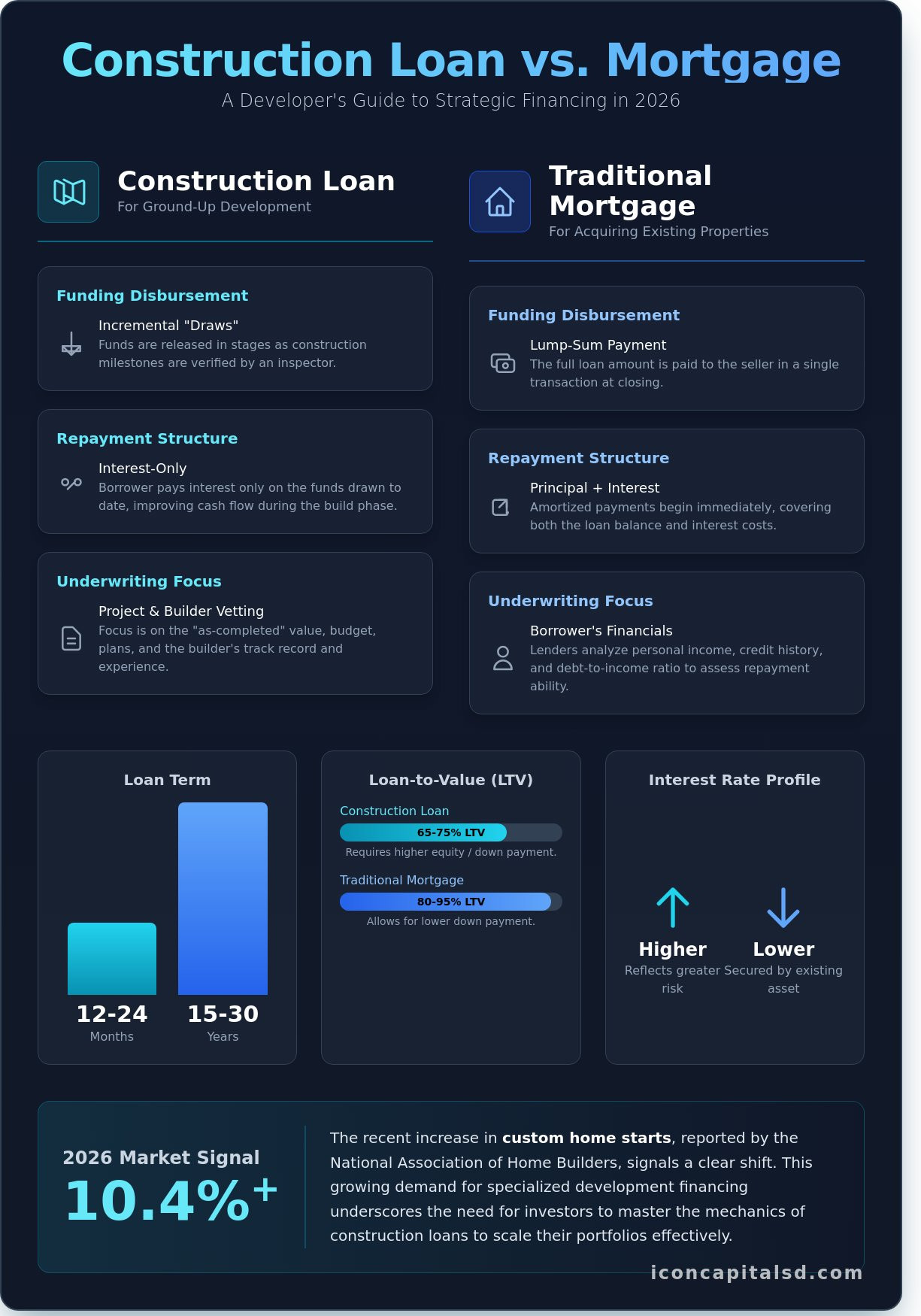
Construction loans often feature a lower Loan-to-Value (LTV) than traditional mortgages because of the higher risk profile of an unbuilt asset. While a standard mortgage might allow for 80% to 95% LTV, construction financing often caps at 65% to 75% of the total project cost. This ensures the borrower has significant “skin in the game” before the first draw is ever funded. The process is transactional and data-driven, focusing on the viability of the asset rather than just the borrower’s personal narrative.
The Traditional 30-Year Mortgage
This product focuses on the borrower’s long-term ability to repay via income and asset verification. Because the collateral is a finished home, the lender has the security of an asset that can be sold immediately in a default scenario. Terms are standardized at 15, 20, or 30 years with fixed or adjustable rates. It’s the primary tool for acquiring stabilized residential or commercial real estate.
The Ground-Up Construction Loan
These loans are short-term, typically lasting 12 to 24 months. Payments are interest-only, which helps investors manage cash flow while no rental income is generated. To qualify, borrowers must provide detailed plans, specs, and a contract with a vetted General Contractor. The lender releases funds in draws as construction milestones are met, ensuring the project stays on schedule and within budget.
Structural Mechanics: Disbursement and Repayment Comparison
Traditional mortgages release a lump sum to the seller at closing. Construction financing operates on a staggered timeline. This is one of the construction loan vs mortgage key differences that impacts cash flow management for the duration of the project. During the build, the lender holds the total loan amount and releases it in “draws” rather than a single payment. This structure protects the lender’s capital by ensuring the asset’s value grows alongside the debt. Borrowers only pay interest on the amount disbursed, which keeps monthly carrying costs lower during the initial phases of development.
The Draw Schedule Explained
Funding follows a strict schedule tied to physical milestones. Lenders typically release funds for the foundation, framing, and finishing phases separately. Before each release, a third-party inspector visits the site to verify that the work matches the draw request. Understanding How Construction Loans Work is critical for maintaining contractor relationships and project momentum. For projects slated for 2026, investors should account for a 5% to 10% contingency fund within their budget to handle potential material price volatility. This ensures the project doesn’t stall if copper or steel costs spike unexpectedly as they have in previous cycles.
Exit Strategies and Refinancing
Repayment structures differ significantly between these two products. While a standard mortgage involves immediate principal and interest payments, construction loans usually require interest-only payments on the funds drawn to date. Once the local municipality issues a certificate of occupancy, the borrower must execute an exit strategy. A “Single-Close” or “Construction-to-Permanent” loan automatically converts to a traditional mortgage. However, many professional investors prefer a “Two-Close” approach. This strategy allows them to lock in better permanent rates or higher leverage once the asset is fully stabilized and appraised at its finished value.
For rental properties, using DSCR loans provides a streamlined exit based on the property’s projected income rather than personal debt-to-income ratios. This is a common tactic for investors looking to scale portfolios quickly without the constraints of traditional underwriting. The 2026 outlook suggests that two-close loans will remain popular for those who expect interest rates to soften after the build is complete. If you’re ready to secure financing for your next project, request a quote to review the latest leverage options and draw terms.
- Lump Sum: Standard for mortgages; funds the purchase of an existing asset.
- Incremental Draws: Standard for construction; funds the creation of a new asset.
- Interest-Only Phase: Reduces overhead during the 12 to 18-month build window.
- P&I Phase: Begins after the construction-to-permanent conversion or refinancing.
Underwriting and Approval: Who and What Gets Vetted?
Underwriting for a standard mortgage is a predictable process. The lender validates your income, checks your debt obligations, and orders an appraisal on an existing structure. Construction financing is significantly more complex. It requires a three-way vetting process that scrutinizes the borrower, the builder, and the project feasibility. This multifaceted approach represents one of the construction loan vs mortgage key differences. Lenders prioritize the builder’s track record because an unfinished project is a liability that cannot be easily liquidated.
The approval timeline for construction loans often takes 45 to 60 days, compared to the 30 day average for conventional mortgages. This extra time is dedicated to verifying the “soft costs” and “hard costs” of the build. If the builder lacks the necessary liquidity or the project plans don’t align with local zoning, the loan will stall regardless of the borrower’s credit strength.
Builder and Project Vetting
Builder approval is the primary hurdle in construction financing. Lenders require a minimum of 3 to 5 years of experience and proof of active general liability insurance. They review the “Specs and Plans” alongside a granular “Line Item” budget. This document must list every projected expense from foundation pouring to final interior trim.
Lenders also differentiate between Loan-to-Cost (LTC) and Loan-to-Value (LTV). In construction, lenders typically cap the loan at 80% to 85% of the total cost to build (LTC). For a conventional mortgage, the focus is strictly on the LTV of the finished home. The “draw schedule” is also vetted during this phase. This schedule dictates when the lender releases funds as specific construction milestones are met, ensuring the builder doesn’t receive payment for work that isn’t finished.
Borrower Qualification in 2026
In 2026, qualification standards for developers and investors have shifted toward asset-based and alternative income verification. Traditional Debt-to-Income (DTI) remains a staple for conventional mortgages, but self-employed developers often use P&L Home Loans to secure funding based on business health rather than individual tax returns. This allows for greater flexibility when personal income doesn’t reflect the true cash flow of a development firm.
Credit score benchmarks are generally stricter for construction. While a 620 score might secure a conventional mortgage, construction lenders frequently require a 680 or 720 to offset the increased risk of ground-up builds. High-net-worth investors may also use asset depletion models to qualify, bypassing standard income requirements entirely. If you’re ready to see how your portfolio stacks up, you can request a quote to review your specific leverage options.
Costs, Rates, and Down Payments in the 2026 Market
Construction loans carry higher interest rates than traditional mortgages. This pricing reflects the lender’s risk; they’re financing a blueprint rather than a finished asset. In the 2026 market, construction rates typically sit 100 to 300 basis points above standard 30-year fixed mortgages. One of the construction loan vs mortgage key differences is the payment structure. Mortgages require principal and interest payments immediately. Construction loans utilize interest-only payments during the build phase, applied only to the funds already disbursed.
Borrowers must account for several costs that don’t exist in standard home buying. These include:
- Inspection fees for every draw request to verify construction progress.
- Title update fees to ensure no mechanic’s liens are filed during the build.
- Interest reserves, which act as a pre-funded account to cover monthly payments.
Institutional lenders offer the lowest rates but require extensive documentation and credit scores often exceeding 720. Hard money construction loans prioritize the asset’s value and the developer’s track record. These products offer faster funding and more flexible underwriting, though rates often exceed 10% in the current 2026 environment.
Interest Rates and Reserves
Interest reserves are a critical component of construction financing. Lenders calculate the total interest due over a 12 or 18-month build cycle and include this amount in the total loan. This ensures payments are made even if the borrower’s cash flow is tied up in the project. Most 2026 construction loans utilize floating rates based on the Secured Overnight Financing Rate (SOFR). While some construction-to-permanent loans offer fixed rates, they often carry a premium. Market data from early 2026 suggests rates will remain range-bound as the Federal Reserve maintains a neutral stance.
Equity and Down Payment Needs
Lenders require 20% to 30% equity to mitigate risk. If you already own the lot, you can use the land’s appraised value toward your down payment requirement. Experienced developers often secure higher Loan-to-Cost (LTC) ratios, sometimes reaching 80% or 85%. First-time builders are typically capped at 70% or 75% LTC. For those combining construction with a quick exit strategy, reviewing types of loans for flipping houses helps determine if a ground-up or bridge product fits the project’s specific timeline. Understanding these construction loan vs mortgage key differences allows investors to budget for the higher capital requirements of a new build.
Ready to secure financing for your next build? Request a quote today to see our current rates and LTC limits.
Strategic Selection: Which Loan Fits Your 2026 Goal?
Choosing the right capital structure depends on your specific asset strategy and timeline. A mortgage is the standard tool for turnkey rentals or move-in ready investments. These loans allow for rapid acquisition. You get immediate cash flow. Construction loans are designed for ground-up development or projects involving major structural additions. Understanding the construction loan vs mortgage key differences helps you avoid over-leveraging or stalling your project due to incorrect funding.
Fix and flip investors often operate in a middle ground. If your project is primarily cosmetic, a bridge loan is usually better than a construction loan. Bridge loans provide the speed necessary to secure distressed assets. They don’t require the rigorous oversight of a construction draw schedule. This allows you to finish the renovation and sell or refinance faster. Icon Capital LLC specializes in these transitions, helping you move from a high-interest build phase into a stable, long-term hold.
The Investor Decision Matrix
Analyzing ROI is the first step. Buying a finished property means you pay a market premium. Building for equity allows you to capture the developer profit margin. This often results in substantial equity gains upon project completion. However, speed to market is a critical factor. Mortgages win if you need immediate cash flow. You can close a DSCR loan and place a tenant in under 30 days. Construction projects often take 12 to 18 months before they generate a single dollar in rent.
- ROI: Building can yield 20% higher equity than buying turnkey assets.
- Speed: Mortgages close 50% faster than construction loans on average.
- Customization: Construction allows you to target high-end or niche rental markets with specific floor plans that command higher premiums.
Getting Started with Icon Capital LLC
Your 2026 project requires a lender that understands complex deal structures. You can request a quote today to see how our Non-QM products fit your portfolio. We focus on creative financing solutions that traditional banks often overlook. Our team prioritizes LTV and asset viability over rigid conventional guidelines. We understand that every deal has unique requirements.
To move forward, gather your executive summary and builder documentation. We need to see your track record and the project’s projected value. We streamline the submission process so you can focus on the build. It’s time to scale your portfolio with a partner who values efficiency and results. Our process is direct. We get straight to the point to ensure your loan closes on time.
Execute Your 2026 Development Strategy
Choosing the right debt structure determines your project’s liquidity and total ROI. Construction loans provide capital through milestone-based draws for ground-up builds, whereas mortgages secure stabilized assets with standard monthly payments. Understanding the construction loan vs mortgage key differences helps you navigate 2026 market requirements, where underwriting focus has shifted toward builder experience and liquidity reserves. Investors must match their financing to the specific phase of their development to avoid over-leveraging or stalling production during the 2026 fiscal year.
Icon Capital offers specialized ground-up construction programs designed for the complexities of the 2026 market. We’re Non-QM experts who understand the unique needs of self-employed developers. Our fast-track builder vetting process ensures your project doesn’t get bogged down in administrative delays. Don’t let rigid traditional lending boxes limit your 2026 growth. Secure your 2026 construction project with a custom quote from Icon Capital and get the leverage your portfolio needs. We’re ready to help you break ground on your next high-yield asset.
Frequently Asked Questions
Can I use a construction loan to buy the land and build the house?
You can use a construction loan to finance both the land acquisition and the building costs simultaneously. Lenders offer single-close options where the lot purchase is rolled into the total project cost. If you already own the land, the equity in that property counts toward your down payment requirement, which often reduces the cash needed at the closing table.
Is it harder to get a construction loan than a traditional mortgage?
Securing a construction loan involves more rigorous underwriting than a standard home loan. Lenders require a minimum credit score of 680 to 720 and detailed project documentation like floor plans and builder contracts. Understanding the construction loan vs mortgage key differences is vital, as banks must mitigate the risk of an unfinished asset by vetting the general contractor’s financial history and license.
What happens if the construction takes longer than the loan term?
You must request a loan extension if the project exceeds the standard 12 to 18 month construction period. Lenders typically charge an extension fee ranging from 0.25% to 1% of the loan amount for an additional 6 months of coverage. Failure to secure an extension or complete the build can result in the loan being called due or interest rate hikes.
Do I need a large down payment for a construction-to-perm loan?
Most construction-to-perm loans require a down payment of 20% to 25% of the total projected value. While FHA and VA programs offer lower entries of 3.5% or 0% for eligible borrowers, conventional products demand higher equity to offset market volatility. You’ll need to provide proof of liquid assets to cover these costs plus a 10% contingency reserve for unexpected construction expenses.
Can I act as my own general contractor on a construction loan?
Most institutional lenders prohibit borrowers from acting as their own general contractor unless they’re licensed professionals with a documented track record. Owner-builder loans are specialized products that require 5 to 10 years of experience in the trades. If you aren’t a licensed builder, you must hire a vetted third-party contractor to manage the project and satisfy the lender’s risk requirements.
What is the ‘Interest Reserve’ in a construction loan?
An interest reserve is a dedicated fund established at closing to cover monthly interest payments during the building phase. This allows the borrower to avoid out of pocket payments while the home is under construction. The lender calculates the estimated interest based on the draw schedule and includes this amount in the total loan balance, ensuring the project remains current during the build.
How do rates for construction loans compare to 30-year mortgage rates in 2026?
Construction loan rates typically sit 0.5% to 1.5% higher than standard 30-year fixed mortgage rates. In 2026, market projections suggest a premium remains necessary due to the short-term, interest-only nature of the draw period. These rates are often variable during construction, though many products allow you to lock in a permanent rate during the initial closing phase.
Can foreign nationals apply for construction loans in the U.S.?
Foreign nationals can access construction financing through Non-QM loan programs designed for international investors. These products typically require a higher down payment of 30% to 40% and a valid passport or ITIN. Lenders focus on the asset’s value and the borrower’s global liquidity rather than domestic credit history, making it a viable path for building U.S. real estate portfolios.