

Financing a new build is fundamentally different from acquiring an existing asset. For investors and builders, the decision between a construction loan vs mortgage is not a matter of terminology-it is a critical strategic choice that directly impacts project timelines, cash flow, and profitability. Confusion over the complex application process, managing draw schedules, and the eventual conversion to permanent financing can create significant and costly roadblocks. Misunderstanding the structure can jeopardize an entire project before the foundation is even poured.
This guide provides a direct, technical breakdown of these two distinct financing vehicles. We will dissect the critical differences in their purpose, underwriting requirements, and payment structures. By clarifying how and when each loan is used, you will gain the necessary insight to navigate the process efficiently. You will leave equipped to select the correct financing for your custom home or investment property with confidence, ensuring your project is structured for success from the ground up.
Key Takeaways
- A construction loan finances a project plan and its execution, while a mortgage finances a completed, existing asset.
- Understand how the phased draw schedule of a construction loan impacts project cash flow, unlike the lump-sum payout of a mortgage.
- The core difference in the construction loan vs mortgage decision is financial term: one is a short-term bridge, the other is long-term financing.
- Learn to navigate the intensive underwriting for a construction loan, which vets the entire project, not just the borrower and property value.
Core Purpose: Financing a Plan vs. Buying a Finished Asset
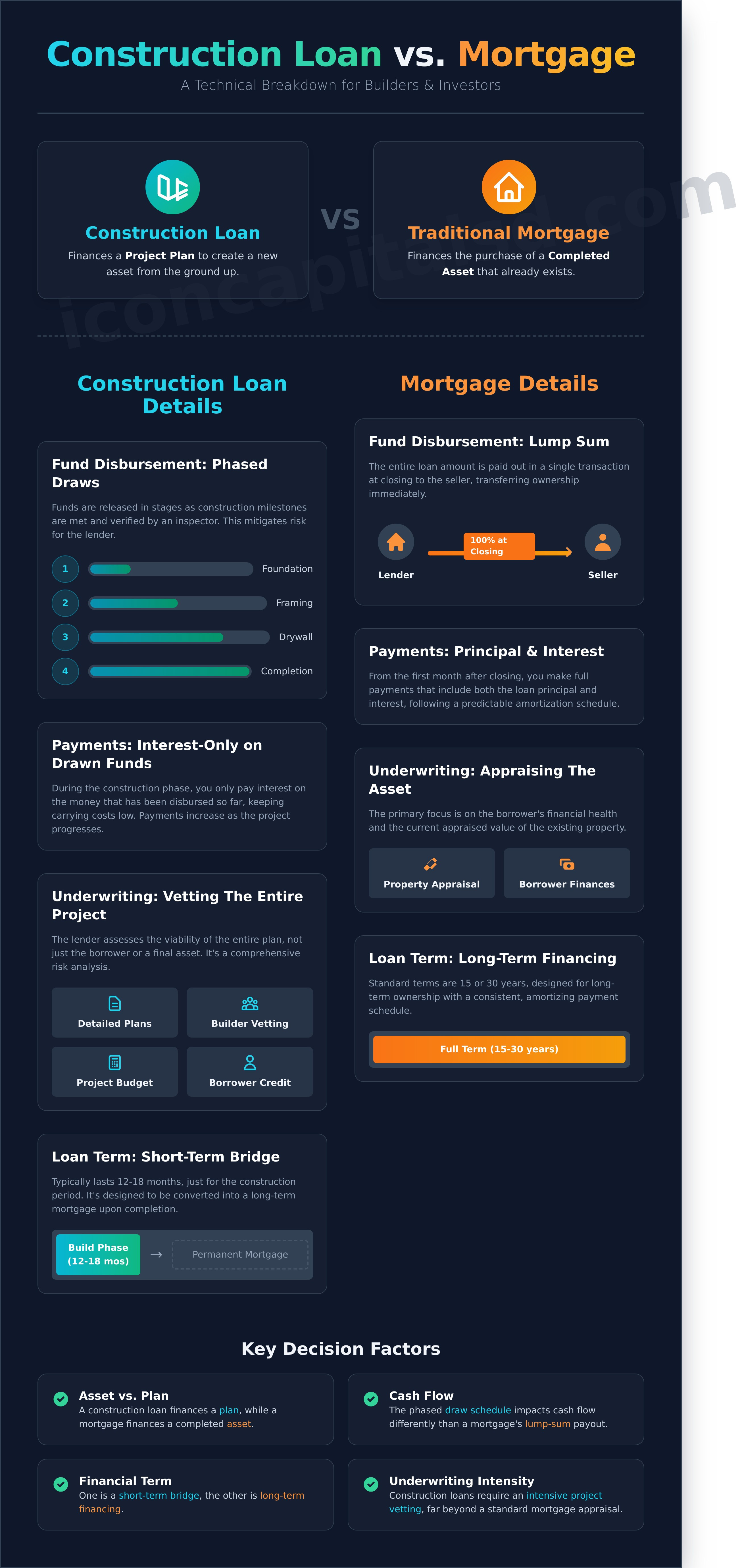
The fundamental distinction in the construction loan vs mortgage debate lies in what the capital is intended for. One finances the acquisition of a finished asset, while the other funds the process of its creation. A mortgage is used to purchase a tangible, existing structure. A construction loan, by contrast, finances a detailed plan, transforming architectural drawings and materials into a completed property.
Understanding this core purpose is the first step in determining the correct financing vehicle for your real estate objective, whether you are an investor building a spec home or a buyer purchasing a turnkey residence.
What a Traditional Mortgage Covers
A conventional mortgage loan is a financial instrument designed exclusively for the purchase of a pre-existing property. The lender assesses the current value of the asset to determine risk and loan amount. The funds are then transferred in a single transaction at closing, facilitating the change of ownership from the seller to the buyer.
- Asset Type: Used for purchasing pre-built homes, condominiums, or multi-unit properties.
- Valuation: The loan amount is determined by the appraised value of the existing, completed structure.
- Disbursement: Funds are paid in a single lump sum to the seller upon closing the transaction.
What a Construction Loan Covers
A construction loan is a specialized, short-term financing tool that covers the costs associated with building a property from the ground up. This type of loan is structured to mitigate the risks of the construction process, with funds disbursed in stages as work is completed. It is a critical tool for developers, investors, and individuals building custom homes.
- Scope of Costs: Finances the purchase of land, labor, building materials, permits, and related fees.
- Valuation: The loan amount is based on the projected future value of the home once construction is complete.
- Use Cases: Essential for building custom homes, speculative (spec) homes, or new investment properties.
Loan Structure & Payout: Lump Sum vs. Phased Draws
A fundamental operational difference when evaluating a construction loan vs mortgage is the method of fund disbursement. A standard mortgage involves a single, upfront transaction, while a construction loan utilizes a phased approach. This structural variance directly impacts cash flow, risk management, and your payment obligations throughout the life of the loan.
How Mortgage Funds Are Disbursed
With a conventional mortgage, the process is direct and standardized. At closing, the lender transfers the full loan amount in a single lump sum to the seller or their closing agent. Your repayment obligation begins immediately, with principal and interest payments scheduled from the following month. This one-time transaction simplifies the process, providing immediate ownership and a predictable amortization schedule from day one.
The Construction Loan Draw Schedule Explained
Construction financing is designed to mitigate risk by releasing capital in stages. The lender holds the approved funds and disburses them in periodic payments known as ‘draws’. These draws are not arbitrary; they are tied to a pre-approved construction schedule and specific, verifiable milestones. For example:
- Foundation poured and cured
- Framing and roofing complete
- Windows, doors, and drywall installed
- Final finishes and certificate of occupancy
Before each draw is released, a third-party inspector must visit the site to verify that the work has been completed to standard. This phased payout structure is a core component of Construction Loans, ensuring that the lender’s capital is used as intended and that the project is progressing on schedule, protecting both the borrower and the lender.
Payments During the Construction Phase
The draw schedule also dictates your payment structure during the building period. Instead of making full principal and interest payments on the total loan amount, borrowers typically make interest-only payments. Crucially, this interest is calculated only on the funds that have been drawn to date. As the project progresses and more funds are disbursed, the monthly interest payment increases incrementally. This approach keeps carrying costs manageable during a period when the property is not yet complete or generating income.
Application & Underwriting: Appraising a Property vs. Vetting a Project
The core difference in the construction loan vs mortgage approval process lies in the nature of the collateral. A standard mortgage is secured by an existing, tangible asset-the house. A construction loan, however, is secured by a project that has yet to be built. This distinction fundamentally changes the lender’s risk assessment and underwriting requirements, making the construction loan process significantly more intensive.
Lenders are not just evaluating your financial stability; they are underwriting the entire construction project from concept to completion. This requires a comprehensive review of your plans, your budget, and the team you have hired to execute the build.
Standard Mortgage Approval Requirements
The approval process for a conventional mortgage is highly standardized. Underwriters focus primarily on the borrower’s financial profile and the property’s current value. Key evaluation criteria include:
- Borrower Financials: Credit score, income verification, assets, and debt-to-income (DTI) ratio.
- Property Appraisal: A licensed appraiser assesses the home’s current market value to ensure it adequately collateralizes the loan.
For a qualified borrower with a property that appraises appropriately, the process is relatively straightforward and efficient.
Construction Loan Underwriting: What Lenders Need
Securing a construction loan involves a deeper level of due diligence. Lenders must validate the viability of the project itself to mitigate the risk of budget overruns or incomplete work. This level of scrutiny is necessary because, as the Consumer Financial Protection Bureau on construction loans explains, the lender is financing a future asset. Expect to provide a detailed project file, including:
- Detailed Plans: Full architectural drawings and specifications (often called the ‘blue book’).
- Comprehensive Budget: A line-item budget detailing all projected costs, from permits and materials to labor.
- Contractor Vetting: The lender must approve your general contractor, which includes verifying their license, insurance, and professional track record.
- Projected Value Appraisal: An appraiser determines the home’s estimated value after construction is complete, based on the plans and specifications provided.
Managing this volume of paperwork—from architectural plans and contractor agreements to draw requests and payment authorizations—can be a significant challenge. Platforms designed for secure workflow management, such as Chaindoc, can centralize these documents, signatures, and payments, streamlining the process for borrowers, builders, and lenders alike.
Terms, Rates, and Repayment: Short-Term vs. Long-Term Financing
The fundamental difference in the construction loan vs mortgage debate lies in their financial structure and timeline. A construction loan is a temporary bridge designed to fund the building process, while a mortgage is a long-term instrument for property ownership. This distinction directly impacts their terms, interest rates, and repayment schedules, reflecting the different levels of risk lenders assume for each product.
Typical Construction Loan Terms
Construction loans are short-term financing solutions, typically lasting 12 to 18 months-just enough time to complete the project. Because the collateral (the home) does not yet exist, these loans are considered higher risk. This results in:
- Variable Interest Rates: Often tied to the prime rate, meaning your payment can fluctuate during the build.
- Interest-Only Payments: During construction, you typically only pay interest on the funds that have been drawn to date for labor and materials.
- Full Balance Due: The entire loan balance must be paid off or refinanced into a permanent mortgage upon project completion.
Standard Mortgage Loan Terms
A conventional mortgage is designed for stability and long-term ownership. Once the property is built or purchased, this loan finances the asset over decades. Key features include:
- Long Repayment Periods: The most common terms are 15 or 30 years, providing predictable monthly payments.
- Rate Options: Borrowers can choose between a stable fixed-rate or a variable adjustable-rate mortgage (ARM).
- Amortizing Payments: From the first month, your payments include both principal and interest (P&I), steadily reducing your loan balance over time.
Converting to Permanent Financing: The ‘End Loan’
The transition from a construction loan to a mortgage is a critical step. There are two primary paths:
- Two-Time Close: You secure a construction loan first and then apply for a separate mortgage after the home is built. This involves two sets of closing costs and two underwriting processes.
- One-Time Close: This efficient option, also known as a construction-to-permanent loan, combines both financing phases into a single transaction. You lock in your rate upfront, saving significantly on fees and simplifying the process.
To determine the most effective structure for your project, it’s essential to analyze the numbers. You can request a quote to see your specific options and build a clear financial plan. At Icon Capital LLC, we specialize in structuring the creative financing solutions needed for complex projects.
Decision Framework: Which Loan Is Right for Your Project?
The decision between a construction loan and a mortgage is fundamentally determined by one factor: the existence of a habitable structure on the property. From there, your project’s objective-whether for a primary residence or a portfolio asset-dictates the precise financing path. This framework breaks down the scenarios to clarify your required loan type.
Scenario 1: Buying an Existing Property
If you are purchasing a move-in-ready home, a traditional mortgage is your financing instrument. This applies to both primary residences and turnkey investment properties where no significant structural changes are planned. Construction loans are not applicable in this scenario, as their function is to fund the creation of an asset, not the acquisition of an existing one.
Scenario 2: Building a Custom Home
For those building a home from the ground up, a construction loan is the mandatory first step. This short-term, interest-only loan covers land acquisition and building costs, disbursing funds in draws as work is completed. Upon receiving the certificate of occupancy, the construction loan is converted or refinanced into a permanent, long-term mortgage. Underwriting for this process focuses heavily on your personal financial profile and creditworthiness.
Scenario 3: For Real Estate Investors
Investors building property-a spec home for resale or a rental for cash flow-must also begin with a construction loan. The critical difference is the exit strategy. While the end loan can be a traditional mortgage, sophisticated investors often leverage a DSCR loan for rental properties, qualifying based on asset income, not personal DTI. Optimizing this construction-to-permanent financing is key to project profitability. Icon Capital specializes in structuring these complex investor solutions.
To provide maximum clarity, this guide summarizes the construction loan vs mortgage choice based on common project types:
- Project: Buying an existing home.
Loan Type: Traditional Mortgage. - Project: Building a personal home.
Loan Type: Construction Loan-to-Permanent Mortgage. - Project: Building an investment property to sell (flip).
Loan Type: Construction Loan (often with a Hard Money component). - Project: Building an investment property to rent.
Loan Type: Construction Loan-to-DSCR Loan or Permanent Mortgage.
The Right Financial Tool for Your Build
Ultimately, the construction loan vs mortgage decision hinges entirely on your project’s stage and strategic goals. A construction loan is the essential tool for creation, providing short-term, phased funding to bring a blueprint to life. In contrast, a traditional mortgage offers long-term, amortizing financing for a completed, existing property. Recognizing this core distinction-funding a dynamic process versus purchasing a static asset-is the critical first step in structuring a successful real estate investment.
For sophisticated investors and builders, navigating these financial instruments requires a specialist. At Icon Capital, we focus on investor construction loans, structuring creative financing for complex projects that fall outside the scope of conventional lenders. Our streamlined underwriting process is engineered for efficiency, providing the clarity and speed your project demands to maintain momentum from groundbreaking to completion.
Partner with a lender who understands the mechanics of your deal. Request a quote to structure your construction financing and take the definitive step toward turning your vision into a valuable asset.
Frequently Asked Questions: Construction Loan vs. Mortgage
What is a construction-to-permanent loan?
A construction-to-permanent loan is a single-close financing solution that combines the short-term construction financing with the long-term mortgage into one product. This structure streamlines the process, requiring only one application and one set of closing costs. Once construction is complete and a certificate of occupancy is issued, the loan automatically converts to a traditional, permanent mortgage without the need for refinancing. This offers both efficiency and rate security.
How much of a down payment is required for a construction loan?
Down payment requirements for construction loans are typically higher than for standard mortgages, generally ranging from 20% to 25% of the total project cost. This total cost includes both the land value and the projected construction expenses. The higher equity requirement mitigates the lender’s risk during the build phase. The specific Loan-to-Value (LTV) ratio will depend on the borrower’s qualifications, the lender’s program, and the project specifics.
Can I use a construction loan to finance major renovations?
Yes, a construction loan can be structured to finance major renovations. This product is often used for projects too large for a home equity loan, such as a complete gut renovation or a significant home addition. The loan amount is based on the property’s after-renovation value (ARV). The lender will require detailed architectural plans, a qualified contractor, and a line-item budget to underwrite the loan and ensure the scope of work justifies the financing.
What happens if my construction project goes over budget?
The borrower is responsible for covering any construction costs that exceed the approved loan budget. Most construction loans include a contingency reserve, typically 5-10% of the build cost, to handle minor overruns. If expenses surpass this reserve, the borrower must pay the difference out-of-pocket. The lender will not release the next construction draw until the budget shortfall is resolved, which can cause significant project delays if not managed properly.
Can I act as my own general contractor on a construction loan?
Acting as your own general contractor, known as an owner-builder loan, is possible but presents significant underwriting challenges. Lenders require extensive documentation proving your experience, including a valid contractor’s license and a portfolio of successfully completed projects. Due to the high risk of budget overruns and delays associated with inexperienced builders, most lenders prefer to work with a vetted, professional general contractor. Approval is subject to stringent qualification criteria.
How are interest rates on construction loans different from mortgages?
Interest rates on construction loans differ significantly from traditional mortgages. They are typically variable-rate loans set at a margin above the prime rate and are higher to compensate for increased lender risk. During the construction phase, you make interest-only payments on the funds that have been disbursed. Upon project completion, the loan converts to a permanent mortgage with a standard fixed or adjustable rate based on the prevailing market conditions at that time.
Do I need to own the land before applying for a construction loan?
It is not a requirement to own the land before applying. A construction loan can be structured to finance both the land acquisition and the cost of construction within a single transaction. If you already own the land, the equity you hold can be applied toward your down payment requirement. This is a critical consideration when evaluating the financial structure of a construction loan vs mortgage for a new build where land is not yet owned.