

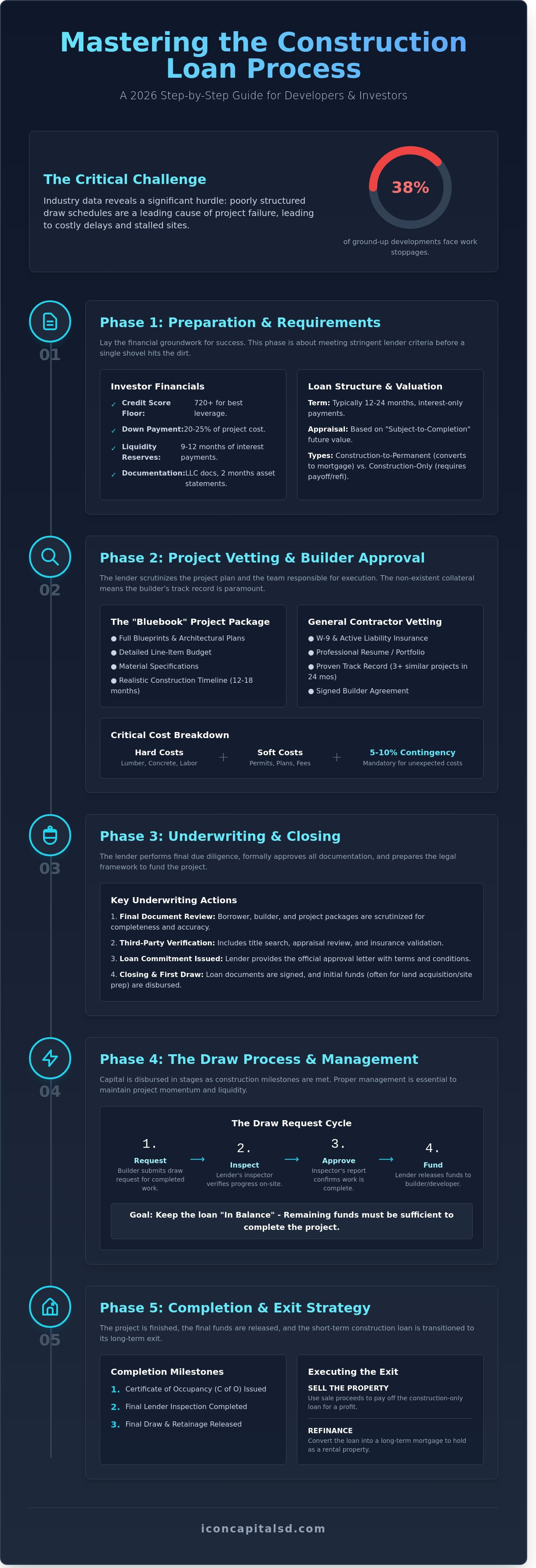
Industry data from 2024 reveals that 38% of ground-up developments face work stoppages due to poorly structured draw schedules. You already know that the difference between a profitable exit and a stalled site often comes down to how well you manage the builder-lender relationship. This guide clarifies the construction loan process step by step to ensure your project remains liquid and on schedule. We provide a professional roadmap designed to help you handle strict builder approval requirements and manage interest-only payments during the 12 to 18 month build cycle.
You recognize that traditional banks often lack the flexibility required for non-QM or high-leverage projects. We’ll show you how to master the complexities of construction financing with a clear, phase-by-phase breakdown of the loan process. This 2026 guide covers everything from the initial application and asset valuation to the final inspection and transition into permanent financing.
Key Takeaways
- Identify the 2026 credit score floors and investor-specific requirements necessary to secure short-term construction financing.
- Learn how lenders evaluate project viability through “As-Completed” appraisals and non-existent structure comps.
- Navigate the construction loan process step by step to properly structure your “Bluebook” project package and builder approval documentation.
- Manage liquidity during the build phase by mastering the draw request process to maintain consistent project momentum.
- Finalize your exit strategy by understanding the transition from the Certificate of Occupancy to final retainage release.
Phase 1: Preparation and Construction Loan Requirements
A construction loan is a short-term, high-interest financing vehicle designed to cover the hard and soft costs of building a structure from the ground up. These loans typically carry terms of 12 to 24 months and require interest-only payments during the build phase. As we move into 2026, the market has shifted toward stricter investor-centric requirements. Lenders now frequently mandate credit score floors of 720 or higher to access the most competitive leverage options. Mastering the construction loan process step by step begins with understanding that these are not standard mortgages; they are complex, risk-heavy assets that require precise preparation.
The “Subject-to-Completion” appraisal serves as the cornerstone of the entire loan structure. Unlike a standard purchase where the current value dictates the loan amount, a construction appraiser evaluates the project based on its future value once the certificate of occupancy is issued. This valuation relies on your detailed line-item budget and architectural plans. Developers must also distinguish between two primary types of loans available for these projects. Construction-to-permanent loans convert into a traditional long-term mortgage once the build is finished. Construction-only loans require a full payoff or a separate refinance upon completion, which is the standard choice for speculative builders looking to sell immediately.
Financial Qualifications for Investors
Investment-grade construction projects generally require a 20-25% down payment. This capital injection ensures the investor has significant skin in the game. For self-employed developers who don’t show traditional income on tax returns, Non-QM options are essential. These programs allow for qualification via 12-month bank statements or a CPA-prepared P&L statement. Beyond the down payment, lenders look for liquidity reserves. You’ll typically need to show enough cash to cover 9 to 12 months of interest payments to ensure the project remains solvent during unforeseen delays.
The Pre-Approval Milestone
A standard residential pre-approval is insufficient for ground-up projects. Lenders must vet the borrower, the builder, and the project’s feasibility simultaneously. You’ll need to organize your entity documentation, including LLC Operating Agreements and Articles of Incorporation, alongside two months of personal and business asset statements. This documentation proves you have the infrastructure to manage a million-dollar build. To begin the construction loan process step by step, your first tactical move is to submit a request for a quote. This allows an underwriter to review your high-level numbers and provide a structural framework for the deal before you spend thousands on architectural renderings.
Phase 2: Project Vetting and Builder Approval
Lenders evaluate the builder’s track record as rigorously as the borrower’s financial profile. The collateral doesn’t exist yet, so the asset’s value depends on the contractor’s ability to execute. The “Bluebook” or project package serves as the primary underwriting tool. It must contain full blueprints, detailed specifications, and a line-item budget. A realistic timeline is also vital. Most construction loans carry a 12 to 18 month term. If the project exceeds this window, the loan hits maturity, which can trigger extension fees or default clauses.
Approving the General Contractor
The builder vetting package includes a W-9, active general liability insurance certificates, and a professional resume. Lenders typically look for a history of three similar projects completed within the last 24 months. They verify financial stability by checking trade references and reviewing the contractor’s standing with local licensing boards. The Builder Agreement is a critical document. It outlines the scope of work and payment schedule, ensuring the investor’s capital remains protected against mechanics’ liens or project abandonment. Understanding how construction loans work involves recognizing that the lender acts as a risk manager for these professional relationships.
The Detailed Cost Breakdown
The budget must clearly separate hard costs from soft costs. Hard costs cover tangible items like lumber, concrete, and labor. Soft costs include expenses such as $4,500 permit fees or $10,000 architectural drawings. A 5% to 10% contingency reserve is mandatory to cover unexpected price spikes. This ensures the loan stays “in balance.” This means the remaining undisbursed funds are always sufficient to complete the build. Managing this part of the construction loan process step by step prevents funding gaps that stall production. If you need a professional review of your budget’s feasibility, request a quote to see how we structure these specialized deals.
Phase 3: Underwriting and Closing the Loan
Underwriting for a construction loan is more complex than a standard mortgage. Icon Capital underwriters focus on project viability and builder risk rather than just borrower credit. They scrutinize the line-item budget, the builder’s resume, and the project timeline to ensure the deal is feasible. The process moves from “Underwriting” to “Funding” status once the lender verifies the builder’s insurance and the feasibility of the construction schedule. This stage of the construction loan process step by step ensures that the capital is secured against a realistic development plan.
The Construction Appraisal Process
Appraisers determine the “Subject-to” value by reviewing the architectural plans and specifications. They select comparable properties that match the finished quality of the proposed structure. In 2026, market data indicates that labor costs have risen by 4.8% annually, a factor appraisers now integrate into future value projections. If the appraisal comes in lower than the total construction cost, the borrower must bridge the gap with additional equity or adjust the project scope. Lenders rely on these valuations to maintain strict risk parameters during volatile market cycles.
Final Loan Structuring
Lenders finalize the Loan-to-Cost (LTC) and Loan-to-Value (LTV) ratios before drawing up the final documents. Experienced developers often see LTC caps at 80% to 85%, while LTV usually stays below 75% of the future value. You’ll sign the Construction Loan Agreement, which includes the Draw Schedule. This schedule dictates exactly when funds are released based on completed milestones like foundation or framing. During the build, you’ll make interest-only payments, which are calculated only on the funds disbursed to date. This structure preserves cash flow for the developer.
Unique closing costs for construction include:
- Inspection Fees: Costs ranging from $250 to $500 per site visit to verify progress.
- Title Updates: Fees for title searches performed before each draw to ensure no liens have been filed.
- Builder’s Risk Insurance: Specialized coverage required for the duration of the build.
- Legal Review: Costs associated with vetting the construction contract and builder’s credentials.
Once all documents are executed, the loan is officially funded. You can request a quote to see how these ratios apply to your specific project. This transition marks the end of the administrative phase and the beginning of the actual build.
Phase 4: The Draw Process and Construction Management
The draw process functions as the primary mechanism for capital distribution during the construction loan process step by step. It ensures capital flows to the job site while protecting the lender’s collateral. Unlike a traditional mortgage where funds disperse in a single lump sum at closing, construction financing releases money in increments. This structure allows the lender to verify that work is completed to 100% of the project specifications before any payment is issued.
The builder or developer initiates this phase by submitting a formal Draw Request form. This document itemizes the specific costs for the phase completed, such as the foundation or roofing. Along with this request, the builder must provide Lien Waivers from all subcontractors and material suppliers. These waivers serve as legal confirmation that laborers and vendors have been paid. They are essential for protecting the property title. Without these documents, the risk of a title cloud increases significantly; industry data suggests that 25% of construction disputes stem from payment disagreements with subcontractors.
Step-by-Step Draw Execution
- Step 1: The builder completes a specific milestone and submits a formal draw request for the associated hard costs.
- Step 2: The lender dispatches a third-party inspector to the site within 48 hours to confirm the percentage of work completed.
- Step 3: The title company performs a date-down search to confirm no new liens have been recorded against the property since the last disbursement.
- Step 4: Funds are wired directly to the builder or borrower, typically within 5 to 7 business days, based on the loan agreement.
Managing Inspections and Timelines
Lenders utilize inspections to mitigate financial risk. Inspectors verify structural completions at major milestones like framing, mechanical rough-ins, and drywall. Delays often occur if the inspector finds work that doesn’t match the approved plans or if the site is inaccessible. To keep the construction loan process step by step on schedule, ensure all permits are visible and the builder is present for the walkthrough.
The project must remain in balance at all times. This means the remaining loan balance must always be sufficient to complete the build. If a builder requests 60% of the funds but the inspector only verifies 40% completion, the draw will be adjusted downward. Icon Capital maintains strict adherence to these progress reports to prevent over-leveraging. Most lenders also hold back a 10% retainage on each draw to ensure the builder completes the final punch list items.
Efficient capital management is the key to project success. Request a quote from Icon Capital to see how we structure our draw schedules for maximum builder momentum.
Phase 5: Project Completion and the Exit Strategy
The final phase of the construction loan process step by step begins when the local building department issues the Certificate of Occupancy (CO). This document confirms the structure meets all building codes and is legally habitable. For lenders, the CO is the primary trigger to initiate the final draw and move toward the exit strategy. At this stage, the lender releases the retainage funds, which is typically 10% of the total contract price held back throughout the build to ensure the builder finishes the project to the required standards.
Investors must act quickly once the CO is in hand. Most construction loans have a short maturity window, often 12 to 24 months. You have two primary paths: sell the property to clear the debt or refinance into a long-term debt structure. Icon Capital facilitates this transition by providing DSCR loans for investors who want to keep the property as a rental. This allows you to pay off the high-interest construction debt and secure a 30-year term based on the property’s rental income rather than personal debt-to-income ratios.
Transitioning to Permanent Financing
If you used a “Construction-to-Perm” loan, the debt automatically modifies into a permanent 30-year mortgage once the CO is recorded. However, many professional investors prefer “Construction-Only” loans for their flexibility. In this scenario, you’ll refinance the balance into a DSCR or traditional loan. Timing is vital. You should start the refinance application 45 days before the expected completion to capture the “As-Completed” equity. If your total cost was $600,000 but the final appraisal hits $850,000, you’ve created $250,000 in equity that can be used to meet LTV requirements for the new loan.
Closing Out the Builder Relationship
Before the final check is cut, conduct a thorough walk-through to create a punch-list of minor fixes. Don’t authorize the final draw until every item is resolved. You must also collect final unconditional lien waivers from the general contractor and all major subcontractors. These documents prove that everyone who worked on the site has been paid in full, protecting you from future legal claims or mechanic’s liens. Once the paperwork is settled, you can explore creative financing options to leverage your newly completed asset for your next investment opportunity.
- Verify CO: Ensure the document is filed with the county.
- Final Inspection: Confirm the bank’s inspector approves the 100% completion status.
- Lien Waivers: Secure signed releases from all trades.
- Execute Exit: Close your refinance or list the property for sale immediately.
Scale Your Development Portfolio
Navigating the construction loan process step by step requires a strategic approach to capital and project management. Success in the 2026 market hinges on two critical factors: rigorous pre-development vetting and a liquid exit strategy. Investors who secure 90% LTC financing can maximize their leverage while maintaining the cash reserves needed for unexpected site costs. Icon Capital specializes in these high-leverage Non-QM products, providing the technical expertise required to move from initial underwriting to the first draw without the friction of traditional banking.
Our team focuses on the mechanics of your deal. We offer streamlined draw processes designed to fund within 48 hours, ensuring your contractors stay on schedule. Whether you’re scaling a multi-unit portfolio or breaking ground on a single-family build, our 75% LTV options provide the flexibility your balance sheet needs. We’ve built our reputation on closing complex investor loans that traditional institutions decline. Take the next step in your project timeline today.
Request a Quote for Your Construction Project
Your vision deserves a financial partner that moves as fast as your build team.
Frequently Asked Questions
How long does the construction loan process typically take from start to finish?
The construction loan process typically takes 45 to 90 days from the initial application to the final closing. This timeline includes 20 days for underwriting and 15 days for the specialized appraisal. Delays often occur if builder documentation or local permits aren’t submitted within 10 days of the lender’s request. Efficiency depends on having your 2 years of tax returns and project bids ready immediately.
Can I get a construction loan if I am self-employed or have a non-traditional income?
You can secure a construction loan as a self-employed borrower using Non-QM products like 12-month or 24-month bank statement programs. These loans allow for qualification based on business deposits rather than tax returns. Icon Capital provides options for borrowers with a minimum 680 credit score who don’t fit the traditional W-2 box. We focus on the last 12 months of cash flow to determine your debt-to-income ratio.
What is a draw schedule, and why is it important for my builder?
A draw schedule is a detailed payment plan that releases funds in 5 to 7 stages as specific construction milestones are met. It’s critical for your builder because it ensures cash flow for labor and materials after third-party inspections verify work completion. Following the construction loan process step by step requires aligning these draws with the project timeline to avoid work stoppages and 30-day delays in material orders.
How much of a down payment is required for an investment construction loan in 2026?
Investment construction loans in 2026 require a down payment between 20% and 30% of the total project cost. Lenders typically cap the Loan-to-Cost (LTC) at 80% for experienced investors with 3 or more successful exits. For those with fewer than 2 completed projects, the down payment may increase to 35% to mitigate risk. We evaluate the After Repair Value (ARV) to ensure the deal meets a 1.25 DSCR.
What happens if the construction costs exceed the original loan amount?
Borrowers must cover cost overruns out of pocket unless a 5% to 10% contingency fund was built into the original loan amount. If costs exceed the total loan, the lender won’t increase the principal mid-project. Maintaining a 15% cash reserve is recommended to handle price spikes in materials like lumber or steel. We require a signed change order for any modification that alters the budget by more than $1,000.
Is interest paid on the entire loan amount or only on the funds drawn?
You only pay interest on the funds that have been disbursed to the builder, not the entire loan amount. If you’ve drawn $150,000 of a $600,000 loan, your monthly interest-only payment is calculated based only on that $150,000 balance. This structure lowers your carrying costs during the initial phases of the construction loan process step by step. It’s a standard feature designed to preserve your liquidity during the 12-month build cycle.
Can I act as my own general contractor on a construction loan?
Most lenders require a third-party licensed general contractor and won’t allow you to act as your own builder. Exceptions exist for borrowers who’ve held a valid GC license for at least 5 years and can prove a track record of 4 similar projects. Owner-builder loans are rare and often carry a 1.5% higher interest rate. We typically require a 25% down payment for self-managed projects to offset the increased operational risk.
What is a ‘Subject-to-Completion’ appraisal?
A Subject-to-Completion appraisal estimates the market value of the property as if the construction is already finished. The appraiser uses the builder’s plans, specs, and a $750 site visit fee to compare the future home to 3 similar properties sold within the last 6 months. This value determines the maximum LTV the lender will approve. If the appraisal comes in low, you may need to increase your 20% down payment.