

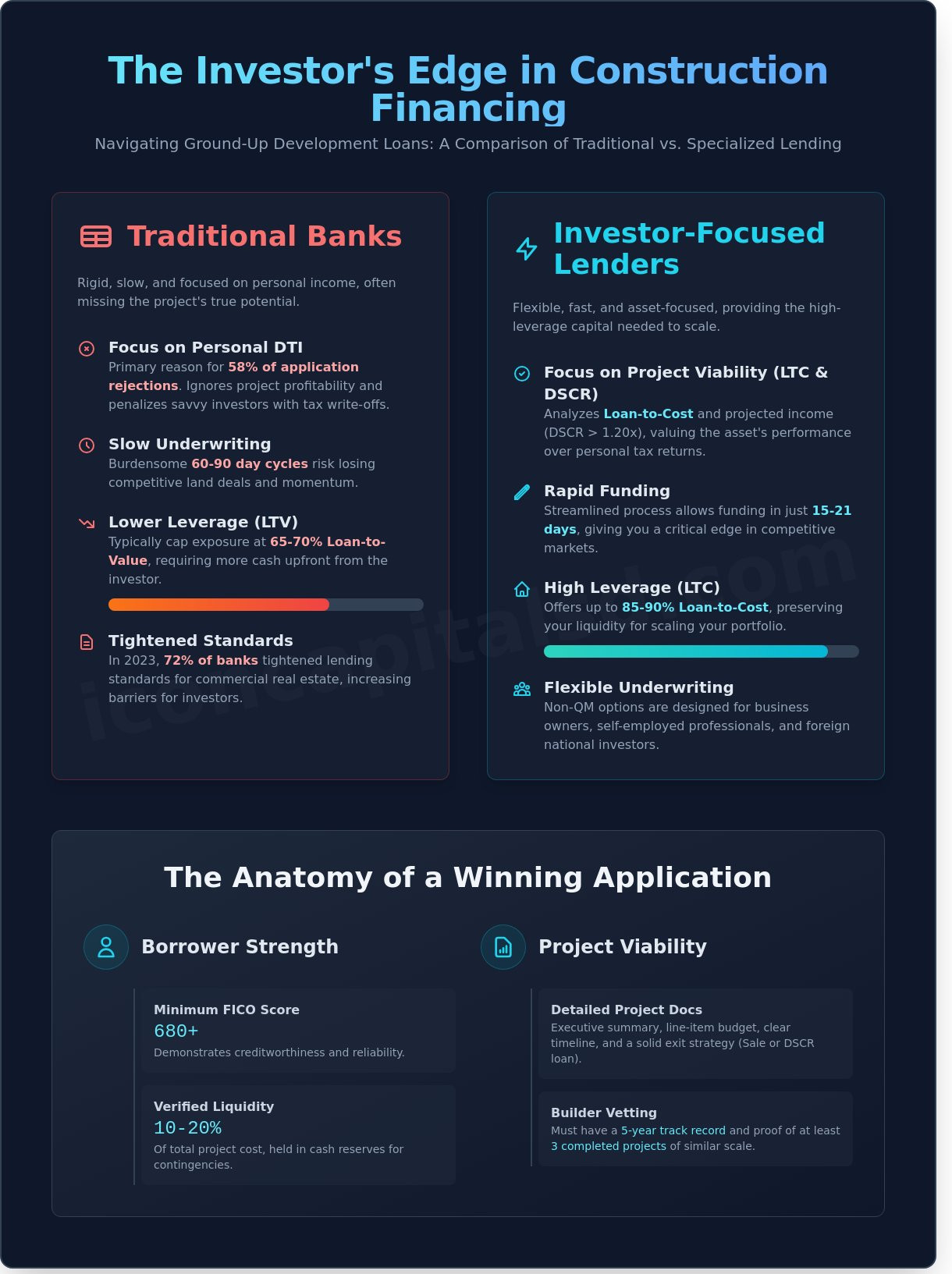
Your personal debt-to-income ratio is the least important metric in a successful ground-up development, yet it’s the primary reason 58% of traditional bank applications are rejected. Most investors realize that standard retail banks aren’t built for the speed of modern construction. They’re often bogged down by 60-day underwriting cycles and rigid income requirements that ignore the project’s profit potential. A professional construction loan application requires a shift in focus from your personal tax returns to the project’s Loan-to-Cost (LTC) and overall viability.
It’s frustrating when a shovel-ready project sits idle because a lender doesn’t understand your draw schedule or non-standard income. You deserve a financing partner that values asset performance over personal paperwork. This guide provides the exact framework needed to master the complexities of ground-up financing and secure high-leverage capital quickly. We’ll examine the specific documentation required for a professional submission, the nuances of 90% LTC financing, and the mechanics of efficient draw management to ensure your project never loses momentum.
Key Takeaways
- Identify the critical differences between consumer-grade products and high-leverage investor financing for ground-up developments and major renovations.
- Master the documentation requirements to ensure your construction loan application highlights project feasibility and borrower liquidity for faster approval.
- Learn how underwriters evaluate build schedules and the necessity of a solid exit strategy, such as a sale or a transition into a DSCR loan.
- Follow a structured, step-by-step guide to organizing entity documents and project specs to maximize leverage and streamline the funding process.
- Discover how to navigate complex lending scenarios with flexible underwriting options designed for business owners and foreign national investors.
Understanding Construction Loans for Real Estate Investors
Investor construction loans differ fundamentally from consumer products. While a consumer construction-to-perm loan focuses on the borrower’s personal residence and long-term ability to pay, investor-focused financing targets the asset’s profitability. Icon Capital LLC provides capital for ground-up developments and major renovations where the primary objective is a profitable exit or long-term rental income. A successful construction loan application in the investor space requires a detailed line-item budget, a clear timeline, and a proven track record of similar projects.
Leverage is the primary driver for professional developers. Traditional lenders typically focus on Loan-to-Value (LTV), often capping their exposure at 65% or 70% of the finished value. Icon Capital LLC prioritizes Loan-to-Cost (LTC). We provide up to 85% or 90% of the total project costs, including land acquisition and hard construction expenses. This approach preserves the investor’s liquidity for other opportunities. High leverage is essential for scaling, especially when the 2023 Federal Reserve Senior Loan Officer Opinion Survey indicated that 72% of banks tightened their lending standards for commercial real estate.
Traditional banks often fail investors because they rely on personal income profiles. They use Debt-to-Income (DTI) ratios that don’t account for the unique financial structures of real estate professionals. Business owners with significant tax write-offs often show lower taxable income, leading to immediate rejection from big banks. Icon Capital LLC looks at the deal’s viability instead. We analyze the project’s projected Net Operating Income (NOI) and the developer’s experience rather than just a W-2 form.
Ground-Up Construction vs. Fix & Flip
Fix and flip loans are short-term bridge products, usually lasting 12 months. They are designed for cosmetic or structural repairs on existing shells. Ground-up construction requires 18 to 24 month interest-only periods to account for site prep, foundation work, and vertical build. When managing draw schedules for multi-family projects, Understanding Floor Loans helps developers manage cash flow during the initial lease-up phase. For 5-8 unit multi-family developments, the construction loan application must demonstrate a clear transition plan from the interest-only construction phase to a permanent DSCR loan once the building reaches 90% occupancy.
The Non-QM Advantage in Construction Financing
Non-QM (Non-Qualified Mortgage) products offer a path forward for investors who don’t fit the standard lending box. These products bypass the 43% DTI cap mandated by many federal guidelines. Instead, we use the Debt Service Coverage Ratio (DSCR). If the projected rental income covers the debt at a 1.20x ratio, the project is viable. The speed advantage is quantifiable. While a traditional bank takes 60 to 90 days to close a construction loan, specialized private lenders like Icon Capital LLC can move from application to funding in 15 to 21 days. This speed allows investors to secure land deals in competitive markets where sellers won’t wait for a bank’s bureaucracy. We focus on the exit strategy, whether it’s a 30-year fixed-rate hold or a quick sale, ensuring the financing structure matches the investor’s goal from day one.
The Critical Components of a Construction Loan Application
Successful financing begins with a precise construction loan application. Lenders prioritize two primary pillars: your financial strength and the project’s feasibility. For borrower credentials, most institutional programs require a minimum 680 FICO score. Liquidity is equally critical. You’ll need to verify cash reserves covering 10% to 20% of the total project cost to handle unexpected overruns. This ensures the project doesn’t stall if material costs fluctuate by 5% or 10% during the build cycle.
Project documentation acts as the development’s resume. This package must include a detailed Executive Summary. It outlines the scope, timeline, and exit strategy. Lenders also scrutinize your builder. They typically require a 5-year track record and proof of at least 3 completed projects of similar scale. This vetting ensures the team can execute the plans within the proposed budget. Understanding How Construction Loans Work helps you prepare for these distinct underwriting requirements, especially the transition from interest-only phases to final payoff.
Income verification differentiates traditional banks from private capital. While banks demand two years of tax returns, Icon Capital offers Non-QM alternatives. These programs allow for qualification based on actual cash flow rather than net taxable income. This is vital for developers who utilize heavy tax deductions to lower their reported earnings.
The “Project Pack”: Pro-Formas and Plans
Your “Project Pack” must distinguish between hard costs and soft costs. Hard costs comprise 70% to 80% of the budget, covering physical labor and materials. Soft costs include architectural fees, permits, and engineering reports. Underwriters review these against your submitted architectural plans to ensure the budget is realistic. A final appraisal determines the After-Repair Value (ARV). This figure is vital because it sets the maximum loan-to-value (LTV) ratio, often capped at 75% for speculative residential builds.
Specialized Borrower Applications: Self-Employed & Foreign Nationals
Self-employed investors often face hurdles with traditional debt-to-income ratios. We solve this by using 12 or 24-month bank statements to verify gross deposits. This reflects your true buying power. For Foreign Nationals, we eliminate the need for US credit history. These applications rely on a 35% to 45% down payment and local asset verification. If you have an existing portfolio, you can use those assets to cross-collateralize and leverage your equity for new construction starts. This asset-based approach streamlines the construction loan application by focusing on collateral strength rather than personal history. It allows for faster closings, often within 21 to 30 days, compared to the 60-day window required by traditional retail lenders.
Navigating the Underwriting Process: Project vs. Borrower
Underwriters scrutinize the project’s viability as much as the borrower’s credit score. They analyze the build schedule to ensure it’s realistic for the local market. If a 10-unit multifamily timeline is set for six months, an underwriter will likely flag it as high risk. Most ground-up projects of this scale require 12 to 14 months for completion. Understanding how construction loans work requires a deep dive into the underwriting phase where project math meets market reality. Your construction loan application must demonstrate that the contractor has the capacity to meet these milestones without delays.
The exit strategy is the most critical component of the approval process. Lenders need to see a clear path to repayment. Investors typically choose between selling the asset upon completion or refinancing into a long-term DSCR loan. For a refinance exit, underwriters require a projected debt service coverage ratio of at least 1.20x. If the numbers don’t support this ratio based on current market rents, the loan amount will be capped to mitigate risk.
Risk mitigation involves two primary financial buffers. First, we require a contingency reserve, usually 10% to 15% of the total hard costs. This covers unexpected price spikes in materials or labor. Second, an interest reserve is established. This is a set-aside fund that covers monthly interest payments during the construction phase, ensuring the loan stays current while the property generates zero income. For developments exceeding a $5 million valuation, a third-party feasibility study is mandatory. These studies provide data-driven insights into absorption rates and local demand to validate the project’s future success.
Managing the Draw Schedule
A draw schedule acts as the financial roadmap for your build. It dictates when funds are released based on specific construction milestones. Icon Capital uses a progress-based system. Before any cash is released, a third-party inspector visits the site to verify that work is complete. For example, if the schedule allocates $50,000 for the foundation, the inspector must confirm the pour is finished before the lender wires funds. 18% of project stalls occur because of poorly managed documentation. To avoid delays, keep all invoices and lien waivers organized. Missing paperwork is the primary reason draws are held up, which can stop a project’s momentum entirely.
Appraisal Challenges in New Construction
Valuing a property that doesn’t exist yet is complex. Appraisers provide an “As-Complete” valuation, which estimates the property’s worth once the certificate of occupancy is issued. This differs from the “As-Is” land value, which only accounts for the raw dirt and any existing infrastructure. Appraisers select comparable sales, or “comps,” from similar properties sold within a 1-mile radius over the last 6 months. If your construction loan application includes high-end finishes that exceed the neighborhood standard, you might face a value gap. Construction costs often rise faster than market values; if your build cost is $900,000 but the appraisal comes in at $850,000, you’ll need to bridge that $50,000 gap with additional equity. We focus on the Loan-to-Cost (LTC) and Loan-to-Value (LTV) metrics to ensure the deal remains profitable for the investor.
Step-by-Step Guide to Submitting Your Application
The construction loan application process at Icon Capital is built for speed and precision. We prioritize the mechanics of the deal to ensure investors can move from land acquisition to vertical construction without unnecessary delays. The process begins with an initial consultation where we structure the deal for maximum leverage. Our goal is to hit 80% to 85% Loan-to-Cost (LTC) ratios, allowing you to preserve liquidity for other projects. During this phase, we analyze your exit strategy, whether it’s a long-term hold with a DSCR refinance or a direct sale upon completion.
Document collection follows a strict checklist to keep the timeline moving. You’ll need to organize your entity documents, including the Operating Agreement and Articles of Organization for your LLC or Corporation. On the project side, we require detailed specifications: a line-item budget, architectural plans, and a construction timeline. Providing a complete package at the start prevents back-and-forth delays during the review period. We expect professional-grade documents that reflect a realistic cost-to-build in the current market.
Once your file moves to underwriting, the timeline typically spans 14 to 21 business days. Our underwriters focus on the feasibility of the project and the experience of the development team. We track the file from “Submitted” to “Clear to Close” with daily updates. Efficiency in this stage is critical because it dictates when you can break ground. If the land is already owned, we coordinate the payoff of any existing liens. If you’re purchasing the land, the initial funding occurs at closing to facilitate the transfer of title.
Pre-Approval and Term Sheets
A term sheet is a non-binding offer that outlines the primary financial parameters of the deal. At Icon Capital, our term sheets specify interest rates, often ranging from 9.5% to 11%, along with origination points and the maximum LTC. A pre-approval letter from us is a powerful tool. You can use it to secure land purchase agreements or finalize builder contracts with the confidence that your construction loan application has been vetted by a professional lender.
Final Submission and Closing Logistics
The final stage involves vetting the builder’s track record and verifying insurance requirements, specifically Builder’s Risk coverage. You should Request a Quote to start your project assessment before finalizing these contracts. We also coordinate with title companies to ensure construction-specific endorsements, like the 100.1 or 100.2, are in place. This protects the priority of the mortgage lien against potential mechanic’s liens during the build process.
Successful developers don’t wait for market shifts; they secure their funding and start building. If you have a project ready for review, our team is prepared to analyze the numbers and provide a clear path to funding. We focus on the data and the deliverables to move your project from a blueprint to a finished asset.
Ready to secure your project funding? Apply with Icon Capital today to get your term sheet started.
Why Icon Capital for Your New Construction Financing
Icon Capital manages a diverse portfolio of high-value investment loans, focusing on deals that range from $1 million to $50 million. Our underwriting team specializes in complex scenarios that traditional banks often decline. This includes self-employed borrowers using 12-month bank statements and foreign nationals with no established US credit history. We don’t rely on the rigid criteria used by depository institutions. Instead, we analyze the project’s viability and the developer’s track record. This ensures your construction loan application receives a fair, asset-based evaluation. We focus on results and closing deals on time.
Our expertise allows us to offer up to 85% Loan-to-Cost (LTC) for experienced builders. We understand the nuances of ground-up development, from site preparation to the final certificate of occupancy. By focusing on the mechanics of the deal, we provide a level of certainty that retail lenders cannot match. Our capital is private and direct. This means we control the funds and the timeline. We prioritize speed and professional execution above all else. Your project needs a partner that understands the financial requirements of 2024 real estate markets.
Creative Financing Solutions for Modern Developers
The 5-8 unit multi-family market is currently underserved. Most lenders view these projects as too small for commercial desks but too large for residential programs. Our specialized programs address this 15% market gap directly. You gain direct access to decision-makers and internal underwriters. This transparency reduces the risk of last-minute surprises. Many of our clients use a 12-month bridge loan for initial site control while finalizing their construction loan application. This two-step approach allows you to scale your portfolio without tying up excessive liquid capital. We provide the leverage needed to move from acquisition to construction without delays.
We also specialize in the seamless transition from construction to long-term stabilization. Once your project is built, we offer DSCR (Debt Service Coverage Ratio) rental financing. We typically look for a 1.20 DSCR to qualify for 30-year fixed rates. This allows you to pay off the construction debt and hold the asset for long-term cash flow. Our process is designed to keep your capital moving. We eliminate the need to search for a new lender once the build is complete. Everything is handled within our ecosystem to maximize your efficiency.
Ready to Build? Get Your Custom Quote
Efficiency is our standard operating procedure. Our four-step process removes the friction common in construction lending. It begins with a 24-hour initial review of your project’s pro forma and budget. We then issue a clear term sheet outlining the LTV, interest rates, and draw schedule. Once you apply for a construction loan quote and submit your plans, our team moves your file into underwriting. We target a 30-day closing window. This speed is critical for securing labor and materials in a competitive environment.
Icon Capital provides the professional assurance you need to break ground. We offer the leverage, speed, and execution required to succeed in today’s high-stakes development environment. Our team is ready to structure a solution that fits your specific project needs. Contact us today to discuss your next build and secure the financing required to scale your investment business. We are the specialist partner for developers who value technical expertise and direct communication.
Secure Your Ground-Up Financing
A successful construction loan application requires more than just a high credit score; it demands a detailed project budget and a clear exit strategy that aligns with current market data. Navigating the underwriting process means balancing your personal financial standing with the projected value of the completed asset. Icon Capital streamlines this transition by offering high-leverage LTC options up to $2M+ for qualified projects. We provide specialized DSCR and Fix & Flip programs that prioritize the deal’s potential over traditional documentation hurdles.
Our team applies no-nonsense underwriting standards for self-employed investors and foreign nationals, ensuring that complex backgrounds don’t stall your progress. Whether you’re scaling a single-family portfolio or managing a multi-unit development, we focus on the technical mechanics of your deal to deliver results quickly. It’s time to move past the limitations of conventional lending and secure the capital your project requires. We’re ready to help you break ground on your next investment.
Explore your creative financing options and request a quote today
Frequently Asked Questions
What is the minimum down payment for a construction loan application?
The minimum down payment for a construction loan application is typically 20% of the total project cost. Icon Capital requires a maximum 80% Loan-to-Cost (LTC) ratio for most residential builds. This means if your land and build costs total $500,000, you need $100,000 in liquid capital. We evaluate your liquidity and assets to ensure you can cover the initial phases before the first draw.
Can I apply for a construction loan if I am self-employed with no tax returns?
You can apply for construction financing using bank statements if you don’t have traditional tax returns. We offer Non-QM programs that analyze 12 or 24 months of business bank statements to verify cash flow. This allows self-employed investors with at least a 680 credit score to qualify based on actual revenue rather than taxable income. It’s a pragmatic solution for business owners who utilize high tax deductions.
How long does the construction loan application and approval process take?
The timeline from the initial construction loan application to closing typically ranges from 30 to 45 days. This period includes the 10 days required for a specialized construction appraisal and the 5 days needed for a detailed budget review. Delays often stem from incomplete builder packets or missing permits. We streamline this by assigning a dedicated underwriter to your file as soon as the loan structure is finalized.
What is a draw schedule and how does it work during the build?
A draw schedule is a structured disbursement plan that releases funds in 5 to 7 stages as specific build milestones are met. After a third-party inspector confirms the completion of a phase, such as the foundation or framing, we release the corresponding funds within 48 hours. Most schedules include a 10% retainage fee. This amount is held until the final certificate of occupancy is issued to ensure total project completion.
Can foreign nationals apply for construction financing in the US?
Foreign nationals can secure construction financing with a minimum 35% down payment. Icon Capital provides loans to non-resident investors using DSCR or asset-based qualification methods. You’ll need to maintain 12 months of interest reserves in a US-based bank account. This program enables international clients to leverage US real estate markets without a domestic credit history or Social Security number. We focus on the asset’s value and the project’s viability.
What is the difference between a construction-to-permanent loan and a standalone construction loan?
A construction-to-permanent loan closes once and converts to a 30-year mortgage, while a standalone loan only covers the 12-month build period. Standalone loans require a second closing and additional sets of fees once the home is finished. Most of our clients prefer the single-close option to lock in a 6.5% or 7% interest rate early. It eliminates the risk of rising interest rates during the construction phase.
What happens if construction costs exceed my original loan amount?
If costs exceed the original loan amount, the borrower is responsible for covering 100% of the overage out of pocket. We require a 10% contingency fund built into every budget to account for price fluctuations in materials like lumber or steel. If a major change order occurs, you must provide proof of funds for the difference before work continues. This ensures the project reaches completion without funding gaps or mechanics liens.
Do I need to own the land before applying for a construction loan?
You don’t need to own the land before applying because we can combine the lot purchase and construction costs into one loan. If you already own the parcel, we can credit up to 100% of its appraised value toward your down payment requirement. For land owned less than 12 months, we use the lower of the purchase price or appraised value. This flexibility allows you to secure the site and the build capital simultaneously.