

For successful entrepreneurs, traditional mortgage qualification is a paradox. You’ve built a profitable business, yet strategic tax write-offs that maximize your company’s efficiency can disqualify you from securing the home loan you deserve. The standard W-2 and tax return documentation simply fails to capture the true financial strength of your enterprise. This is where Business Bank Statement Home Loans provide a critical advantage, offering a direct path to financing based on your actual cash flow, not your adjusted gross income.
This definitive 2026 guide is engineered for business owners who demand a financing solution that aligns with their financial reality. We will detail the mechanics of qualifying for a high-value mortgage using your business bank statements, allowing you to leverage your revenue while maintaining your tax strategy. Prepare to navigate the process with clarity, bypass common underwriting hurdles, and move toward a fast, predictable closing. It’s time to secure the property you’ve earned, using the real strength of your business.
Key Takeaways
- Understand how Non-QM financing bypasses the “tax return trap” that disqualifies many successful business owners from traditional mortgages.
- Discover the lender’s formula for calculating qualifying income from deposits, including the standard “expense factor” and how to potentially lower it.
- Identify the specific credit score and Loan-to-Value (LTV) requirements needed to qualify for Business Bank Statement Home Loans in 2026.
- Determine whether a 12-month or 24-month lookback period is the optimal strategy for documenting your business’s cash flow, especially with seasonal income.
Why Traditional Mortgages Fail Business Owners (and the Non-QM Solution)
For successful entrepreneurs, the conventional mortgage process presents a significant paradox. You run a profitable business, yet when it comes to securing a home loan, you are often disqualified. This is the “Tax Return Trap”: the same legal deductions and write-offs used to minimize your tax liability-a standard and prudent business practice-also reduce the net income shown on your tax returns. Traditional lenders base their “Ability to Pay” calculations almost exclusively on this net income figure, effectively penalizing you for sound financial management.
The market is shifting. Lenders increasingly recognize that for business owners, liquidity and consistent cash flow are truer indicators of financial health than a tax-filed AGI. This has driven the growth of alternative documentation loans, with business bank statement home loans emerging as the primary solution for self-employed borrowers.
The Problem with W-2 Bias in 2026
Conventional mortgage underwriting is built for W-2 wage earners, applying a rigid debt-to-income (DTI) formula that fails to capture the reality of business finance. Big banks and traditional lenders struggle to analyze the complex income streams of LLCs and S-Corps, often misinterpreting legitimate business expenses. The opportunity cost is immense; entrepreneurs are forced to either overpay on taxes for two years to create “clean” returns or delay their homeownership goals entirely.
The Non-QM Advantage for Entrepreneurs
Non-Qualified Mortgage (Non-QM) loans operate outside the restrictive framework of conventional lending. A Non-QM loan is a flexible alternative to government-backed mortgages, designed for borrowers with unique financial profiles. Instead of focusing solely on tax returns, the underwriting for Business Bank Statement Home Loans analyzes the bigger picture. Lenders evaluate 12 to 24 months of statements to verify consistent revenue and determine a qualifying income based on actual cash flow. This approach is a type of Non-conforming mortgage, structured to bridge the gap for high-net-worth individuals whose assets and liquidity are not accurately reflected by traditional documentation.
Mechanics of Business Bank Statement Loans: 12 vs. 24 Months
The mechanics of Business Bank Statement Home Loans operate on a fundamentally different principle than conventional financing. Instead of relying on tax returns, which are often structured to minimize tax liability, lenders analyze the actual cash flow demonstrated by your business deposits. Unlike conventional mortgages that must adhere to the strict Ability-to-Repay rule using tax returns, this Non-QM solution focuses on proven revenue streams over a set period-typically 12 or 24 months.
The 24-month option is the industry standard, providing underwriters a comprehensive view of your business’s financial health and long-term stability. This longer lookback period is ideal for businesses with seasonal or “lumpy” income, as it averages out high-revenue months with slower periods, presenting a more consistent qualifying income.
The 12-month option offers greater flexibility, particularly for businesses with strong, recent growth. If your last year’s revenue significantly outpaced the prior year’s, a 12-month lookback can result in a higher qualifying income. However, this shorter period may be subject to closer scrutiny to ensure the income trend is stable and sustainable.
A critical component in this process is the CPA letter. This document, prepared by a licensed Certified Public Accountant, verifies your ownership percentage (typically 25% or more), confirms the business has been operating for at least two years, and establishes a standard expense factor for your industry. Lenders apply this expense factor to your gross deposits to calculate the net income used for qualification.
Business vs. Personal Bank Statements: Which Should You Use?
Using dedicated business bank statements is the cleanest approach, as it clearly separates business revenue from personal finances. While personal statements can be used for sole proprietorships, commingled funds create complexity. Underwriters will disregard large, inconsistent transfers between accounts that are not identifiable as payroll or standard owner’s draws, potentially reducing your qualifying income.
Ownership and Seasoning Requirements
Lenders require verification that your business has been established for a minimum of two years to demonstrate a track record of stability. For businesses with multiple owners, all partners with a significant stake (usually 25% or more) must be documented. Key documents include:
- Business formation documents (e.g., Articles of Incorporation)
- Operating or partnership agreements
- Business licenses
Recent changes to your business structure may be acceptable, provided the core business and ownership remain fundamentally unchanged.
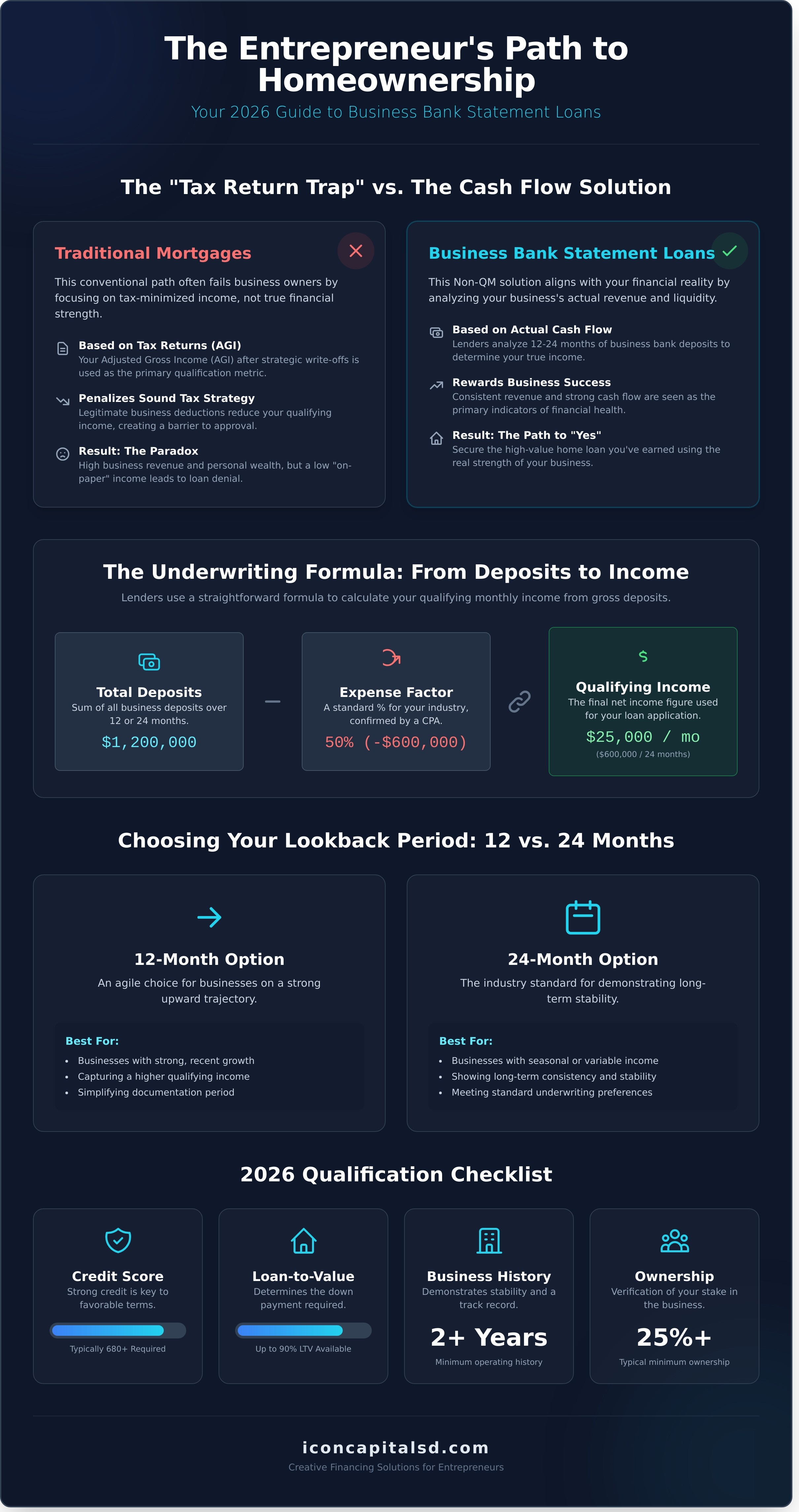
The Underwriting Secret: How Lenders Calculate Business Income
Underwriters for Business Bank Statement Home Loans analyze your deposits to construct a verifiable monthly income, but they do not simply use your total deposit amount. The process involves a critical calculation to estimate your business’s net profit by applying an “expense factor.” This is because every business has operating costs, and lenders must account for them to determine the actual income available to you for a mortgage payment.
The standard expense factor applied is often 50%, meaning the lender assumes half of your deposits are used for business expenses. However, this default ratio can be adjusted. Service-based businesses with low overhead, such as consulting or freelance work, often have a significant advantage over product-based businesses that manage inventory and higher costs. Underwriters also scrutinize statements for non-revenue deposits, which are excluded from income calculations. These include:
- Transfers from other personal or business accounts
- Loan proceeds or cash advances
- Tax refunds or other one-time credits
An underwriter also assesses the stability of your cash flow. A pattern of declining deposits over the 12 or 24-month review period is a significant red flag, potentially indicating business instability and leading to a loan denial.
Calculating Your Qualifying Monthly Income
The formula for determining your qualifying income is direct and methodical. Lenders use a variation of this calculation: (Total Deposits – Exclusions) * (1 – Expense Factor) / Number of Months Reviewed. For service-based businesses with lower overhead, this formula often results in a higher qualifying income. A formal letter from your CPA verifying your actual business expense ratio can significantly impact your qualification. For example, a CPA letter can reduce your default expense factor from 50% to as low as 20%, drastically increasing your approvable loan amount.
Handling Business Debt and DTI
Business debt does not automatically count against your personal debt-to-income (DTI) ratio. If a business debt payment is documented as being paid from your business account for the previous 12 consecutive months, it can typically be excluded from your personal DTI calculation. This is why a clean financial history is paramount. Underwriters require a 12-month history with zero Non-Sufficient Funds (NSF) fees, as this demonstrates consistent financial management. To optimize your profile, strategically prepare your statements 3-6 months before applying by maintaining consistent deposit levels and avoiding unusual transactions.
Qualifying for a Business Bank Statement Loan: 2026 Requirements
While you get to bypass tax returns, lenders offering Business Bank Statement Home Loans conduct a thorough analysis of your financial profile. Underwriting focuses on key pillars that demonstrate your ability to repay: credit history, equity position, post-closing liquidity, and property type. These standards provide the structure and security necessary for this powerful Non-QM financing solution.
In 2026, the primary qualification benchmarks are expected to remain focused on these core areas:
- FICO Score Thresholds: The typical entry point is a FICO score between 640 and 660. This provides the lender with a baseline of confidence in your creditworthiness, which is critical when not evaluating traditional income documentation.
- Loan-to-Value (LTV) Limits: Borrowers should anticipate a down payment of at least 10% to 20%. This means you can generally secure financing up to 90% LTV, though a larger down payment strengthens your application and can improve your terms.
- Reserve Requirements: Lenders require you to have “skin in the game” after closing. You must demonstrate sufficient liquid assets to cover a set number of monthly mortgage payments (PITI), typically between 6 and 12 months, depending on the loan amount and your credit profile.
- Eligible Property Types: These loans are versatile and can be used to purchase or refinance a primary residence, second home, or an investment property with 1-4 units.
Credit and Asset Documentation
Non-QM guidelines are significantly more flexible with past credit events than conventional loans. A bankruptcy or foreclosure may be acceptable after a “seasoning” period of just one to two years. Your down payment can be sourced from either business or personal accounts, as long as the funds are properly documented. Strong liquid assets beyond the minimum reserve requirement can serve as a powerful compensating factor for a borderline application.
Loan Limits and Terms
Business bank statement programs are designed to accommodate high-net-worth borrowers, with jumbo loan capabilities often reaching $3 million or more. Depending on the 2026 interest rate environment, you may choose between a stable 30-year fixed-rate mortgage or an Adjustable-Rate Mortgage (ARM) for a lower initial payment. Before applying, request a personalized quote to see current market rates and available terms for your scenario.
The Icon Capital Process: Simplifying Creative Financing
Traditional lenders often fail to understand the complex financial profile of a successful business owner. At Icon Capital LLC, our entire process is engineered to bypass these conventional roadblocks. We provide direct, efficient financing solutions built on the real cash flow of your enterprise, not just your tax returns.
Our streamlined, four-step approach is designed to deliver clarity and speed, ensuring you can secure capital and move on your next opportunity without delay. We specialize in structuring Business Bank Statement Home Loans that align directly with your financial reality.
- Step 1: The Initial Consultation and Cash Flow Analysis. We begin by conducting a detailed analysis of your business bank statements from the last 12-24 months. This allows us to calculate a qualifying income based on your actual revenue deposits, providing a clear and accurate assessment of your borrowing capacity.
- Step 2: Structuring the Loan. Every entrepreneur and investor has unique objectives. We structure the loan terms, LTV, and documentation requirements to meet your specific needs, whether you are purchasing a primary residence, a second home, or a multi-unit investment property.
- Step 3: Direct Underwriting and Speed-to-Close. Our in-house underwriting team manages the entire approval process. This direct line of communication eliminates delays and ensures decisions are made quickly by experts who understand complex business financials. The result is a significant speed-to-close advantage.
- Step 4: Funding and Scaling. Once approved, we move directly to funding. Our efficient process not only secures your immediate real estate acquisition but also establishes a foundation for you to leverage and scale your portfolio with a reliable financing partner.
Why Icon Capital LLC Specializes in Business Owners
Our expertise is in the “Creative Financing” that traditional banks lack. We routinely handle high-value, complex transactions for multi-unit and investment properties that fall outside standard lending guidelines. The entire Icon Capital LLC process is built for the speed and efficiency required by busy entrepreneurs, providing decisive action where others see only complications with Business Bank Statement Home Loans.
Next Steps to Your New Home
Preparing for approval is straightforward. Begin by gathering your last 12 to 24 months of business bank statements and contact your CPA to prepare any required verification letters. When you are ready to move forward, submit your scenario for a free quote. Our team will review your information and provide a direct response within 24 hours.
Your Path to Homeownership: Leverage Your Business Income
For entrepreneurs, traditional mortgage qualification is an outdated barrier. As this guide has detailed, the modern solution lies in using your actual business revenue-typically from 12 or 24 months of statements-to verify income and secure financing. This pragmatic approach recognizes your true financial strength, bypassing the tax-return hurdles that so often sideline successful business owners from prime real estate opportunities.
Navigating this process requires a specialist. At Icon Capital, we provide creative financing solutions built for entrepreneurs. Our direct underwriting ensures faster approvals for Business Bank Statement Home Loans with loan amounts up to $4M+. Stop letting paperwork dictate your potential and partner with a lender that understands the mechanics of your success. Get a Custom Business Bank Statement Loan Quote to see what you qualify for today.
The right financing solution is within reach. Let’s build your real estate portfolio.
Frequently Asked Questions About Business Bank Statement Home Loans
Do I need tax returns for a business bank statement loan?
No. The primary advantage of a bank statement loan is that it allows self-employed borrowers to qualify using business revenue instead of tax returns. This program is specifically designed for individuals whose tax documents may not accurately reflect their cash flow due to business deductions. Lenders analyze 12 to 24 months of business bank statements to determine and verify your qualifying income, bypassing the need for traditional tax documentation like W-2s or Form 1040s.
What is the minimum credit score for a bank statement mortgage?
The minimum credit score for a bank statement mortgage typically starts around 600. However, specific requirements vary between lenders and loan programs. A higher credit score, often 680 or above, will grant you access to more favorable terms, including lower interest rates and a higher loan-to-value (LTV) ratio. Strong credit demonstrates financial stability and reduces the lender’s perceived risk, which is critical for non-QM financing solutions like these.
Can I use business bank statements for an investment property?
Yes, business bank statement loans are an effective financing tool for purchasing investment properties. These non-QM products are well-suited for real estate investors who need to qualify based on cash flow rather than tax returns. The loan can be used for various property types, including single-family homes, multi-unit properties, and second homes. Be aware that down payment and reserve requirements may be higher for investment properties compared to a primary residence.
How much down payment is required for a bank statement loan in 2026?
While specific guidelines for 2026 are subject to future market conditions, current requirements provide a strong indicator. As of today, down payments for bank statement loans typically range from 10% to 25%. The exact amount depends on factors like your credit score, loan amount, and property type. It is reasonable to expect that similar parameters will apply in 2026, with the most qualified borrowers securing financing with as little as 10% down.
What happens if my business has a lot of internal transfers?
Underwriters will carefully analyze your bank statements to identify and subtract any non-income deposits, including internal transfers between accounts. This is done to prevent the double-counting of revenue and establish an accurate picture of your business’s true cash flow. To streamline the process, it is beneficial to provide clean, well-organized statements. A letter from your CPA can also help clarify complex transactions and validate the final income calculation.
Are interest rates higher for bank statement loans than traditional loans?
Yes, interest rates for bank statement loans are generally higher than those for conventional or government-backed mortgages. As a non-QM (Non-Qualified Mortgage) product, this type of financing carries a higher perceived risk for lenders due to the use of alternative income documentation. The higher interest rate compensates the lender for that additional risk. The specific rate depends on your credit profile, LTV, and the overall strength of your loan application.
Can I get a bank statement loan if I have been self-employed for only one year?
Securing a bank statement loan with only one year of self-employment history is challenging but possible. Most lenders require a minimum of two years in business to demonstrate stability. However, some specialized programs may consider applicants with 12-24 months of history. These scenarios typically require strong compensating factors, such as a high credit score, a significant down payment, substantial cash reserves, or experience in a similar industry prior to self-employment.
What is a CPA letter and why do I need one for this loan?
A CPA letter is a document prepared by a Certified Public Accountant that validates key details about your business. For business bank statement home loans, it typically confirms your self-employment status, the business’s duration, and that the expense ratio used by the underwriter is reasonable for your industry. This letter provides a third-party verification of your financial standing, adding crucial credibility to your application and helping underwriters approve your loan with confidence.