

Accessing the U.S. real estate market doesn’t require a Social Security Number; it requires the right capital structure. While traditional banks often issue automatic rejections for non-SSN applicants, specialized itin mortgage loan lenders are filling the gap as the Non-QM market expands to 15% of total volume in May 2026. You’ve likely faced the frustration of documentation hurdles or the anxiety of seeing interest rates for these products range from 6.87% to 8.50%. It’s a common barrier for investors who have the assets but don’t fit into a standard lending box.
This guide identifies the top providers and shows you how to secure high-leverage financing for your next investment. You’ll learn how to navigate the 10% to 25% down payment requirements and leverage alternative credit history to bypass traditional FICO constraints. We’ll analyze the current trade-offs between LTV ratios and documentation types so you can secure a competitive rate and scale your portfolio with confidence.
Key Takeaways
- Identify the LTV thresholds and interest rate structures that distinguish the top itin mortgage loan lenders from traditional banking institutions.
- Learn to navigate advanced income verification methods using P&L statements and bank statements to qualify without standard W-2 documentation.
- Discover how to leverage specialized financing for diverse investment strategies, including short-term bridge loans for fix and flip projects and long-term rental portfolio scaling.
- Understand the critical requirements for sourcing and seasoning funds to ensure your down payment meets strict Non-QM underwriting standards.
- Streamline the closing process by mastering a two-step approach focused on upfront deal structuring and proactive document collection.
Understanding ITIN Mortgage Loans and the 2026 Non-QM Market
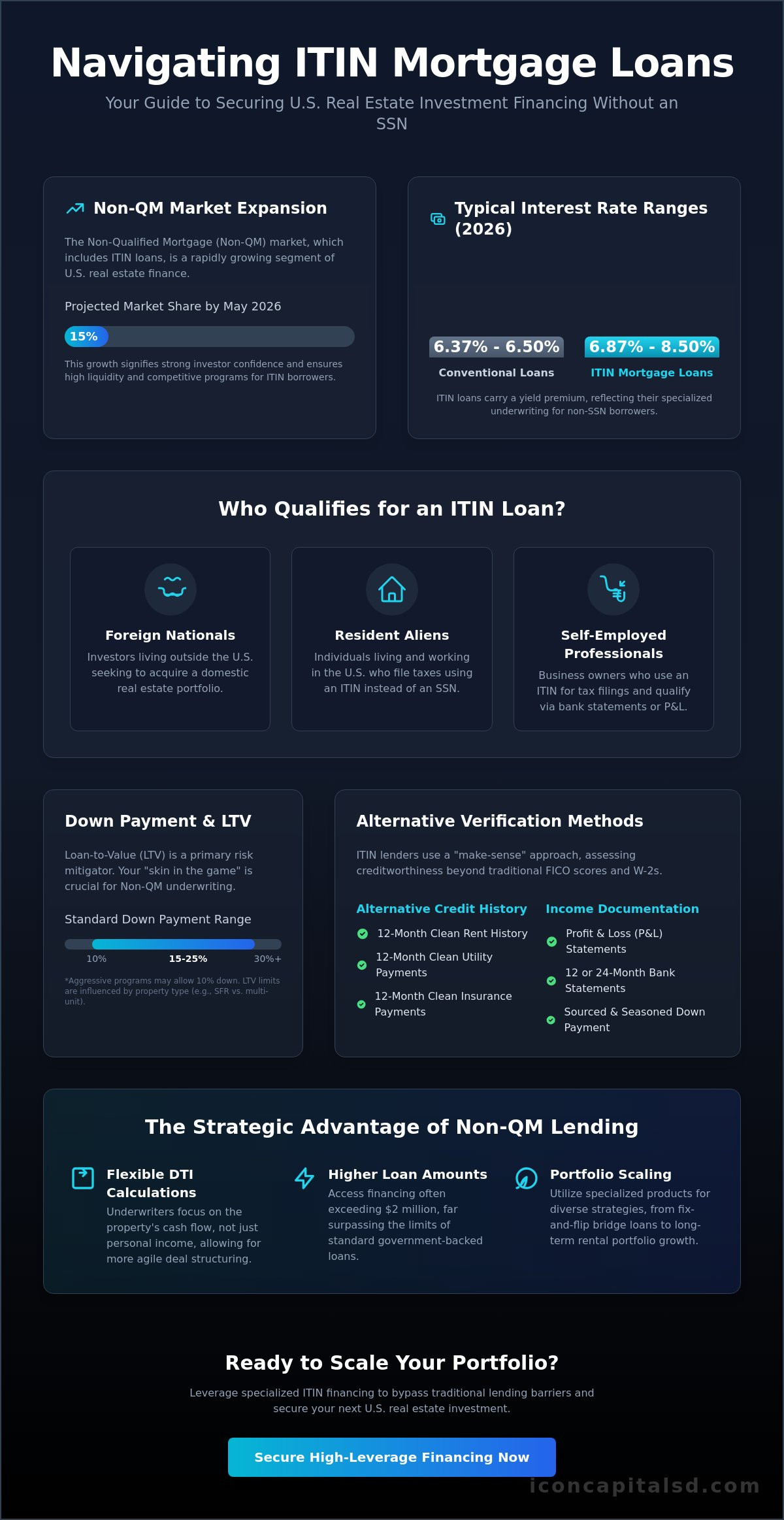
An ITIN mortgage is a specialized Non-QM (Non-Qualified Mortgage) product designed for borrowers who use an Individual Taxpayer Identification Number to fulfill their U.S. tax obligations. These loans don’t follow the rigid guidelines set by Fannie Mae or Freddie Mac. Instead, they operate within a private capital ecosystem where creditworthiness is assessed through alternative data. In May 2026, the Non-QM market has reached a 15% share of total mortgage volume. This growth is driven by a maturing secondary market that values the high credit quality of ITIN borrowers despite their lack of a Social Security Number.
ITIN loans have become a staple for U.S. real estate investment because they bypass the “automatic rejection” phase typical of big-box retail banks. While conventional 30-year fixed rates currently hover between 6.37% and 6.50%, ITIN products carry a yield premium. Expect rates to range from 6.87% to 8.50% depending on your leverage and documentation type. The distinction is clear; traditional FHA or Conventional routes require an SSN and strict W-2 reporting. Specialized itin mortgage loan lenders focus on the asset’s performance and the borrower’s global financial footprint. Current 2026 liquidity remains high. Institutional investors are actively purchasing these loan pools, which ensures that competitive programs remain available for well-qualified applicants.
Who Qualifies for an ITIN Loan?
Qualification isn’t limited to a single demographic. It’s about how you document your economic activity in the U.S. and abroad. The primary groups served by itin mortgage loan lenders include:
- Foreign Nationals: Investors living outside the U.S. who want to build a domestic real estate portfolio.
- Resident Aliens: Individuals living and working in the U.S. who pay taxes via an ITIN rather than an SSN.
- Self-Employed Professionals: Business owners who utilize an ITIN for tax filings and require bank statement or P&L based qualification.
The Strategic Advantage of Non-QM Lending
Non-QM lending provides a level of agility that traditional banking cannot match. One major benefit is the flexibility in debt-to-income (DTI) calculations. Underwriters in the Non-QM space often look at the cash flow of the property itself rather than just personal income. This allows for higher loan amounts, often exceeding $2 million, which far outpaces standard agency limits. You can also utilize specific products like Foreign National Loans to scale portfolios across international borders. It’s about using the right tool for the deal structure. This approach prioritizes the math of the investment over the rigid boxes of government-backed financing.
Key Criteria for Evaluating ITIN Mortgage Loan Lenders
Selecting a financial partner requires a focus on technical qualifications rather than marketing fluff. In 2026, itin mortgage loan lenders are evaluated primarily on their ability to manage Non-QM risk while providing competitive leverage. Most institutional lenders in this space offer a mix of 30-year fixed-rate terms and 5/1 or 7/1 Adjustable-Rate Mortgages (ARMs). While fixed rates provide long-term stability, ARMs often offer a lower initial entry rate for investors planning to refinance or exit the asset within five years. You need a lender that understands the mechanics of the deal, not just the borrower’s residency status.
Down Payment and LTV Requirements
In the current 2026 market, the standard down payment for an ITIN loan ranges from 15% to 25%. While some aggressive programs might allow for 10% down, these typically require higher credit scores or significant cash reserves. Property type heavily influences your Loan-to-Value (LTV) limits. A Single-Family Residence (SFR) usually qualifies for the highest leverage, whereas multi-unit properties or condos might see a 5% to 10% reduction in the allowable LTV. Lenders view this “skin in the game” as a primary risk mitigator for non-SSN borrowers who don’t fit the traditional agency box.
Alternative Credit Evaluation Methods
Traditional FICO scores aren’t the only way to prove creditworthiness. Many specialized lenders now utilize a “make-sense” underwriting approach that accounts for the lack of a U.S. credit file. An Urban Institute ITIN mortgage study highlights that ITIN borrowers often demonstrate strong repayment patterns through non-traditional channels. Lenders will look for a clean 12-month history of rent, utility, and insurance payments to establish a credit profile. It’s important to distinguish between “no credit” and “bad credit.” A lack of history is a solvable documentation issue; a history of recent defaults is a disqualifier.
Execution speed is another critical metric. You don’t want a lender that gets stuck in an endless loop of documentation requests. Specialized Non-QM underwriters have the authority to approve loans based on the totality of the file, including foreign assets and bank statement income. This efficiency allows for closing timelines that rival conventional loans, which is vital in a competitive bidding environment. If you’re ready to see how your specific assets translate into borrowing power, you can request a personalized scenario analysis to get started.
ITIN Mortgage Requirements: Documentation and Asset Verification
Documentation is the engine of a successful Non-QM close. While traditional banks demand a standard W-2, itin mortgage loan lenders utilize a more expansive set of data points to verify repayment ability. The process begins with a valid Individual Taxpayer Identification Number letter from the IRS and an unexpired government-issued photo ID, such as a passport or matricula consular. According to the CFPB on ITIN Mortgage Eligibility, lenders have the legal authority to accept these documents in place of a Social Security Number, provided they maintain rigorous anti-money laundering (AML) and “know your customer” (KYC) standards.
Asset verification requires a clear audit trail. Most programs require 60 days of bank statements to verify the “seasoning” of funds. If you’re transferring capital from a foreign account, the funds must be moved to a U.S. financial institution prior to closing. Underwriters look for large, unexplained deposits that could indicate undisclosed debt. A concise “Letter of Explanation” is often the most effective tool for addressing these anomalies. It provides the context needed for a “make-sense” underwriting decision, explaining everything from gift funds to variations in monthly income.
Self-Employed ITIN Borrowers
Business owners often face challenges with traditional tax returns that show high deductions. To solve this, specialized itin mortgage loan lenders offer P&L Home Loans. These programs allow you to qualify based on a profit and loss statement prepared by a qualified accountant. You can also opt for 12-month or 24-month bank statement programs that calculate income based on average monthly deposits rather than net taxable income. If your revenue is foreign-sourced, lenders will require a certified translation and currency conversion to U.S. dollars at the current market rate.
Property and Appraisal Standards
The collateral must meet specific quality benchmarks to support the loan amount. Eligible properties include single-family homes, warrantable condos, and 2-4 unit residential buildings. For investors, the most efficient path is often a program that prioritizes the property’s income. You should review the mechanics of What Is a DSCR Loan? to understand how the Debt Service Coverage Ratio applies to ITIN files. If the projected rent covers the monthly debt obligation, the lender may waive personal income verification entirely, focusing instead on the asset’s cash flow and your available liquidity.
Leveraging ITIN Loans for Real Estate Investment Portfolios
ITIN holders are increasingly moving beyond primary homeownership to build professional real estate portfolios. In May 2026, the fastest growing segments of the Non-QM market are self-employed and DSCR borrowers. This shift reflects a maturing landscape where itin mortgage loan lenders provide the capital necessary for high-leverage investment strategies. Whether you’re focused on short-term gains through renovation or long-term wealth through rentals, the ability to access institutional-grade financing is a critical competitive advantage. You don’t need a Social Security Number to scale; you need a lender that understands the mechanics of asset-based lending.
Scaling a portfolio often requires advanced structures like cross-collateralization. This allows you to leverage the equity in multiple properties to secure a single, larger loan or better interest rates. While refinance application volume dipped between 1.7% and 4% in late April 2026, savvy investors continue to use bridge strategies to acquire new assets. Utilizing Flipping Houses with Hard Money is a standard practice for investors who need to move quickly on distressed properties before transitioning into permanent ITIN-based financing.
ITIN Fix and Flip Strategies
Short-term bridge loans are essential for “Fix and Flip” projects where speed is the primary driver. These products often cover both the purchase price and a portion of the renovation costs, providing the liquidity needed to execute a value-add strategy. Most Fix and Flip Loans require a clear exit strategy, which usually involves selling the property or refinancing into a long-term ITIN loan once the rehab is complete. This allows you to recycle your capital and move on to the next deal without being tied to a high-interest bridge product for longer than necessary.
The DSCR Advantage for ITIN Investors
The Debt Service Coverage Ratio (DSCR) is the ultimate tool for ITIN holders with complex international tax returns. Instead of analyzing your personal income, lenders look at the property’s ability to pay for itself. You should review What Is a DSCR Loan? to see how this ratio is calculated. Most specialized itin mortgage loan lenders require a minimum DSCR of 1.0 to 1.25. If the projected rental income exceeds the monthly debt obligation, your personal DTI becomes irrelevant. This allows for rapid scaling because your borrowing power is limited only by the quality of the assets you acquire rather than your personal tax filings.
If you’re ready to expand your holdings, the first step is a technical review of your current assets. You can get a custom loan scenario to see how much leverage your portfolio can support in the current market.
Structuring Your ITIN Loan: The Icon Capital Process
Closing a complex loan requires a methodical framework that prioritizes technical precision over generic checklists. Leading itin mortgage loan lenders prioritize technical deal structure over rigid agency checklists. Our process is designed to move your application from initial inquiry to funded status with maximum efficiency, accounting for the specific nuances of Non-QM underwriting in the May 2026 market. By following a structured four-step path, we eliminate the guesswork that often leads to delays in traditional banking environments.
The process begins with Step 1: Initial deal structure and scenario analysis. We review your asset’s performance, your available liquidity, and your long-term investment goals. This stage determines whether a DSCR approach or a P&L-based home loan provides the best leverage for your specific profile. Once the structure is set, we move to Step 2: Document collection. This is the most critical phase for avoiding underwriting delays. We gather your ITIN letter, unexpired passport, and seasoned bank statements upfront to ensure a “clean file” submission.
After the file is complete, it enters Step 3: Submission and the Non-QM underwriting review. Unlike traditional banks that use automated “yes/no” algorithms, our underwriters perform a “make-sense” review of the entire file, focusing on your global financial strength and the property’s value. Finally, Step 4: Funding and closing occurs once all conditions are cleared. In a market where refinance volumes have fluctuated by 4% in late April 2026, having a certain path to closing provides the stability needed to scale your portfolio.
Why Specialist Lenders Beat Big Banks
Traditional financial institutions aren’t built for the complexities of ITIN lending. They lack the infrastructure to verify foreign-sourced income or alternative credit histories. Specialist itin mortgage loan lenders provide direct access to underwriters who understand the specific regulatory and documentation requirements of non-SSN borrowers. This expertise results in transactional efficiency, often allowing you to close in three to four weeks. We offer creative solutions for “out of the box” profiles that big banks simply cannot accommodate, ensuring your capital isn’t sidelined by rigid corporate policy.
Get Started with Icon Capital
Success in the 2026 real estate market depends on your ability to secure reliable financing quickly. We provide professional guidance for brokers, realtors, and individual investors who need high-leverage solutions without the friction of traditional lending. Whether you’re looking for a bridge loan for a quick acquisition or a long-term DSCR product for a rental portfolio, we can help you structure the deal correctly from day one. You can access our Request a Quote portal now to receive a custom scenario analysis tailored to your specific investment goals.
Scale Your Portfolio with Strategic ITIN Financing
Navigating the 2026 mortgage market requires more than just high-quality assets; it requires a partnership with specialized itin mortgage loan lenders who understand the mechanics of Non-QM underwriting. You’ve seen how leveraging alternative documentation like profit and loss statements can bypass the automatic rejections of traditional banks. By focusing on property cash flow through DSCR products or utilizing bridge loans for quick acquisitions, you can maintain a competitive edge even when refinance volumes fluctuate. Successfully scaling a portfolio depends on matching your deal structure with the right capital source.
Icon Capital operates as a specialist in creative financing, offering dedicated programs for foreign nationals and ITIN holders. Our expertise in high-value investment property loans ensures that your application is handled with transactional efficiency and technical precision. We focus on the performance of your assets and the strength of your liquidity. Don’t let the lack of a Social Security Number stall your investment momentum in this maturing market. Request a custom ITIN loan quote from Icon Capital today and secure the leverage needed to expand your holdings with confidence.
Frequently Asked Questions
Can I get a mortgage with only an ITIN and no Social Security Number?
Yes, you can secure a mortgage without a Social Security Number by utilizing specialized Non-QM programs. These itin mortgage loan lenders qualify borrowers using an IRS-issued tax ID instead of an SSN. This path is standard for foreign nationals and resident aliens who meet tax obligations but don’t fit into traditional agency guidelines.
What is the minimum down payment for an ITIN mortgage loan in 2026?
The minimum down payment for an ITIN mortgage in May 2026 typically ranges from 10% to 25%. While 20% is the industry standard for most Non-QM products, some aggressive programs accept 15% with strong alternative credit. Property type and loan-to-value (LTV) ratios will ultimately dictate your specific cash-to-close requirement.
Do ITIN lenders require a US credit score?
No, a traditional U.S. credit score isn’t always mandatory for approval. Lenders often build an alternative credit profile using 12 months of on-time payments for rent, utilities, and insurance. If you do have a FICO score, most programs require a minimum between 620 and 660 to qualify for the most competitive pricing tiers.
Are interest rates higher for ITIN loans compared to conventional mortgages?
Yes, ITIN loans carry a yield premium of 0.5% to 2% over conventional 30-year fixed rates. In the current market as of May 1, 2026, expect rates to fall between 6.87% and 8.50%. This premium reflects the increased risk and manual underwriting required for Non-QM files that don’t meet government-backed standards.
Can I use an ITIN loan to buy an investment property or a fix-and-flip?
Yes, you can utilize ITIN financing for both long-term rental investments and short-term fix-and-flip projects. Investors often use DSCR loans to qualify based on the property’s income rather than personal tax returns. For renovations, bridge loans provide the necessary liquidity to acquire and rehab distressed assets quickly before refinancing into permanent debt.
How long does the ITIN mortgage application process take?
The ITIN mortgage process generally takes between 21 and 30 days from submission to funding. Efficiency depends on the speed of document collection, particularly for foreign-sourced assets. Specialized itin mortgage loan lenders use streamlined underwriting to match the closing speeds of conventional residential transactions, provided all P&L or bank statements are ready for review.
Can I use gift funds for the down payment on an ITIN loan?
Gift funds are typically permitted for down payments on primary residences, provided you have a certified gift letter and a clear paper trail. For investment properties, lenders usually require the borrower to contribute at least 10% of their own capital. This ensures “skin in the game” and mitigates risk for the institutional underwriter.
What documents do I need to provide for an ITIN bank statement loan?
You must provide your official ITIN letter, an unexpired government ID like a passport, and 12 to 24 months of consecutive bank statements. These statements are used to calculate an average monthly income based on deposits rather than net tax figures. This method is the primary alternative for self-employed borrowers who don’t utilize traditional W-2 reporting.