

A real estate investment lives or dies by its liquidity, not just its blueprints. You already understand that even a 14 day delay in fund releases can stall a job site, disrupt contractor schedules, and erode your ROI through mounting carrying costs. Managing these transitions requires a precise construction loan draw schedule template to bridge the gap between completed work and capital reimbursement. Poorly documented draw requests are the primary cause of funding bottlenecks, often leading to 20% longer project durations when contractors stop work due to payment delays.
This guide details the mechanics of the draw process to ensure seamless funding from the first footer to the final inspection. It provides the tools to eliminate cash flow gaps, satisfy lender inspection requirements, and utilize a standardized template that meets institutional underwriter standards. This technical breakdown ensures your project maintains the momentum needed to reach the finish line without unnecessary financial friction. We’ll examine the specific milestones lenders look for and how to align your project budget with their disbursement phases to ensure you’re never left waiting for capital.
Key Takeaways
- Define clear, milestone-based payment plans to maintain project momentum and ensure consistent contractor performance throughout the build.
- Identify standard construction phases, from foundation to exterior “dry-in” status, to align project progress with capital disbursement.
- Learn to structure a professional construction loan draw schedule template by grouping detailed line-item costs into logical funding milestones.
- Eliminate funding bottlenecks by coordinating third-party inspections and securing the precise documentation required for rapid draw approval.
- Leverage specialized construction and bridge loan products to optimize project liquidity and scale your real estate investment portfolio.
What Is a Construction Loan Draw Schedule?
A construction loan draw schedule is a pre-negotiated payment plan that releases loan proceeds in stages as specific project milestones are met. It functions as a financial roadmap for the Real estate development process, ensuring capital is available exactly when needed. By utilizing a construction loan draw schedule template, investors and lenders establish a transparent framework for fund disbursement before the project begins.
The “draw” is the lifeblood of a job site. It maintains project momentum by ensuring contractors receive timely payments for completed labor and delivered materials. Without a structured schedule, cash flow bottlenecks can lead to work stoppages or strained professional relationships. For Icon Capital, this schedule acts as a primary risk management tool. It ensures the loan remains collateralized by the actual value added to the property. It protects the borrower by preventing overpayment to contractors before they finish specific tasks.
Individual draw amounts are tied directly to the total construction budget. Each payment represents a slice of the total loan commitment, released only after an inspection verifies that the work matches the requested amount. This alignment keeps the project on budget and prevents the misallocation of funds.
The Mechanics of the Draw Process
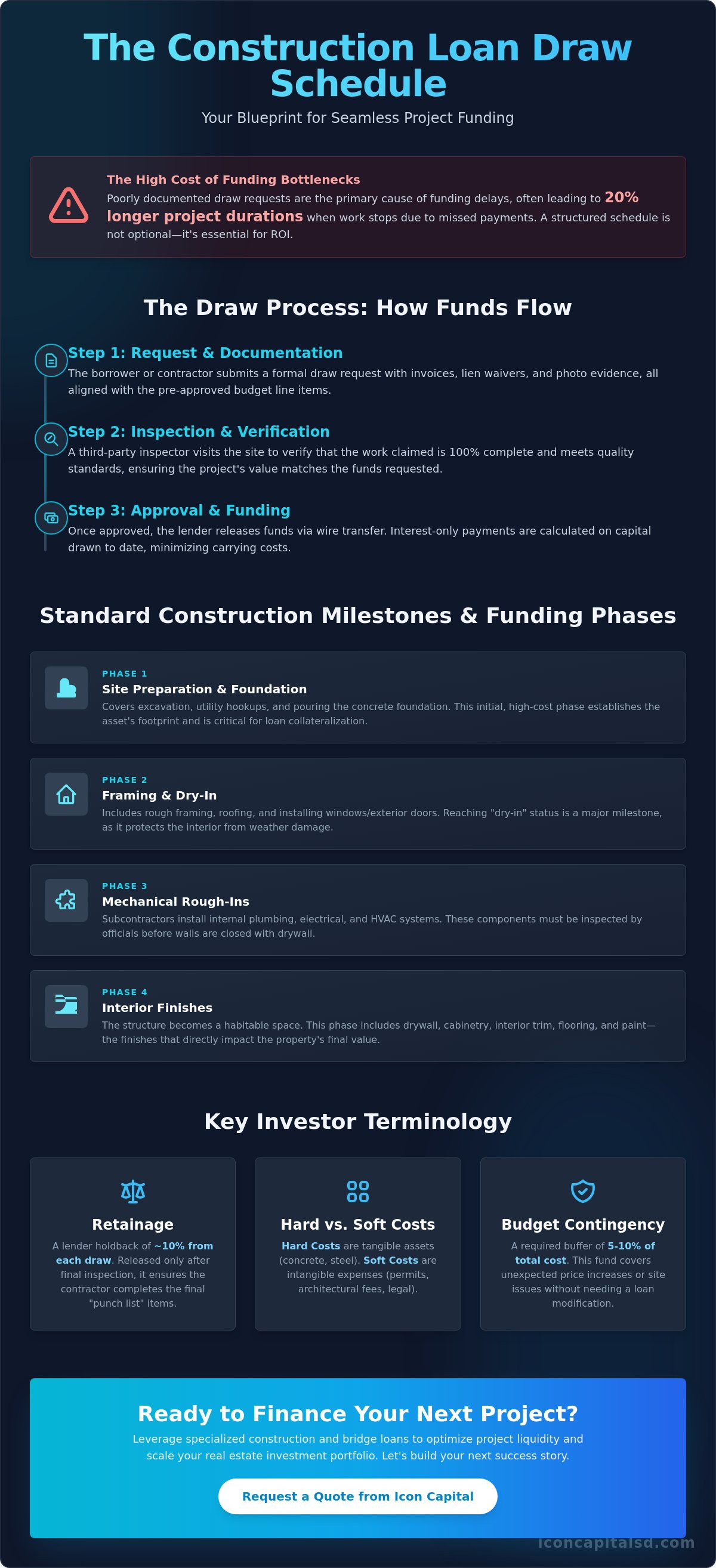
Funds move from the lender to the borrower or directly to the general contractor via wire transfer or check after a draw request is approved. Lenders typically use one of two methods for valuation: percentage-completion or milestone-based draws. In a milestone-based system, money is released after specific stages, such as the foundation or framing, are 100% complete.
During the construction phase, borrowers typically make interest-only payments. These payments are calculated only on the amount of capital already drawn, not the total loan amount. This structure reduces the borrower’s monthly carrying costs while the property is not yet generating income.
Key Terminology for Investors
- Retainage: Lenders often hold back 10% of each draw request. This “retainage” is released only after the final inspection and the filing of a notice of completion. It ensures the contractor finishes the final punch list items.
- Hard Costs vs. Soft Costs: Hard costs refer to tangible assets like concrete, steel, and roofing. Soft costs include intangible expenses such as architectural fees, permits, and legal costs. A professional construction loan draw schedule template clearly separates these categories.
- Budget Contingency: Most lenders require a contingency buffer of 5% to 10% of the total construction cost. This fund covers unexpected price increases or hidden site conditions without requiring a loan modification.
Investors looking to scale their portfolios through renovation or ground-up builds can request a quote to see how these financing structures fit their next project. Structuring the draw schedule correctly is the first step toward a successful exit strategy.
Standard Milestones in a Construction Draw Template
A construction loan draw schedule template relies on logical progress markers to release funds at specific intervals. Lenders use these milestones to verify that the project’s physical value matches the capital disbursed. Before finalizing a schedule, investors should understand What is a construction loan? and how its structure differs from traditional mortgage products. Standard schedules typically follow five distinct phases of development.
- Phase 1: Site preparation and foundation. This initial stage covers excavation, utility hookups, and the completion of the foundation. It’s a high-cost phase that establishes the footprint of the asset.
- Phase 2: Framing and dry-in. This includes the rough framing, roofing, and installation of windows and exterior doors. Achieving “dry-in” status is a major milestone because it protects the interior from weather damage.
- Phase 3: Mechanical rough-ins. During this phase, subcontractors install the internal components of the plumbing, electrical, and HVAC systems. These must be inspected before the walls are closed.
- Phase 4: Interior finishes. This phase transforms the structure into a living space. It includes drywall, cabinetry, interior trim, and flooring. These elements represent a significant portion of the project’s aesthetic value.
- Phase 5: Final completion. The final draw occurs after landscaping is finished and the local municipality issues a Certificate of Occupancy. This confirms the building is safe and ready for its intended use.
Customizing the Schedule for Fix & Flip Projects
Renovation draws differ significantly from ground-up construction because the core structure is already in place. Investors should tailor their construction loan draw schedule template to prioritize high-value milestones like kitchen and bath completion. These specific areas drive the highest ROI and often require heavy upfront material costs. Since there’s no foundation or framing phase in a standard remodel, the draw schedule focuses more on the sequence of interior trades. You can find more detail on managing these timelines in our Fix and Flip Loans guide.
Allocating Percentages to Each Milestone
Precision in percentage weighting prevents cash flow bottlenecks during the build. Typical weights assign 15-20% of the total budget to framing and 20-30% to interior finishes. It’s vital to ensure front-loaded costs, such as the foundation, are covered without over-extending the lender’s risk. If an investor allocates too much capital to the early stages, they may lack the leverage needed to finish the project if costs rise. Aligning draw amounts with actual contractor payment schedules keeps the builder capitalized while protecting the investor’s equity. For those ready to move forward with a project, you can request a quote to see how we structure these draws for maximum efficiency.
How to Build an Effective Draw Schedule for Your Project
Creating a functional construction loan draw schedule template requires a methodical approach to project cash flow. It isn’t just a list of costs; it’s a strategic document that matches capital disbursement to specific construction phases. Follow these four steps to build a schedule that keeps your project moving.
Step 1: Obtain a detailed line-item cost breakdown. Your general contractor must provide a comprehensive budget. This list should include every expense from site clearing to final landscaping. A standard 2,500-square-foot residential build often involves 35 to 50 distinct cost codes. Precision here prevents budget shortfalls later.
Step 2: Group line items into 5 to 7 logical funding milestones. Don’t request funds for every small task. Group related items into major phases like foundation, framing, dried-in, and interior finishes. This structure simplifies administration and keeps the project organized.
Step 3: Factor in time for inspections and processing. Lenders don’t release funds the moment you ask. Most institutions require 48 hours to schedule a third-party inspector and another 3 to 5 business days for wire processing. Understanding How Construction Loans Work is vital because funds are typically paid in arrears for completed work. You need enough working capital to cover these gaps.
Step 4: Review the schedule with your lender before closing. Your lender’s underwriter will verify that the draw amounts align with the total loan commitment. If you’re looking for a specific structure, you can request a quote to see how your budget fits our leverage models.
Essential Elements of the Template
A professional construction loan draw schedule template must include these three core components to remain valid for bank audits:
- Itemized Work Descriptions: Specific details of what constitutes “completion” for each draw phase.
- Financial Tracking: Clear dollar amounts for each draw, including cumulative totals and the remaining balance.
- Verification Signatures: Dedicated lines for the borrower, general contractor, and the bank-appointed inspector to sign off on every disbursement.
Aligning the Schedule with Your Loan Type
The structure of your draws changes based on the asset class and loan product. For example, Hard Money Fix and Flip projects usually operate on shorter timelines, often requiring only 3 to 4 draws to cover a 6-month renovation. In contrast, 5-8 unit multi-family construction requires a more granular schedule to manage higher LTC (Loan-to-Cost) requirements.
Your schedule must also reflect your specific LTV (Loan-to-Value) constraints. If your loan covers 80% of costs, the draw schedule should clearly show where your 20% equity is being deployed. Most lenders require the investor’s capital to be “first in” before they begin funding draws.
Managing the Draw Process: Documentation and Inspections
Efficiency in the draw process determines the velocity of your project. Incomplete or missing documentation causes 85% of draw delays in the private lending sector. Lenders require total precision to mitigate risk; any deviation from the established construction loan draw schedule template can stall your capital flow for several weeks. Managing this phase requires a methodical approach to paperwork and site access.
Lien waivers serve as your primary defense against title encumbrances. You must collect these from every subcontractor and material supplier before releasing funds. A conditional waiver clears the path for payment, while an unconditional waiver confirms the debt is fully satisfied. Failure to secure these documents leaves the property vulnerable to mechanic’s liens, which can trigger a technical default on your loan and halt the project entirely.
Required Documentation Checklist
Lenders won’t process a request without a complete package. Your administrative team should maintain a digital folder for each draw containing the following items:
- Draw Request Form: This must be signed by the borrower and the general contractor to acknowledge the work performed.
- Lien Waivers: Both conditional and unconditional forms for the current billing cycle to protect the property title.
- Soft Cost Invoices: Receipts for permits, architectural fees, or engineering reports that fall outside of physical labor.
- Visual Verification: High-resolution photos documenting progress for each specific line item requested in the draw.
The Inspection Walkthrough
Lenders dispatch third-party inspectors to verify that the work claimed matches the physical reality on-site. During a framing inspection, the inspector confirms that all studs, plates, and headers are in place according to the approved plans. To ensure a fast turnaround, the site must be accessible and organized. Inspectors don’t have the time to search for keys or move debris to view the foundation.
Partial completions often complicate the funding process. If a line item in your construction loan draw schedule template is only 60% finished, the inspector will pro-rate the draw accordingly. Don’t expect a full payout for incomplete milestones. This transparency keeps the loan-to-value (LTV) ratio in balance and protects the lender’s collateral position.
Change orders represent the most common disruption to a fixed schedule. When site conditions require a pivot, you must document the budget shift immediately. Unapproved changes often lead to “out-of-balance” loans where the remaining funds aren’t sufficient to finish the project. Clear communication with your underwriter regarding these budget adjustments prevents unexpected funding freezes.
Financing Your Next Project with Icon Capital
Success in real estate development depends on the reliable flow of capital. A construction loan draw schedule template is a vital tool for planning, but it requires a sophisticated lending partner to execute. Icon Capital provides the professional structure necessary for complex construction and bridge loans. We focus on the mechanics of your deal, ensuring that your project maintains liquidity from the first foundation pour to the final inspection.
We understand that experienced investors require efficiency over narrative. Our process removes the friction typically found in traditional banking environments. By prioritizing clear communication and technical accuracy, we help you scale your portfolio without the delays of bureaucratic oversight. Our team evaluates your project’s specific needs, whether you’re managing a single-family build or a multi-unit development.
Our Construction and Fix & Flip Programs
Icon Capital specializes in providing creative financing solutions that traditional banks often overlook. We leverage our deep expertise in Types of Loans for Flipping Houses to offer programs tailored for modern investors. This includes specialized products for self-employed individuals and foreign national investors who possess the experience but don’t fit into standard lending boxes.
- Direct access to underwriters for faster draw approvals and reduced wait times.
- Loan amounts up to $2 million to support high-end residential and commercial projects.
- Flexible qualification criteria focusing on asset value and project viability.
- Pragmatic LTV structures designed to maximize your leverage and cash on hand.
Our approach is built on speed and certainty. By working directly with underwriters, we bypass the layers of middle management that slow down most funding cycles. This allows you to maintain your construction timeline and keep your contractors on schedule without worrying about funding gaps.
Get Started with a Custom Quote
Moving from a construction loan draw schedule template to a fully funded project requires a partner that understands the technical aspects of your budget. We invite you to request a quote from Icon Capital today. Our team will perform a professional review of your project details and draw requirements to ensure your loan is structured for maximum efficiency.
Submit your project details for a comprehensive evaluation. We don’t just provide capital; we provide a structured financial foundation. Let us help you manage your next project with the precision and speed your investment strategy demands. Contact us to explore how our non-QM and hard money products can accelerate your growth.
Execute Your Build with Precision
Managing a construction project requires a rigorous approach to cash flow. A well-structured construction loan draw schedule template serves as the financial backbone for your build, aligning specific milestones with funding disbursements. This level of organization ensures that contractors remain paid on time and the project stays on its projected 12 or 24-month timeline. Accurate documentation and timely inspections are the only ways to avoid delays that impact your LTV ratios. It’s a system that turns complex site work into a predictable financial sequence.
Icon Capital provides the specialized financing real estate investors need to scale their portfolios. We specialize in DSCR and Fix & Flip products, offering creative non-QM structures that traditional lenders often ignore. Our team understands that speed is critical in this industry. We’ve built a streamlined draw process designed specifically for high-volume investors and developers who value efficiency over narrative. You’ll get the capital you need without the typical bureaucratic friction.
Secure your next project with a professional construction loan from Icon Capital
Your next successful close is just a structured deal away.
Frequently Asked Questions
How many draws are typically allowed in a construction loan?
Most construction loans allow between 5 and 10 draws over the project’s duration. The specific number depends on the lender’s policy and the complexity of the build. For instance, a 12 month ground-up project often requires more frequent disbursements than a 4 month renovation. Your construction loan draw schedule template should outline these milestones clearly before the first shovel hits the ground.
What is retainage and why do lenders use it in draw schedules?
Retainage is a portion of the loan proceeds, typically 10% of each draw, held back by the lender until the project reaches 100% completion. Lenders use this mechanism to ensure the contractor finishes the final punch list items and all subcontractors receive payment. This practice protects the lender’s collateral by preventing mechanics’ liens from being filed against the property by unpaid vendors.
Can I change my draw schedule after the loan has closed?
You can modify a draw schedule after closing, but it requires a formal change order approved by the underwriter. Investors must submit a written request detailing why the budget or timeline shifted. Lenders often charge a fee for these modifications, which can range from $250 to $500 per change. It’s better to finalize your construction loan draw schedule template accurately during underwriting to avoid these administrative delays.
How long does it take to receive funds after a draw request is submitted?
Funding typically occurs within 3 to 5 business days after the lender receives the inspection report. The process starts when the investor submits a draw request, followed by a site visit from a third party inspector. Once the inspector verifies the work’s completion percentage, the lender approves the release of funds via wire transfer. Delays often happen if the inspector can’t access the property immediately.
Do I need to provide receipts for all materials to get a draw approved?
Lenders primarily fund based on work in place verified by an inspector rather than just material receipts. While you don’t always need to show a receipt for every small item, you must provide invoices for major line items like HVAC units or custom cabinetry. Most institutional lenders require a signed lien waiver from subcontractors for any draw exceeding $5,000 to ensure funds are distributed correctly.
What happens if my project goes over budget during the draw process?
If a project exceeds the initial budget, the borrower is responsible for covering the shortfall before the lender releases further draws. This is known as the equity in rule. Lenders maintain a balanced loan, meaning they won’t fund a draw if the remaining loan balance is less than the cost to complete the project. You’ll need to prove you have the liquidity to bridge the gap.
Who pays for the construction inspections required for each draw?
The borrower pays for all construction inspections, with costs typically ranging from $150 to $300 per visit. These fees are often deducted directly from the draw proceeds or paid upfront at closing as part of the administrative costs. The lender hires an independent third party to conduct these site visits to ensure the work matches the progress reported in the draw request before releasing capital.
Is a draw schedule different for a fix and flip loan versus ground-up construction?
Fix and flip draw schedules are generally simpler and focus on 3 to 5 major renovation phases. Ground-up construction schedules are far more granular, often featuring 10 or more draws tied to specific milestones like foundation, framing, and dried-in status. Ground-up projects also require more detailed municipal inspections and permits before the lender releases funds for subsequent stages of the build.