

On October 15, a developer in Austin realized their project was 80% complete, but their 12-month construction term was ending in exactly 10 business days. It’s a reality many investors face because supply chain issues and permit delays have pushed standard build cycles into 18-month timelines. You’ve likely felt the pressure of a looming maturity date while waiting on final inspections or contractor availability. Knowing exactly what happens if construction loan expires is the only way to prevent a manageable delay from becoming a financial disaster.
This guide details the immediate consequences of a matured loan, from default interest rates that often spike to 18% or higher to the legal steps lenders take toward foreclosure. You’ll learn how to navigate unresponsive brokers and identify the specific documentation needed to secure a formal extension. We’ll also examine how to structure a bridge loan to provide the liquidity required to finish the build and protect your equity before the lender initiates a workout or legal action.
Key Takeaways
- Understand the immediate financial implications of the maturity date, including the point when the full principal and remaining interest become due.
- Identify the common regulatory and supply chain bottlenecks that dictate what happens if construction loan expires before your project is complete.
- Learn the specific documentation required for an extension request and how to negotiate fees ranging from 0.25% to 1.00% of the loan amount.
- Discover strategic exit paths, including utilizing bridge loans for final-stage completion or transitioning to long-term DSCR financing once a CO is secured.
- Leverage Icon Capital’s creative financing structures and direct communication to maintain project momentum when traditional banks refuse to extend terms.
The Immediate Impact of a Construction Loan Maturity Date
A construction loan expiration marks the definitive end of your financing agreement. This is the maturity date. At this point, the entire principal balance and any accrued interest become due in full. Most construction contracts define a specific window for the construction phase, often 12 to 18 months, which is separate from the final maturity date. Investors must realize what happens if construction loan expires before the project reaches completion. The lender no longer has a legal obligation to provide capital, and the borrower loses the ability to request further funding.
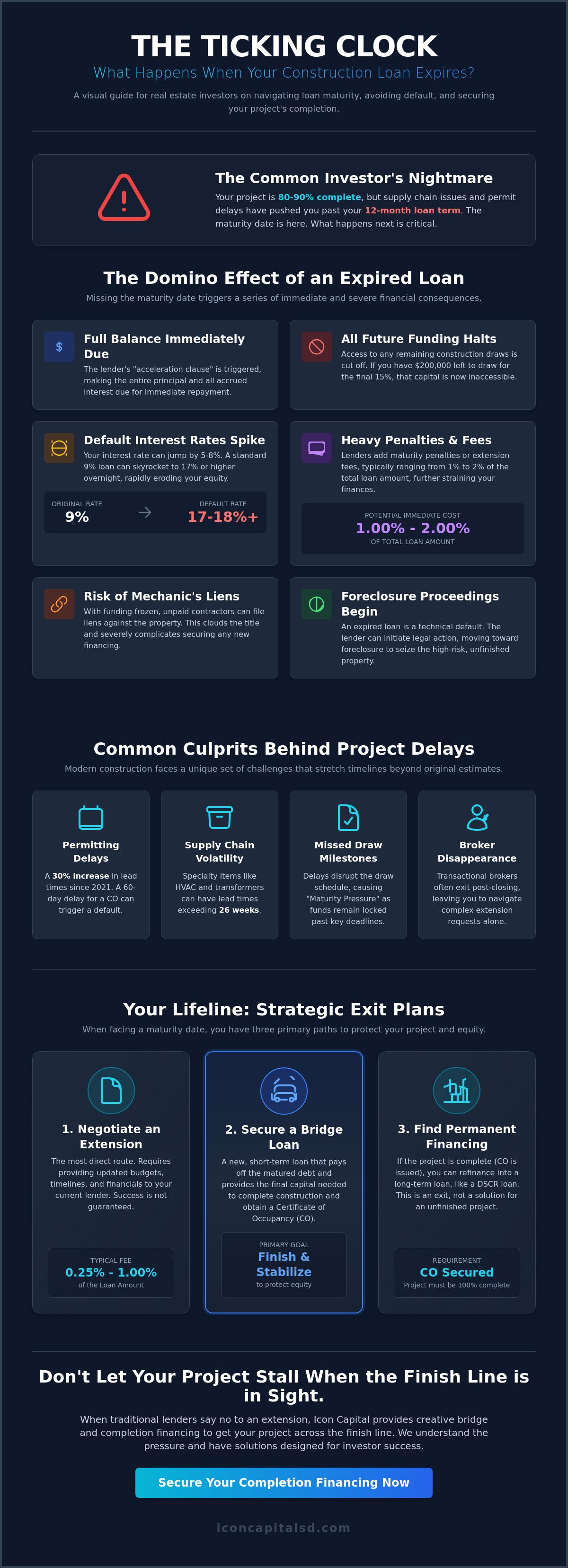
The financial shift is abrupt. During the project, you likely paid interest only on the funds you actually drew down. Once the loan expires, the lender triggers the acceleration clause. This provision allows the institution to demand immediate repayment of the total debt. It also terminates your access to remaining draws. If your project is 85% complete, you’re suddenly responsible for the full balance while lacking the funds to finish the final 15% of the build. Understanding what happens if construction loan expires is the first step in avoiding a total project stall.
The Legal Status of an Unfinished Project
An expired loan creates a technical default. This status applies even if your monthly interest payments were always on time. Lenders view properties without a Certificate of Occupancy (CO) as high-risk collateral. Without a CO, the property cannot be sold to a retail buyer or occupied by tenants, which limits the lender’s exit options. This period also increases the risk of mechanic’s liens. If subcontractors aren’t paid because draws are frozen, they can file a lien against the title within 90 days in most jurisdictions. This complicates your ability to secure a bridge loan to finish the work and clear the debt.
Default Interest Rates and Penalties
The financial cost of missing a maturity date is high. Most notes include a default spread, which is a pre-set interest rate hike. It’s common for rates to jump by 5% to 8% above your original note. A loan at 9% can quickly spike to 17%. Lenders also apply maturity penalties or extension fees, often ranging from 1% to 2% of the total loan commitment. Default interest is a tool lenders use to force borrower action. If you’re approaching your deadline, you should request a quote for a refinance or a bridge solution to protect your equity before these penalties compound.
Why Construction Loans Expire: Common Culprits and Contractual Realities
Construction loans are short-term instruments, typically carrying terms of 12 to 24 months. These timelines are rigid. In the 2026 regulatory environment, investors face a 30% increase in permitting lead times in major metropolitan areas compared to 2021. When local municipalities delay a final certificate of occupancy by 60 days, the entire financial structure risks collapse. Understanding what happens if construction loan expires begins with identifying these external pressures before they manifest as a default notice.
Supply chain volatility remains a primary driver of expiration. While lumber prices stabilized in 2024, specialized components like electrical transformers and HVAC units still carry lead times exceeding 26 weeks. These delays disrupt the “Draw Schedule,” which is the pre-negotiated timetable for fund release. If a milestone is missed, the capital remains locked.
The “Interest Reserve” is another critical failure point. Most lenders capitalize interest for the expected duration of the build. If a project slated for 12 months enters month 13, the reserve is exhausted. The borrower must then service the debt out-of-pocket while simultaneously funding construction overruns. Furthermore, many investors fall victim to the “Broker Disappearance” phenomenon. Transactional brokers often exit the relationship after the loan closes, leaving the borrower to navigate complex extension requests with a rigid servicing department that lacks context on the project. To avoid these pitfalls, investors should study How Construction Loans Work to understand the transition from interest-only phases to maturity.
The Relationship Between Draw Schedules and Expiration
A draw schedule isn’t just a budget; it’s a ticking clock. When milestones like “dried-in” or “rough-in” are missed, the project experiences “Maturity Pressure.” Lenders generally do not allow draws after the maturity date. If your loan expires with $200,000 in “Unused Funds,” you cannot access that capital to finish the building. The funds are effectively frozen until a formal extension is signed or the loan is refinanced.
The “Technical Default” vs. “Payment Default”
It’s vital to distinguish between running out of time and running out of money. A “Technical Default” occurs when the maturity date passes, even if you’ve made every interest payment. A “Payment Default” occurs when you miss the monthly obligation. Lenders are significantly more cooperative if a project is 90% complete. At that stage, their collateral is nearly marketable. If the project is only 50% complete at expiration, the lender-borrower relationship shifts from partnership to asset recovery. If you’re approaching a deadline, you may need to request a quote
Extension vs. Refinance: Navigating Your Lender’s Response
When you evaluate what happens if construction loan expires, the outcome depends on your project’s current status and your transparency with the lender. Lenders generally prefer to avoid the foreclosure process, but they won’t maintain a matured loan indefinitely. You’ll likely face a choice between a formal extension or a complete refinance into a new debt structure. Most institutional lenders offer 3 to 6 month extensions for a fee, typically ranging from 0.25% to 1.00% of the total loan commitment. If your loan is $2,000,000, expect to pay $5,000 to $20,000 to keep the current terms in place.
Lenders prioritize “Equity Protection” during this review. They examine the loan-to-value ratio to ensure the asset’s current worth still provides a sufficient buffer against the outstanding balance. If the project is underwater or stalled, the lender may issue an “Exit Demand.” This is a formal notice that they won’t extend the term and require immediate payoff. Understanding what happens if construction loan expires is critical because an Exit Demand is often the final step before the lender initiates legal action to recover their capital.
How to Strengthen Your Extension Request
Lenders approve extensions when they see a clear path to repayment. To secure an approval, you must provide a verified “Remaining Cost to Complete” report signed by your general contractor. This document proves you have enough remaining budget to finish the build. You should also present a commitment letter for a permanent take-out loan or a DSCR loan to prove your exit strategy is viable. Finally, provide updated financial statements showing you have the liquidity to cover interest carry and potential cost overruns during the extension period.
Refinancing an Unfinished Build
Traditional banks rarely refinance a project that’s mid-construction because of the high risk associated with mechanics’ liens and structural liabilities. If your current lender refuses to extend, you’ll need specialized bridge financing. Specialized Fix and Flip loans often serve as an effective bridge to completion when the original construction loan expires. During these negotiations, lenders shift focus from Loan-to-Cost (LTC) to Loan-to-Value (LTV). They’ll base their funding on the “as-is” value of the property rather than the total project cost. This shift often requires investors to bring more cash to the table to close the gap between the existing debt and the new loan’s maximum LTV. If you’re facing a maturing loan and need to explore your funding options quickly, you should request a quote to see what bridge products are available for your specific scenario.
Strategic Exit Plans: Scrambling for Bridge or Permanent Solutions
When a project stalls, understanding what happens if construction loan expires becomes a matter of asset preservation. You need a pivot strategy immediately. Traditional banks rarely extend terms beyond the initial 12 or 18-month window without imposing heavy extension fees or requiring a full re-underwrite. Investors often find themselves with a 90% completed shell and no remaining draws. At this stage, the goal shifts from construction management to capital restructuring.
You have four primary tools to salvage the deal:
- The Bridge Loan: This short-term solution covers the gap between 80% completion and the final Certificate of Occupancy. It provides the final 10% to 20% of funding needed to cross the finish line.
- Hard Money Rescue Capital: If the project is only 50% finished and the primary lender halts funding, hard money lenders step in as a secondary source. While rates are higher, this capital prevents a total loss of equity.
- Transition to Permanent Debt: Once the CO is in hand, you move the debt into a long-term instrument to pay off the construction lender.
- The Cash-In Refinance: If the property value has dipped or interest rates have risen, the lender may require you to bring 15% to 25% more capital to the table. This lowers the lender’s risk and facilitates a loan extension.
The DSCR Exit Strategy for Rental Investors
Investors targeting the rental market use a DSCR Loan as the primary exit. These products are ideal for multi-unit or single-family rentals because they bypass personal income verification. Qualifying depends on property income rather than your personal DTI. In 2024, most lenders require a Debt Service Coverage Ratio of 1.20 or higher to approve the transition. This strategy links the construction completion directly to the rental income potential, allowing you to lock in 30-year financing as soon as the building is habitable.
Using Bridge Loans as a Safety Net
If you’re flipping houses with hard money, you already understand how a secondary timeline protects your investment. A bridge loan serves as a safety net when your initial construction term expires before the sale is finalized. Bridge loans prioritize speed over low interest. The cost of bridge capital is often 2% to 4% higher than traditional construction debt, but it’s far cheaper than a default. It buys you the 6 to 9 months needed to find a buyer or complete the final aesthetic touches that drive market value.
How Icon Capital Structures Construction Loans for Investor Success
Icon Capital operates with a focus on technical expertise and direct communication. We understand that real estate investment requires speed and precision, qualities often missing from traditional banking institutions. Our Creative Financing & Non-QM loan products offer the flexibility required for complex projects that don’t fit into standard lending boxes. We’ve simplified the loan process into a transparent workflow that moves from the “Structure Loan” phase to “Close Loan” without unnecessary delays.
Working with a specialized lender means you’re partnering with an entity that understands investor-specific challenges. When you’re managing a major build, you need to know exactly what happens if construction loan expires before you reach the finish line. We proactively address these risks by structuring loans with realistic exit strategies from day one. Our team prioritizes the mechanics of the deal, focusing on LTV, credit scores, and asset value to ensure your capital is secured and your project remains viable.
Proactive Management of Loan Timelines
We help investors calculate realistic construction phases during the initial structuring phase. It’s not just about getting the funds; it’s about ensuring the timeline matches the project’s physical reality. Our portfolio includes integrated DSCR and Fix & Flip options, allowing you to pivot your strategy if market conditions or project goals change. If project timelines shift due to external factors, you have direct access to decision-makers. You won’t wait weeks for a committee to review a simple extension request or a modification to your draw schedule. This direct access is a critical safeguard for when you’re navigating what happens if construction loan expires unexpectedly.
Getting Started with a Quote
Financially literate investors choose specialized partners who value their time and understand the nuances of non-traditional lending. Our process is designed to be methodical and results-driven. We follow a clear, 4-step path to secure your investment capital:
- Structure Loan: We define the terms, leverage, and qualifications based on your specific asset and project scope.
- Submit Loan: You provide the documentation, and we move straight to the technical review without the red tape of big banks.
- Underwrite: Our specialists evaluate the deal’s risk and viability quickly to keep your timeline on track.
- Close: Capital is deployed, allowing you to start or continue your project without financial friction.
We focus on the data and the outcomes. Our goal is to enable your growth by providing the liquidity your portfolio requires through expert structuring and efficient execution. Request a specialized quote for your construction or investment project here.
Secure Your Project Exit Strategy
Construction delays are a reality of the current market. According to the U.S. Census Bureau’s 2023 Survey of Construction, the average completion time for a multifamily building now reaches 19.8 months. When your timeline shifts, you need a clear understanding of what happens if construction loan expires to avoid technical default or forced liquidation. Investors must choose between negotiating a formal extension or refinancing into a bridge or permanent DSCR product before the maturity date arrives. Managing these contractual realities requires a lender who understands the mechanics of the deal rather than just the checkboxes.
Icon Capital provides the specialized Non-QM expertise needed to navigate these high-stakes transitions. We offer direct lender communication and tailored investment loan programs designed for non-traditional assets and complex borrower profiles. Our process focuses on tangible outcomes like LTV optimization and portfolio scaling. It’s time to move beyond rigid traditional limits and secure a partner who prioritizes your project’s completion. Explore Creative Financing Solutions with Icon Capital to keep your investment on track.
Frequently Asked Questions
Can a construction loan be extended if the project is behind schedule?
Yes, most lenders offer extensions if the project shows at least 70% completion and progress remains steady. You’ll need to submit a formal request at least 30 days before the maturity date to avoid penalties. Lenders evaluate the current LTV and the contractor’s performance before approving any timeline adjustments. If the project is stalled due to documented supply chain issues, underwriters typically require updated site inspections before granting the extension.
What is a typical extension fee for a construction loan?
Extension fees typically range from 0.25% to 1% of the total committed loan amount. For a $1 million loan, this results in a $2,500 to $10,000 cost for an additional 3 to 6 months of capital access. These fees cover the lender’s administrative costs and the increased risk of an extended hold. Lenders often deduct these fees from the remaining interest reserve or require cash at the time the extension agreement is signed.
Will my interest rate change if my construction loan expires?
Your interest rate often increases significantly if the loan expires or enters a formal extension period. Many contracts include a “default rate” clause that spikes the interest by 5% or more above the original note rate. Even with a standard extension, lenders may adjust the rate to reflect current SOFR or Prime Rate benchmarks. Investors should review the specific “Maturity Date” provisions in their documents to avoid these sudden cost increases.
Can I refinance a house that is still under construction?
You can refinance a property mid-construction using specialized bridge or hard money products designed for unfinished assets. This is a common strategy when an investor needs more capital or a better rate than the original lender provides. Lenders typically require an updated appraisal and a detailed “cost to complete” report from a third-party inspector. Most programs cap the LTV at 65% to 75% of the current “as-is” value during the construction phase.
What happens to the remaining funds in my draw schedule after expiration?
Lenders typically freeze all remaining funds in the draw schedule once the loan reaches its maturity date. You can’t access capital for materials or labor until you secure an extension or refinance the debt. If you’re wondering what happens if construction loan expires, the immediate result is a liquidity crunch that can stop work on-site. Resolving the expiration is the only way to resume disbursements and keep your contractors paid.
How long do I have to pay back the loan once it expires?
The entire balance is technically due immediately upon the maturity date stated in your contract. However, most lenders provide a 10 to 30 day window to finalize an extension or payoff before initiating legal proceedings. If the balance isn’t paid or extended within this timeframe, the lender can issue a formal “Notice of Default.” Investors must act quickly to avoid the acceleration of the debt, which makes the full amount due instantly.
Does a construction loan expiration affect my credit score?
An expired loan impacts your credit score if the lender reports a “missed payment” or “default” to the credit bureaus. FICO scores can drop by 50 to 100 points following a reported 30-day delinquency. While some private lenders don’t report to consumer bureaus, a technical default will appear in public records during future background checks. Maintaining clear communication with your underwriter prevents these negative marks on your professional track record.
What is the difference between a technical default and a foreclosure?
A technical default occurs when you violate a loan covenant, like missing a completion deadline, without necessarily missing an interest payment. Foreclosure is the subsequent legal process where the lender seeks to seize the property to recover their investment. Understanding what happens if construction loan expires is vital because an expiration is a technical default. It serves as the legal trigger that allows a lender to start the foreclosure process in court.