

A 620 FICO score isn’t just a number; it’s the specific threshold that determines if you secure 80% leverage or face a 35% down payment requirement. While property cash flow drives the deal, the minimum credit score for dscr loan qualification remains the primary filter for risk-adjusted pricing in 2026. You already know that traditional debt-to-income (DTI) metrics are irrelevant to your scaling strategy, yet the lack of clarity around credit tiers often creates friction during the underwriting process.
It’s a common reality that even experienced investors face reduced LTVs due to non-perfect credit profiles. You’ll discover the exact credit benchmarks required to qualify for DSCR financing and how your score dictates your specific interest rate. We’ll break down the 2026 lender requirements, from the 620 floor to the 740+ premium tiers, helping you find the right capital partner for your creative credit profile. This data allows you to calculate potential leverage accurately before you even submit a loan application.
Key Takeaways
- Understand why personal credit remains a critical risk indicator in DSCR underwriting despite the primary focus on property cash flow.
- Identify the 2026 minimum credit score for dscr loan eligibility and the specific “pricing cliffs” that dictate your final interest rate.
- Learn how your FICO tier directly impacts your maximum Loan-to-Value (LTV), determining the total liquidity required for your down payment.
- Explore creative financing workarounds for challenged credit, including Icon Capital LLC’s asset-based qualification and the strategic use of credit partners.
- Get a clear roadmap for identifying your mid-FICO score and calculating your property’s DSCR ratio to streamline the loan submission process.
The Role of Credit Scores in DSCR Underwriting
DSCR loans represent a fundamental shift in how lenders evaluate risk. Unlike traditional financing that relies on personal debt-to-income (DTI) ratios and tax returns, DSCR underwriting focuses on the property’s ability to cover its own debt. This no-DTI approach allows investors to scale portfolios without the constraints of personal income limits. However, personal credit history remains a critical component of the equation. Lenders view a borrower’s credit score as the primary indicator of financial reliability and the likelihood of asset default.
In 2026, the credit landscape for investment properties is highly segmented. While the property’s cash flow determines eligibility, the borrower’s FICO score dictates the specific terms of the loan. Lenders use these scores to set the maximum Loan-to-Value (LTV) and the interest rate spread. A lower score translates to higher risk, which usually results in a requirement for more equity upfront. Understanding the minimum credit score for dscr loan programs is the first step in structuring a viable deal.
High credit scores also provide flexibility regarding the Debt Service Coverage Ratio itself. Some aggressive 2026 programs allow for a 1.00 DSCR or even “no ratio” options if the borrower maintains a premier credit profile. In these cases, the lender trusts the borrower’s historical repayment patterns enough to offset a tighter margin on property cash flow.
DSCR vs. Traditional Mortgage Credit Checks
Traditional mortgage lenders use credit reports to calculate a borrower’s monthly liabilities against their gross income. In the DSCR space, the process is different. Lenders analyze the “Mid-FICO” score, which is the middle value of the scores provided by Equifax, Experian, and TransUnion. They don’t use credit to verify DTI. Instead, they use it to assess the probability that an investor will prioritize mortgage payments during market downturns. A clean credit history suggests a professional approach to debt management, which is vital for non-recourse or limited-recourse lending structures.
Why Investors Prioritize Credit Health
Maintaining a strong credit profile is a strategic move for serious investors. It directly impacts the capital stack and long-term profitability. Key benefits include:
- Leverage Access: Scores above 720 or 740 typically unlock 80% LTV options. This reduces the cash-to-close requirement by 5% to 10% compared to lower-tier scores.
- Interest Savings: A 50-point difference in FICO can result in a 0.50% to 1.00% interest rate reduction. Over a 30-year term, this saves tens of thousands of dollars in debt service.
- Refinance Speed: Credit health influences “seasoning” requirements. Investors with high scores often face fewer hurdles when executing cash-out refinances to pull equity for their next acquisition.
Investors looking to optimize their next acquisition can request a quote to see how their current score impacts available LTV and rate spreads. While the minimum credit score for dscr loan qualification may start as low as 620 or 640 for some niche products, the most competitive capital is reserved for those in the 700+ range.
Minimum Credit Score Requirements for 2026
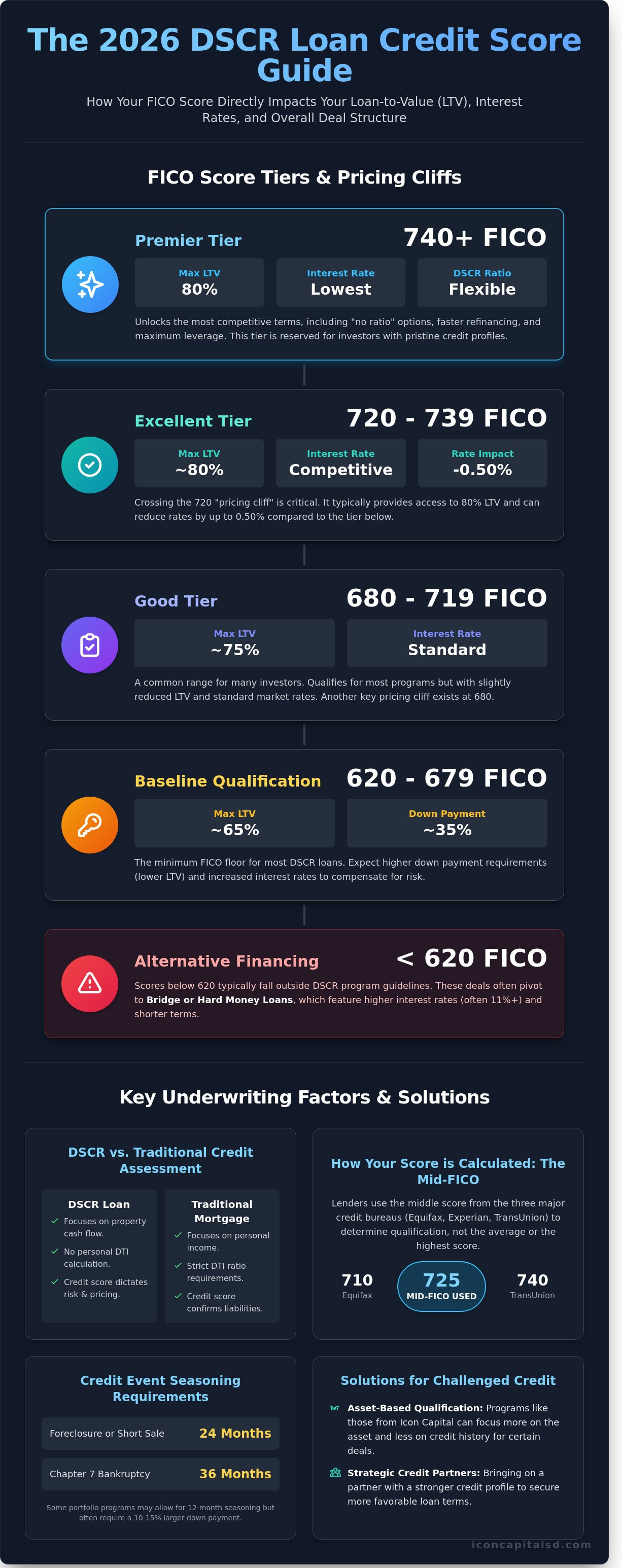
In 2026, the minimum credit score for dscr loan approval generally sits between 620 and 640. This range represents the baseline for most institutional Non-QM lenders. Scores below 620 typically shift the deal into bridge or hard money categories where interest rates often exceed 11%. While the property’s cash flow is the primary underwriting focus, the borrower’s FICO score remains the leading indicator of default risk for secondary market investors.
Lenders utilize tiered eligibility structures that act as pricing cliffs. These critical benchmarks occur at 680, 720, and 760. Crossing a single tier can significantly alter the deal’s economics. For example, moving from a 718 to a 720 score can reduce an interest rate by 25 to 50 basis points. These tiers also dictate the maximum loan-to-value (LTV) ratios available for specific asset types.
Recent credit events impact eligibility regardless of the numerical score. Most 2026 programs require a 24 month seasoning period for foreclosures or short sales. Chapter 7 bankruptcies typically require 36 months of seasoning. Some specialized portfolio programs allow for 12 month seasoning, but they expect a 10% to 15% increase in the down payment requirement to offset the risk. Foreign National programs operate on different benchmarks entirely. These borrowers often lack a U.S. credit history, so lenders require a credit reference letter from a financial institution in their home country or a 700 equivalent international score to access 65% to 70% LTV.
The 620-640 Floor: What to Expect
Investors at the 620 to 640 floor should expect lower LTV limits, usually capped at 65% for purchases and 60% for refinances. Interest rate premiums are standard at this level to mitigate risk. Lenders also mandate higher cash reserves, often requiring 6 to 12 months of PITIA (Principal, Interest, Taxes, Insurance, and Association dues) to be held in a liquid account. This ensures the investor can maintain debt service during vacancies.
The 740+ Advantage: Maximum Leverage
A score of 740 or higher provides the most aggressive financing terms in the 2026 market. This bracket allows for 80% LTV on purchases and 75% on cash-out refinances. These borrowers access the best available interest rates, which often rival conventional investment products. High-score borrowers also benefit from flexible DSCR ratios. Some programs allow for a 1.0x ratio or even “no-ratio” options where the property’s income isn’t the sole qualifying factor. Investors looking to leverage these tiers can request a quote to see current rate spreads based on their specific FICO profile.
Understanding these requirements is vital for scaling a portfolio. The minimum credit score for dscr loan products is just the entry point; the real value lies in hitting the 720 and 760 tiers to maximize cash-on-cash returns. Maintaining a clean credit profile allows for higher leverage and lower debt service costs, directly increasing the property’s net cash flow.
How Your Score Impacts Loan-to-Value (LTV) and Rates
Your FICO score acts as the primary lever for capital preservation and portfolio growth. While the minimum credit score for dscr loan programs typically starts at 620, the gap between a marginal score and a prime score dictates your cash-to-close requirements. High-tier scores allow for maximum leverage, whereas lower scores force investors to lock up more liquidity in a single asset. For a $500,000 property, a score of 720 often secures 80% LTV, while a 640 score might cap at 70% LTV. This creates a $50,000 difference in the required down payment, directly impacting your ability to scale into additional units.
Leverage vs. Credit Score Matrix
- 620-659 FICO: Max 70% LTV. These deals require substantial “skin in the game” to offset credit risk.
- 660-699 FICO: Max 75% LTV. This mid-tier range offers a balance of leverage and moderate pricing.
- 700+ FICO: Max 80% LTV. Investors in this bracket access the highest leverage and lowest reserve requirements.
Interest Rate Sensitivities
Yield spread premiums and Loan Level Price Adjustments (LLPAs) fluctuate based on these credit tiers. In the 2026 market, the spread between a 660 and a 760 score is projected to remain between 100 and 150 basis points. This impact is magnified on 5-8 unit multi-family DSCR deals where complexity increases. Underwriters view lower scores as a higher default risk on commercial-lite assets, often adding a 0.50% premium to the base rate on top of standard tier adjustments. A Pricing Grid is a standardized table used by non-QM underwriters to calculate interest rate add-ons based on specific risk variables like credit score and leverage.
The DSCR ratio also interacts with your score to determine final terms. A high DSCR ratio (e.g., 1.50x) can sometimes mitigate a lower credit score, but it rarely replaces the need for a strong FICO when seeking 80% LTV. Most aggressive leverage programs require both a 1.25x DSCR and a 700+ score to qualify for the most competitive pricing.
Case Study: $500,000 Investment Property
Investor A has a 760 score. They qualify for 80% LTV at a 7.125% interest rate. Their down payment is $100,000, and the monthly debt service is manageable, leaving significant cash flow. Investor B has a 640 score. Although they meet the minimum credit score for dscr loan eligibility, they are capped at 70% LTV with an 8.625% rate. Investor B must bring $150,000 to the closing table. Over a five-year hold, Investor B pays approximately $38,000 more in interest and loses the opportunity cost of the extra $50,000 tied up in equity. To see how your specific score affects your next deal, you can request a quote to view current market adjustments.
Qualifying with Challenged Credit: Creative Solutions
Investors often hit a wall when their FICO drops below 620. However, the minimum credit score for dscr loan qualification isn’t always the final word on a deal. Icon Capital provides several paths to bypass credit challenges through strategic deal structuring. We focus on the viability of the asset and the overall strength of the borrower’s financial profile.
One common solution involves a credit partner. In these scenarios, an investor with lower credit brings in a co-borrower with a higher mid-FICO score to lead the application. This allows the partnership to leverage better terms and higher LTVs, often capping at 80% for purchases. It’s a pragmatic way to scale a portfolio while rebuilding personal credit depth.
Conversely, some investors face the opposite problem: a 740+ credit score but a property with a DSCR below 1.0. Our “No-Ratio” program ignores the property’s monthly cash flow entirely. We qualify the loan based on the borrower’s credit strength and liquidity instead. This is particularly effective for short-term rentals or properties in high-appreciation markets where current rents don’t yet reflect market potential.
Asset-Based Alternatives
When FICO scores dip, Icon Capital’s Asset Qualification program can bridge the gap. This approach prioritizes liquidity over traditional credit history. We often look for a 1:1 asset-to-loan ratio. If you’re seeking a $500,000 loan, having $500,000 in verifiable liquid assets can override a marginal credit score. This provides a safety net for the lender and a path forward for the investor.
Eligible assets for this qualification include:
- Cash in personal or business checking and savings accounts.
- Publicly traded stocks and bonds, usually valued at 70% to 90% of market price.
- Vested retirement accounts like 401(k)s or IRAs, typically valued at 60% to 80% to account for potential tax penalties.
You can Explore Asset Qualification Home Loans to see how your current portfolio can secure your next acquisition.
International Investors and Credit
Foreign nationals frequently lack a U.S. Social Security Number or a domestic credit history. We don’t require a domestic minimum credit score for dscr loan approval for these clients. Instead, we utilize international credit reports from providers like Experian or Equifax in the borrower’s home country. This allows us to verify financial responsibility across borders.
If a formal report isn’t available, we accept three letters of reference from international financial institutions. These letters must confirm the investor has held accounts in good standing for at least 24 months. These loans typically carry a maximum LTV of 65% to 70% to offset the lack of U.S. credit data. For a deeper dive into these requirements, see our Foreign National Loan Guide.
Next Steps: Securing Your DSCR Loan with Icon Capital
Transitioning from research to execution requires a systematic approach. Most investors fail to secure financing because they don’t prepare their data before reaching out to a lender. Follow these four steps to streamline your acquisition or refinance and ensure your numbers align with current market requirements.
- Step 1: Identify your mid-FICO score. Pull a comprehensive credit report from all three bureaus. Lenders use the middle score of the three. If your scores are 680, 700, and 720, your qualifying score is 700. Knowing this number immediately tells you if you meet the minimum credit score for dscr loan programs, which typically starts at 620 for most aggressive tiers.
- Step 2: Calculate the property DSCR. Divide the gross monthly rent by the total monthly debt service, including principal, interest, taxes, insurance, and HOA fees. A ratio of 1.20 or higher often yields the most competitive LTV and rate combinations.
- Step 3: Consult an Icon Capital specialist. We analyze your specific FICO and DSCR metrics to find the optimal program. This eliminates the guesswork and prevents multiple unnecessary inquiries on your credit profile.
- Step 4: Lock your rate. Once the scenario is approved, move into our simplified underwriting. We focus on the asset’s performance rather than your personal debt-to-income ratio.
Why Icon Capital Specializes in Investor FICO Nuance
Icon Capital provides direct access to non-QM underwriters who prioritize the deal over rigid traditional guidelines. We understand that a 660 FICO score for a seasoned investor with a $5 million portfolio represents a different risk profile than a first-time buyer. Our programs allow for flexible vesting in LLCs or S-Corps. This structure protects your personal assets while allowing you to scale your portfolio efficiently. For a deeper dive into the mechanics of these products, read our guide on What is a DSCR Loan?.
Get a Custom DSCR Quote
Securing a minimum credit score for dscr loan qualification is only the first step; getting a term sheet that works for your numbers is the goal. We perform initial scenario reviews without a hard credit pull, protecting your score during the discovery phase. Our team generates term sheets within 24 to 48 hours to ensure you remain competitive in high-demand markets where speed is a currency. Request a Quote from Icon Capital today to lock in your financing and move toward a fast closing.
Secure Your Next Investment Property with Precision
Success in the 2026 real estate market depends on your ability to navigate shifting underwriting standards. Your minimum credit score for dscr loan qualification directly impacts your borrowing power, with benchmarks typically starting at 620 for entry-level programs. Investors who maintain scores above 720 often secure the most aggressive rates and maximum leverage. Icon Capital specializes in Non-QM and creative financing, providing up to 80% LTV for qualified borrowers across all 50 states. We also offer dedicated pathways for Foreign Nationals to acquire U.S. assets without traditional domestic credit history. Our team focuses on the numbers that matter, ensuring your property’s cash flow drives the deal forward. We’ve streamlined our process to eliminate the bottlenecks found at traditional banks. You don’t have to wait weeks for a decision when your next deal is on the line. Take control of your portfolio’s growth by accessing the capital you need today. We’re ready to help you close your next deal with speed and certainty.
Get a Custom DSCR Loan Quote in Minutes
Frequently Asked Questions
Can I get a DSCR loan with a 600 credit score?
Most lenders set the minimum credit score for dscr loan at 620. While a 600 score makes qualification difficult, some private lenders accept it if the property maintains a 1.25x ratio and you provide a 35% down payment. Expect higher interest rates, often 2% to 3% above market averages, to offset the increased risk profile. This ensures the deal remains viable for the capital provider.
Does a DSCR loan require a hard credit pull?
Yes, lenders require a hard credit pull from all three bureaus to finalize the underwriting process. While a soft pull provides an initial quote, the hard inquiry confirms your FICO scores and debt history before closing. This inquiry typically stays on your report for 24 months and might lower your score by 5 to 10 points initially. It’s a standard requirement for most non-QM products.
Will my business credit score be used for a DSCR loan?
Lenders use your personal FICO scores rather than your business credit score to determine eligibility. Even if you close the loan under an LLC or corporate entity, the personal credit history of all members with 20% or more ownership is evaluated. This ensures the individuals backing the deal meet the necessary financial stability requirements. Business credit history rarely impacts the final terms or LTV.
What is the minimum DSCR ratio required for a 640 credit score?
A 640 credit score typically requires a minimum DSCR ratio of 1.20x to 1.25x. Lenders often reduce the maximum LTV to 70% or 75% for scores in this range. If the property’s annual net operating income doesn’t exceed the debt service by 20%, you’ll likely need to increase your cash reserves to at least 6 or 12 months of payments to secure the deal and mitigate risk.
How does a bankruptcy affect my DSCR loan eligibility in 2026?
You’ll face a mandatory seasoning period of 36 to 48 months following a bankruptcy discharge before you’re eligible for most programs. By 2026, a Chapter 7 discharge from 2022 or earlier would meet the standard 4-year requirement. Lenders also verify that you’ve maintained a clean payment history on all new credit lines since the filing date. Any late payments post-bankruptcy usually result in an automatic denial.
Can I use a co-borrower to improve my DSCR loan credit score?
Adding a co-borrower won’t bypass the minimum credit score for dscr loan requirements because lenders use the lower of the two borrowers’ middle scores. If your score is 580 and your partner’s is 740, the file is priced based on the 580 score. However, a co-borrower’s liquidity can help meet the 10% to 15% reserve requirements needed for approval. This strategy strengthens the cash position but not the credit profile.
Do DSCR lenders average the credit scores of all partners?
Lenders don’t average scores; they use the lowest middle score among all guarantors with 20% or more ownership. If three partners have middle scores of 720, 680, and 640, the underwriter uses 640 to determine the interest rate and LTV. This ensures the loan’s risk is assessed based on the weakest link in the ownership structure. Partners with lower scores should consider reducing their ownership stake to below 20%.
What happens if my credit score drops during the loan process?
A score drop during the process triggers a mandatory re-underwrite and potential re-pricing of your interest rate. If the new score falls below the 620 program floor, the lender will likely deny the application. This often occurs if you open new credit lines or increase credit card utilization by more than 30% before the loan closes. Always maintain your credit profile until the final funding is complete.