

A high credit score and $500,000 in liquid reserves mean nothing to a traditional bank if your tax returns show heavy depreciation. For the 2026 investor, relying on 45-day bank approval cycles is a guaranteed way to lose a $1.2 million acquisition to a faster cash buyer. You’ve likely felt the frustration of a deal stalling because an underwriter couldn’t interpret a complex Schedule C or an 1120-S. Asset based lending for real estate solves this by prioritizing the property’s performance and your total liquidity over traditional monthly income statements.
We agree that your growth shouldn’t be restricted by outdated underwriting boxes that ignore your actual buying power. This guide reveals how to leverage property value and personal liquid assets to secure high-leverage financing without any traditional income verification. You’ll learn the mechanics of closing deals in under 14 days, maximizing LTV through property cash flow, and qualifying via asset depletion. We’re outlining the exact framework you need to scale your portfolio with speed and efficiency.
Key Takeaways
- Discover how asset based lending for real estate provides a strategic alternative to restrictive bank debt by prioritizing collateral value over traditional income verification.
- Compare DSCR and liquid asset qualification models to determine which “collateral-first” approach best fits your current investment profile.
- Learn to calculate key metrics like ARV and LTV to accurately assess deal profitability and the speed-to-close advantages of creative financing.
- Match specific investment objectives—from Fix & Flip bridge loans to 30-year DSCR products—with the optimal high-leverage lending strategy.
- Explore the roadmap for scaling a real estate portfolio through specialized Non-QM products and long-term lending partnerships.
Asset Based Lending for Real Estate in 2026: Beyond Traditional Financing
Asset based lending for real estate is a financing model where the loan is secured primarily by the property value or the borrower’s liquid assets. In 2026, market volatility has forced traditional banks to tighten their credit boxes, making these flexible structures essential for active investors. While retail lenders focus on personal income history, asset-based lenders prioritize the collateral. This shift allows for a more pragmatic approach to debt. Primary asset types used to secure these loans include:
- The Real Estate Asset: Focused on Loan-to-Value (LTV) and After Repair Value (ARV).
- Accounts Receivable: Used by commercial entities to bridge cash flow gaps.
- Developer Inventory: Unsold units or land held by builders.
Speed-to-close is the primary driver for acquisitions in 2026. Closing a deal in 10 days allows investors to outmaneuver buyers reliant on 45-day bank cycles. In a market where timing dictates the internal rate of return, the ability to bypass red tape is a significant competitive advantage.
Why Traditional Mortgages Fail Modern Investors
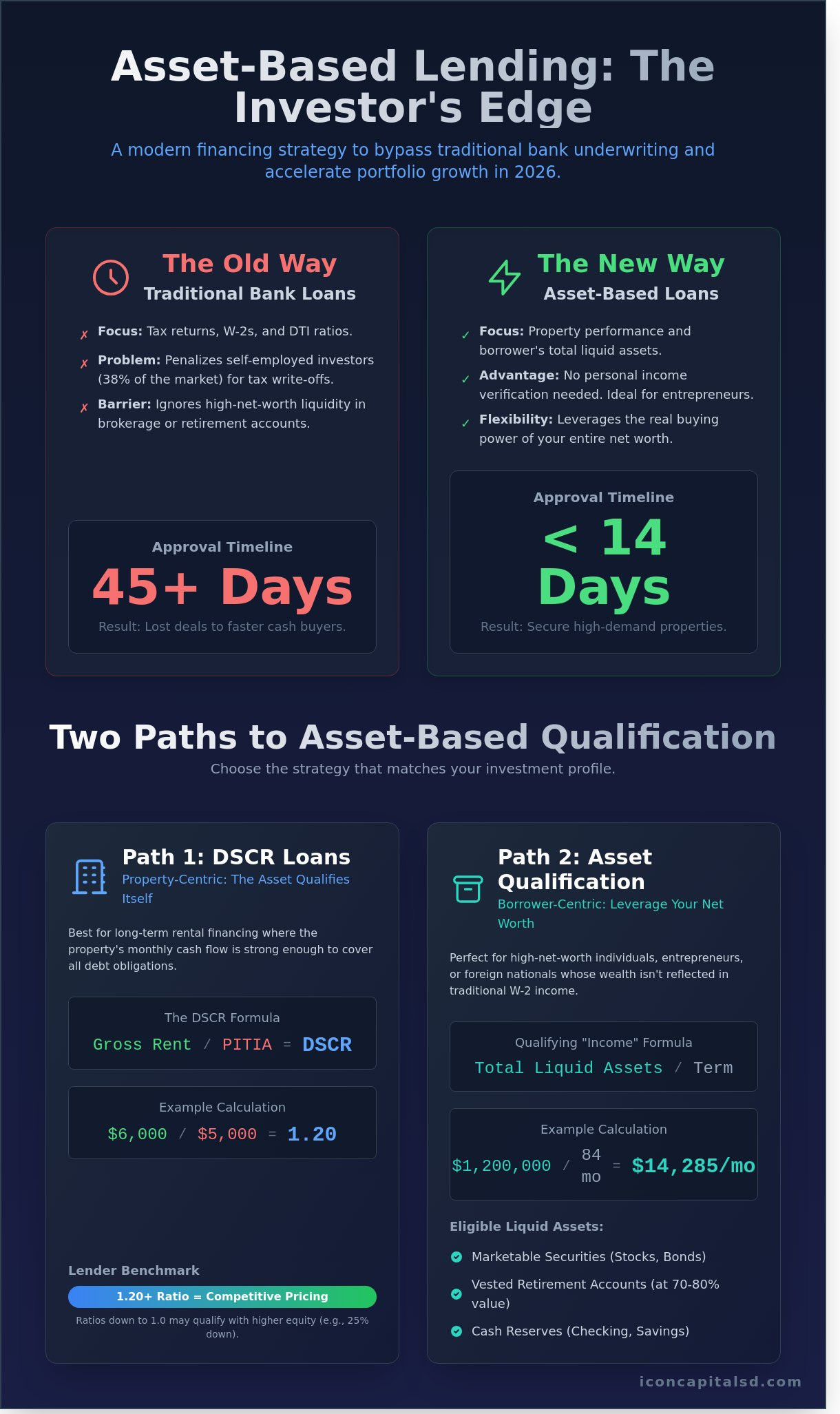
Standard Debt-to-Income (DTI) requirements create a bottleneck for the 38% of active real estate investors who are self-employed. Traditional underwriting penalizes business owners who use legal tax write-offs to reduce their taxable income. These write-offs lower your tax bill but simultaneously destroy your borrowing power at a retail bank. W-2-centric models fail to account for high-net-worth liquidity. They often ignore $1 million or more in brokerage accounts because there isn’t a recurring monthly paycheck attached to the balance.
The 2026 Real Estate Landscape and Leverage
The 2026 interest rate environment shows a clear spread between products. While traditional 30-year fixed rates average 6.85%, asset-based products typically range from 8.9% to 11.5%. Investors pay this premium for agility and certain execution. With housing inventory sitting at a tight 3.1-month supply, quick-close bridge loans are the only way to secure high-demand assets before they hit the open market. Asset-based lending serves as a strategic tool for capital efficiency rather than a last resort for subprime borrowers. Investors looking to scale their portfolios quickly can request a quote to determine how much leverage their current assets can generate.
Property-Centric vs. Borrower-Centric: Two Paths to Asset Qualification
Asset based lending for real estate provides two distinct underwriting tracks: property-focused or borrower-wealth focused. Private and non-QM lenders prioritize the collateral’s value and income potential rather than the borrower’s W-2 history. This shift allows sophisticated investors to bypass the debt-to-income (DTI) constraints that often stall portfolio growth. By adopting a “collateral first” philosophy, lenders focus on the asset’s ability to settle the debt, whether through rental cash flow or the liquidation of personal holdings.
DSCR: When the Property Does the Talking
The Debt Service Coverage Ratio (DSCR) is the primary metric for long-term rental financing. Lenders calculate this by dividing the monthly gross rent by the full PITIA (Principal, Interest, Taxes, Insurance, and Association dues). A 1.20 ratio is the 2026 benchmark for competitive pricing; however, many programs now allow for a 1.0 ratio if the investor brings 25% or more equity to the closing table. If a multi-unit property generates $6,000 in monthly rent and the debt service is $5,000, the 1.2 threshold is met. Personal income is irrelevant in this scenario. The property’s performance is the sole driver for approval, making it the ideal solution for scaling residential portfolios.
Asset Qualification: Leveraging Your Net Worth
Asset qualification, often called “Asset Depletion,” serves high-net-worth entrepreneurs and Foreign Nationals who lack traditional US-based income. Underwriters convert liquid wealth into a monthly income proxy to satisfy repayment requirements. The standard formula involves taking the total value of eligible assets and dividing them by a set timeframe, typically 60 or 84 months.
Eligible assets for this path include:
- Vested Retirement Accounts: 401(k)s and IRAs, often discounted to 70% or 80% of their face value.
- Marketable Securities: Stocks, bonds, and mutual funds held in brokerage accounts.
- Cash Reserves: Checking and savings account balances verified over a 90-day period.
For example, an investor with $1,200,000 in a brokerage account can generate a monthly income proxy of $14,285 using an 84-month depletion schedule. This provides the necessary “income” to qualify for high-balance loans without needing a single pay stub. Before choosing a path, request a quote to see which qualification method yields the highest leverage for your specific portfolio.
Documentation requirements remain streamlined compared to bank financing. For the property-centric path, lenders require a 12-month Property P&L and an appraisal with a Form 1007 rent schedule. For the borrower-centric asset path, the focus shifts to two or four months of consecutive bank statements to verify the liquidity and seasoning of funds. These requirements ensure a faster closing cycle, often finishing in 15 to 21 days.
Evaluating Real Estate Asset Based Loans: Key Terms and Metrics
Successful asset based lending for real estate requires a technical understanding of leverage and liquidity. Unlike traditional mortgages, these loans prioritize the property’s income potential and current value over the borrower’s personal debt-to-income ratio. Lenders focus on two primary metrics: Loan-to-Value (LTV) and After-Repair Value (ARV). LTV measures the loan amount against the current purchase price, while ARV projects the property’s worth once renovations are finalized. Accurate ARV calculations are vital because they dictate the total capital available for your construction draws.
Investors choose asset based lending for real estate because speed and capital access outweigh the higher interest rates. You’ll typically encounter “points,” which are upfront percentage fees of the total loan amount. While rates often sit 200 to 400 basis points higher than conventional products, the interest is usually tax-deductible. The ability to close a deal in 10 days or less allows you to secure distressed assets that traditional buyers can’t touch.
Every ABL deal requires a documented exit strategy. Lenders don’t want to hold these short-term notes indefinitely. You must demonstrate a clear path to repayment, whether through a property sale or transitioning into a long-term DSCR loan. If you’re looking to scale your portfolio quickly, you can request a quote to see how different exit paths impact your leverage options.
Liquidity reserves play a decisive role in the underwriting process. Lenders verify that you have enough cash on hand to cover 6 to 12 months of interest payments and potential renovation overruns. This “interest carry” ensures the project remains solvent even if market conditions shift or contractor timelines slip by 15% to 20%.
Understanding LTV and Leverage Limits
In 2026, Fix & Flip programs offer up to 90% LTV on the purchase price, while long-term rental products typically cap at 80% LTV. Your “skin in the game” directly influences your pricing tier. Increasing your down payment by 5% can often reduce your interest rate by a full percentage point. Credit scores still matter in 2026; a 700+ score is the standard threshold for accessing 90% leverage and the lowest available points.
The Role of Appraisal in ABL
Appraisals determine both the As-Is Value and the As-Completed Value. Modern 2026 valuation methods have shifted toward neighborhood-specific data modeling, using real-time absorption rates and hyper-local inventory levels to ensure accuracy within a 2% margin. The appraiser acts as the lender’s eyes on the ground, validating that your renovation budget aligns with local market demands. In ABL, the property’s marketability is the lender’s primary risk mitigator.
The Investor’s Buying Guide: Choosing Your Asset-Based Strategy
Successful execution in 2026 requires matching specific capital structures to your exit strategy. Asset based lending for real estate isn’t a one size fits all solution. It’s a toolkit where the wrong choice can erode your margins by 2% to 4% through unnecessary interest or hidden costs. Investors must align their financing with the property’s lifecycle to maximize liquidity.
- Fix & Flip Investors: You need short-term, high-LTV bridge loans. These products typically cover 85% to 90% of the purchase price and 100% of the renovation budget. Speed and leverage are your primary goals.
- Buy & Hold Landlords: 30-year DSCR products are the standard for long-term cash flow. These bypass personal DTI requirements, focusing instead on whether the property’s gross rent covers the debt service.
- Foreign Nationals: specialized asset qualification programs allow you to bypass a lack of US credit history. Qualification relies on the property’s income potential and 12 months of verified reserves in a US-based account.
Matching Loan Products to Investment Goals
Short-term bridge loans serve as a 12 to 24 month stopgap for acquisitions needing execution in 7 to 10 days. Construction loans are vital for ground-up developers, allowing land equity to be used as a credit toward the total project cost. For those targeting 5-8 unit small apartments, asset based lending for real estate provides a faster alternative to commercial bank debt. These programs avoid the 60-day board approvals and rigid 1.25x DSCR constraints typical of traditional institutions, often closing in half the time.
Vetting Your Lending Partner
Transparency is the most critical metric when selecting a partner. Red flags include “due diligence” fees charged before a Term Sheet is issued or hidden junk fees that appear only at the closing table. You must ask if they lend to LLCs, as this is essential for liability protection. Inquire about prepayment penalties; a standard 3-2-1 step-down structure is common, but you don’t want to be locked into a 5-year penalty for a 2-year hold.
Prioritize lenders with in-house underwriting. This ensures the person making the decision is in the same building as the person processing your file, which provides certainty of execution. To see how these variables impact your next deal, request a personalized mortgage quote to see current 2026 rates for your specific asset class.
Secure your next acquisition with a partner who understands the mechanics of the deal. Apply for an asset-based loan quote today.
Scaling Your Portfolio with Icon Capital’s Creative Financing
Success in 2026 requires more than just identifying properties. It demands a lending partner that understands the mechanics of asset based lending for real estate. Icon Capital operates as a specialist in Non-QM and creative debt, providing the leverage necessary to move beyond single-family flips into large-scale portfolios. While traditional banks focus on tax returns, we focus on the asset’s performance and the investor’s track record.
Transitioning from a single deal to a portfolio-wide relationship is a logical progression for professional investors. We help you aggregate assets to optimize LTV and interest rates. For international investors, our Foreign National program serves as a critical entry point. It allows global capital to access US markets without the typical hurdles of domestic credit history or Social Security numbers. Our process remains consistent regardless of the deal size: Structure, Submit, Close.
The Icon Capital Advantage: Speed and Flexibility
Professional timelines don’t allow for the 60-day underwriting cycles of retail banks. Our no-nonsense approach prioritizes speed. In August 2024, we financed a 12-unit multi-family project after a traditional lender stalled for 45 days. We closed that loan in 14 days because we understood the project’s complexity; we didn’t get bogged down in bureaucratic red tape. We offer specialized products for business owners and those with non-traditional income, including:
- Bank Statement Loans: Use 12 or 24 months of deposits to prove cash flow.
- P&L Loans: Qualification based on accountant-prepared profit and loss statements.
- DSCR Programs: Focused entirely on the property’s ability to cover debt service.
Next Steps: From Structure to Funding
Securing capital starts with a complete Deal Package. You’ll need your purchase contract, entity documents, and property details ready for review. Our asset-based underwriters provide a 24-hour turnaround for initial loan structures. This speed allows you to make confident offers in competitive markets. When you’re ready to scale, the process is streamlined to ensure capital is available exactly when the deal closes. This efficiency is why professional investors choose us for asset based lending for real estate.
The path to a funded loan is simple. First, we structure the deal based on your specific goals. Second, you submit the required documentation through our secure portal. Third, we move to a rapid close. Connect with an Icon Capital specialist today to leverage your assets for your next acquisition.
Master Your 2026 Investment Strategy
Success in 2026 requires a pivot from traditional credit checks to property performance metrics. Investors are moving away from restrictive bank requirements and prioritizing speed. asset based lending for real estate remains the most efficient path to scale because it focuses on the deal’s potential rather than the borrower’s personal income. By utilizing DSCR ratios and high-leverage structures, you can secure properties that traditional lenders often overlook. Speed is the new currency in this market.
Icon Capital provides the specialized expertise needed for these Non-QM and creative financing solutions. We offer high-leverage LTV options up to 90% for flips, keeping your capital liquid for the next opportunity. Our dedicated Foreign National and DSCR programs ensure that every investor has a tool for growth regardless of their residency or tax structure. We’ve built a process that prioritizes technical data and rapid closing timelines to keep your portfolio moving forward.
Secure your next deal with an Icon Capital asset-based loan. You’ve got the vision; we’ve got the capital to make it happen.
Frequently Asked Questions
Is asset based lending for real estate more expensive than a traditional mortgage?
Yes, asset based lending for real estate typically carries interest rates 1.5% to 4% higher than conventional 30-year fixed mortgages. Investors trade lower documentation requirements for higher capital costs and faster execution. You’ll also see origination fees ranging from 1% to 2.5% of the total loan amount. These costs reflect the increased risk and speed associated with non-QM financing solutions compared to government-backed products.
Can I get an asset based loan for a primary residence?
No, asset based loans are strictly for investment properties and business purposes. Federal regulations like the Dodd-Frank Act impose strict debt-to-income requirements on primary residences. Icon Capital focuses on non-owner occupied assets where the property’s income potential or the borrower’s liquidity drives the approval. If you intend to live in the home, you must utilize traditional or specific Non-QM consumer products instead of commercial-purpose loans.
What are the minimum liquid asset requirements for an asset qualification mortgage?
Most programs require liquid reserves equal to 6 to 12 months of principal, interest, taxes, insurance, and association dues. For a $500,000 loan with a $4,000 monthly payment, you’ll need at least $24,000 in verified cash or equivalents. Some aggressive 2026 programs allow for a 1:1 asset-to-loan ratio; this means $1,000,000 in liquid assets can secure a $1,000,000 loan without any employment verification.
Do asset based lenders require a minimum credit score in 2026?
Yes, most lenders require a minimum FICO score of 660 to access the most competitive leverage tiers. While some bridge programs allow scores as low as 620, these often come with a 10% to 15% reduction in Loan-to-Value ratios. Higher scores above 740 unlock the best pricing and allow for up to 80% LTV on purchase transactions. Credit depth still matters even when you’re using asset based lending for real estate.
How fast can an asset based real estate loan actually close?
Average closing times range from 7 to 14 business days depending on the appraisal turnaround. Traditional banks often take 45 to 60 days to process a single file. Because we prioritize the asset’s value and the borrower’s liquidity over personal tax returns, we bypass the lengthy manual underwriting cycles common in retail banking. A clean title report and a completed valuation are the primary drivers of the timeline.
Can foreign nationals qualify for asset based lending in the United States?
Foreign nationals can qualify for these loans with a minimum down payment of 25% to 30%. You don’t need a U.S. credit score or a Social Security number if you provide a valid passport and a letter from a financial institution in your home country. Lenders typically require 12 months of reserves to be held in a U.S. bank account prior to closing the transaction to ensure liquidity.
What happens if the property’s DSCR falls below 1.0?
If the Debt Service Coverage Ratio falls below 1.0, the loan is considered “negative cash flow” and requires higher equity. You’ll typically face a 5% to 10% reduction in maximum LTV, meaning you’ll need a 35% down payment instead of 25%. Some 2026 programs still fund these deals if the borrower shows 18 months of reserves to cover the monthly shortfall between rental income and debt obligations.
Are there prepayment penalties on asset-based bridge loans?
Most bridge loans include a 6 to 12-month minimum interest requirement or a specific prepayment penalty. For example, a 6-month yield maintenance clause ensures the lender receives at least 180 days of interest even if you refinance in 90 days. Long-term DSCR loans often use a 3-2-1 or 5-4-3-2-1 step-down structure; the penalty percentage decreases each year the loan remains active until it reaches zero.