

Waiting 45 days for a conventional mortgage is the fastest way to lose a distressed asset to a cash buyer in 2026. You already know that the most profitable deals don’t wait for tax return verifications or standard bank appraisals. When a property requires $50,000 in structural repairs, a traditional underwriter won’t even open the file. Utilizing Hard Money for Rental Properties allows you to bypass these institutional hurdles, providing the speed needed to close in 5 to 7 days while your competitors are still stuck in processing.
You’ll learn how to leverage short-term capital to acquire and stabilize assets that traditional lenders won’t touch. We’ll outline the exact strategy to maximize your LTV during the construction phase and provide a clear roadmap for transitioning that equity into a permanent, 30-year DSCR loan. This guide covers the mechanics of high-leverage bridge debt and the specific metrics required to scale your portfolio without personal income verification or debt-to-income constraints. We move from the initial funding of the purchase to the final refinance; ensuring your capital stays liquid for the next deal.
Key Takeaways
- Identify how Hard Money for Rental Properties acts as a high-leverage bridge to secure and rehab distressed assets that traditional lenders reject.
- Learn the strategic transition from short-term asset-based funding to long-term DSCR financing for stabilized rental portfolios.
- Calculate the impact of 2026 interest rates and origination fees on your total project ROI and all-in costs.
- Streamline the BRRRR method by utilizing construction holdbacks to increase property value before refinancing.
- Leverage creative Non-QM programs to scale your real estate investments when traditional bank criteria cannot be met.
What is Hard Money for Rental Properties?
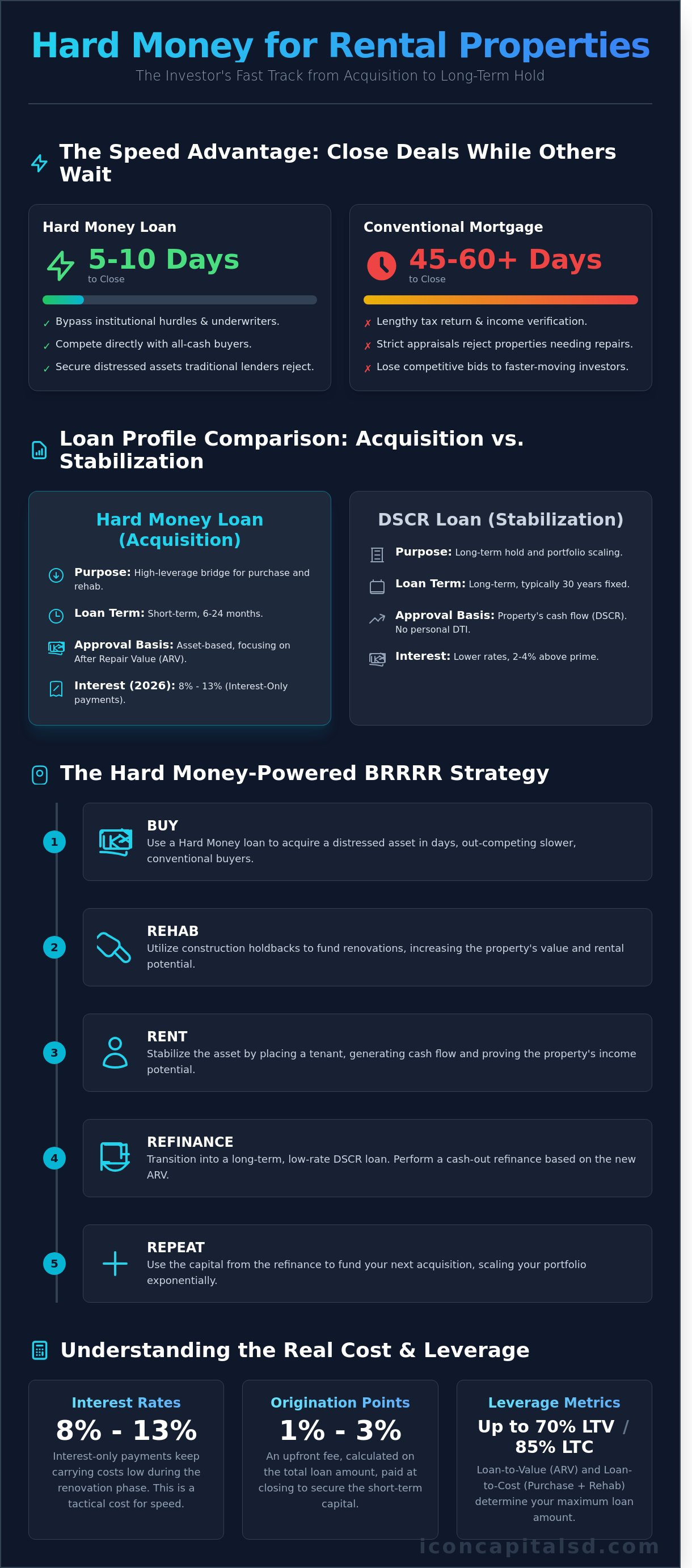
Hard money for rental properties is a private-capital bridge for rapid property acquisition. It’s a short-term, asset-based loan secured by the real estate’s intrinsic value instead of the borrower’s personal credit profile or debt-to-income ratio. Investors typically deploy this capital for “fix and rent” projects where the asset’s current condition precludes traditional bank financing. Standard loan terms in this niche range from 6 to 24 months. These products feature interest-only payments to keep carrying costs low while the investor stabilizes the asset for long-term hold or refinancing.
Why Investors Choose Hard Money Over Conventional Loans
Execution speed defines the hard money advantage. Funding often occurs in 5 to 10 days. Traditional institutional mortgages require 45 to 60 days to clear underwriting. This timeline difference allows investors to win competitive bids and secure off-market deals that require fast closings. Hard money also accommodates distressed assets. Banks rarely lend on properties with structural issues or missing essential systems. We focus on the After Repair Value (ARV). This flexible underwriting prioritizes the property’s potential rather than the borrower’s personal tax returns, enabling faster portfolio scaling.
Key Features of Hard Money Rental Loans in 2026
Current market data for 2026 shows interest rates for these bridge products ranging between 8% and 12%. While these rates sit higher than institutional 30-year debt, the cost is a functional trade-off for speed and leverage. Capital requirements depend on two primary metrics: Loan-to-Value (LTV) and Loan-to-Cost (LTC). Most lenders cap LTV at 70% of the projected ARV or 85% of the total acquisition and renovation cost.
- Origination Points: Expect to pay 1% to 3% of the loan amount as an upfront fee at closing.
- Interest-Only Payments: Monthly debt service covers only the interest, preserving capital for property improvements.
- Asset-Based Approval: The property’s collateral value serves as the primary security, simplifying the documentation process.
Investors ready to secure their next asset can request a quote to review specific terms for their project. Using hard money for rental properties provides the necessary leverage to acquire undervalued real estate, complete renovations, and eventually transition into long-term DSCR or conventional financing once the property is stabilized.
Hard Money vs. DSCR Loans: Choosing Your Strategy
Successful investors distinguish between the acquisition phase and the stabilization phase. Hard Money for Rental Properties serves as a short-term tool for speed and property improvement. DSCR loans provide the long-term structure for portfolio scaling. While hard money lenders focus on property equity and After Repair Value (ARV), DSCR underwriters prioritize the property’s ability to generate cash flow above the monthly debt obligation.
The cost of capital reflects these functional differences. Hard money typically carries rates between 10% and 13% with a 6 to 12-month term. This high-cost capital is a tactical expense for rapid entry. DSCR loans offer 30-year fixed terms at lower rates, usually 2% to 4% above prime, ensuring predictable monthly margins. Choosing the right product depends on where the asset sits in the investment lifecycle.
When to Use Hard Money for Acquisition
Speed is the primary differentiator in competitive markets. When a seller demands a 7-day close, traditional financing is not an option. Hard money allows you to compete with “cash-only” buyers. Use this leverage for properties requiring structural repairs or cosmetic overhauls that fail to meet FHA or conventional standards. It also functions as a bridge for 1031 exchanges, allowing you to secure a replacement property before your relinquished asset’s funds are fully processed.
When to Transition to a DSCR Rental Loan
Transitioning occurs once the property is stabilized. This means the rehab is complete and a tenant has signed a lease. Moving into a DSCR loan allows you to lock in a 30-year fixed rate, protecting your cash flow from interest rate volatility. If the property’s value increased significantly during the rehab, a cash-out refinance at 75% or 80% LTV provides the liquidity needed for your next purchase. You can request a quote to see how current DSCR rates impact your portfolio’s debt service coverage.
Calculating the Real Cost and ROI of Hard Money
Investors using Hard Money for Rental Properties prioritize capital access and execution speed over the lowest possible interest rate. For the 2026 market, expect interest rates for private capital to hover between 9% and 13%. Beyond the base rate, origination fees typically range from 1% to 3% of the total loan amount. These points are paid at closing and represent the primary “all-in” cost of securing the debt.
The structure of your rehab draws also dictates your actual interest expense. Most lenders utilize draw schedules to release funds as specific renovation milestones are met. It’s critical to confirm if the lender charges interest on the full loan amount from day one or only on the disbursed funds. Charging interest on undisbursed capital, often called “Dutch Interest,” can increase your effective rate by 2% or more over the life of the project.
Don’t ignore the cost of waiting. While a 12% interest rate looks high compared to a 7% conventional loan, traditional bank financing often takes 45 to 60 days to close. In a competitive market, that delay can cost you a deal with $50,000 in immediate equity. Hard money allows you to close in as little as 5 to 10 days, capturing value that slower capital misses.
Understanding Loan-to-Value (LTV) Limits
Most private lenders cap their exposure at 70% to 75% of the After Repair Value (ARV). This margin protects the lender if the market shifts or the rehab exceeds the budget. Your experience level directly dictates your leverage. Investors with 5 or more documented exits in the last 24 months often qualify for 80% LTV, while beginners should expect to bring a 20% to 25% down payment. Higher “skin in the game” from the borrower typically results in a 0.5% to 1% reduction in the interest rate.
Hidden Fees to Watch For
Analyze the term sheet for costs that erode your margins. Common charges include:
- Document preparation fees: $500 to $1,500.
- Inspection fees: $150 to $350 per draw request.
- Underwriting or “junk” fees: $900 to $2,000.
Prepayment penalties are rare in the hard money space, which is a major advantage for those planning to refinance into long-term debt quickly. However, you must account for extension options. If a project takes 14 months instead of the agreed 12, lenders usually charge a 1% fee to extend the term for an additional 3 to 6 months. To see how these costs fit your specific deal, request a quote to get a transparent breakdown of current market terms.
The BRRRR Method: Leveraging Hard Money for Rentals
The BRRRR strategy relies on speed and calculated leverage. Hard money for rental properties acts as the catalyst for this process. It allows investors to acquire distressed assets that traditional banks won’t touch due to condition or occupancy issues. Because hard money lenders focus on asset value over borrower income, you can secure funding and close deals in under 10 days.
- Step 1: Buy. Use hard money to purchase a property at a discount. Speed is your primary advantage against cash buyers.
- Step 2: Rehab. Leverage the loan’s construction holdback. You draw funds as milestones are met to force appreciation and increase the After Repair Value (ARV).
- Step 3: Rent. Place a qualified tenant. A signed lease is required to establish the income side of your Debt Service Coverage Ratio.
- Step 4: Refinance. Transition the short-term debt into a long-term DSCR mortgage. This pays off the high-interest bridge loan.
- Step 5: Repeat. Pull out your initial capital through the refinance to fund your next acquisition.
The Refinance Exit Strategy
Professional investors don’t enter a deal without two exit paths. Exit A is the DSCR refinance. Exit B is an immediate sale if market conditions shift. To execute Exit A, your property must meet a minimum DSCR of 1.2x. This means the rental income is 20% higher than the PITI payment. In 2026, seasoning requirements remain a factor. Most non-QM lenders require 12 months of ownership to use the new appraised value for a cash-out refinance. If you’ve owned the asset for less than 12 months, the loan amount is often capped at the total cost basis.
Common Pitfalls in the BRRRR Process
Overestimating the ARV is the most frequent error. A 5% dip in projected appraisal value can leave you with insufficient equity to pull your cash back out. This forces you to stay in a high-interest loan longer than planned. Additionally, rehab budgets often see 15% to 20% cost overruns. If you don’t have liquid reserves, the project stalls. You must also calculate a 60-day vacancy period into your carrying costs. Failing to account for interest payments during the rehab and tenant search phases can erode your profit margins quickly.
Move your project forward with a partner who understands the numbers. Request a quote for your next rental acquisition.
Icon Capital: Creative Financing for Every Investor
Traditional banks often reject investors who don’t fit into a rigid underwriting box. Icon Capital LLC specializes in Non-QM and creative financing solutions designed for these exact scenarios. We provide direct access to specialized programs like DSCR, Fix & Flip, and Foreign National loans. When you utilize hard money for rental properties, you need a partner that understands how to transition short-term leverage into long-term wealth.
Our firm focuses on high-value deals with loan amounts reaching $2 million. We prioritize “cash in hand” options that allow investors to pull equity from existing assets to fund new acquisitions. Efficiency is built into our four-step operational model:
- Structure: We analyze the deal mechanics to ensure the right product fit.
- Submit: Documentation is gathered and organized for maximum clarity.
- Underwrite: Our team evaluates risk based on asset performance and collateral value.
- Close: Funding is deployed quickly to meet tight escrow deadlines.
Solutions for Foreign Nationals and Self-Employed
Non-US citizens often face hurdles due to a lack of domestic credit history. We offer financing for foreign nationals that bypasses traditional US credit requirements, focusing instead on the asset’s potential. For domestic business owners, we provide bank statement and P&L loans. These programs allow you to qualify using 12 to 24 months of actual cash flow rather than tax returns that show heavy deductions. Our asset qualification programs look at the strength of your portfolio, ensuring your paycheck isn’t the only metric for success.
Get Started with Your Next Rental Deal
Icon Capital LLC simplifies the transition from bridge debt to permanent financing. We understand the specific mechanics of the deal and how hard money for rental properties serves as a catalyst for larger portfolio growth. Working with a lender that recognizes the value of speed and leverage gives you a competitive edge in tight markets. We don’t just provide capital; we provide the structure needed to scale your operations effectively.
Ready to scale? Request a personalized mortgage quote from Icon Capital LLC.
Scale Your 2026 Portfolio with Data-Driven Financing
Executing a successful BRRRR strategy in 2026 demands speed and high-leverage capital. Traditional lenders often fail to meet the tight timelines required for distressed acquisitions or rapid portfolio expansion. Utilizing Hard Money for Rental Properties allows you to secure assets quickly, renovate, and transition into long-term DSCR debt. Icon Capital specializes in these complex transitions, offering creative financing for $2M+ loan amounts that institutional banks often reject. Our specialized Foreign National and DSCR programs provide the flexibility necessary for diverse investment strategies across the United States. You won’t find vague promises here; we rely on a no-nonsense, data-driven underwriting process to evaluate your assets and move to closing. Whether you’re managing a single-family portfolio or a large-scale multifamily project, the right leverage determines your ultimate ROI. We focus on the technical details of your deal so you can focus on finding the next one. It’s time to secure a partner who understands the mechanics of non-traditional lending.
Request a Quote for Your Next Rental Deal
Your next acquisition is ready for funding.
Frequently Asked Questions
Is hard money a good idea for a long-term rental property?
Hard money isn’t a viable long-term solution because interest rates typically range from 10% to 15%. It’s a strategic tool for the acquisition and renovation phase. Investors use hard money for rental properties to secure assets quickly before transitioning into a 30 year DSCR loan at a lower rate. This bridge strategy allows you to capture equity through immediate property improvements.
Can I get 100% financing for a rental property with hard money?
You can’t typically secure 100% financing as most lenders require a 15% to 20% down payment. Some specialized programs fund 100% of renovation costs if the total loan stays below 75% of the after-repair value. You’ll still need enough cash to cover closing costs and 6 months of interest reserves. Most deals require some skin in the game to mitigate lender risk.
Do hard money lenders check my personal credit score?
Yes, most private lenders require a minimum FICO score of 620 to qualify for standard terms. While the asset’s value is the primary focus, your credit history demonstrates financial reliability. A score above 740 often unlocks the lowest 9.99% interest rates and higher 85% LTV options. Lenders use a tri-merge credit report to verify your existing debt obligations and payment history.
How long does it take to close on a hard money rental loan?
Closing typically takes 5 to 10 business days once you submit a completed application package. Speed is the primary advantage over traditional banks that take 45 to 60 days to fund. If your title work and insurance are ready, some specialized firms can fund the deal in 72 hours. Your efficiency in providing bank statements and entity documents determines the final timeline.
What is the minimum DSCR ratio required to refinance out of hard money?
Most long-term lenders require a minimum Debt Service Coverage Ratio of 1.20 to 1.25. This means the property’s gross monthly rent must be 20% to 25% higher than the mortgage payment, taxes, and insurance. Some programs accept a 1.0 ratio where the rent just covers the debt. Lower ratios usually result in a 0.50% interest rate increase or a 5% reduction in leverage.
Can foreign nationals use hard money to buy U.S. rental properties?
Foreign nationals can use hard money for U.S. real estate, though they usually face a 30% to 35% down payment requirement. You’ll need a valid passport and an Individual Taxpayer Identification Number for the transaction. Lenders often require 12 months of interest reserves held in a U.S. bank account. These programs are efficient because they don’t require a domestic credit history or social security number.
What happens if I cannot refinance my hard money loan before it expires?
You’ll face default interest rates that can reach 18% or 24% if the loan maturity date passes. Most lenders offer a 3 to 6 month extension if you pay a fee equal to 1% of the loan balance. If you don’t pay off the balance or secure an extension, the lender will initiate foreclosure proceedings. It’s critical to start your refinance process 90 days before the term ends.
Are hard money loan interest rates tax-deductible for rental properties?
Interest paid on hard money for rental properties is a fully deductible business expense under IRS guidelines. You can also deduct origination points and closing fees over the life of the loan. If the loan term is 12 months, you’ll likely deduct the full cost in one tax year. Consult a CPA to ensure you’re correctly listing these expenses on your Schedule E to offset rental income.