

Your personal debt to income ratio is the least important factor for your next $5 million property acquisition. As the market shifts, savvy investors are bypassing the red tape of conventional banks to focus on asset-based financing. Understanding the specific dscr loan requirements 2026 is the difference between a stalled portfolio and a closed deal.
You already know that calculating Net Operating Income is more complex than just subtracting taxes from gross rent. This is especially true as 2025 interest rate fluctuations continue to impact your 2026 cash flow projections and overall leverage. You need a partner that values the property’s performance over your personal tax returns.
This guide provides the exact financial benchmarks and property standards you need to secure funding in the current environment. We’ll break down the 1.20x to 1.50x ratio tiers, provide a 12-point qualification checklist, and explain why closing in an LLC is your most efficient path to scaling your assets. You’ll gain the technical clarity required to present a clean file to underwriters and secure competitive LTVs without the friction of traditional income verification.
Key Takeaways
- Understand how property cash flow and stabilized interest rates have positioned DSCR loans as the primary tool for scaling real estate portfolios.
- Master the formula for calculating Net Operating Income and why a 1.20x coverage ratio remains the essential benchmark for 2026 approvals.
- Identify the specific dscr loan requirements 2026 regarding credit score tiers and LTV limits to secure the most competitive market rates.
- Utilize the “no-income” advantage to bypass traditional documentation like tax returns while protecting personal assets through LLC borrowing.
- Navigate the 21-30 day underwriting window by aligning loan structures with property performance for maximum investment ROI.
The 2026 DSCR Loan Landscape: Key Market Shifts
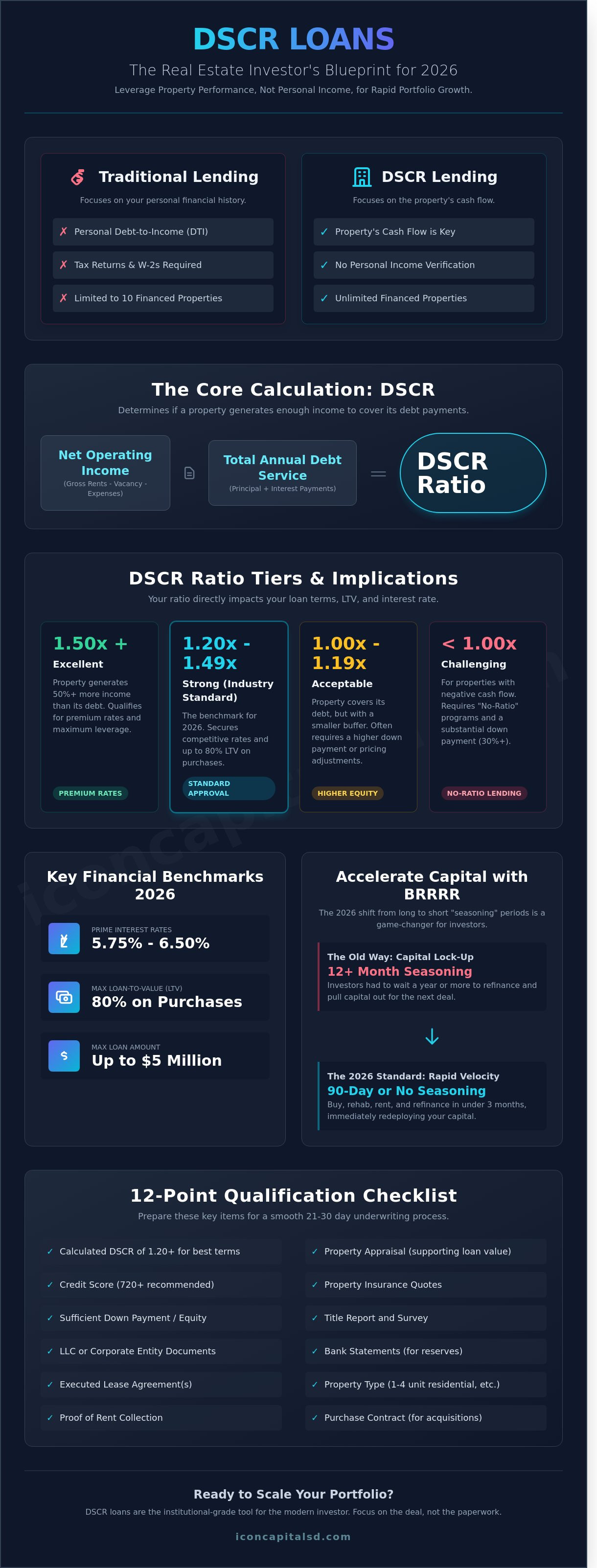
DSCR loans qualify borrowers based on the property’s gross rental income rather than personal income, tax returns, or debt-to-income (DTI) ratios. This financing model relies on the Debt Service Coverage Ratio (DSCR) to determine if a property generates enough cash flow to cover its annual debt obligations. By January 2026, the market has moved away from the volatility of previous years. Meeting the updated dscr loan requirements 2026 is now the standard path for investors who want to scale without the documentation hurdles of traditional retail banking.
The 2026 shift is defined by stabilized interest rates and a surge in Non-QM lending volume. Traditional Fannie Mae and Freddie Mac loans often limit investors to 10 financed properties and require extensive verification of personal earnings. Investors are moving toward DSCR products because they offer 40-year interest-only terms and loan amounts reaching $5 million. These products allow for rapid portfolio expansion that isn’t possible under the restrictive caps of conventional financing. The focus has moved entirely to the asset’s performance, making the borrower’s employment status secondary to the lease agreement’s strength.
Current Rate Environment and DSCR Feasibility
Interest rates for prime DSCR products in 2026 have plateaued between 5.75% and 6.50% for most 1-4 unit residential assets. This stability allows for precise “coverage” math during the acquisition phase. A 1.20x ratio remains the benchmark for competitive pricing; however, lenders have adjusted their models to accommodate lower margins in high-growth markets. The relationship between loan pricing and the debt service ratio is direct. A ratio of 1.50x might secure a 0.25% rate discount, while a 1.00x ratio usually triggers a pricing adjustment of 0.50% or higher.
- No-Ratio Programs: These have seen a 20% increase in utilization for deals with at least 30% equity.
- Par Pricing: Typically achieved at a 1.25x coverage mark in the current 2026 credit environment.
- Loan-to-Value (LTV): Most lenders cap LTV at 80% for purchases when the DSCR exceeds 1.15x.
Refinance and Seasoning Trends
Liquidity management is the primary objective for investors in 2026. Current standards for cash-out refinances have become significantly more aggressive, with many lenders offering “no seasoning” or 90-day seasoning options. This allows investors to buy a distressed property, renovate it, and pull their initial capital out based on a new appraisal in under three months. This speed is critical for the BRRRR (Buy, Rehab, Rent, Refinance, Repeat) strategy which remains the dominant growth tactic this year.
Property values across major metropolitan areas saw a 4.2% average increase throughout 2025, which has stabilized LTV requirements. Investors can now leverage this forced appreciation almost immediately. Under dscr loan requirements 2026, a 75% LTV on a cash-out refinance is standard for borrowers with a 720+ credit score. Lenders are prioritizing the “as-is” value post-renovation, provided the new lease agreement supports the debt service. This shift from 12-month seasoning to 90-day windows has increased the velocity of capital for professional real estate firms.
DSCR loans in 2026 are the primary leverage tool for self-employed investors who require streamlined capital to acquire and hold income-producing assets without traditional DTI constraints.
The DSCR Ratio: Calculating Your Coverage for Approval
The Debt Service Coverage Ratio (DSCR) is the primary metric used to evaluate the viability of an investment property. Unlike traditional mortgages that focus on debt-to-income ratios, dscr loan requirements 2026 prioritize the asset’s ability to pay for itself. The calculation is a hard data point: divide the property’s Net Operating Income (NOI) by its Total Annual Debt Service. This result tells a lender exactly how much breathing room exists between the property’s earnings and its liabilities. For example, a 1.25 DSCR means the property generates 25% more income than the mortgage payment, providing a necessary buffer for the investor and the financial institution.
In the 2026 lending environment, the 1.20x ratio remains the industry standard for standard leverage products. Meeting this benchmark typically allows investors to access 80% Loan-to-Value (LTV) options with the most aggressive interest rates available. If a property falls below this mark, it doesn’t automatically trigger a rejection. Many programs now accommodate low-ratio scenarios, including 1.0x (break-even) or even 0.75x (negative cash flow) ratios. These paths require higher down payments, often ranging from 35% to 45%, to offset the increased risk of a property that doesn’t fully cover its own debt service from day one.
Defining Net Operating Income (NOI) for Lenders
Lenders calculate NOI by starting with the gross annual rent and subtracting specific operating expenses. Underwriters strictly include property taxes, hazard insurance, and any applicable HOA or property management fees. They ignore personal expenses, depreciation, and individual tax write-offs, as these don’t impact the property’s fundamental ability to service the debt. For vacant units or properties transitioning to new management, lenders utilize a Form 1007 Market Rent Survey. This appraisal-based document ensures the NOI reflects 2026 market realities rather than historical data that might be outdated.
Total Debt Service Components
The “Debt Service” part of the equation is the annual sum of PITIA: Principal, Interest, Taxes, Insurance, and Association dues. Investors often choose between a standard 30-year fixed-rate mortgage and an Interest-Only (IO) period. Interest-Only options are a strategic tool to satisfy dscr loan requirements 2026 because they lower the monthly debt obligation during the initial phase of the loan. By excluding the principal portion of the payment, the debt service figure decreases, which mathematically raises the DSCR. This strategy is particularly effective for investors looking to structure loan options that maximize monthly cash flow on high-value assets where traditional amortizing payments might squeeze margins.
To ensure accuracy in your application, you must account for the following data points in your debt service calculation:
- Principal and Interest: The monthly cost of the loan based on the current 2026 rate environment.
- Property Taxes: The most recent assessment from the local municipality.
- Insurance: The annual premium for landlord or “DP3” policies.
- HOA Dues: Mandatory monthly or annual fees for condos or planned unit developments.
Lenders in 2026 are increasingly precise with these figures. They often use a 5% to 10% vacancy factor in their internal stress tests, even if your property is currently 100% occupied. Understanding these mechanics allows you to present a deal that is move-in ready for the underwriting department, reducing the time from submission to funding.
Borrower and Property Eligibility Standards
Qualifying for investment financing in the current market requires a clear understanding of how lenders weigh risk versus collateral. The dscr loan requirements 2026 focus primarily on the asset’s ability to generate revenue, but the borrower’s financial profile determines the available leverage. While these loans don’t require tax returns or pay stubs, underwriters still demand specific credit and liquidity benchmarks to offset the lack of personal income verification.
Lenders categorize eligibility into three main buckets: credit reputation, skin in the game, and property viability. Most programs maintain a 620 FICO floor. However, a 620 score often limits your Loan-to-Value (LTV) to 65% or 70%. To access the maximum 80% LTV for purchases, investors typically need a score of 740 or higher. Refinance transactions are slightly more restrictive; expect a 75% LTV cap for rate-and-term deals and a 70% cap for cash-out refinances. Property eligibility has also expanded. While single-family residences and 2-4 unit multi-family homes remain the standard, the 5-8 unit niche has become a staple of Non-QM lending, allowing investors to scale without moving into full commercial bridge territory.
Credit Score Impact on Leverage
Your credit score is the primary lever for pricing and down payment requirements. A score above 700 significantly reduces the capital needed upfront, often allowing for a 20% down payment on residential investment properties. If you have “broken” credit due to a foreclosure or bankruptcy, Non-QM flexibility still exists. Most 2026 guidelines allow for these events if they occurred at least 24 months ago. The most critical advantage here is that your personal Debt-to-Income (DTI) ratio is completely ignored. The underwriter doesn’t care about your car note or personal mortgage; they only care about the property’s performance and your history of managing debt.
Asset and Reserve Requirements
Liquidity is the safety net that lenders require to ensure the mortgage gets paid during vacancy periods. You’ll need to show 3 to 6 months of PITI (Principal, Interest, Taxes, and Insurance) in liquid reserves. Acceptable sources for your down payment and reserves include:
- 1031 Exchange Funds: Ideal for deferring taxes while scaling into larger assets.
- Business Funds: Capital held in an LLC or Corp account is acceptable with an entity letter.
- Gift Funds: Some programs allow a percentage of the down payment to be gifted from a family member.
- Asset Depletion: High-net-worth individuals can use their total brokerage or retirement account balances to bolster the file, even if they don’t have a traditional job.
Standardizing your documentation is essential for a fast closing. Lenders will verify the last 60 days of account statements to ensure funds are seasoned. If you’re moving money between accounts, do it early to avoid complex paper trails during the underwriting process. Meeting the dscr loan requirements 2026 isn’t about proving how much you earn at a 9-to-5 job; it’s about proving you have the capital to close and the credit history to stay committed to the investment. By maintaining a 740 FICO and keeping six months of payments in a liquid account, you position yourself for the lowest possible interest rates and maximum leverage.
Documentation and Entity Requirements for Investors
The core appeal of the DSCR model is the removal of traditional friction points. Unlike conventional financing, dscr loan requirements 2026 don’t mandate the submission of personal tax returns, W-2s, or debt-to-income (DTI) calculations. This “no-income” advantage is a strategic tool for self-employed investors or those with complex tax filings that show high deductions. Instead of verifying your salary, underwriters focus on the property’s ability to pay for itself. You’ll need to provide 2 months of bank statements to verify down payment funds and 6 to 12 months of PITI reserves, but your personal employment history stays out of the equation.
This streamlined documentation allows for significantly faster closing times. While a traditional bank might take 45 days to process a loan, DSCR deals often close in 21 days or less. The emphasis remains on the asset’s liquidity and the borrower’s credit score rather than a 40-hour work week. To see how these streamlined standards apply to your next purchase, you can Request a Quote to see your specific eligibility based on your current portfolio.
The LLC and Corporate Advantage
In 2026, approximately 88% of professional investors choose to close loans under an entity rather than their personal names. Borrowing as an LLC or Corporation provides a layer of asset protection that separates your personal wealth from your real estate liabilities. It also allows for easier scaling, as these loans don’t appear on your personal credit report in the same way a standard mortgage does. To qualify under an entity, you’ll need to provide specific documentation:
- Articles of Organization: Proof that the entity is legally registered.
- Operating Agreement: This must outline who has the authority to sign for the loan.
- EIN Confirmation: The IRS letter assigning your Employer Identification Number.
- Certificate of Good Standing: A state-issued document showing the entity is active and compliant.
Most lenders require a Personal Guarantee (PG) from any individual with 20% or more ownership in the LLC. This doesn’t mean the loan is based on your income, but it does mean you’re personally responsible if the entity defaults on its obligations.
Appraisal and Rent Verification
The appraisal is the most critical document in the DSCR process because it verifies the “R” in the ratio. For single-family homes, appraisers use Form 1007, the Single-Family Comparable Rent Schedule. The appraiser analyzes three local rental comps within a 2-mile radius to determine the fair market rent. If the 1007 shows a market rent of $3,000 and your total carrying costs are $2,400, your DSCR is a healthy 1.25.
For multi-unit properties, specifically those with 5-8 units, underwriters require Form 216, known as the Operating Income Statement. This form is more detailed than the 1007. It accounts for actual vacancy rates, which are typically modeled at 5% to 7%, and annual maintenance costs. Short-term rentals (STRs) follow a different path in 2026. Underwriters now accept AirDNA “Rentalizer” reports or 12-month historical statements from platforms like Airbnb. However, most lenders apply a 20% haircut to projected STR income to account for seasonal volatility and management fees.
Ready to leverage your property’s cash flow for your next investment? Check your DSCR loan eligibility today.
Executing the Deal: From Application to Closing
Structuring a deal for maximum ROI requires a tactical approach to leverage and cash flow. In the 2026 market, a 1.25x debt service coverage ratio is the standard benchmark for unlocking 80% LTV. If a property’s cash flow only generates a 1.10x ratio, lenders typically reduce leverage to 70% or 75% to mitigate risk. Understanding the dscr loan requirements 2026 is only the first step; execution is what secures the asset. Investors must analyze the 1007 Rent Schedule during the appraisal process, as this data point often dictates the final loan amount more than the purchase price. If market rents don’t support the requested loan amount, you may need to consider a rate buy-down to lower the annual debt service and maintain your desired LTV.
The underwriting phase typically spans a 21 to 30 day window. During this period, the lender scrutinizes the asset’s performance rather than your personal tax returns or debt-to-income ratio. This Non-QM approach allows for a streamlined verification process, but it demands absolute accuracy in the initial submission. Underwriters focus on the property’s historical income and the validity of existing lease agreements. Any discrepancy between the stated income and the appraiser’s market rent analysis can trigger a re-structure of the deal terms. Expect a conditional approval within the first 7 to 10 days, followed by a final review once the appraisal and title work are complete.
Closing logistics involve more than just signing papers; they require precise entity and insurance coordination. You must verify that the title is prepared for vesting in a legal entity, such as an LLC or Corporation, because most DSCR programs prohibit individual vesting. Insurance policies require a specific “Loss Payee” and “Additional Insured” clause that names the lender’s funding entity correctly. Missing this detail can stall a closing by 48 to 72 hours while the agent issues a corrected accord. Entity documents, including the Operating Agreement and a Certificate of Good Standing issued within the last 30 days, are mandatory for the final loan set. Meeting dscr loan requirements 2026 involves keeping these administrative details organized to prevent last-minute delays.
Avoiding Common Processing Delays
Processing bottlenecks often occur when leases aren’t fully executed or are expired. Ensure all tenant signatures are present before submission. If the property has vacancies exceeding 10%, provide a clean Letter of Explanation detailing the specific marketing plan or recent renovations. Additionally, confirm your insurance coverage meets the lender’s exact deductible limits, which often cap at $5,000 or 1% of the policy value. Verify these details early to ensure a smooth 30-day close.
Why Icon Capital LLC is the Investor’s Choice
Icon Capital LLC specializes in complex scenarios that traditional banks won’t touch. We provide financing for 5 to 8 unit properties, Foreign National investors, and Fix & Flip portfolios. Our clients get direct access to underwriters who prioritize investment math over rigid red tape. To secure your next acquisition with a partner who understands scale, get a custom DSCR quote today. Efficient execution in 2026 requires a lender who understands the speed of the investment market.
Leverage Your Capital for 2026 Growth
Navigating the evolving landscape of dscr loan requirements 2026 requires a precise understanding of debt coverage and asset valuation. Success hinges on maintaining a 1.20x or higher DSCR ratio while ensuring your LLC is properly structured for commercial lending. Icon Capital delivers deep expertise in Non-QM and creative financing to help you bridge the gap between opportunity and capital. Our specialized programs for 5-8 unit properties provide a distinct advantage for investors targeting mid-sized multifamily assets that traditional banks often overlook. We’ve refined a streamlined 4-step loan process to eliminate friction, taking you from initial structure to a funded deal efficiently. You’ll benefit from a lending partner that prioritizes the technical mechanics and speed of your transaction. Don’t let rigid traditional standards stall your portfolio growth when specialized solutions are ready for deployment. We’re here to get your next acquisition across the finish line with confidence.
Request a DSCR Loan Quote from Icon Capital
Frequently Asked Questions
What is the minimum credit score for a DSCR loan in 2026?
The minimum credit score for most DSCR programs in 2026 is 620. However, investors seeking an 80% LTV typically need a score of 720 or higher. Lower scores between 620 and 660 usually trigger a 5% to 10% reduction in maximum leverage. Meeting these specific dscr loan requirements 2026 ensures you access the most competitive pricing tiers and the lowest available points at closing.
Can I get a DSCR loan for a short-term rental or Airbnb?
You can secure a DSCR loan for short-term rentals and Airbnb properties using projected market data. Lenders typically verify income through AirDNA reports or the last 12 months of the property’s actual operating history. Most programs require a 1.0x coverage ratio based on these short-term projections to qualify for standard 75% LTV terms. This flexibility allows investors to capitalize on high-yield vacation markets without traditional lease agreements.
Do DSCR loans require personal tax returns?
DSCR loans don’t require personal tax returns or debt-to-income (DTI) calculations. Underwriters focus exclusively on the property’s gross monthly rent versus the PITIA, which includes principal, interest, taxes, insurance, and association dues. This streamlined process allows self-employed investors to scale without the 24-month income history required by traditional banks. It’s an ideal solution for those with high deductions that lower their taxable income on Form 1040.
What is the standard down payment for a DSCR loan?
The standard down payment for a DSCR loan ranges from 20% to 25% of the purchase price. First-time investors should expect a 25% down payment requirement to mitigate lender risk. Experienced investors with at least 3 successful exits in the last 36 months can often access 80% LTV options, requiring only a 20% cash injection at closing. These requirements stay consistent across most residential 1-4 unit investment properties.
Is there a limit to how many DSCR loans I can have?
There’s no limit to the number of DSCR loans an investor can hold simultaneously. Unlike conventional financing that caps borrowers at 10 financed properties, private lenders focus on the individual asset’s performance. You can leverage these dscr loan requirements 2026 to build a portfolio of 50 or more units as long as each property meets the minimum coverage ratio. This enables rapid scaling that isn’t possible through Fannie Mae or Freddie Mac.
What happens if the DSCR ratio is below 1.0?
If the DSCR ratio falls below 1.0, the property is considered “negative cash flow” and requires higher equity. Lenders often permit ratios as low as 0.75, but they’ll reduce the maximum LTV to 65% or 70%. You’ll likely face a 0.25% to 0.50% interest rate premium for any loan where the rental income doesn’t fully cover the debt service. This structure ensures the deal remains viable for the underwriter.
Can foreign nationals qualify for DSCR loans in the US?
Foreign nationals qualify for DSCR loans with a valid passport or ITIN. These borrowers typically need a 30% down payment and must maintain 12 months of PITIA reserves in a US-based financial institution. The underwriting process skips US credit history requirements, focusing instead on the property’s 1.2x DSCR performance and the borrower’s liquidity. It’s a direct path for international investors to enter the US real estate market without a domestic credit profile.
Are DSCR loan interest rates higher than traditional mortgages?
DSCR loan interest rates are typically 1% to 2% higher than traditional 30-year fixed mortgages. This 100 to 200 basis point spread compensates the lender for the increased risk of non-QM lending and the lack of personal income verification. Investors accept these costs for the ability to close in 21 days and bypass strict DTI limits. The higher rate is often offset by the ability to acquire more units through increased leverage.