

Traditional bank guidelines are currently disqualifying 42% of active real estate investors based on personal debt-to-income ratios alone. If you’re relying on conventional mortgages, you’re likely facing a ceiling that has nothing to do with your property’s actual performance. You understand that rigid underwriting often fails to account for the cash flow of the asset or the unique financial structure of a self-employed professional. It’s a common bottleneck where a profitable 80% LTV deal stalls because of a tax return that doesn’t reflect your true liquidity.
This 2026 guide provides a technical breakdown of how to bypass these barriers using Loans for Investment Properties that prioritize asset performance over personal income. We’ll show you how to master real estate leverage through DSCR, Fix & Flip, and Non-QM products designed for rapid growth. You’ll gain a clear understanding of how a 1.20 debt service coverage ratio can replace traditional income verification to help you scale your portfolio without the typical institutional constraints.
Key Takeaways
- Understand why conventional mortgages often fail and how specialized Loans for Investment Properties provide the flexibility needed for non-owner-occupied real estate.
- Explore the technical advantages of DSCR and Fix & Flip products to maximize leverage on both long-term rentals and short-term value-add projects.
- Learn to qualify using bank statement programs that allow self-employed investors to prove liquidity without traditional tax returns or W-2 documentation.
- Identify strategies for scaling your portfolio through the “Velocity of Money,” comparing HELOCs and cash-out refinancing to keep capital moving.
- Discover a simplified, deal-first approach to underwriting that accelerates the transition from loan structure to funding.
What Are Loans for Investment Properties and Why Traditional Financing Often Fails?
Loans for investment properties are specialized financial instruments designed for non-owner-occupied real estate. These aren’t standard home loans; they’re business tools used to acquire, renovate, or hold income-producing assets. While traditional banks prioritize your personal salary and history, professional lenders look at the deal’s viability. Real estate investing relies on leverage. If you can’t access capital efficiently, your portfolio stagnates. By 2026, the distinction between the borrower’s personal profile and the asset’s performance has become the defining factor in loan approval speeds and interest rate tiers.
The traditional mortgage market isn’t built for scale. Most retail banks use automated underwriting systems that flag any borrower with a complex tax return. If you’re a full-time investor, your 1040 probably shows significant depreciation and business deductions that lower your taxable income. To a bank, you look like a risk. To a private lender, those deductions represent savvy tax planning. This disconnect is why the 2026 lending environment favors asset-based solutions over government-backed products that require mountains of personal paperwork.
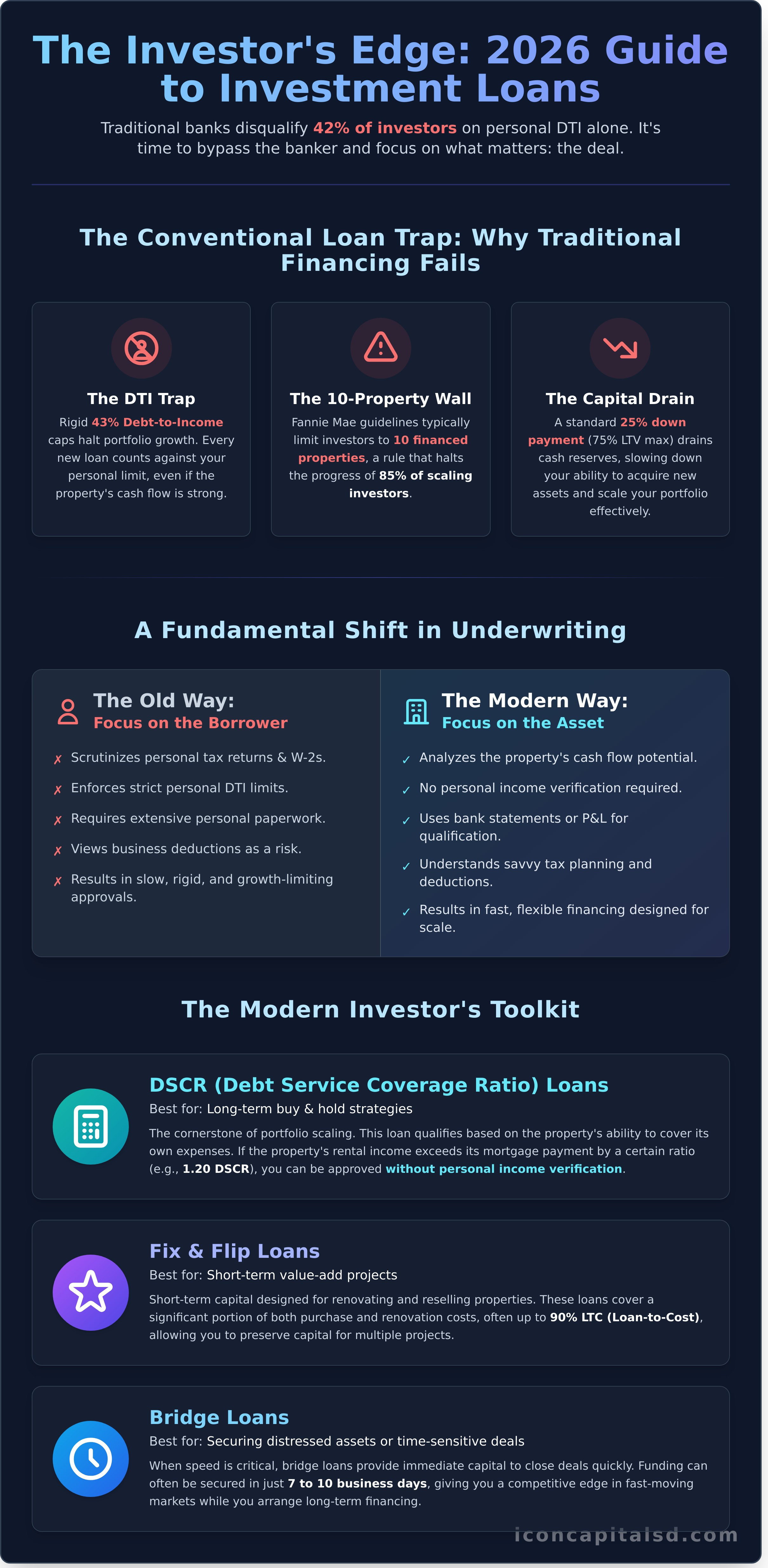
The “DTI Trap” is the primary reason investors stop at three or four properties. Conventional lenders cap your personal debt-to-income ratio at 43%. Every mortgage you take out counts against this limit, even if the rental income covers the payment. Eventually, your personal debt profile prevents you from securing another loan regardless of your net worth. Professional investors bypass this by using Loans for Investment Properties that focus on the property’s income to qualify, effectively decoupling their personal credit from their business growth.
The Limitations of Conventional Mortgages for Investors
Traditional financing hits a hard ceiling quickly. Fannie Mae guidelines generally limit a borrower to 10 financed properties, a rule that halts the progress of 85% of scaling investors. The 75% LTV wall is another major hurdle. Most banks won’t lend beyond 75% of the value for an investment property, requiring a 25% down payment. This drains cash reserves 30% faster than creative alternatives. For full-time investors without a W-2, these rigid barriers make traditional banks a dead end for growth.
The Rise of Non-QM and Creative Financing
Non-QM (Non-Qualified Mortgage) products fill the gap left by big banks. These loans don’t follow federal government-backed guidelines, allowing for more flexible documentation and higher loan amounts up to $2 million or more. Creative financing turns borrowing into a strategic advantage. It’s about structuring the debt to fit the asset’s lifecycle rather than forcing the borrower into a box. We focus on three primary vehicles for 2026:
- DSCR (Debt Service Coverage Ratio): Qualification based on property cash flow; no personal income verification required.
- Fix & Flip: Short-term capital for renovations with up to 90% LTC (Loan to Cost).
- Bridge Loans: Immediate capital for quick closings, often funded in 7 to 10 business days to secure distressed assets.
The shift toward asset-based lending in 2026 reflects a more pragmatic approach to Loans for Investment Properties. Instead of scrutinizing a borrower’s grocery spending, lenders are now analyzing the rental market’s strength and the property’s ability to generate a return. This transition allows for rapid scaling that was previously impossible under old-school banking regulations.
The Investor’s Toolkit: Exploring DSCR, Fix & Flip, and Bridge Loans
Scaling a real estate portfolio in 2026 requires a departure from traditional banking constraints. Conventional lenders often cap an investor at ten properties and impose strict debt-to-income (DTI) limits that stifle growth. Professional investors instead utilize specialized Investment Property Loans that prioritize the asset’s performance over the borrower’s personal income. This shift allows for rapid acquisition without the friction of tax return scrutiny or employment verification.
DSCR Loans: Financing Based on Property Cash Flow
Debt Service Coverage Ratio (DSCR) loans represent the primary tool for long term buy and hold strategies. These products evaluate the property’s ability to cover its own monthly expenses rather than looking at the borrower’s W-2 income. Lenders calculate the ratio by dividing the Gross Rental Income by the total Debt Service, which includes principal, interest, taxes, insurance, and association fees. A 1.0 or higher ratio serves as the standard benchmark for loan approval.
The advantages of DSCR financing are practical and immediate. Closing times typically range from 21 to 30 days. Because there is no DTI calculation, an investor with 50 properties can qualify as easily as an investor with one. Typical terms include 30 year fixed rates or interest only options with loan to value (LTV) ratios reaching 80% for purchases. This structure keeps capital liquid and allows for the acquisition of multiple assets simultaneously.
Fix & Flip and Construction Loans for Developers
Short term value add projects require a different capital structure. Fix and flip loans are designed to cover both the acquisition price and 100% of the renovation costs. Lenders use the After Repair Value (ARV) as the primary metric for sizing these loans. Most programs fund up to 75% of the ARV, ensuring the investor has a 25% equity cushion upon project completion.
The funding follows a specific cadence known as the draw process. Once the loan closes, the purchase capital is released. Renovation funds remain in escrow. As the developer completes specific milestones, such as plumbing or roofing, an inspector verifies the work. Funds are then released in stages to pay contractors and purchase materials. This methodical approach protects the lender and ensures the project maintains momentum toward a profitable exit or a long term refinance.
Bridge Loans for Rapid Acquisitions
Bridge loans act as the connective tissue for time sensitive transactions. These are often used when an investor needs to secure a new property before a current asset has sold or when a property requires minor stabilization before qualifying for long term debt. Speed is the defining characteristic of this product. Funding can occur in as little as 7-10 days, allowing investors to compete with cash buyers in high demand markets. You can Request a quote to see current bridge rates and terms for your specific scenario.
- Bridge Loan LTV: Usually capped at 70% to 75% of the current value.
- Interest Rates: Higher than DSCR but lower than hard money, typically structured as interest only.
- Exit Strategy: Required at the outset, usually via a sale or a refinance into a permanent DSCR loan.
Utilizing the right Loans for Investment Properties ensures that capital is never the bottleneck for your expansion. Whether you are stabilizing a distressed asset or building a rental empire, choosing the correct instrument is the first step toward a successful closing. If you are ready to scale, you can structure your next deal with a partner who understands creative financing.
Qualifying Without a W-2: Leveraging Bank Statements and P&L Programs
Traditional underwriting relies on net taxable income. This creates a bottleneck for self-employed investors who utilize aggressive tax write-offs to minimize their liabilities. In 2026, an estimated 35% of professional real estate investors fall into this category, showing minimal “paper” income despite healthy cash flow. Non-QM products solve this by prioritizing gross deposits over tax return figures. These programs allow you to secure Loans for Investment Properties by proving your ability to repay through actual liquidity and business performance.
Standard documentation for these loans bypasses the IRS Form 1040 entirely. Lenders instead analyze 12 or 24 months of consecutive bank statements to determine an average monthly income. For a comprehensive overview of how basic lending differs from these specialized products, refer to the Consumer Financial Protection Bureau guide on mortgages. While traditional paths are rigid, creative financing focuses on the functional reality of your business operations.
Bank Statement and P&L Loans for Entrepreneurs
Underwriters calculate “effective income” by totaling all eligible deposits over a 12 or 24-month period. If you use business bank statements, lenders typically apply a standard 50% expense ratio to determine qualifying income. You can lower this ratio by providing a Profit and Loss (P&L) statement prepared by a licensed CPA, potentially qualifying you for a higher loan amount. Asset Qualification is another viable path; it allows you to qualify based on total liquid assets. For example, a borrower with $1 million in liquid reserves can use a percentage of that total as “income” to meet debt-to-income requirements without showing a single paycheck.
- Documentation: 12-24 months of business or personal statements.
- LTV Limits: Typically up to 80% for purchase or rate-and-term refinances.
- Credit Scores: Programs often start at a 660 FICO, though 720+ secures the best 2026 rates.
- Loan Amounts: Available from $150,000 up to $5 million for high-end portfolios.
Foreign National Investment Programs
US real estate remains a primary global asset class in 2026 due to its relative stability and transparent legal framework. Foreign National programs are designed for non-US citizens looking to build a domestic portfolio. These Loans for Investment Properties don’t require a US credit history or a Social Security number. Instead, lenders utilize international credit reports or letters of reference from foreign financial institutions to establish creditworthiness.
Qualification centers on the property’s potential. Most Foreign National loans are structured as DSCR products, where the rental income of the property must cover the debt service. Borrowers must provide a valid Passport and a specific Visa type, such as a B-1, B-2, H-2, or H-3. An ITIN (Individual Taxpayer Identification Number) is often required for tax purposes, but the focus remains on the asset’s performance. This streamlined approach allows international investors to close deals in as little as 21 days, providing the speed necessary to compete in high-demand markets like Florida, Texas, and Arizona.
Strategic Scaling: How to Use Leverage to Grow Your Real Estate Portfolio
Successful scaling in 2026 depends on the Velocity of Money. This concept measures how quickly your capital moves from one asset to the next. Stagnant equity is dead weight; it represents trapped value that isn’t working for you. Professional investors prioritize recycled capital over total ownership. By extracting equity through Loans for Investment Properties, you ensure your initial down payment continues to fund new acquisitions rather than sitting idle in a single roof.
Choosing the right extraction tool is critical. A Home Equity Line of Credit (HELOC) on a primary residence offers a flexible, revolving credit line, which is ideal for short-term funding or earnest money deposits. However, cash-out refinancing on an existing investment property is often superior for long-term growth. By 2026 standards, cash-out refinances allow you to lock in fixed rates on 75% of a property’s appraised value, providing a predictable capital stack for your next purchase.
For those managing multiple assets, cross-collateralization offers a sophisticated path to expansion. This involves securing a single blanket loan against a pool of properties. Instead of managing five separate Loans for Investment Properties, you consolidate them into one facility. This strategy often lowers your total debt service and can reduce closing costs by approximately 2.2% compared to individual originations. It also allows you to use the high equity in one property to offset a lower equity position in another.
The most common objection to scaling is the fear of higher interest rates. This is a mathematical error. Your focus should be on the spread between the cost of capital and the asset’s yield. If a loan costs 8.5% but the property generates a 14% cash-on-cash return through strategic leverage, the 5.5% spread represents profit you wouldn’t have without the loan. Leverage isn’t just about debt; it’s about amplifying your Return on Equity (ROE).
Leveraging Equity for the Next Deal
The BRRRR method remains the standard for portfolio growth in 2026. You buy a distressed asset, rehab it to add value, rent it to stabilize income, and then refinance using a Debt Service Coverage Ratio (DSCR) loan. To succeed, your “Investment Readiness” checklist must include a minimum 680 FICO score, a 1.25 DSCR on the target property, and at least six months of cash reserves. Pulling cash out of a stabilized asset to fund a new Fix & Flip is the fastest way to double your door count within a 12-month cycle.
Portfolio Loans for Multi-Unit Investments
Financing for 5-8 unit buildings requires a shift in mindset. These assets are treated as commercial properties because their value is derived from Net Operating Income (NOI) rather than residential comps. Lenders prioritize the building’s ability to generate cash flow over your personal debt-to-income ratio. This commercial classification allows for more flexible terms and higher loan amounts. You can Contact Icon Capital for a portfolio review to determine if your current assets qualify for commercial-grade consolidation.
Ready to move your equity into a more productive asset? Apply for a custom leverage strategy to start scaling your portfolio today.
Simplifying the Investment Loan Process with Icon Capital LLC
Retail banks often fail to grasp the nuances of non-traditional real estate assets. Icon Capital LLC operates with a “Deal-First” philosophy, focusing on the underlying mechanics of the transaction rather than just a borrower’s personal tax returns. This approach is essential for scaling a portfolio in 2026. We’ve refined our internal workflow into a direct, four-step process designed for speed:
- Structure: We analyze the asset’s cash flow and your specific exit strategy to determine the best program fit.
- Submit: You provide the necessary digital files through our secure, streamlined portal.
- Underwrite: Our specialists evaluate the DSCR and property value without the red tape of retail banks.
- Close: We finalize the funding, often closing in 14 days or less depending on the product type.
Working with a specialist provides a level of efficiency that generalist lenders can’t match. A retail bank might manage everything from car loans to checking accounts, which dilutes their expertise in complex real estate debt. We focus exclusively on financing for investors. This specialization means we understand why a 75% LTV on a fix-and-flip makes sense or how to cross-collateralize assets to unlock equity. It’s time to move from browsing listings to borrowing with a partner who speaks the language of ROI. Loans for Investment Properties require a technical eye, and our process ensures no time is wasted on redundant paperwork.
The “Deal-First” mentality means we look at the numbers that drive your profit. If the property generates a 1.25 DSCR, it’s a viable candidate for funding. We’ve seen that 40% of our clients come to us after being rejected by traditional lenders for reasons that have nothing to do with the quality of the real estate. Our goal is to provide the leverage you need to expand your holdings without the 60-day waiting periods common in the retail sector.
The Icon Capital Advantage
We provide creative financing solutions for unique scenarios that don’t fit into a standard box. Our team handles high loan amounts, frequently exceeding $2,000,000 for serious investors looking to acquire high-value assets or multi-unit portfolios. We prioritize speed and transparency, providing clear terms early in the process. While 62% of traditional loan applications face delays due to administrative bottlenecks, our streamlined underwriting focuses on the data that matters. This results in faster approvals and a more predictable path to the closing table.
Getting Started: Your Next Steps
Preparation is the difference between a funded deal and a missed opportunity. You should have a specific deal or a signed Letter of Intent (LOI) ready for review. You’ll also need to gather your Entity Docs, such as your LLC Operating Agreement and EIN confirmation, since we lend to business entities to maximize your professional leverage. Having these files organized in a digital format can shave 72 hours off your total processing time. If you’re ready to secure capital for your next acquisition, get your custom mortgage quote today. We specialize in the Loans for Investment Properties that help you build long-term wealth.
Scale Your Real Estate Portfolio with Precision Financing
Navigating the 2026 real estate market requires a shift from restrictive traditional lending to more agile, asset-based strategies. Investors who rely solely on W-2 income often hit a ceiling that prevents significant growth. By leveraging specialized Loans for Investment Properties, you can unlock capital through DSCR and Bank Statement programs that focus on property performance rather than personal tax returns. These Non-QM tools are essential for maintaining liquidity while expanding your holdings.
Icon Capital LLC delivers these results through a sophisticated suite of creative financing options. We provide specialized programs for Foreign Nationals and self-employed individuals who require flexible documentation. Our team manages a rigorous 4-step closing process to ensure your deals move from initial structure to funded status efficiently. Whether you’re managing a $2 million acquisition or a high-turnover portfolio, we provide the technical expertise to keep your capital moving. It’s time to stop letting rigid bank guidelines dictate your investment timeline.
Secure your next deal with a custom loan quote from Icon Capital
Your next acquisition is within reach when you have the right financial partner.
Frequently Asked Questions
Can I get a loan for an investment property with no money down in 2026?
Acquiring an investment property with zero money down in 2026 requires creative structures like seller financing or cross-collateralization. Traditional lenders typically demand a 20% to 25% down payment to offset risk. You can achieve 100% financing by leveraging equity in other real estate assets you already own. This strategy allows you to secure a new acquisition without liquidating cash, provided the total portfolio LTV stays below 75%.
What is the minimum credit score required for a DSCR loan?
The minimum credit score for a DSCR loan is 620. While some specialized Non-QM programs accept scores as low as 600, these often require a 10% reduction in maximum leverage. To access the most competitive interest rates and 80% LTV, you should aim for a score of 720 or higher. Lenders prioritize the property’s cash flow, but your credit score still dictates the final pricing and reserve requirements.
How do interest rates for investment properties compare to primary residences?
Interest rates for loans for investment properties typically run 0.75% to 1.25% higher than rates for primary residences. This premium accounts for the higher default risk associated with non-owner-occupied assets. In 2026, a borrower with a 740 credit score might see a 6.5% rate on a primary home while facing a 7.5% rate on a rental. Increasing your down payment to 30% can often help narrow this interest rate spread.
Is it better to buy an investment property in my personal name or an LLC?
Purchasing through an LLC is the standard choice for 90% of professional investors to limit personal liability. While closing in a personal name might offer slightly lower upfront costs, an LLC protects your individual assets from litigation related to the property. Most DSCR and portfolio lenders allow you to close in an entity’s name. This structure also facilitates easier partnership agreements and helps you scale your portfolio more efficiently.
Can I use a bridge loan to buy a property at a foreclosure auction?
You can use a bridge loan to acquire properties at foreclosure auctions if the lender provides proof of funds or pre-funded accounts. These loans offer the speed required for auction deadlines, often closing in 5 to 7 days. Most bridge products offer a 12-month term with interest-only payments. Expect to provide a 20% down payment based on the purchase price or the property’s current as-is value at the time of sale.
What happens if the property’s DSCR ratio is below 1.0?
If a property’s DSCR ratio falls below 1.0, you can still secure funding through no-ratio or debt-service-blind programs. These loans focus on your liquidity and the asset’s long-term appreciation potential rather than immediate monthly cash flow. You’ll face a lower maximum LTV, typically capped at 65%. Lenders often require 12 months of interest reserves to offset the projected monthly deficit until rents can be increased to market levels.
Are foreign national loans more expensive than standard investment loans?
Foreign national loans are more expensive, with interest rates typically 1.0% to 1.5% higher than domestic investment loans. Lenders require a larger down payment, often starting at 35%, because they can’t rely on a U.S. credit score for qualification. You’ll need to provide a valid passport and international credit reports or bank reference letters. Despite the higher costs, these programs remain a vital tool for global investors looking to enter the U.S. market.
How many investment properties can I finance at one time?
You can finance an unlimited number of loans for investment properties using DSCR and portfolio lending programs. Conventional Fannie Mae and Freddie Mac guidelines limit individual borrowers to 10 financed properties. Once you hit this cap, you must transition to commercial-style financing. These programs don’t report to your personal credit, allowing you to scale your portfolio to 50 or 100 units without impacting your personal debt-to-income ratio.