

Traditional bank financing is a strategic liability for the 10.6 million self-employed investors entering the 2026 market. You’ve likely experienced the friction of 45 day closing timelines and rigid debt-to-income (DTI) ratios that fail to account for your actual business cash flow. Buying a rental property now requires a shift from personal qualification to asset-based performance. It’s time to stop letting traditional underwriting hurdles cap your growth and start focusing on the mechanics of the deal.
This guide provides the technical blueprint for mastering financial metrics and creative lending strategies to build a profitable real estate portfolio. You’ll learn how to leverage DSCR loans with 75% LTV thresholds and use non-QM products to bypass personal income verification. We’ll analyze the specific acquisition steps required to identify high-yield properties and secure leverage based on property income alone. This is the roadmap to scaling from a single asset to a multi-unit portfolio with speed and precision.
Key Takeaways
- Identify the 2026 market shifts and inventory trends that make professionalized landlording a premier strategy for long-term wealth acquisition.
- Master essential valuation metrics like Net Operating Income (NOI) and Cap Rate to ensure every asset meets your target yield requirements.
- Overcome traditional lending hurdles by utilizing Non-QM loan products tailored for non-W2 borrowers and complex investor profiles.
- Implement a streamlined 5-step roadmap for Buying a Rental Property to move efficiently from initial deal analysis to funded acquisition.
- Scale your portfolio rapidly with creative financing solutions designed to provide maximum leverage and expedited funding timelines.
Why Buying a Rental Property Remains a Premier Wealth Strategy in 2026
Buying a rental property in 2026 requires a shift from speculative gains to disciplined, cash-flow-centric underwriting. This asset class relies on the strategic use of leverage to control high-value assets with minimal initial capital. While the interest rate cycles of the previous three years reshaped the landscape, the current market shows a 12% increase in institutional participation, signaling a shift toward professionalized landlording. Investors must view this as a business rather than a hobby. Success depends on understanding the mechanics of a comprehensive guide to real estate investing to ensure every acquisition meets strict debt service coverage ratio (DSCR) requirements from the outset.
Passive income is often a misnomer for the uninitiated. Sole owners typically face 10 to 15 hours of monthly management per unit unless they hire a property manager. The real value lies in the tax code. Internal Revenue Code Section 167 allows for depreciation over 27.5 years, which creates a paper loss to offset actual rental income. Additionally, the 1031 exchange remains the most effective tool for deferring capital gains taxes when scaling from single-family units into larger multifamily portfolios. These mechanisms ensure that wealth isn’t just created; it’s preserved. Key tax benefits include:
- Depreciation: Deducting the property’s value over 27.5 years to lower taxable income.
- Mortgage Interest: Full deductibility of interest payments on investment loans.
- Operating Expenses: Writing off repairs, insurance, and property management fees.
- 1031 Exchange: Deferring 100% of capital gains taxes by reinvesting in “like-kind” assets.
Current market conditions in 2026 reflect a persistent housing shortage. National inventory levels sit at a 3.2-month supply, well below the 6-month equilibrium. This scarcity supports rental rate stability. Smart investors prioritize properties in markets with job growth exceeding 2% annually. They focus on the numbers, not the aesthetics. A property’s value is determined by its ability to generate income, which is why Buying a Rental Property remains the preferred vehicle for sophisticated capital looking for inflation-protected yields.
The Three Pillars of Rental ROI
Cash flow represents the immediate liquidity generated after accounting for the mortgage, property taxes, insurance, and a 10% maintenance reserve. It’s the primary defense against market volatility. Appreciation provides the long-term upside. In high-demand US metros, residential properties have maintained a 4.5% compound annual growth rate over the last 30 years. Finally, debt paydown acts as a forced savings account. Tenants effectively pay off the principal balance of your loan, increasing your equity position every month without additional out-of-pocket costs. Most investors target an entry LTV of 75% to 80% to balance leverage with safety.
Portfolio Diversification for Business Owners
Real estate serves as a critical hedge for entrepreneurs whose primary income is tied to business performance. Business owners can leverage retained earnings or business liquidity to secure property down payments, often utilizing Non-QM loan products that prioritize asset value over personal W-2 income. This transition from self-employment income to asset-based wealth provides a safety net. If a primary business sees a 20% revenue dip, the fixed rental income from a diversified property portfolio remains stable. Buying a Rental Property isn’t just about the house; it’s about structuring a financial fortress that operates independently of your daily labor and provides a clear exit strategy for retirement.
Analyzing the Numbers: Essential Metrics for Rental Property Success
Successful investors prioritize data over intuition. Buying a rental property is a mathematical exercise where the objective is to secure a predictable yield. You need to master four primary metrics before signing a contract to ensure the asset performs according to your financial goals.
Net Operating Income (NOI) represents your total income minus all operating expenses. It excludes mortgage payments and income taxes. NOI tells you how much cash the asset generates on its own. It’s the bedrock of all property valuations. To find the NOI, subtract costs like property management, insurance, and utilities from your gross collected rent. If a property generates $60,000 in rent and costs $25,000 to run, your NOI is $35,000.
Capitalization Rate (Cap Rate) measures the unleveraged return on investment. Calculate it by dividing NOI by the purchase price. In January 2026, a 6.5% to 7.8% Cap Rate is a standard target for Class B multi-family assets in growth corridors. This metric allows you to compare properties regardless of how they’re financed. It reveals the natural profitability of the real estate itself.
Cash-on-Cash (CoC) Return evaluates the performance of your actual out-of-pocket capital. It is the annual pre-tax cash flow divided by the total cash invested. This includes your down payment, closing costs, and any initial renovation capital. If you invest $120,000 to acquire a property and it nets $10,800 in annual cash flow after debt service, your CoC return is 9%. This is the most critical metric for investors focused on liquidity and immediate income.
The 1% Rule serves as a quick-scan method for filtering potential deals. It suggests that the monthly rent should equal at least 1% of the total acquisition cost. While difficult to find in premium coastal markets in 2026, it remains a valid benchmark for secondary markets. Investors must weigh these metrics against the risks and rewards of rental properties to ensure the deal aligns with their long-term risk tolerance.
Mastering the DSCR Ratio
Lenders use the Debt Service Coverage Ratio (DSCR) to determine if a property can sustain its own debt. Calculate it by taking the Annual Rental Income and dividing it by the Annual Debt Service. A ratio of 1.0 means the property breaks even. Most Non-QM lenders require a DSCR above 1.2x to offer competitive interest rates. Maintaining a ratio of 1.25x or higher often unlocks 80% LTV options and lower points at closing. It proves to the underwriter that the asset is self-sufficient.
Predicting Operating Expenses
Accurate forecasting prevents cash flow shortfalls that sink portfolios. The 50% Rule is a conservative estimate for quick analysis. It assumes that 50% of gross income will go toward taxes, insurance, and maintenance. While aggressive, it provides a safety margin for unexpected costs.
Accounting for vacancy rates is vital. In 2026 market conditions, budgeting for an 8% vacancy rate is prudent. This covers the 30 days a unit might sit empty during turnover. You must also establish Capital Expenditure (CapEx) reserves. Set aside 10% of monthly rent for high-ticket items. A $14,000 roof replacement or a $5,500 HVAC failure shouldn’t require a personal loan. Properly structuring these reserves allows you to scale your real estate portfolio without facing a liquidity crisis when major repairs arise.
Financing Your Acquisition: Why Traditional Mortgages Often Fail Investors
Conventional banks rely on rigid debt-to-income (DTI) frameworks that favor W2 employees with predictable paystubs. This creates a bottleneck for anyone following a guide to buying your first rental property because tax deductions and business expenses often lower reported income. Big banks often require 45 to 60 days to close a loan; a timeline that frequently results in lost deals when competing against cash buyers. Non-QM (Non-Qualified Mortgage) lending solves this by removing the “Red Tape” of personal income verification.
Non-QM products focus on the asset’s ability to generate revenue. When Buying a Rental Property, your focus should be on leverage versus liquidity. While a 20% down payment is the baseline, many investors opt for 25% or 30% to improve their interest rate and monthly cash flow. High leverage preserves your capital for the next acquisition, but it requires a lender who understands how to structure debt for scale. Speed of execution is a critical competitive advantage. Non-QM lenders can move from submission to funding in 14 days or less, allowing you to secure properties in tight markets where sellers prioritize certainty and speed.
DSCR Loans: The Gold Standard for Investors
Debt Service Coverage Ratio (DSCR) loans are the primary tool for professional investors. These programs don’t require tax returns or W2s. Qualification depends on whether the property’s gross rent covers the debt service, typically requiring a 1.2x ratio. Because these loans don’t report to your personal credit profile in the same way as consumer debt, there’s no limit on the number of properties you can finance. Closing in an LLC is standard practice, which shields your personal assets from rental liabilities and keeps your personal debt-to-income ratio clean for future borrowing.
Solutions for Self-Employed and Foreign Nationals
Business owners often show minimal net income on tax returns due to aggressive depreciation. Bank Statement and P&L loans solve this by using 12 to 24 months of business deposits to determine qualifying income. For international investors, Foreign National programs provide a path to US real estate without a domestic credit history. These programs typically require a 30% to 35% down payment and 12 months of reserves. If you have significant capital but low reportable income, asset qualification programs allow you to leverage your brokerage accounts or cash reserves as the primary source of repayment strength.
Short-Term Capital: Bridge and Fix & Flip Loans
Rapid acquisition often requires short-term capital. Bridge loans provide the liquidity needed to close a deal before long-term financing is secured, often with interest-only payments to maximize cash flow during the transition. For those Buying a Rental Property that needs work, Fix & Flip loans provide up to 90% of the purchase price and 100% of the renovation budget. This is the foundation of the BRRRR (Buy, Rehab, Rent, Refinance, Repeat) strategy. Once the property is stabilized and the 6-month seasoning requirement is met, you can transition the debt into a 30-year fixed DSCR loan to lock in long-term profitability.
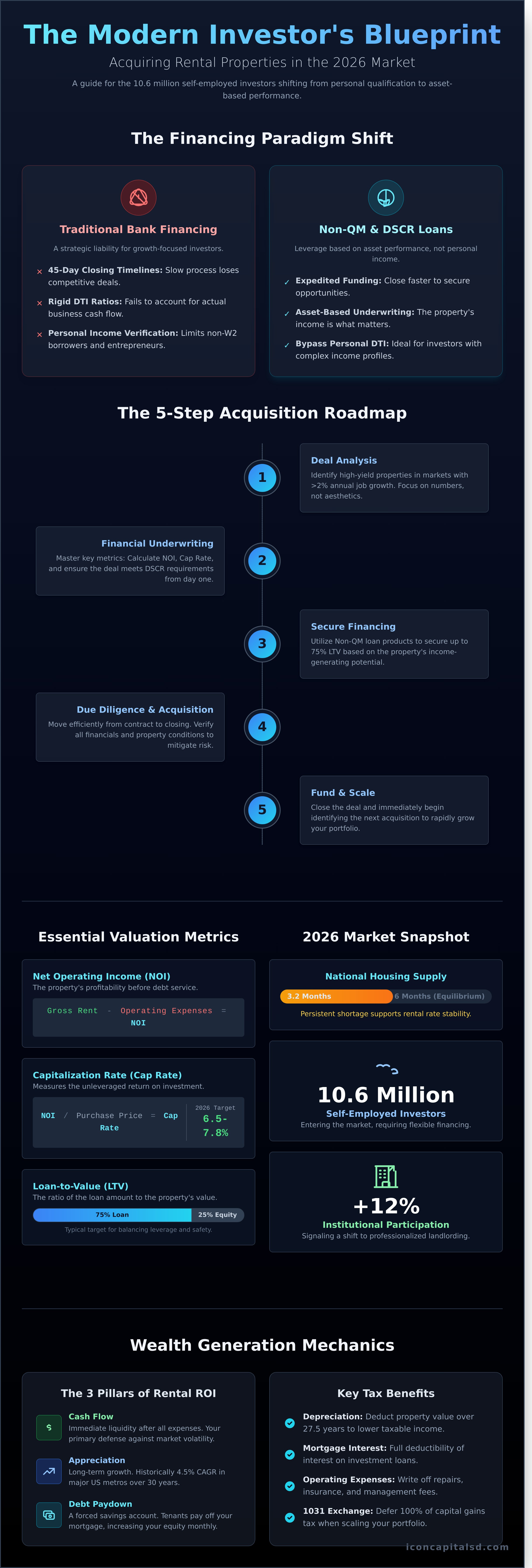
The 5-Step Roadmap to Buying Your First Rental Property
Buying a rental property requires a systematic approach to mitigate risk and maximize cash flow. Successful investors don’t rely on intuition; they use data-driven frameworks to identify and acquire assets. The process begins with a clearly defined buy-box. You must establish parameters for location, property type, and financial performance. Most seasoned investors target a 6% to 8% yield in stable markets, focusing on single-family residences (SFR) for easier resale or multi-unit properties for better scale.
Efficiency in Buying a Rental Property depends on these five core steps:
- Define the Buy-Box: Select a specific asset class, such as 2-4 unit properties, and set a maximum entry price based on your available capital.
- Secure Financing: Partner with a lender that understands investor needs. Get a pre-approval based on Debt Service Coverage Ratio (DSCR) rather than personal income to ensure your borrowing capacity isn’t capped by traditional debt-to-income limits.
- Execute the Search: Use specialized portals like Roofstock or PropStream to find listings. Don’t ignore off-market tactics; contacting wholesalers can often secure deals at 15% below market value.
- Due Diligence: Conduct a thorough inspection and audit all existing leases. You need to verify the T12 (trailing 12 months) of income and expenses to confirm the seller’s claims.
- Closing and Onboarding: Finalize the loan and transfer the asset to your management system. This includes setting up an escrow account for property taxes and insurance.
Market Research and Selection
Identify “path of progress” neighborhoods where annual population growth exceeds 2%. You must analyze local property taxes, as a 2.5% rate in Texas impacts your bottom line differently than a 1.1% rate in Florida. Landlord-tenant laws also dictate your risk; states like Tennessee offer faster eviction processes than California. Local investing allows for direct oversight, but out-of-state markets often provide better price-to-rent ratios if you budget for a 10% professional management fee.
The Offer and Negotiation Phase
Winning in a competitive market requires showing closing certainty. Use a “proof of funds” letter from a Non-QM lender to demonstrate that you don’t face the same red tape as retail buyers. Keep your inspection period to 10 days or less to appeal to sellers. You can waive the appraisal contingency if your loan-to-value (LTV) ratio is below 70%, which signals a low-risk transaction to the seller and speeds up the timeline.
Post-Closing: Managing Your Asset
Decide between self-management and hiring a professional firm. Professional managers typically charge 8% to 12% of gross monthly rent but handle all tenant relations and maintenance. Implement a tech stack using tools like Stessa for automated expense tracking or AppFolio for larger portfolios. The stabilization period is the 90-day window where you execute initial repairs, place a qualified tenant, and transition the asset from a liability to a cash-flowing entity.
Ready to scale your portfolio with financing that matches your ambition? Explore our Non-QM and DSCR loan programs to secure your next investment.
Scaling Your Portfolio with Icon Capital
Buying a rental property is the first step toward long-term wealth; scaling that investment into a multi-unit portfolio requires a partner who understands non-traditional asset classes. Retail banks often struggle with the complexity of investor tax returns or high-volume acquisitions. Icon Capital LLC specializes in creative real estate financing designed for speed and flexibility. We move deals from initial structure to funding in as little as 10 to 14 days. This efficiency allows investors to secure properties in competitive markets where traditional 45-day closing cycles often fail.
Professional investors value capital certainty over generic banking relationships. While retail lenders focus on personal debt-to-income ratios, we focus on the asset’s performance. Our underwriters evaluate the deal based on its ability to generate revenue. This shift in perspective enables business owners and self-employed individuals to leverage their current holdings without the restrictive documentation requirements of conventional lending. Moving from a single-family home to a 10-unit portfolio requires access to capital that scales with your ambition. Icon Capital LLC provides that leverage through specialized Non-QM products.
The transition from a single property to a diversified portfolio involves strategic capital recycling. Investors often use our cash-out refinance options to pull equity from existing assets to fund new down payments. We support this growth by offering loan amounts up to $2,000,000 and beyond. By focusing on the numbers that drive profitability, we help you bypass the “loan limits” that typically stop investors at four or five properties. Our goal is to provide the liquidity needed to keep your capital working in the market rather than sitting idle in equity.
Our Direct Loan Programs
Our programs prioritize high-leverage outcomes for diverse investor profiles. We offer DSCR (Debt Service Coverage Ratio) loans with competitive LTVs reaching 80%. These products are ideal for foreign nationals and business owners who need flexible terms without traditional income verification. We look at the property’s ability to cover the mortgage through its own rental income. Our specific product features include:
- 30-year fixed-rate options for long-term stability and predictable cash flow.
- Interest-only periods to maximize monthly liquidity during the initial years of ownership.
- 5/6 and 7/6 ARM options for investors with shorter-term hold strategies of 5 to 7 years.
- No limit on the number of properties financed, allowing for unlimited portfolio expansion.
Get Your Investment Quote Today
Scaling shouldn’t involve a mountain of paperwork or months of waiting. We’ve streamlined the intake process to focus on the data points that drive approvals. You get direct access to underwriters who understand investment deals, not just general mortgage guidelines. This direct communication eliminates the bottlenecks found in larger financial institutions. To begin structuring your next acquisition or to refinance an existing asset, Request a Quote from Icon Capital LLC today. We provide clear terms and fast execution to ensure you don’t miss out on the next opportunity for buying a rental property. Our team is ready to analyze your deal and provide a funding solution that aligns with your specific ROI targets.
Execute Your 2026 Acquisition Strategy
Success in the 2026 real estate market requires more than just identifying a location; it demands a sophisticated approach to leverage. Buying a Rental Property remains a premier wealth strategy if you prioritize asset performance over traditional credit hurdles. You’ve learned that conventional 30 year mortgages often fail modern investors, especially those who are self employed or foreign nationals. By focusing on Debt Service Coverage Ratio (DSCR) metrics, you can bypass personal income verification and focus on the property’s cash flow. Icon Capital provides the specialized Non-QM products needed to scale, offering loan amounts up to $2 million. We’re specialists in creative financing who understand that speed and certainty are your most valuable assets. Don’t let rigid bank requirements stall your portfolio growth when tailored solutions are available. It’s time to capitalize on the 2026 market dynamics with a partner that speaks the language of professional investors.
Ready to fund your next deal? Request a Quote from Icon Capital today.
Your next strategic acquisition is within reach.
Frequently Asked Questions
Is buying a rental property a good investment in 2026?
Buying a rental property is a profitable investment in 2026 because national rental demand is projected to rise by 3.2% annually. Investors should target a 7% capitalization rate to ensure the asset outpaces current inflation levels. Data from the 2025 Housing Report shows that inventory remains 15% below the ten year average, which provides a solid foundation for 4% annual capital appreciation and low vacancy.
How much down payment do I need for a rental property?
You typically need a 20% down payment to secure a loan for a single family home, though 25% is required for the best interest rates. On multi family properties with 2 to 4 units, 85% of conventional programs require a 25% down payment. When buying a rental property with Non-QM loans, LTV ratios usually cap at 80%, meaning you’ll need at least 20% equity plus 6 months of cash reserves.
Can I buy a rental property with a DSCR loan if I am self-employed?
You can definitely buy a rental property with a DSCR loan if you’re self-employed since these programs don’t require tax returns or W-2s. The underwriter qualifies the deal based on the property’s ability to generate income, specifically requiring a DSCR of 1.0 or higher. It’s an efficient solution for business owners who have $50,000 or more in tax deductions that would otherwise disqualify them from traditional bank financing.
What is the minimum credit score for an investment property loan?
The minimum credit score for most investment property loans is 620, but you’ll need a 740 or higher to access rates below 6.5%. If your score is between 640 and 680, expect to pay 0.75% to 1.25% more in points or interest. Non-QM lenders offer more flexibility than big banks, often approving experienced investors with scores as low as 640 if the LTV is 70% or less.
How do foreign nationals buy rental property in the US?
Foreign nationals buy US rental property by using specialized loan programs that don’t require a US credit history or Social Security number. These loans typically require a 30% to 40% down payment and 12 months of mortgage payments held in a US bank account. You’ll also need an Individual Taxpayer Identification Number and a valid passport to satisfy FIRPTA requirements and close the transaction legally.
What are the main risks of buying a rental house?
The main risks involve vacancy rates and capital expenditures, which typically account for 10% to 15% of your gross annual income. Maintenance costs usually hit 1% of the property’s total value each year; therefore, a $500,000 asset requires $5,000 in annual upkeep. Credit risk is another factor; the 2024 delinquency rate of 3.1% shows why rigorous tenant screening is vital for protecting your cash flow.
Should I buy a rental property in my own name or an LLC?
You should buy a rental property in an LLC because it provides a legal shield that separates your personal assets from your real estate liabilities. Data shows 72% of professional investors use LLCs to limit their personal exposure to lawsuits or debt defaults. While it involves state filing fees ranging from $50 to $500, it’s the standard choice for anyone looking to scale a portfolio professionally.
How do I calculate the potential rent for a property?
You calculate potential rent by comparing at least three similar properties within a 0.5-mile radius that have leased in the last 6 months. A common benchmark is the 1% rule, where monthly rent should equal 1% of the total acquisition cost. When buying a rental property, using a professional 1007 rent schedule provides the concrete data needed to verify your cash flow projections for the underwriter.