

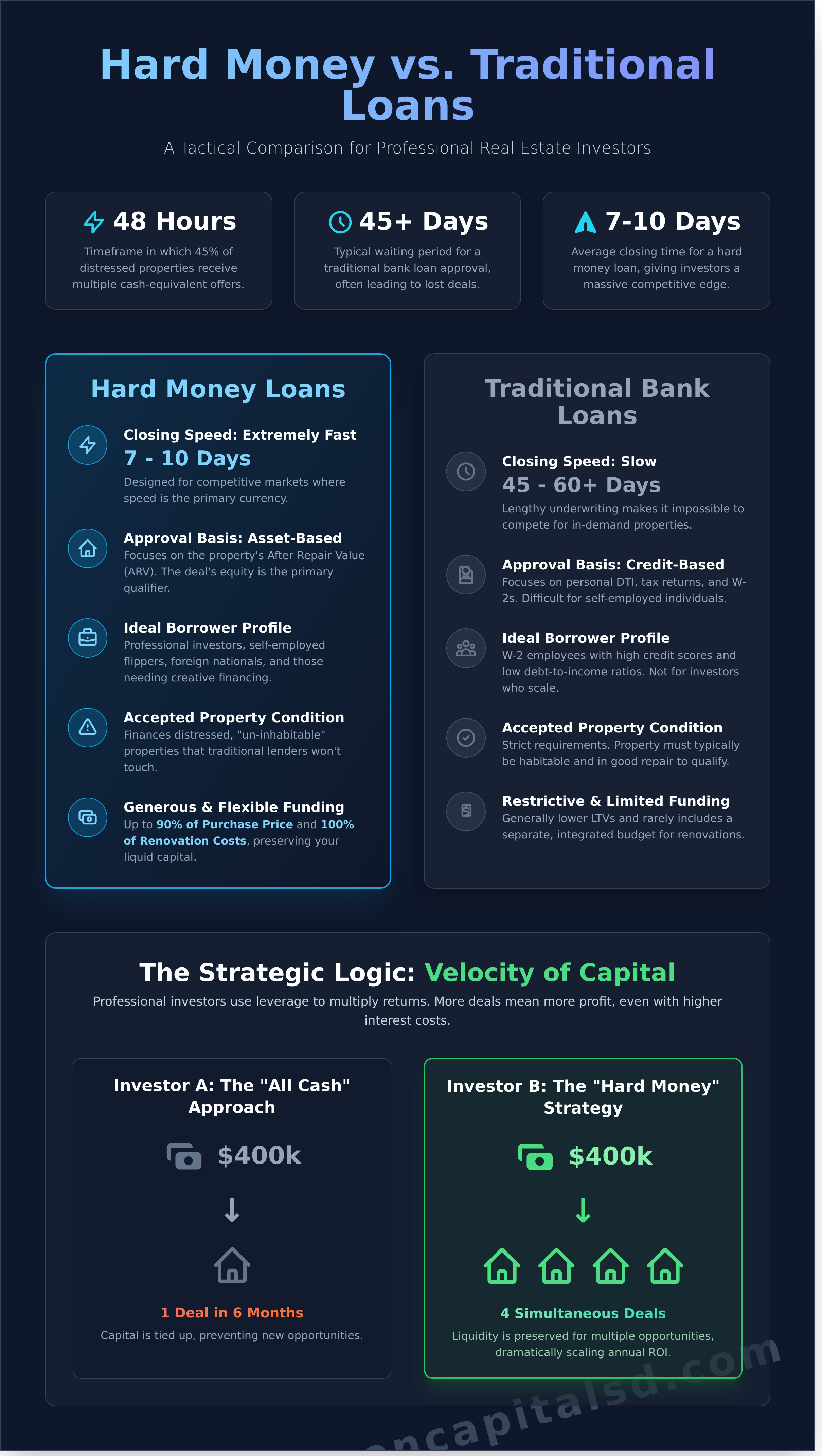
In a market where 45% of distressed properties receive multiple cash offers within 48 hours, waiting 45 days for a traditional bank approval is a recipe for lost opportunity. Professional investors don’t view hard money fix and flip loans as high-cost debt; they view them as a strategic tool for scaling. Liquid capital is an investor’s most valuable asset. Tying up 100% of your own cash in a single renovation is a bottleneck that prevents you from seizing the next deal while your capital is parked in a single set of four walls.
You understand that the velocity of capital determines your annual ROI more than a few percentage points of interest ever will. This guide details how to leverage hard money to cover up to 90% of the purchase price and 100% of the renovation budget, even if your self-employment status disqualifies you from conventional products. We’ll examine the specific LTV and ARV structures that top-tier investors use to close deals in under 10 days and keep their portfolios moving. By the end of this article, you’ll have a clear roadmap for securing funding that scales with your ambition.
Key Takeaways
- Learn how professional investors use the velocity of capital to scale from a single cash deal to managing multiple simultaneous projects through strategic leverage.
- Understand the specific mechanics of hard money fix and flip loans, including how renovation draws and short-term structures are designed for rapid asset turnaround.
- Compare the tactical advantages of asset-based financing over traditional banks, focusing on 7-10 day funding speeds and the ability to finance “un-inhabitable” properties.
- Master the 70% Rule and learn to factor in upfront points and interest costs to ensure every deal meets your target ROI before you commit.
- Discover flexible underwriting solutions for foreign nationals and self-employed flippers who require creative financing paths that traditional institutions cannot provide.
The Strategic Logic: Why Professional Flippers Use Hard Money
Professional real estate investors don’t use hard money because they lack cash. They use it because they understand the mechanics of leverage and the time value of money. A Hard money loan is a specific type of asset-based financing where the property itself serves as the primary collateral. These are short-term instruments, typically lasting 6 to 18 months, designed to bridge the gap between acquisition and the final sale or a long-term refinance. Unlike traditional mortgages, the approval process focuses on the equity in the deal rather than the borrower’s personal financial history.
The logic rests on the velocity of capital. Consider an investor with $400,000 in liquid capital. They could purchase one distressed property for cash, renovate it, and sell it in six months. Alternatively, they can use hard money fix and flip loans to secure four separate properties by putting 20% down on each. Even with interest rates hovering between 10% and 13%, the total profit from four deals significantly outpaces the single cash transaction. This is the “Guru Paradox” in action. Wealthy investors prefer high-interest debt because it keeps their liquidity available for other high-yield opportunities.
Speed is the primary currency in real estate. Conventional bank financing often requires 45 to 60 days to close. In a competitive 2026 inventory environment where supply remains 22% below pre-pandemic levels, waiting on a bank means losing the deal to a faster bidder. Professional flippers view the higher interest rate as a “speed tax” that ensures they capture the opportunity. Losing a $60,000 profit margin because you wanted to save 4% on interest is a mathematical failure. Hard money fix and flip loans allow for closings in as little as 7 to 10 days, providing a massive competitive advantage over buyers relying on traditional credit-based products.
Asset-Based vs. Credit-Based Lending
Traditional lenders focus on the borrower’s Debt-to-Income (DTI) ratio and personal tax returns. This creates barriers for the 16.5 million self-employed workers in the U.S. who utilize legal deductions to reduce taxable income. Hard money lenders prioritize the After Repair Value (ARV). If the property math works, the loan gets funded. This shift in focus allows for rapid scaling without the red tape of consumer mortgage regulations. It makes the property the star of the application, not the borrower’s W-2.
Preserving Liquidity for Scale
Liquidity is a safety net. Smart investors keep cash reserves to cover the 12% to 15% budget overages common in major renovations. Tying up every dollar in a single purchase leaves no room for structural surprises or market shifts. Additionally, the interest paid on these loans is typically a fully deductible business expense. Under current tax codes, this reduces the effective cost of the debt. The math of scaling is simple: earning a 10% profit on five houses generates $250,000, while a 20% profit on one house only yields $100,000. Debt is the engine that drives that volume.
How Hard Money Fix and Flip Loans Work in 2026
The 2026 lending environment prioritizes speed and collateral quality over traditional borrower credit profiles. Hard money fix and flip loans function as bridge financing, designed specifically for the acquisition and renovation of distressed assets. These loans typically carry a term structure of 12 to 24 months. This short duration reflects the intended lifecycle of a flip: buy, renovate, and exit. Because these are asset-based products, the property’s potential value drives the approval process. Investopedia explains hard money loans as being secured by the real estate itself, which allows for closing times as fast as 5 to 7 business days.
Monthly obligations are structured to preserve the investor’s liquidity. Most 2026 fix and flip products utilize interest-only payments. You aren’t paying down principal during the rehab phase; you’re only servicing the cost of the capital. This maximizes monthly cash flow, ensuring that capital remains available for unexpected contractor costs or material price fluctuations. When the project concludes, the borrower executes an exit strategy. In the current market, 68% of investors choose to sell the property for a capital gain. The remaining 32% opt to refinance the bridge debt into a long-term Debt Service Coverage Ratio (DSCR) loan to hold the property as a rental. If you’re looking to scale your portfolio, you can view current leverage options to see how these structures fit your next deal.
The Mechanics of LTV and ARV
Lenders evaluate deals using two primary metrics: Loan-to-Value (LTV) and After-Repair Value (ARV). In 2026, standard benchmarks for experienced investors are 85% of the purchase price and 100% of the renovation costs, provided the total loan doesn’t exceed 75% of the ARV. Appraisals for these loans differ from standard residential valuations. An appraiser must provide an “as-is” value and a “subject-to” value based on your specific renovation plans. This requires a detailed analysis of comparable sales that have been recently renovated to a similar standard within a 0.5-mile radius.
The Renovation Draw Process
Construction funds are not disbursed at the closing table. They’re held in an escrow account and released through a “Renovation Draw” process. To manage this effectively, you must submit a detailed Scope of Work (SOW) during underwriting. This SOW breaks the project into specific milestones, such as foundation repair, roof replacement, or kitchen installation. Once a milestone is 100% complete, you request a draw. The lender sends an inspector to verify the work, usually within 48 to 72 hours, and then releases the funds. Efficiently managing these draws is critical to maintaining momentum with your contractors and avoiding project delays.
- Interest-Only Payments: Keeps carrying costs low during the construction phase.
- 12-24 Month Terms: Provides a realistic window for permitting, labor, and listing.
- No Prepayment Penalties: Most hard money fix and flip loans allow you to exit as soon as the house sells without extra fees.
- Cross-Collateralization: Some 2026 programs allow you to use equity in other properties to achieve 100% financing on a new acquisition.
Success in 2026 requires a firm grasp of these technical mechanics. Professional flippers treat the loan as a tool for leverage, not just a source of debt. By aligning your SOW with the lender’s disbursement schedule, you ensure the project remains capitalized from demolition to the final walkthrough.
Hard Money vs. Traditional Bank Financing: A Tactical Comparison
Success in real estate requires a clear understanding of the capital stack. Traditional bank financing and hard money fix and flip loans serve different purposes. The primary differentiator is the speed of execution. A standard commercial bank typically requires 45 to 60 days to move from application to funding. In a competitive market, this delay is a liability. Hard money lenders operate on a 7 to 10 day timeline. This speed allows investors to secure properties that would otherwise go to cash buyers.
Property condition often creates an insurmountable barrier for conventional lenders. Banks require a property to meet habitability standards. This means a house must have a functioning kitchen, working plumbing, and a sound roof to qualify for a loan. If a project is a true fixer-upper with stripped copper or a failing foundation, a bank will reject the application immediately. Hard money lenders view these deficiencies as the value-add opportunity. They fund the purchase based on the After Repair Value (ARV) rather than the current distressed state.
The documentation burden represents another tactical divide. Conventional loans require two years of full tax returns and strict Debt-to-Income (DTI) ratios, often capped at 43%. This process is intrusive and slow. Hard money lenders prioritize asset performance. They utilize bank statements and Profit and Loss (P&L) statements to verify liquidity. This allows self-employed investors to scale without the constraints of personal income tax filings.
- Funding Speed: 7 to 10 days for hard money vs. 45 to 60 days for banks.
- Asset Condition: Hard money allows for “un-inhabitable” shells; banks require move-in readiness.
- Qualification: Focus on property ARV and liquidity rather than DTI and tax returns.
- Leverage: Ability to bypass the 10-property limit often found in conventional lending.
Total cost of capital is higher with hard money, but the speed to close offsets the expense. Interest rates for these products range from 10% to 13%, compared to 7% or 8% for traditional investment loans. However, the cost of capital is secondary to the opportunity cost. Losing a $50,000 profit margin because a bank took 50 days to underwrite is more expensive than paying a 3% higher interest rate for a six-month term.
When to Choose a Traditional Bank
Traditional financing is the correct tool for long-term hold strategies where the interest rate is the primary concern. If a property requires only minor cosmetic updates, such as paint or carpet, and the borrower has a high W-2 income, a bank loan is more cost-effective. These loans work best when the investor plans to keep the asset for 10 to 30 years and doesn’t need to bypass conventional loan caps.
When Hard Money is the Only Logical Choice
Use hard money fix and flip loans for distressed assets like REOs or short sales that don’t meet FHA standards. This capital is essential for major structural rehabs or when an investor needs to move faster than the 45-day bank cycle. It’s also the primary solution for scaling a portfolio once an investor hits the 10-loan limit imposed by most conventional institutional lenders. Speed is the leverage that wins the deal.
Calculating Your Flip ROI: When Hard Money Makes Financial Sense
Profitability in real estate investment depends on precise mathematical modeling rather than market intuition. The 70% Rule serves as the primary baseline for evaluating any potential deal. This formula dictates that an investor should pay no more than 70% of the After Repair Value (ARV) minus the estimated renovation costs. For a property with a $450,000 ARV and $60,000 in required repairs, the maximum allowable offer is $255,000. This 30% margin is designed to absorb the costs of hard money fix and flip loans while protecting your equity against market volatility.
Successful investors prioritize the cash-on-cash return over the total net profit. If you deploy $200,000 of your own cash to net a $40,000 profit, your return is 20%. However, by using leverage, you could use that same $200,000 as a 20% down payment on five separate $200,000 projects. Even with the added interest expense, the ability to scale your portfolio across multiple assets often yields a higher aggregate return on your initial capital. You aren’t just buying a house; you’re buying the ability to move onto the next deal faster.
Upfront costs, specifically “points,” are a critical variable in your ROI calculation. Points are origination fees paid at closing, typically ranging from 1% to 3% of the loan amount. On a $300,000 loan, 2 points represent a $6,000 immediate cost. You must also account for holding costs, which include property taxes, insurance, and utilities. These expenses accrue daily, meaning your daily “burn rate” directly impacts your final exit proceeds. A project that takes nine months instead of six can easily see $15,000 in profit evaporate through these recurring carrying costs.
The Real Cost of a Fix and Flip Loan
For a standard six-month project in 2026, expect interest rates to range between 10% and 13% depending on your experience level. A $250,000 loan at 11% creates a monthly interest obligation of $2,291, totaling $13,746 over the project duration. Closing costs and origination fees in the current 2026 market generally add another 3% to 5% to the total capital requirement. The break-even point for a leveraged flip is the exact sale price where the gross profit matches the sum of the purchase price, renovation costs, financing fees, and holding expenses.
Leverage and Multiplier Effects
Leverage acts as a force multiplier for your liquid capital. A case study of a recent $300,000 acquisition shows that a 12% loan can result in a 40% annual ROI when the investor only contributes $60,000 in down payment and renovation costs. While the interest reduces the absolute profit per house, the return on the specific dollars you invested increases dramatically. Managing the risk of over-leveraging is vital, especially if local market data shows inventory sitting for more than 45 days. To analyze how these variables impact your specific project, Request a Quote to run your specific numbers with a specialist.
Securing Your Next Deal with Icon Capital LLC’s Fix and Flip Program
Icon Capital LLC operates as a direct facilitator of capital for investors who require speed and flexibility. We don’t rely on the rigid, automated systems used by retail banks. Instead, our team focuses on the underlying value of the asset and the viability of the renovation plan. This specialized approach allows us to fund hard money fix and flip loans that traditional institutions typically reject due to property condition or borrower complexity. We prioritize the mechanics of the deal, ensuring that the financing structure supports your specific exit strategy.
Self-employed flippers and foreign nationals often face unnecessary hurdles in the mortgage market. Current data shows that 16.5 million people in the United States work in the gig economy or run their own businesses. These individuals frequently lack the standard W-2 documentation that conventional lenders demand. Icon Capital LLC solves this by utilizing bank statement programs and asset-based underwriting. For foreign investors, we leverage the property’s potential rather than a domestic credit score. This enables international capital to enter the US real estate market without the usual 60-day waiting periods seen at major banks.
Investor partnerships thrive on predictable fee structures. Hidden costs can erode a project’s profit margin by 3% to 5% if they aren’t disclosed early. We provide clear, itemized term sheets that outline every cost before you commit. This directness builds a foundation for long-term partnerships. Investors who know their exact cost of capital can bid more aggressively on competitive properties. They know their financing won’t shift at the closing table. The efficiency of hard money fix and flip loans depends on this level of clarity, allowing you to scale your portfolio with confidence.
Our Fix & Flip Loan Parameters
We offer loan amounts up to $2 million to accommodate both single-family entries and high-end luxury renovations. Our programs typically provide up to 90% of the purchase price and 100% of the renovation costs, capped at 75% of the After Repair Value (ARV). You won’t face any pre-payment penalties; you can exit your flip as soon as the property sells. This flexibility preserves your liquidity. Because you have direct access to decision-makers, we often provide deal approvals in 24 to 48 hours.
How to Get Started Today
Our streamlined 4-step process is designed to move your project from structure to funding in as little as 7 to 10 days. We eliminate the bureaucratic delays that kill profitable deals. Follow these steps to secure your capital:
- Step 1: Submit your deal details for a preliminary review to determine basic eligibility.
- Step 2: Provide a detailed Scope of Work (SOW) and property photos to verify the project’s scale.
- Step 3: Undergo rapid underwriting and property valuation to finalize the loan structure.
- Step 4: Close the loan and begin your renovation with the funds you need.
Don’t let a lack of capital hold back your next investment. Get your custom fix and flip loan quote today and see how our creative financing solutions can help you leverage your expertise and scale your real estate business.
Scale Your Investment Strategy with Strategic Leverage
Winning in the 2026 real estate market requires more than just finding the right property; it demands speed and liquidity that traditional banks simply don’t provide. By utilizing hard money fix and flip loans, you bypass the 45-day closing cycles of conventional lenders and focus on asset value rather than personal debt-to-income ratios. This strategic leverage allows you to secure distressed assets before competitors can even finish their paperwork. Professional flippers use these tools to maintain a competitive edge in high-demand markets where cash is king.
Icon Capital specializes in these creative financing solutions, offering asset-based qualification to ensure you don’t miss a profitable opportunity. We provide loan amounts up to $2 million to support high-end renovations and multi-unit projects. Our process is built for efficiency, prioritizing the mechanics of the deal so you can scale your portfolio without the typical red tape. As specialists in Non-QM and creative financing, we understand that timing is the most critical factor in your ROI. Don’t let a lack of capital stall your momentum. Explore Icon Capital’s Fix & Flip Loan Programs today and secure the funding your next project requires.
Frequently Asked Questions
Is hard money safe for a first-time house flipper?
Yes, hard money is safe for new investors when the deal maintains a 15% to 20% equity cushion and a documented exit strategy. First-time flippers use hard money fix and flip loans to purchase distressed properties that don’t meet traditional bank standards. Success depends on accurate After Repair Value calculations rather than just borrower experience. Most lenders require a minimum 620 FICO score to ensure the borrower can manage the 12 month project timeline effectively.
How much of a down payment do I need for a hard money fix and flip loan?
Most lenders require a down payment between 10% and 25% of the total purchase price. For a $350,000 property, you’ll need to bring $35,000 to $87,500 in cash to the closing table. Loan-to-Value ratios typically cap at 85% of the purchase price or 70% of the After Repair Value. Higher down payments often help you secure lower interest rates and reduced origination points during the underwriting process.
Can I get a fix and flip loan with a low credit score?
You can obtain financing with a credit score as low as 550 because the property itself serves as the primary collateral. Lenders prioritize the asset’s profit potential and your 20% to 30% equity stake over your personal credit history. However, scores below 600 usually result in interest rates 2% higher than the market average. It’s common for lenders to focus on the property’s debt service coverage capabilities rather than traditional credit metrics.
What is the average interest rate for hard money loans in 2026?
Average interest rates for hard money fix and flip loans in 2026 range from 10.5% to 13.5% based on current capital market projections. These rates fluctuate depending on your professional experience level and the specific LTV ratio of the deal. Most bridge loans also carry 1 to 3 origination points paid at the time of closing. These costs reflect the short-term nature of the 6 to 18 month loan terms provided by private lenders.
How long does it take to get approved for a hard money loan?
Approval typically takes 24 to 48 hours with full funding occurring in 5 to 10 business days. This speed allows investors to compete with cash buyers who often close in under 14 days. You must provide a signed purchase contract, a detailed scope of work, and proof of liquidity to maintain this fast timeline. Traditional bank financing usually requires 45 days, which often results in lost opportunities in competitive real estate markets.
Will a hard money lender fund 100% of the renovation costs?
Many lenders fund 100% of the renovation budget through a series of structured draws released as work is completed. These funds are held in escrow and distributed after an inspector verifies milestones like plumbing or electrical rough-ins. While the lender covers the construction, they usually limit the total loan amount to 75% of the After Repair Value. You’ll need to fund the initial phase of work before requesting your first reimbursement draw.
What happens if I can’t sell the flip before the loan term ends?
You must either request a 3 to 6 month loan extension or refinance the property into a long-term DSCR loan. Extensions typically require a 1% fee and proof that the property is listed for sale or under contract. If the term expires without a payoff, the lender may initiate foreclosure proceedings within 30 to 60 days. Most 12 month terms provide sufficient time if your contractor stays on the original 4 month renovation schedule.
Do hard money lenders require an appraisal?
Yes, 95% of hard money lenders require a professional appraisal to determine the current value and the projected After Repair Value. This report costs between $500 and $900 and ensures the deal meets the 70% LTV threshold required for funding. Some lenders use an Interior Broker Price Opinion to speed up the 7 day underwriting process. Accurate valuations are necessary to protect your equity and the lender’s capital investment in the project.