

In a competitive real estate market, speed is the ultimate advantage. How many high-value deals have been lost while waiting for traditional financing to clear? When capital is tied up in one asset, seizing the next opportunity becomes impossible. This is the critical gap where strategic Bridge Loans provide a decisive advantage for the serious investor. This short-term financing is engineered to provide immediate liquidity, enabling you to acquire new properties without being constrained by the sales timeline of your existing portfolio.
This guide delivers a functional, data-driven framework for mastering bridge financing in 2026. We will dissect the core mechanics, from structuring deals and calculating loan-to-value (LTV) limits to defining the clear exit strategies that underwriters require. You will gain the knowledge to leverage this powerful financial instrument, allowing you to transition seamlessly between investment phases and secure competitive properties with confidence. It’s time to stop missing opportunities and start closing them.
Key Takeaways
- Learn how to use short-term financing to acquire high-value properties before long-term capital is secured.
- Understand the key 2026 qualification metrics, including LTV ratios and credit score thresholds, to position your deal for approval.
- Analyze the cost structure of Bridge Loans, including current rates and fees, to accurately calculate the ROI on your next investment.
- Identify the critical components of a successful deal, from initial structuring to defining a clear and viable exit strategy.
What is a Bridge Loan? Strategic Short-Term Financing Explained
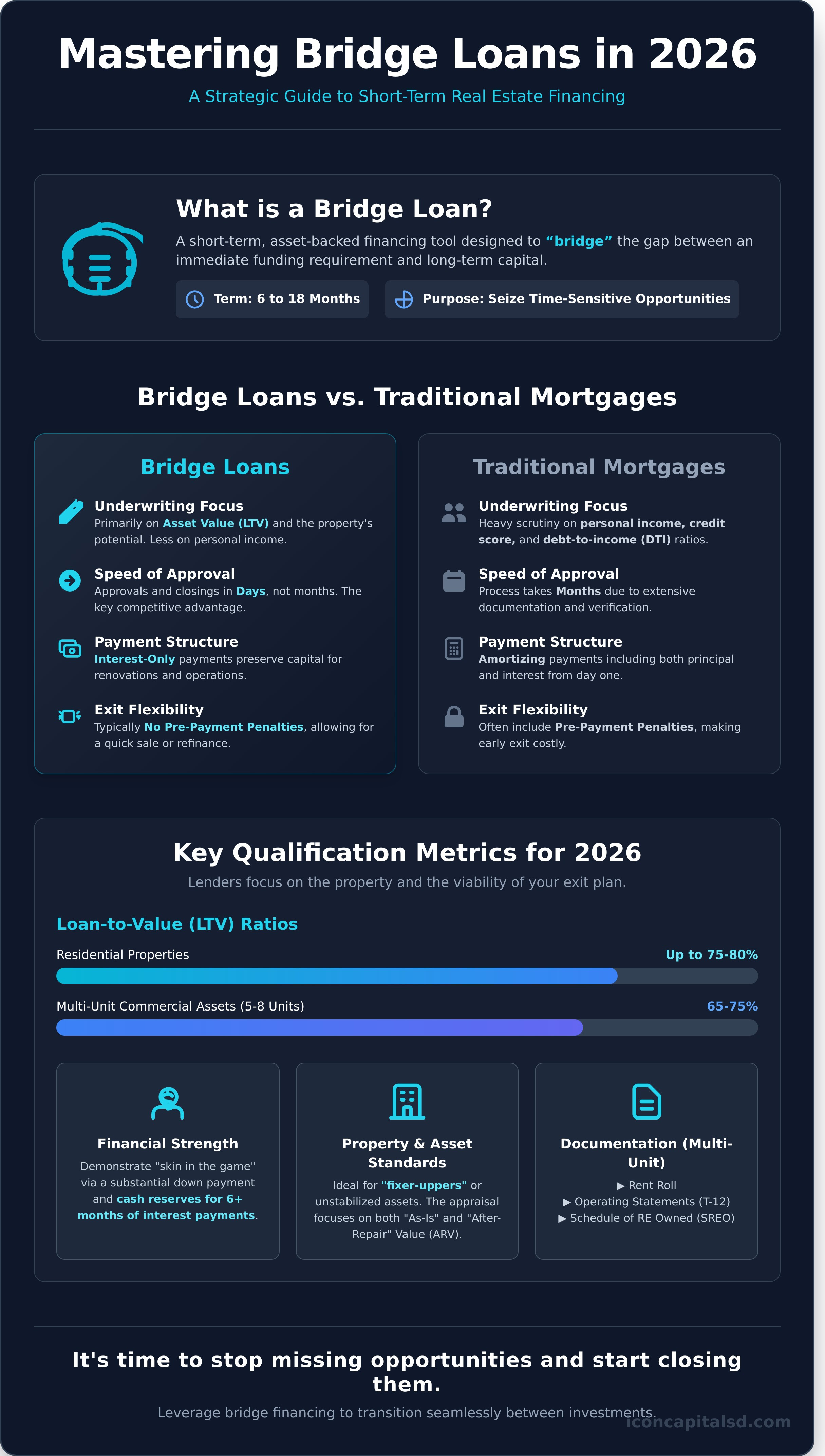
A bridge loan is a short-term, asset-backed financing tool designed to “bridge” the gap between an immediate funding requirement and the arrangement of long-term capital. Its primary function is providing transitional liquidity for real estate investors to acquire or renovate a property quickly. To understand the core principles of what is a bridge loan, it’s essential to view it as a strategic instrument for seizing time-sensitive opportunities. With typical terms ranging from 6 to 18 months, these loans are structured around a clear exit strategy, such as a property sale or refinance.
In competitive bid scenarios, speed is the definitive advantage. Investors who leverage bridge loans can present offers that rival all-cash buyers, bypassing the prolonged and document-heavy underwriting process of traditional lenders. This agility is often the deciding factor in securing high-demand assets.
The Mechanics of Transitional Capital
Bridge financing operates by leveraging the equity in an existing property or the target asset itself to fund a transaction. While “swing loans” are consumer-facing products for homeowners purchasing a new primary residence, hard money bridge structures are commercial tools for investors. These focus on the asset’s value (LTV) rather than extensive borrower financials. This is critical for investors positioning for market cycle shifts, such as the anticipated “gap” opportunities leading into 2026, where rapid capital deployment will be paramount.
Bridge Loans vs. Traditional Mortgages
The operational differences between bridge financing and conventional mortgages are not just details-they are fundamental strategic advantages for the professional real estate investor.
- Speed of Approval: Bridge loan underwriting is asset-focused, enabling approvals and closings in days. Traditional mortgages require months of income verification and credit analysis.
- Payment Structure: Most bridge products feature interest-only payments, preserving capital for renovations and operational costs. Conventional loans require fully amortizing principal and interest payments.
- Exit Flexibility: Professional bridge financing typically carries no pre-payment penalties, allowing an investor to sell the property or refinance into permanent debt as soon as their objective is met.
Bridge Loan Requirements: Qualification Metrics for 2026
Unlike traditional mortgages that heavily scrutinize personal income and debt-to-income ratios, qualification for bridge loans is primarily asset-based. Lenders focus on the viability of the real estate collateral and the borrower’s capacity to execute their strategy, whether it’s a sale or a refinance. This asset-centric approach allows for greater flexibility, especially from non-QM lenders who cater to real estate investors and self-employed individuals who may not fit the rigid criteria of large banks. The key metrics revolve around the property’s value, the borrower’s liquidity, and the credibility of the exit plan.
Financial Strength and Liquidity
Lenders require borrowers to have significant “skin in the game,” which translates to a substantial down payment or existing equity in the collateral property. This aligns the interests of both parties. For self-employed investors, underwriting often relies on profit and loss (P&L) statements and bank statements rather than traditional tax returns. While specific Bridge Loan Requirements can vary, a common benchmark is having sufficient cash reserves to cover at least six months of interest payments, ensuring you can service the debt during the transitional period.
Property and Asset Standards
Bridge financing is an ideal tool for acquiring properties that would not qualify for conventional loans, such as “fixer-uppers” or unstabilized assets. Lenders are less concerned with a property’s current condition and more focused on its potential marketability and value post-renovation. The appraisal is critical, often providing two key figures: the “As-Is” value and the “After-Repair” value (ARV), which dictates the total loan amount, including funds for construction.
For multi-unit assets (5-8 units), expect to provide more detailed documentation:
- Rent Roll: A current list of tenants, lease terms, and monthly income.
- Operating Statements: Typically for the trailing 12 months (T-12) to show property performance.
- Schedule of Real Estate Owned (SREO): A portfolio overview for experienced investors.
Loan-to-value (LTV) ratios reflect this asset-based focus. Expect LTVs up to 75-80% for residential properties and slightly more conservative figures, around 65-75%, for multi-unit commercial assets, depending on the deal’s strength.
Tactical Use Cases: How Investors Leverage Bridge Financing
Beyond simple speed, sophisticated real estate investors deploy bridge financing as a strategic tool to capitalize on opportunities that fall outside the scope of conventional lending. These short-term loans provide the liquidity and flexibility needed to execute complex transactions, from acquiring assets in competitive markets to navigating strict regulatory deadlines. The primary function is to create a “bridge” to a more stable, long-term financial solution.
Common strategic applications include:
- Securing Properties in Hot Markets: In a bidding war, a fast close is paramount. Bridge financing can be secured in days, not weeks, giving an investor a competitive edge that rivals a cash offer before long-term DSCR or conventional financing is in place.
- Financing Non-Conforming Properties: Acquiring properties that are vacant, in disrepair, or otherwise do not qualify for traditional mortgages. The bridge capital funds both the purchase and the necessary renovations to stabilize the asset for a conventional refinance.
- Executing a 1031 Exchange: The strict 45-day identification and 180-day closing windows for a 1031 exchange leave no room for financing delays. A bridge loan provides the transactional certainty required to meet IRS deadlines.
- Consolidating Debt: An investor can use a single bridge facility to consolidate multiple smaller, higher-interest loans across a portfolio, simplifying debt service and preparing for a new blanket loan.
The Bridge-to-DSCR Strategy
A primary strategy for rental investors is using a bridge loan to purchase a vacant or underperforming property, perform necessary upgrades, and secure a tenant. Once the property generates verifiable income, it qualifies for a long-term DSCR (Debt Service Coverage Ratio) loan, which pays off the bridge financing. This method allows an investor to force appreciation and maximize ROI by transforming a non-performing asset into a stabilized, cash-flowing rental. Structuring this two-step financing requires expertise; to model a custom bridge-to-DSCR plan, you can request a quote for your deal.
Managing Career Transitions and New Construction
Bridge loans are also critical for investors in unique situations. Self-employed individuals can leverage equity from an existing property to acquire a new one without waiting to sell, bridging the gap in liquidity. This approach requires careful structuring to meet lender requirements, which often align with principles found in Fannie Mae bridge loan guidelines regarding the use of secured funds. Similarly, developers use bridge capital for “horizontal” construction phases (e.g., grading, utilities) before securing a full vertical construction loan, while foreign nationals use it for rapid entry into the U.S. real estate market.
The Cost of Speed: Interest Rates, Fees, and ROI Analysis
The primary advantage of a bridge loan is speed, and this velocity comes at a calculated premium. Investors must analyze this cost not as an expense, but as a strategic investment to secure time-sensitive opportunities. The ROI calculation is paramount, weighing the cost of capital against the potential profit or the cost of a missed deal.
By 2026, interest rates for bridge financing are projected to range from 9% to 13%, a notable increase over the 6% to 8% range typical for traditional 30-year fixed mortgages. This higher rate reflects the short-term nature, increased risk, and rapid deployment of capital. The fee structure is also distinct and typically includes:
- Origination Points: Generally 1 to 3 points (1-3% of the loan amount) paid upfront to the lender for structuring and funding the loan.
- Appraisal & Underwriting Fees: Standard third-party costs required for property valuation and risk assessment.
- Exit Fees: A potential fee charged upon repayment of the loan. It is critical to confirm if this is part of your loan terms.
The most effective strategy to minimize total cost is executing an aggressive project timeline. The shorter the holding period, the less interest carry an investor pays, directly improving the net return.
Evaluating Interest-Only Payment Structures
Interest-only payments are standard for short-term financing, designed to maximize monthly cash flow by deferring principal repayment. This preserves capital for renovations and other project costs. However, this structure culminates in a balloon payment-the full principal balance-due at the end of the term. A clear exit strategy, such as a sale or refinance, must be in place from inception to meet this obligation.
The effective interest rate is the true annual cost of funds, factoring in the nominal interest rate plus all points and fees amortized over the loan’s term.
Justifying the Premium for Professional Speed
Consider a scenario where a 10-day close is required to secure a property and prevent the forfeiture of a $50,000 earnest money deposit. The total cost of a bridge loan, perhaps $15,000, becomes a tactical expense to protect the $50,000 deposit and the deal’s potential profit. When compared to a potential $100,000 gain on a high-yield flip, the financing costs are a necessary component of the investment’s success.
Is the higher rate worth the certainty of closing? For serious investors, the answer is unequivocally yes. The certainty and speed provided by bridge loans create a decisive competitive advantage, enabling you to capture opportunities that are inaccessible with slower, traditional financing. For a precise analysis of how this financing fits your project, explore your options with a dedicated lending partner.
Navigating the Bridge Loan Process with Icon Capital
At Icon Capital LLC, we streamline the bridge loan process to deliver capital when you need it most. Our approach is built on speed, clarity, and direct communication, ensuring investors can seize time-sensitive opportunities without the delays of traditional financing. We have refined our system into four key stages designed for maximum efficiency.
- Initial Consultation: We begin by defining a clear deal structure and, most critically, identifying a viable exit strategy from the outset. This ensures the loan serves your long-term investment goals.
- Application and Documentation: Our requirements are tailored for real estate investors and self-employed borrowers. We focus on asset-based qualification, minimizing paperwork and accelerating the submission process.
- Underwriting and Valuation: Leveraging our expertise, we utilize fast-tracked appraisal and asset review protocols. This allows our in-house underwriters to make swift, confident decisions.
- Closing and Funding: As a direct lender, we control the timeline. Our team moves your file from “approved” to “funded” in record time, often closing in a matter of days, not weeks.
Simplifying the Loan Process
Our direct, confident approach to “Creative Financing” means we excel at structuring complex deals. The Icon Capital LLC team is equipped to handle non-traditional files, including Foreign National or Asset Qualification loans, that other lenders avoid. We provide direct answers and actionable feedback on your deal structure. Get immediate insight by submitting your scenario when you Request a Quote.
Preparing Your Exit Strategy
Effective Bridge Loans are defined by their exit plan. Whether your strategy is to sell the property for a profit or refinance into a long-term hold, we help you prepare for the next step. Icon Capital LLC facilitates a seamless transition to permanent financing, such as our DSCR or P&L home loan products, positioning your portfolio for sustained growth. Schedule a call to explore your portfolio scaling options through 2026 and beyond with iconcapitalsd.com.
Execute Your Next Real Estate Strategy with Confidence
As this guide illustrates, success in the 2026 real estate market hinges on strategic liquidity. These short-term instruments enable savvy investors to seize time-sensitive opportunities, fund value-add renovations, and stabilize assets before securing permanent financing. When the ROI analysis is sound, the speed and flexibility offered by this financing method provide a distinct competitive advantage.
However, the effectiveness of Bridge Loans depends entirely on the proficiency of your lending partner. At Icon Capital, we specialize in the Non-QM and creative financing solutions that traditional lenders avoid. We have a proven track record of funding complex deals for self-employed and foreign national borrowers, guided by our streamlined 4-step process: Structure, Submit, Underwrite, and Close.
Do not let a temporary funding gap dictate the pace of your portfolio’s growth. Take decisive action to secure your next asset. Request a custom Bridge Loan quote from Icon Capital today and gain the financial leverage needed to close with certainty.
Frequently Asked Questions
What is the typical interest rate for a bridge loan in 2026?
Projecting specific interest rates for 2026 is speculative, as they are tied to market conditions and benchmark rates like SOFR or Prime. Bridge loan rates are determined by the risk profile of the deal, not a future calendar date. Key factors include the loan-to-value (LTV) ratio, the quality of the underlying real estate asset, and the borrower’s financial strength and exit strategy. Rates are typically higher than conventional financing to reflect the short-term, higher-risk nature of the loan.
Can I get a bridge loan if I am self-employed or a business owner?
Yes. Bridge loans are an ideal financing solution for self-employed individuals and business owners. Unlike traditional mortgages that rely heavily on W-2s and tax returns, bridge lenders focus primarily on the value of the real estate asset securing the loan. Underwriting is asset-based, often utilizing bank statements or stated income programs, which streamlines the process for borrowers with complex or non-traditional income documentation. This makes qualification direct and efficient.
How fast can a bridge loan be funded compared to a traditional mortgage?
A bridge loan can be funded significantly faster than a traditional mortgage. While a conventional loan process often takes 30 to 60 days due to stringent underwriting and regulatory requirements, a bridge loan can typically close within 7 to 14 business days. This speed is possible because the underwriting process is streamlined, focusing on the property’s collateral value and the viability of the exit strategy rather than extensive personal income verification.
What happens if my property doesn’t sell before the bridge loan term ends?
If the exit property does not sell before the loan term expires, borrowers have several options. The most common solution is to request a loan extension from the lender, which may come with extension fees. Another strategy is to refinance the bridge loan into a longer-term financing product, such as a DSCR loan for an investment property or a conventional mortgage. Proactive communication with your lender is critical to structuring a solution before the maturity date.
Are bridge loans available for foreign nationals investing in U.S. real estate?
Yes, many private lenders and financial institutions offer bridge loans specifically designed for foreign nationals. Qualification for these programs is based on the strength of the U.S. real estate asset being used as collateral. Lenders will typically require documentation such as a valid passport, visa, and proof of funds. The process is structured to accommodate international investors seeking to acquire or leverage U.S. property assets quickly and efficiently.
Do I need a high credit score to qualify for a bridge loan?
While credit is considered, a high credit score is not the primary requirement for bridge loan qualification. These are asset-based loans, meaning the lender’s primary focus is on the property’s loan-to-value (LTV) ratio and the borrower’s clear exit strategy. A lower credit score may lead to a higher interest rate or a lower LTV allowance, but it is unlikely to be the sole reason for denial if the underlying real estate deal is strong.
Is a bridge loan the same as a hard money loan?
The terms are often used interchangeably, as both are short-term, asset-based loans funded by private capital. However, a distinction can be made. Hard money loans are often associated with financing distressed properties or high-risk scenarios. Bridge loans serve a broader purpose, such as “bridging” the gap between buying a new property and selling an existing one. Both financing tools prioritize speed and collateral over traditional borrower income verification.
Can I use a bridge loan for a multi-family property (5-8 units)?
Yes. Bridge financing is a common and effective tool for acquiring or repositioning commercial real estate, including multi-family properties with 5 or more units. These loans are ideal for investors who need to close quickly on a property, fund renovations, or stabilize occupancy before securing permanent financing. Underwriting will focus on the asset’s value, its current and projected income, and the investor’s business plan for the property.